Call CA Tally HelpDesk
+91 9205471661,
7428779101
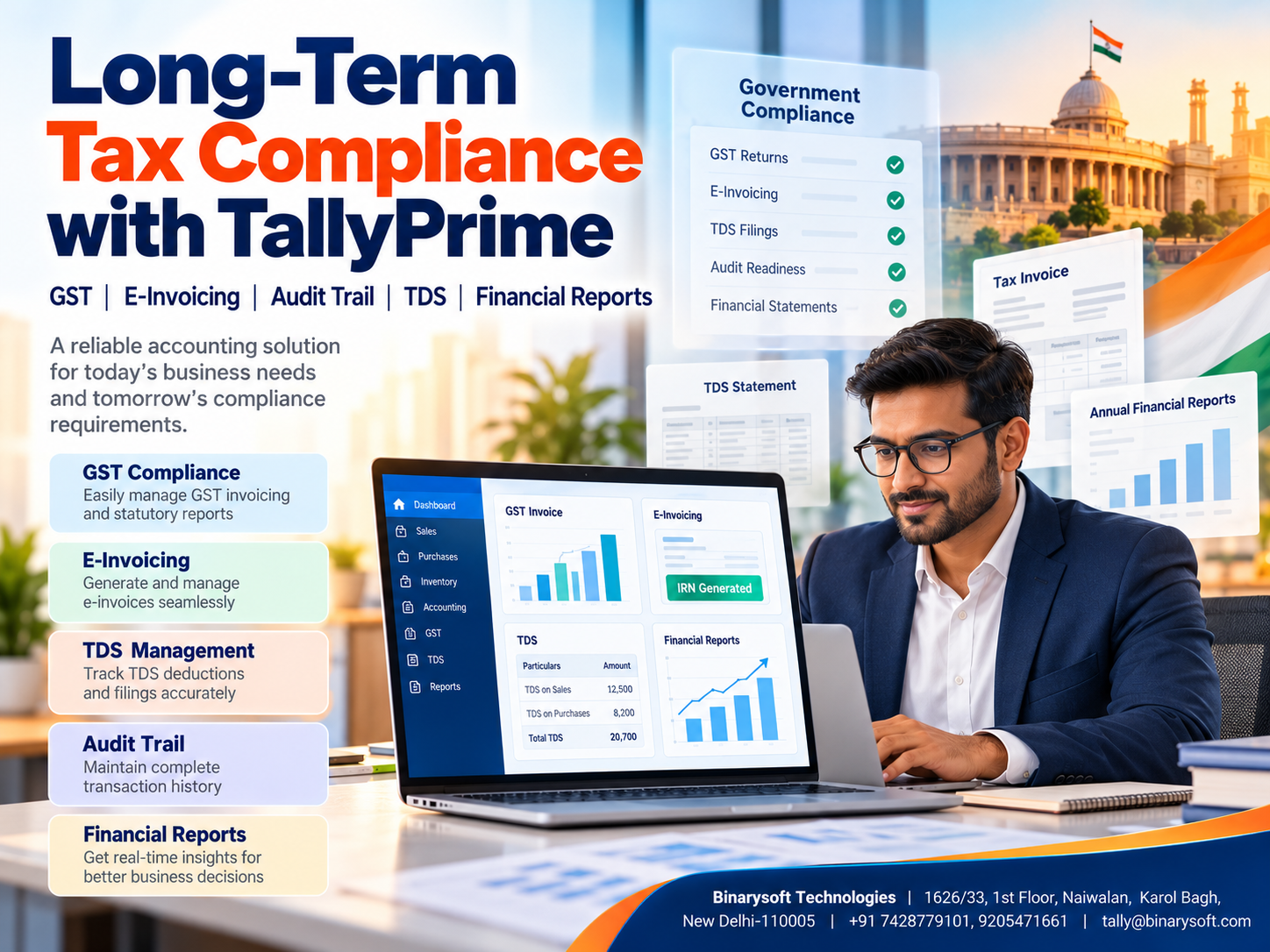
Introduction: Why Long-Term Tax Compliance Has Become a Business Priority
In 2026, Indian businesses face increasing pressure to maintain accurate financial records, comply with changing tax regulations and prepare reliable statutory reports. From GST return filing and e-invoicing to TDS accounting, audit trails and financial statements, compliance has become an essential part of everyday business management.
For small and medium enterprises, the challenge is not simply choosing accounting software that works today. The real question is whether the software will continue supporting business requirements as regulations, reporting formats and transaction volumes change.
Imagine a wholesaler who has maintained accounting records for ten years but suddenly discovers that the software cannot support a newly applicable reporting requirement. The business may need urgent upgrades, manual corrections or expensive data migration.
Such disruptions can affect productivity, customer confidence and financial stability.
A dependable accounting solution should combine accurate bookkeeping, statutory updates, tax reporting, secure records and scalable business management features.
TallyPrime offers an integrated environment for accounting, GST management, inventory, banking and financial reporting. With appropriate configuration and ongoing maintenance, it can support businesses seeking long-term accounting continuity.
This guide explains how to evaluate accounting software for government and tax compliance, what features matter most and how TallyPrime can help Indian businesses remain better prepared for regulatory changes.
1. What Makes Accounting Software Reliable for Long-Term Compliance?
Reliable accounting software should help businesses maintain accurate financial information while adapting to changing statutory requirements.
There is no single accounting application that guarantees complete compliance with every Indian tax or government regulation.
Compliance depends on software capabilities, correct configuration, accurate transactions, timely updates and professional review.
A suitable accounting system should provide GST-ready invoicing, statutory reports, audit trails, access controls and dependable data backup facilities.
It should also support business growth without requiring organizations to repeatedly rebuild their accounting processes.
For example, a retailer may initially need basic invoicing and GST accounting. As the business expands, it may require inventory management, multiple users, e-invoicing and branch-wise reporting.
Software that supports these changing needs can reduce the disruption associated with future expansion.
2. Why Government and Tax Compliance Requirements Keep Changing
Indian businesses operate within a regulatory environment that evolves through notifications, amendments, reporting changes and digital compliance initiatives.
GST rules and reporting procedures have undergone multiple changes since implementation.
Electronic invoicing requirements have expanded to cover additional categories of businesses.
Companies also face requirements relating to accounting records, financial reporting and audit trails.
Income tax provisions, TDS rules and other statutory obligations may require corresponding accounting adjustments.
These changes make regular software maintenance important.
Businesses relying on outdated applications may face difficulties generating reports, validating invoices or reconciling tax records.
An adaptable accounting platform can reduce manual work, but businesses must still verify the applicability and effective dates of individual legal requirements.
3. Essential Features of Tax-Compliant Accounting Software
Businesses should evaluate software based on the following capabilities.
GST-Ready Invoicing
The software should support applicable GST rates, HSN and SAC classifications, tax invoices, debit notes and credit notes.
It should also handle relevant intra-state and inter-state transactions.
GST Return Preparation
Accounting records should support preparation and reconciliation of relevant GST returns, including GSTR-1 and GSTR-3B.
Electronic Invoicing
Businesses covered by e-invoicing requirements should have access to compatible invoice-generation and reporting capabilities.
Audit Trail and Edit Logs
A dependable system should record changes to financial entries and support traceability.
TDS and TCS Accounting
Relevant tax deduction and collection transactions should be recorded accurately.
Financial Reporting
The software should generate Balance Sheets, Profit & Loss Accounts, Trial Balances and other management reports.
Security and Backup
Access controls, backups and recovery procedures help protect accounting records.
Scalability
The system should accommodate additional users, transactions, locations and reporting requirements.
These features provide a practical foundation for evaluating accounting software.
4. How TallyPrime Supports GST Compliance
GST management is one of the most important accounting requirements for Indian businesses.
TallyPrime helps organizations record taxable transactions, calculate applicable GST and maintain supporting accounting records.
GST Invoice Management
Businesses can configure GST details for companies, customers, suppliers and inventory items.
When correctly configured, tax calculations can be applied to relevant transactions.
GST Reporting
TallyPrime provides GST-related reports that help accounting teams review sales, purchases and tax liabilities.
Input Tax Credit Reconciliation
Businesses can compare purchase records with supplier-reported information to identify discrepancies affecting input tax credit.
Supported connected GST and reconciliation capabilities vary by release and eligibility.
Error Identification
GST reports can help users identify incomplete or inconsistent transaction information requiring correction.
Return Preparation
Relevant accounting information can be used to prepare statutory returns through supported workflows.
Businesses should always review returns before submission because software-generated figures depend on the accuracy of underlying transactions.
5. E-Invoicing Compliance: Preparing for Digital Tax Requirements
Electronic invoicing has become an important compliance requirement for eligible Indian businesses.
Under the applicable GST framework, taxpayers meeting the prescribed aggregate annual turnover threshold generally need to report specified invoices to an Invoice Registration Portal.
The ₹5 crore threshold has applied since August 2023, subject to applicable exemptions and notification conditions.
How E-Invoicing Works
A business creates an invoice using compatible accounting software.
The required invoice information is submitted to an authorized Invoice Registration Portal.
Following validation, the system provides an Invoice Reference Number and relevant digitally signed information, including the prescribed QR code.
The business then maintains the corresponding invoice records.
How TallyPrime Helps
Supported TallyPrime releases offer e-invoicing capabilities that can assist with generating and managing eligible electronic invoices.
This can reduce duplicate data entry and improve consistency between accounting and invoice records.
However, businesses must verify current reporting deadlines, eligibility, authentication requirements and applicable portal restrictions.
6. An Emotional Story: The Business Owner Who Feared Losing Everything to an Accounting Mistake
For twenty years, Mahesh operated a family-owned manufacturing business in Faridabad.
His father had started the company with three machines, a small workshop and a determination to provide employment to local workers.
Mahesh gradually expanded the business and began supplying products to customers across several states.
But the company's accounting processes did not grow at the same pace.
Invoices were recorded in one application, inventory was maintained in spreadsheets and tax calculations required frequent manual checking.
One afternoon, Mahesh's accountant discovered inconsistencies between accounting records and GST-related reports.
Several purchase entries needed verification, and the company had limited time to complete an important compliance review.
Mahesh became anxious.
He thought about the employees who depended on the business and the years his father had spent building its reputation.
That evening, he remained in the office long after everyone had left.
Looking at stacks of invoices, he realized that the company had invested heavily in production equipment but had neglected its financial systems.
The next week, Mahesh decided to reorganize the accounting process.
With professional assistance, the company introduced a structured TallyPrime implementation.
Customer and supplier ledgers were reviewed, inventory masters were standardized and GST accounting procedures were strengthened.
Employees received training on invoice verification, bank reconciliation and statutory reporting.
Over time, the accounting department became more organized.
Mahesh could review financial reports with greater confidence and identify discrepancies earlier.
One evening, his father visited the factory and asked whether the accounting problems had been resolved.
Mahesh replied, "We still have responsibilities, but now we have a better system to manage them."
For the family, the improvement represented more than convenience. It meant protecting the business they had spent decades building.
This fictional story illustrates how accounting weaknesses can affect business owners emotionally and why disciplined financial management matters.
7. Audit Trails and Edit Logs: Building Trust in Financial Records
Audit trails help businesses understand how accounting information has changed over time.
An effective audit trail can record modifications, relevant user activity and transaction history.
For companies subject to the applicable Companies (Accounts) Rules, accounting software must meet prescribed audit-trail requirements.
These requirements include recording relevant changes and protecting the integrity of edit logs.
TallyPrime provides Edit Log capabilities through supported configurations and editions.
Why Audit Trails Matter
Audit trails support internal reviews, help investigate discrepancies and improve accountability.
They can also assist auditors in examining accounting changes.
Businesses should verify that their selected edition and configuration meet their legal obligations.
Simply purchasing software with an edit-log feature does not guarantee compliance if the feature is incorrectly configured or required records are not preserved.
8. TDS and TCS Management for Indian Businesses
Tax Deducted at Source and Tax Collected at Source are important components of Indian tax administration.
Businesses may need to deduct or collect tax on specified transactions depending on applicable provisions.
TallyPrime supports relevant TDS and TCS accounting features.
These capabilities can help users maintain transaction records, calculate configured tax amounts and review related reports.
However, the correct tax treatment depends on the nature of the transaction, current legislation and applicable thresholds.
Businesses should verify rates, sections and reporting obligations before finalizing tax calculations.
9. GST Reconciliation and Input Tax Credit Accuracy
Input Tax Credit plays an important role in GST compliance and business cash flow.
Differences between purchase records and supplier-reported information may create reconciliation problems.
Businesses should regularly compare their purchase registers with applicable GST portal information.
TallyPrime supports purchase accounting and relevant GST reconciliation workflows.
Accounting teams can investigate mismatches involving invoice numbers, dates, taxable values and tax amounts.
Regular reconciliation helps businesses identify problems before return preparation.
It also supports more reliable financial records and better communication with suppliers.
10. Case Study One: A Delhi Wholesale Distributor Strengthens GST Compliance
Illustrative case study based on common wholesale accounting challenges.
Business Background
A wholesale electrical goods distributor in Bhagirath Palace, Delhi, supplied products to retailers across North India.
The company maintained thousands of inventory items and processed hundreds of sales and purchase invoices every month.
Challenges
The accounting team used spreadsheets for GST reconciliation and separate records for inventory.
Differences between purchase registers and supplier-reported invoices created difficulties during return preparation.
Management also struggled to review customer outstanding balances and inventory values.
Solution
The distributor reorganized its accounting system using TallyPrime.
Customer and supplier masters were standardized, GST classifications were reviewed and inventory records were integrated with accounting transactions.
Employees received training on GST reports, bank reconciliation and outstanding receivables.
The business also introduced regular software maintenance and data backup procedures.
Business Outcome
The accounting department gained better visibility into GST-related transactions.
Employees could identify discrepancies earlier and prepare reports more systematically.
Management also gained easier access to inventory information and customer balances.
Key lesson: Integrated accounting, regular reconciliation and employee training can improve long-term compliance readiness.
11. Case Study Two: A Manufacturing Company Improves Audit Readiness
Illustrative case study demonstrating the importance of accounting controls.
Business Background
A medium-sized manufacturing company in Faridabad supplied industrial components to customers across India.
Its accounting team handled purchases, inventory movements, production-related expenses and customer billing.
Challenges
The company had difficulty tracking changes made to accounting entries.
Financial records were spread across different departments, and auditors frequently requested supporting documents.
Management wanted a more structured accounting environment.
Solution
The company implemented a suitable TallyPrime configuration with appropriate edit-log capabilities.
User permissions were reviewed, inventory records were standardized and accounting employees received training.
The business also introduced monthly reconciliation and backup procedures.
Business Outcome
Accounting records became easier to review.
Management gained improved visibility into transaction histories and financial reports.
The company also established clearer responsibilities for accounting corrections and document verification.
Key lesson: Audit readiness requires reliable software, accurate records and disciplined internal controls.
12. Financial Reporting and Statutory Record Management
Long-term compliance requires more than submitting tax returns.
Businesses must maintain reliable financial statements and supporting accounting records.
TallyPrime provides reports such as Balance Sheets, Profit & Loss Accounts, Trial Balances, Cash Flow Statements and ledger summaries.
These reports help businesses review financial performance and identify discrepancies.
Inventory records and outstanding balances can also support accounting verification.
Companies subject to specific statutory reporting requirements should confirm whether their reporting formats, disclosures and audit obligations are supported directly or require additional professional preparation.
13. Why Regular Software Updates Matter
Government regulations and reporting procedures can change.
Accounting software should therefore be reviewed and updated when appropriate.
TallyPrime software releases may introduce statutory enhancements, reporting improvements and operational features.
Businesses should maintain applicable subscriptions where necessary to access eligible updates.
Before upgrading, they should create backups and verify compatibility with existing customizations.
Employees should also receive training when changes affect their accounting workflows.
Regular maintenance reduces the risk of depending on outdated procedures.
14. TallyPrime on Cloud for Secure and Accessible Accounting
Cloud hosting can help businesses provide authorized employees with remote access to their accounting environment.
For example, a business owner travelling outside Delhi may need to review financial reports while the accounting team continues recording transactions.
With compatible hosting infrastructure and licensing, TallyPrime can support this requirement.
Cloud services may also offer centralized infrastructure management and scheduled backups.
However, cloud hosting does not automatically guarantee regulatory compliance or data security.
Businesses should evaluate access controls, backup arrangements, data location, service availability and recovery procedures.
15. How to Choose Accounting Software for the Next Five to Ten Years
Businesses should evaluate long-term requirements rather than focusing only on initial purchase costs.
|
Evaluation factor
|
What to check
|
|---|
|
GST compliance
|
Tax invoicing, reconciliation and reports
|
|
E-invoicing
|
Support for applicable IRP workflows
|
|
Audit trail
|
Suitable edit-log functionality
|
|
TDS and TCS
|
Relevant tax accounting features
|
|
Statutory updates
|
Ongoing maintenance and upgrades
|
|
Data security
|
Access controls and backups
|
|
Scalability
|
Multi-user and growing transaction support
|
|
Cloud accessibility
|
Compatible remote hosting
|
|
Support availability
|
Implementation and training assistance
|
|
Financial reporting
|
Reliable accounting and management reports
|
The best choice depends on business size, transaction complexity, statutory obligations and available technical support.
16. How Binarysoft Technologies Helps Businesses Maintain Accounting Continuity
Binarysoft Technologies, an Authorized Tally Partner based in New Delhi, assists businesses with TallyPrime implementation, licensing, software upgrades and related accounting requirements.
Businesses can seek assistance with GST configuration, bill-wise accounting, inventory setup, financial reporting, data migration and cloud-hosting consultation.
Professional implementation helps ensure that software settings align with actual business processes.
Employee training and periodic system reviews can further improve accounting accuracy.
Businesses should also consult qualified tax professionals for interpretation of applicable legal requirements and statutory filings.
Conclusion
Choosing accounting software for long-term government and tax compliance is an important business decision.
A dependable solution should support accurate bookkeeping, GST accounting, electronic invoicing, audit trails, statutory reporting and secure record management.
TallyPrime provides an integrated accounting environment that can help Indian businesses manage these responsibilities.
However, long-term compliance depends on more than software features.
Businesses must maintain accurate records, apply appropriate tax classifications, install relevant updates and perform regular reconciliation.
With suitable implementation, professional support and disciplined accounting practices, organizations can improve compliance readiness while strengthening financial management.
The right accounting software should not simply help a business prepare today's tax return. It should help the business maintain reliable records and adapt confidently to tomorrow's requirements.
Powered by Binarysoft Technologies
Authorized Tally Partner
Location: 1626/33, 1st Floor, Naiwalan, Karol Bagh, New Delhi – 110005, INDIA
Contact Us: +91 7428779101, 9205471661
Email: tally@binarysoft.com
Business Hours: 10:00 AM – 6:00 PM, Monday to Friday
Frequently Asked Questions
How can Binarysoft Technologies assist with TallyPrime?
Binarysoft Technologies can help with software licensing, implementation, configuration, upgrades, cloud-hosting consultation, data migration and employee training.
Why are software updates important for compliance?
Updates may provide statutory enhancements, revised reporting capabilities and operational improvements needed to address changing business requirements.
Can TallyPrime support growing businesses?
Yes. TallyPrime offers accounting, inventory, reporting and multi-user options that can support different business sizes and operational requirements.
Is an audit trail mandatory for Indian companies?
Companies covered by the applicable Companies (Accounts) Rules must use accounting software that meets prescribed audit-trail requirements. Businesses should verify their legal obligations and software configuration.
CA. Sagar Singh advises MSMEs on accounting accuracy, GST compliance, and internal controls. With exposure to high-volume transaction environments, he writes practical guidance on inventory management, billing discipline, and compliance-ready accounting systems.