Call CA Tally HelpDesk
+91 9205471661,
7428779101
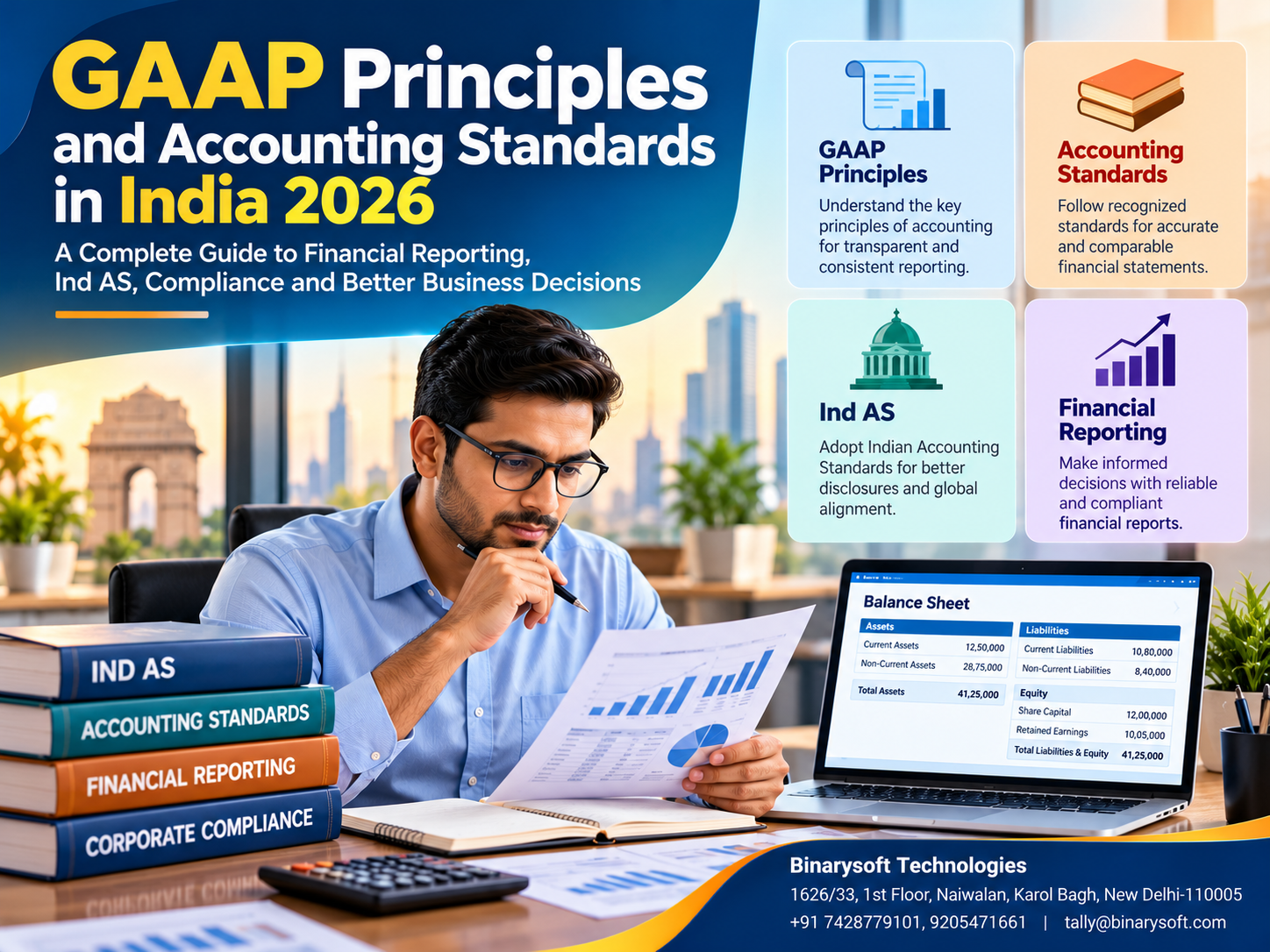
Introduction: Why GAAP and Accounting Standards Matter More Than Ever
In 2026, businesses across India face increasing expectations for financial transparency, accurate reporting and dependable accounting records. Whether operating a small retail shop, manufacturing company, wholesale business or growing enterprise, every organization needs financial information that reflects its actual business performance.
However, accounting becomes complicated when different businesses use different methods to record income, expenses, assets and liabilities.
Imagine two companies earning identical revenue but reporting completely different profits because they follow inconsistent accounting practices. Investors, banks and business owners would struggle to determine which company is financially stronger.
This is where Generally Accepted Accounting Principles (GAAP) and accounting standards become essential.
GAAP provides a foundation of accounting concepts, assumptions and conventions that guide financial reporting. Accounting standards translate these principles into more specific requirements for recording, measuring, presenting and disclosing financial transactions.
In India, applicable Accounting Standards (AS) and Indian Accounting Standards (Ind AS) help businesses maintain consistency and transparency.
TallyPrime supports businesses by organizing accounting transactions, inventory, banking and financial reporting within an integrated system.
This guide explains the fundamental principles of GAAP, the role of accounting standards, practical examples and how TallyPrime can support more reliable accounting practices.
1. What Are Generally Accepted Accounting Principles (GAAP)?
Generally Accepted Accounting Principles are established accounting concepts, conventions and practices used to prepare consistent and reliable financial statements.
They help businesses determine how financial transactions should be recorded and presented.
The objective is to make financial information understandable, comparable and useful to stakeholders.
These stakeholders include business owners, investors, lenders, auditors, regulators and management teams.
GAAP is not one identical set of detailed rules followed by every country.
Different jurisdictions maintain their own financial reporting frameworks. In India, the applicable framework may involve Accounting Standards or Ind AS, depending on the type and classification of the entity.
Why GAAP Is Important
GAAP helps businesses maintain consistency across accounting periods.
It encourages transparent reporting and reduces the risk of misleading financial information.
It also makes financial statements more useful when comparing business performance over time.
For example, a bank reviewing a business loan application may examine the company's profitability, assets, liabilities and cash flow.
Financial statements prepared using appropriate accounting principles provide a stronger basis for that evaluation.
2. What Are Accounting Standards?
Accounting standards are authoritative requirements that explain how particular financial transactions and events should be recognized, measured, presented and disclosed.
While general accounting principles provide the conceptual foundation, standards address specific accounting subjects.
Examples include inventory valuation, revenue recognition, property and equipment, employee benefits, borrowing costs and financial instruments.
Main Objectives of Accounting Standards
-
Improve consistency in financial reporting.
-
Reduce inappropriate differences in accounting treatment.
-
Support transparency and meaningful disclosures.
-
Improve comparability between businesses.
-
Provide guidance for complex accounting transactions.
-
Strengthen confidence in financial statements.
Accounting standards do not replace the responsibility of management to maintain accurate financial records.
Businesses must identify which standards apply to their entity and accounting period.
3. GAAP vs Accounting Standards: Key Differences
|
Basis
|
GAAP principles
|
Accounting standards
|
|---|
|
Meaning
|
Broad accounting concepts and accepted practices
|
Specific financial reporting requirements
|
|
Purpose
|
Establish a reliable accounting foundation
|
Guide treatment of particular transactions
|
|
Scope
|
General accounting assumptions and principles
|
Recognition, measurement, presentation and disclosure
|
|
Examples
|
Accrual, consistency, going concern
|
Inventory, revenue and asset standards
|
|
Application
|
Guides accounting judgments
|
Provides detailed applicable requirements
|
|
Business benefit
|
Improves reliability
|
Improves consistency and comparability
|
Both work together to improve the quality of financial reporting.
4. Important GAAP Principles Every Business Should Understand
4.1 Business Entity Principle
The business entity principle treats business transactions separately from the personal financial activities of its owners.
For example, if a proprietor withdraws ₹25,000 for personal expenses, the withdrawal should not automatically be recorded as a business operating expense.
Maintaining this distinction improves financial accuracy.
4.2 Going Concern Assumption
The going concern assumption generally presumes that a business will continue operating for the foreseeable future unless circumstances indicate otherwise.
This assumption influences the preparation and measurement of financial statements.
For example, machinery used in an ongoing manufacturing operation is ordinarily accounted for differently from assets held for immediate liquidation.
4.3 Accrual Principle
Under accrual accounting, income and expenses are recognized according to applicable recognition requirements rather than simply when cash changes hands.
Suppose a company provides services worth ₹1,00,000 in March but receives payment in April.
If the applicable revenue recognition criteria are satisfied in March, the income is recognized in that period.
4.4 Consistency Principle
Businesses should apply accounting policies consistently across periods unless a justified change is required or permitted.
For example, changing an inventory valuation method without appropriate justification and disclosure can affect reported profitability.
Consistency supports meaningful comparisons.
4.5 Matching Concept
The matching concept emphasizes recognizing expenses in relation to the income or periods they help generate, subject to applicable standards.
For example, depreciation allocates the cost of qualifying assets over their useful lives.
4.6 Historical Cost Concept
Under the historical cost approach, assets are initially recorded using their acquisition cost, subject to the relevant accounting requirements.
For example, machinery purchased for ₹5,00,000 is initially recorded based on its eligible cost components.
Subsequent depreciation, impairment or revaluation treatment depends on the applicable standards.
4.7 Prudence Principle
Prudence encourages caution when making accounting judgments under uncertainty.
Businesses should avoid overstating assets or income and understating liabilities or expenses.
However, prudence does not justify deliberately creating hidden reserves or biased financial statements.
4.8 Materiality Principle
Materiality helps determine which financial information could influence decisions made by users of financial statements.
The significance of an item depends on its nature, size and circumstances.
4.9 Full Disclosure Principle
Financial statements should disclose material information necessary for users to understand the organization's financial position and performance.
This may include significant accounting policies, commitments, contingencies and related-party transactions.
4.10 Monetary Measurement Concept
Accounting records generally express transactions in monetary terms.
Activities that cannot be reliably measured financially may not appear directly in accounting statements, even when they are important to business success.
5. An Emotional Story: The Accountant Who Helped Save a Family Business
For nearly eighteen years, Sanjay operated a small furniture manufacturing company in Delhi.
His father had started the business with a few carpenters and a determination to provide quality furniture to local customers.
Over time, Sanjay expanded operations and began supplying furniture to hotels, offices and retail stores.
The company generated substantial sales, but its financial reports often created confusion.
Inventory values were inconsistent, expenses were sometimes recorded in the wrong periods and personal withdrawals were mixed with business transactions.
One afternoon, Sanjay approached a bank for additional working capital.
The bank requested financial statements for the previous three years.
When the accountant prepared the reports, the figures were difficult to reconcile.
Sanjay feared the bank would reject his application.
That evening, he sat in his father's old office chair, looking at the workshop where employees were finishing an important order.
He remembered how his father had worked late into the night to establish the company.
He wondered whether poor financial management would damage everything his family had built.
Instead of abandoning his expansion plans, Sanjay decided to improve the accounting system.
With professional guidance, the company reviewed its accounting policies, standardized inventory records and reorganized financial transactions.
TallyPrime was configured to maintain consistent ledgers, stock records and accounting reports.
Employees received training on transaction classification, bank reconciliation and financial statement preparation.
Gradually, the company gained more reliable financial information.
Sanjay could review expenses, profitability and inventory values with greater confidence.
The bank still conducted its independent credit assessment, but the company was better prepared to explain its financial position.
One evening, Sanjay told his father that the accounting records were finally becoming as organized as the workshop.
His father smiled and replied, "A strong business needs strong records."
This fictional story illustrates how reliable accounting practices can protect business confidence and support better financial decisions.
6. Indian GAAP, Accounting Standards and Ind AS
India has different financial reporting requirements depending on the entity's legal form, size and regulatory classification.
Traditional Accounting Standards apply to relevant entities that do not follow Ind AS.
Ind AS is a separate framework substantially converged with International Financial Reporting Standards.
Specified companies must apply Ind AS based on applicable regulatory criteria, including listing status, net worth and other requirements.
Not every Indian business is required to adopt Ind AS.
Examples of Accounting Standards
|
Standard
|
Main subject
|
|---|
|
AS 1
|
Disclosure of Accounting Policies
|
|
AS 2
|
Valuation of Inventories
|
|
AS 3
|
Cash Flow Statements
|
|
AS 9
|
Revenue Recognition
|
|
AS 10
|
Property, Plant and Equipment
|
|
AS 11
|
Foreign Exchange Rate Changes
|
|
AS 15
|
Employee Benefits
|
|
AS 16
|
Borrowing Costs
|
|
AS 22
|
Accounting for Taxes on Income
|
The applicable standards and available exemptions should be verified for each entity.
7. Difference Between Indian GAAP, Ind AS and IFRS
Indian GAAP is a broad description of the accounting framework applicable in India.
Ind AS consists of Indian Accounting Standards substantially converged with IFRS, with certain differences reflecting India's regulatory environment.
IFRS refers to international financial reporting standards developed by the International Accounting Standards Board.
|
Feature
|
Indian AS framework
|
Ind AS
|
IFRS
|
|---|
|
Primary application
|
Relevant Indian entities not using Ind AS
|
Specified Indian entities
|
Jurisdictions adopting IFRS
|
|
International alignment
|
Indian accounting framework
|
Substantially IFRS-converged
|
International framework
|
|
Fair value requirements
|
Generally more limited
|
More extensive in specified areas
|
Extensive in specified areas
|
|
Disclosure complexity
|
Depends on applicable standards
|
Often more extensive
|
Often more extensive
|
The correct framework must be selected according to legal applicability rather than business preference alone.
8. How GAAP Principles Improve Financial Reporting
Consistent accounting policies make financial statements easier to understand.
They help businesses compare profitability, expenses and asset values across different periods.
For example, if a distributor consistently applies an appropriate inventory valuation method, management can evaluate changes in gross profit more meaningfully.
Similarly, accurate accrual accounting helps distinguish revenue earned from cash collected.
GAAP principles also support stronger internal controls.
Clear transaction classifications reduce the risk of recording personal expenses as business costs or incorrectly recognizing income.
These practices improve the quality of information used for budgeting, financing and operational decisions.
9. How TallyPrime Supports GAAP-Based Accounting
TallyPrime provides accounting tools that can help businesses apply appropriate financial reporting practices.
Double-Entry Accounting
TallyPrime maintains debit and credit entries, helping businesses record transactions within a structured accounting system.
Ledger Management
Businesses can organize assets, liabilities, income and expenses using appropriate ledger groups.
Accrual Accounting
Sales, purchases, outstanding receivables and payables can be recorded independently of cash settlement.
Inventory Valuation
TallyPrime supports inventory valuation and stock reporting features that help businesses maintain inventory information.
Fixed Asset Accounting
Businesses can maintain fixed asset ledgers and record depreciation through appropriate accounting entries.
Financial Statements
TallyPrime provides Balance Sheet, Profit & Loss Account and Trial Balance reports.
Audit and Verification
Supported edit-log and reporting features can assist with transaction review and accountability.
TallyPrime does not automatically guarantee GAAP, AS or Ind AS compliance. Complex measurements, disclosures and adjustments may require additional calculations, configuration and professional review.
10. Practical Example: Applying GAAP Principles in a Trading Business
Consider a wholesale distributor that purchases goods worth ₹5,00,000 on credit and sells part of the inventory for ₹3,00,000.
The purchase creates inventory and a corresponding supplier liability.
When goods are sold, the business recognizes revenue according to the applicable accounting requirements and records the cost of goods sold.
If the customer pays after 30 days, the outstanding amount remains recorded as a receivable until settlement.
This example demonstrates several accounting concepts.
The business entity principle separates company transactions from the owner's personal finances.
Accrual accounting recognizes qualifying transactions without waiting for cash settlement.
The matching concept connects the cost of goods sold with the corresponding revenue.
Consistency ensures the inventory valuation policy is applied appropriately across accounting periods.
TallyPrime can help record these transactions through purchase vouchers, sales invoices, inventory records and customer outstanding reports.
11. Case Study One: A Delhi Wholesale Distributor Improves Accounting Accuracy
Illustrative case study based on common wholesale accounting challenges.
Business Background
A wholesale electrical goods distributor in Bhagirath Palace, Delhi, managed hundreds of inventory items and supplied products to retailers across North India.
The company maintained accounting records but relied heavily on spreadsheets for inventory valuation and financial reporting.
Challenges
Inventory values were calculated inconsistently, and certain expenses were recorded in the wrong accounting periods.
As a result, monthly profitability reports sometimes differed significantly from year-end statements.
Solution
The business reviewed its accounting policies and adopted more consistent transaction-recording procedures.
TallyPrime was configured with structured inventory masters, appropriate ledger groups and standardized voucher entry processes.
The accounting team also introduced regular reconciliation and financial report reviews.
Business Outcome
Management gained more reliable inventory and profitability information.
Accounting employees could identify discrepancies earlier and prepare financial statements more efficiently.
The company reduced dependence on disconnected spreadsheets.
Key lesson: Consistent accounting policies and organized financial records improve business reporting and decision-making.
12. Case Study Two: A Manufacturing Company Strengthens Financial Reporting
Illustrative case study demonstrating accounting standards implementation.
Business Background
A medium-sized manufacturing company in Faridabad produced industrial components for customers across India.
The business maintained machinery, raw materials, finished goods and several categories of operating expenses.
Challenges
The company experienced difficulties calculating depreciation consistently and allocating expenses to appropriate accounting periods.
Its financial reports required extensive manual adjustments during annual reviews.
Solution
The accounting team reviewed relevant accounting standards and established documented policies for fixed assets, depreciation and inventory valuation.
TallyPrime was used to maintain asset ledgers, accounting entries and financial reports.
Employees received training on voucher classification and period-end adjustments.
Business Outcome
The company established more consistent accounting procedures.
Financial information became easier to verify, and management gained better visibility into expenses and asset balances.
Year-end reporting became more organized.
Key lesson: Accounting software is most effective when supported by documented policies and knowledgeable employees.
13. Common Mistakes Businesses Make When Applying GAAP
One common mistake is recognizing income only when payment is received, even when the applicable accounting framework requires accrual recognition.
Another is recording personal expenses as business expenses.
Businesses may also apply inconsistent inventory valuation methods, overlook depreciation or fail to disclose material accounting information.
Incorrect classification of capital expenditure and revenue expenditure can significantly affect profitability.
To reduce these problems, businesses should establish clear accounting policies and review financial records regularly.
Qualified accounting professionals should assess complex transactions and changes in reporting requirements.
14. How TallyPrime on Cloud Supports Accounting Consistency
Businesses operating across multiple locations may require coordinated access to financial records.
With suitable cloud hosting and licensing, authorized users can access their TallyPrime environment remotely.
This can help accounting teams maintain centralized records and review financial information without relying on multiple disconnected copies.
Cloud hosting may also support backup planning and business continuity.
However, companies must evaluate security, access permissions, data protection and recovery procedures.
Cloud hosting improves accessibility but does not independently ensure compliance with accounting standards.
15. Best Practices for Implementing GAAP and Accounting Standards
Businesses should begin by identifying the financial reporting framework applicable to their organization.
They should then establish documented policies for revenue recognition, inventory valuation, depreciation, provisions and other significant accounting matters.
Employees responsible for accounting entries should receive appropriate training.
Monthly reviews should include ledger reconciliation, inventory verification and examination of unusual transactions.
At year-end, businesses should review adjustments, disclosures and supporting schedules before finalizing financial statements.
TallyPrime can assist with transaction recording and reporting, while professional judgment remains necessary for applying complex standards.
16. How Binarysoft Technologies Helps Businesses Improve Accounting Management
Binarysoft Technologies, an Authorized Tally Partner based in New Delhi, helps businesses implement and manage TallyPrime accounting solutions.
Relevant assistance may include software licensing, ledger configuration, inventory setup, financial reporting, software upgrades, data migration and employee training.
Businesses may also explore suitable cloud-hosting arrangements for remote accounting access.
Professional implementation can help organizations establish more consistent accounting workflows.
For interpretation of applicable Accounting Standards, Ind AS and statutory financial reporting obligations, businesses should consult qualified accounting professionals.
Conclusion
GAAP principles and accounting standards provide the foundation for accurate, transparent and consistent financial reporting.
They help businesses recognize transactions appropriately, maintain comparable records and communicate financial performance to stakeholders.
In India, businesses must identify whether the relevant Accounting Standards or Ind AS framework applies to their circumstances.
TallyPrime supports structured bookkeeping, inventory management, ledger accounting and financial reporting.
However, compliance requires more than software functionality. Businesses must apply correct accounting policies, maintain reliable records and perform regular financial reviews.
With suitable accounting practices, professional guidance and dependable software, organizations can strengthen financial transparency and make better business decisions.
Good accounting is not simply about recording numbers. It is about creating financial information that people can trust.
Powered by Binarysoft Technologies
Authorized Tally Partner
Location: 1626/33, 1st Floor, Naiwalan, Karol Bagh, New Delhi – 110005, INDIA
Contact Us: +91 7428779101, 9205471661
Email: tally@binarysoft.com
Business Hours: 10:00 AM – 6:00 PM, Monday to Friday
Frequently Asked Questions
How can Binarysoft Technologies help businesses with TallyPrime?
Binarysoft Technologies can assist with TallyPrime licensing, implementation, accounting configuration, inventory setup, financial reporting, software upgrades and cloud-hosting consultation.
Does TallyPrime automatically ensure Ind AS compliance?
No. TallyPrime can maintain underlying accounting records, but specialized Ind AS calculations, adjustments and disclosures may require additional work and professional review.
Is Ind AS mandatory for every Indian business?
No. Ind AS applies to specified entities according to applicable legal and regulatory criteria. Other businesses may follow the relevant AS framework.
What is the difference between GAAP and accounting standards?
GAAP provides broad accounting principles, while accounting standards establish specific requirements for recognizing, measuring, presenting and disclosing financial transactions.
CA. Atharv Nambiar provides advisory services in accounting, audit, and taxation. He shares practical guidance on financial reporting, business controls, and technology adoption for modern organizations.