Call CA Tally HelpDesk
+91 9205471661,
7428779101

Introduction: Why Banking and Accounting Transformation Matters for SMEs
Small and medium enterprises are the backbone of India's business economy. From neighbourhood retailers and manufacturing units to wholesalers and professional service providers, SMEs contribute to employment, innovation and economic development.
However, managing financial transactions remains one of their biggest operational challenges.
A typical business may receive customer payments through bank transfers, UPI, cheques and cash while simultaneously making supplier payments, recording expenses and maintaining GST-related information.
When banking and accounting records are managed separately, employees spend valuable time matching transactions, identifying missing entries and correcting financial discrepancies.
These challenges become more serious as transaction volumes increase.
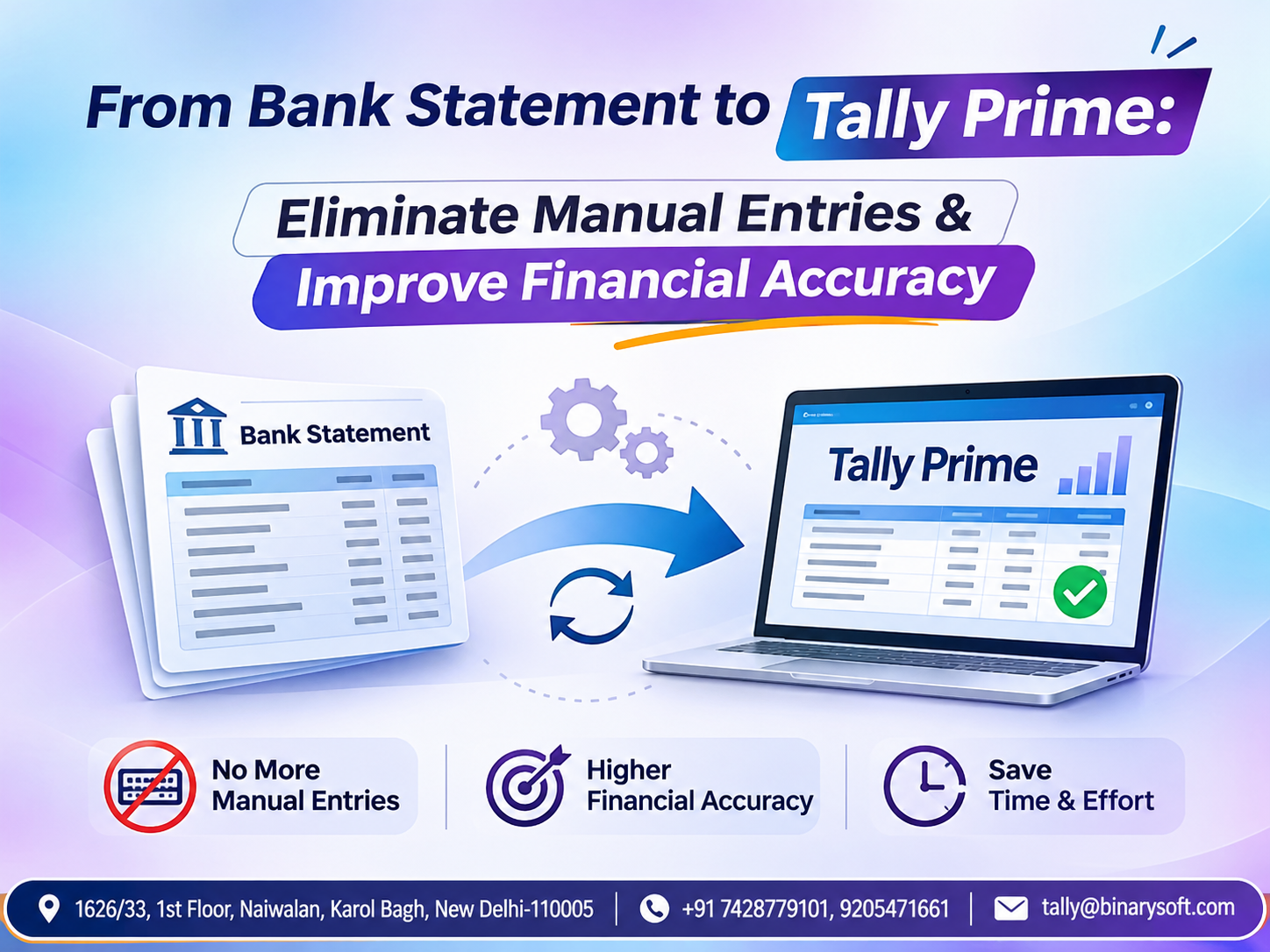
Tally Prime helps SMEs connect daily accounting activities with banking records, enabling businesses to maintain organised financial information, improve reconciliation and monitor cash flow.
With suitable configuration, Tally Prime supports bank account ledgers, transaction recording, reconciliation, payment tracking and financial reporting.
The objective is not simply to reduce manual work. It is to help business owners understand where their money is coming from, where it is going and what financial commitments lie ahead.
1. Understanding the Banking Challenges Faced by SMEs
Small businesses often operate with limited accounting resources.
A single employee may handle invoicing, payment collection, supplier transactions and bank reconciliation.
As the business grows, maintaining accuracy becomes increasingly difficult.
Common Banking and Accounting Challenges
-
Multiple payment channels and bank accounts
-
Delayed recording of customer receipts
-
Differences between bank statements and accounting records
-
Unidentified bank charges or deductions
-
Difficulty tracking unpaid customer invoices
-
Limited visibility into upcoming supplier payments
-
Manual data entry and reconciliation errors
-
Delays in preparing financial reports
These problems can affect working capital, supplier relationships and business planning.
A structured accounting system helps businesses address these issues systematically.
2. How Tally Prime Simplifies Banking Operations
Tally Prime provides banking and accounting capabilities that help organisations manage financial transactions more consistently.
Businesses can create bank ledgers, record payments and receipts, reconcile transactions and examine account balances.
Supported software releases may also provide bank statement import, transaction matching and additional connected banking capabilities.
Availability depends on the bank, software release, licensing and configuration.
Important Banking Capabilities
Bank Ledger Management: Maintain separate records for different business bank accounts.
Receipt and Payment Recording: Record money received and paid through appropriate accounting vouchers.
Bank Reconciliation: Compare accounting transactions with bank statements.
Cheque Management: Maintain relevant cheque transaction information.
Banking Reports: Review recorded bank activity and investigate discrepancies.
Financial Visibility: Examine bank balances alongside customer receivables and supplier payables.
These features help reduce dependence on disconnected records.
3. Bank Reconciliation: A Foundation of Accurate Accounting
Bank reconciliation is the process of comparing transactions recorded in accounting software with transactions appearing in bank statements.
Differences can arise because of timing, missing entries, bank charges or incorrect amounts.
For example, a business may record a supplier cheque payment before the amount is cleared by the bank.
Similarly, a bank may deduct service charges that have not yet been entered in the accounts.
How to Reconcile Bank Transactions in Tally Prime
-
Create or select the appropriate bank ledger.
-
Record relevant receipts and payments.
-
Open the bank reconciliation function for the account.
-
Import a supported bank statement where available, or review entries manually.
-
Match recorded transactions with bank statement entries.
-
Investigate unmatched amounts and dates.
-
Record missing transactions or correct verified errors.
-
Review the remaining reconciliation differences.
The exact interface and automation available depend on the software release.
Regular reconciliation helps businesses maintain reliable bank records and identify accounting issues earlier.
4. Digital Banking and Accounting Automation
Digital payments have changed the way SMEs conduct business.
Customers increasingly use UPI, NEFT, RTGS, IMPS and other electronic payment methods.
Although these methods make transactions convenient, businesses must still maintain accurate accounting records.
Tally Prime can help organise financial information associated with these transactions.
Benefits of Structured Digital Accounting
Businesses can reduce repetitive entry where supported banking functions are available.
Transaction matching helps identify differences between accounting records and bank statements.
Properly recorded receipts can be allocated against customer invoices.
Management can review bank activity and financial obligations without depending entirely on manually prepared summaries.
However, accounting software should not be assumed to initiate every type of bank transaction or provide universal live bank connectivity.
Specific banking services must be confirmed for the selected release and bank.
5. Managing Customer Receipts and Outstanding Payments
Customer receivables are a major component of SME working capital.
A profitable business can still experience financial pressure when customers delay payments.
Tally Prime supports bill-wise accounting and outstanding reports.
Practical Example
A distributor sells goods worth ₹1,00,000 on 30-day credit.
The customer pays ₹60,000 initially, leaving ₹40,000 outstanding.
By recording the receipt against the appropriate invoice, the accounts team can monitor the remaining balance.
This helps the business identify unpaid amounts and plan follow-up activities.
Benefits for SMEs
Businesses can review overdue invoices, examine customer balances and improve collection planning.
Regular outstanding reviews also help identify incorrect allocations and disputed payments.
Better receivables management supports cash flow stability.
6. Supplier Payments and Payables Management
Supplier relationships are essential for businesses that depend on regular inventory purchases or professional services.
Late payments may affect credit terms, delivery schedules and business confidence.
Tally Prime helps record purchase transactions and monitor supplier outstanding balances.
Businesses can examine payment obligations and plan settlements according to available funds.
Example
A wholesale business has supplier payments of ₹3,50,000 due over the next two weeks.
Its accounts team can review outstanding reports and compare expected payments with available bank funds and anticipated customer collections.
This supports better payment scheduling.
However, accounting reports are only as reliable as the transactions and due dates recorded in the system.
7. Improving Cash Flow Management with Tally Prime
Cash flow represents the movement of money into and out of a business.
Even companies reporting healthy sales may face difficulties if customer payments arrive later than supplier obligations.
Tally Prime provides accounting reports that help businesses analyse recorded cash and bank transactions.
Simple Cash Flow Illustration
|
Particulars
|
Amount
|
|---|
|
Opening cash and bank balance
|
₹2,00,000
|
|
Customer collections
|
₹5,50,000
|
|
Supplier payments
|
₹3,20,000
|
|
Salaries and operating expenses
|
₹1,50,000
|
|
Closing balance
|
₹2,80,000
|
This example assumes no other transactions.
A business can use similar calculations to understand available funds.
For forward-looking cash flow planning, management should also consider expected collections, future expenses and financing commitments.
Tally Prime reports can provide useful inputs, while forecasts may require additional planning assumptions.
8. GST Invoicing and Banking Reconciliation
GST invoicing and banking records are closely related to business accounting.
Sales invoices establish customer receivables, while receipts record payments against those obligations.
Tally Prime supports GST-related transaction recording and accounting reports.
Businesses can configure relevant tax details and maintain customer ledgers.
When payments are received, the corresponding receipts can be recorded and allocated appropriately.
Why This Matters
Accurate allocation helps businesses distinguish between invoiced revenue and actual collections.
It also supports customer account reconciliation.
However, GST liability and return reporting are governed by applicable tax rules, not simply by whether a customer has paid an invoice.
Businesses should verify their GST treatment and reconcile statutory reports separately.
9. Inventory, Purchases and Banking: Connecting Business Operations
For trading and manufacturing SMEs, banking activity is closely connected with purchasing and inventory management.
Businesses purchase stock, pay suppliers, sell goods and collect customer payments.
Tally Prime supports these connected accounting activities.
A purchase transaction can record the relevant supplier obligation and inventory information when properly configured.
A subsequent payment can be recorded against the supplier account.
Similarly, sales transactions can update customer receivables and relevant inventory records.
This integrated approach helps management understand financial obligations alongside operational activity.
10. Financial Reports That Improve SME Decision-Making
Accurate accounting provides the foundation for useful financial reporting.
Tally Prime includes important reports such as the Balance Sheet, Profit & Loss Account, Trial Balance, cash and bank books, and outstanding statements.
|
Financial report
|
Business purpose
|
|---|
|
Balance Sheet
|
Understand assets, liabilities and capital
|
|
Profit & Loss Account
|
Review income, expenses and profitability
|
|
Cash/Bank Books
|
Examine recorded money movements
|
|
Receivables
|
Monitor customer outstanding balances
|
|
Payables
|
Review supplier obligations
|
|
Trial Balance
|
Verify ledger balances and classifications
|
Business owners can use these reports to identify financial trends and evaluate operational performance.
Regular reviews are more useful than waiting until the end of the financial year.
11. Emotional Story: The Night a Business Owner Finally Understood His Cash Flow
Ravi operated a small auto-parts distribution business in Delhi.
His father had started the company decades earlier with a modest inventory and a commitment to honest customer service.
Ravi worked hard to expand the business.
Sales increased, new customers joined and supplier relationships grew stronger.
Yet something troubled him.
Despite recording substantial monthly sales, there were days when the company struggled to make supplier payments.
One evening, Ravi sat alone in his office surrounded by invoices, bank statements and handwritten notes.
His daughter had called twice, asking when he would come home.
He realised that he could not clearly explain how much money customers owed or which payments were due next.
The following week, Ravi introduced a more disciplined accounting process using Tally Prime.
He organised customer ledgers, recorded receipts against invoices and reviewed bank reconciliation regularly.
His team also began examining supplier obligations and financial reports every week.
Gradually, Ravi developed a clearer understanding of the difference between sales and available cash.
He could identify overdue customer balances and plan payments with greater confidence.
The business still faced challenges, but financial uncertainty no longer dominated every evening.
One Friday, Ravi closed the office early and attended his daughter's school performance.
For him, better accounting was not only about numbers.
It meant having more time for the people who mattered most.
This fictional story illustrates the emotional impact of improved financial visibility for small-business owners.
12. Case Study One: Banking Reconciliation for a Wholesale Distributor
Illustrative case study; not a verified customer result.
Business Background
A wholesale electrical equipment distributor in Delhi processed approximately 150 daily transactions across multiple payment channels.
Its accounts team maintained bank records and customer receipts using separate spreadsheets.
Challenges
Bank reconciliation was frequently delayed.
Some customer receipts were not allocated promptly, making outstanding balances difficult to verify.
Management also lacked a consistent view of bank-related accounting information.
Implementation
The company configured its bank and customer ledgers in Tally Prime.
Employees were trained to record receipts against relevant invoices and reconcile bank transactions regularly.
The organisation introduced a weekly review of unmatched entries.
Illustrative Results
|
Area
|
Before
|
After
|
|---|
|
Bank reconciliation
|
Irregular manual process
|
Structured routine
|
|
Customer receipts
|
Delayed allocation
|
More consistent matching
|
|
Outstanding reports
|
Difficult to verify
|
Clearer recorded balances
|
|
Financial review
|
Multiple spreadsheets
|
Centralised accounting reports
|
Key Learning: Regular bank reconciliation and disciplined receipt allocation can improve financial accuracy and customer balance visibility.
13. Case Study Two: Cash Flow Improvement for a Manufacturing SME
Hypothetical business scenario; no measured performance claims.
Business Background
A small manufacturing company purchased raw materials from multiple suppliers and supplied finished products to distributors.
The business frequently faced mismatches between expected customer collections and upcoming supplier payments.
Challenges
Payment obligations were monitored manually.
The finance team lacked a structured process for reviewing receivables, payables and available bank funds together.
Implementation
The company organised customer and supplier ledgers in Tally Prime.
Bill-wise accounting was introduced, and employees began recording payment allocations consistently.
Management reviewed outstanding reports, cash and bank books, and monthly financial statements.
Results
The business gained clearer visibility into recorded obligations.
Supplier payment planning became more structured, and customer collection follow-ups were better organised.
Key Learning: Better cash flow management begins with reliable accounting information and regular financial reviews.
14. Security and Accuracy in Digital Banking Records
Financial information is among the most sensitive data maintained by a business.
Organisations should protect accounting records against unauthorised access, accidental changes and data loss.
Tally Prime supports user access controls and other security-related configuration options.
Recommended Practices
Businesses should assign appropriate permissions to employees and restrict sensitive activities.
Passwords should be protected, and software should be maintained using supported releases.
Regular backups should be stored securely and tested periodically.
Bank transactions should be verified against authentic statements.
Employees should never disclose banking passwords, OTPs or confidential credentials to unauthorised individuals.
These practices help protect financial information and strengthen internal controls.
15. How SMEs Can Implement Better Banking and Accounting
A successful implementation requires both software configuration and disciplined processes.
Week 1: Establish the Accounting Foundation
Create the company, configure relevant ledgers and verify opening balances.
Week 2: Organise Banking Transactions
Record bank accounts, receipts, payments and other relevant entries.
Week 3: Improve Reconciliation
Review bank statements, match transactions and investigate discrepancies.
Week 4: Strengthen Financial Reviews
Examine customer receivables, supplier payables, cash balances and financial statements.
After implementation, businesses should continue regular reconciliation and employee training.
The goal is to create repeatable accounting procedures that remain effective as the company grows.
16. Why Choose Binarysoft Technologies for Tally Prime Banking and Accounting?
Binarysoft Technologies is an Authorized Tally Partner assisting businesses with Tally Prime-related requirements.
Organisations can discuss accounting configuration, banking workflows, reconciliation, GST settings and financial reporting.
Areas of Assistance
Software Configuration: Establish suitable accounting and banking ledgers.
Bank Reconciliation Guidance: Understand transaction matching and reconciliation procedures.
Receivables Management: Configure bill-wise accounting and review outstanding reports.
Financial Reporting: Learn to interpret relevant accounting statements.
Employee Training: Improve understanding of routine accounting workflows.
Technical Assistance: Discuss software-related difficulties and suitable solutions.
Service scope, availability and applicable charges should be confirmed directly.
17. The Future of Banking and Accounting for SMEs
Digital financial operations are becoming increasingly important for businesses.
As transaction volumes increase, SMEs need better ways to organise information, reduce repetitive work and maintain financial visibility.
Accounting software can support these goals through integrated transaction recording, reconciliation and reporting.
Future improvements in banking connectivity and automation may further simplify financial workflows.
However, businesses should evaluate each feature according to actual availability, security requirements and operational suitability.
Technology delivers the greatest value when supported by accurate records, trained employees and responsible financial management.
Conclusion
Banking and accounting transformation is an important step toward sustainable SME growth.
Tally Prime helps businesses maintain bank ledgers, record financial transactions, reconcile accounts, monitor customer payments and review financial reports.
These capabilities reduce dependence on disconnected manual records and support better financial decision-making.
For small businesses, organised banking and accounting can improve daily operational confidence.
For growing enterprises, reliable financial information supports cash flow planning, supplier relationships and long-term financial control.
The greatest benefits come from combining suitable software features with regular reconciliation, accurate transaction recording and effective internal controls.
With guidance from Binarysoft Technologies, SMEs can explore practical ways to improve their Tally Prime accounting and banking workflows.
Powered by Binarysoft Technologies
Authorized Tally Partner
Location: 1626/33, 1st Floor, Naiwalan, Karol Bagh, New Delhi – 110005, INDIA
Contact Us: +91 7428779101, 9205471661
Email Us: tally@binarysoft.com
Business Hours: 10:00 AM – 6:00 PM, Monday to Friday
Frequently Asked Questions
Can Tally Prime automatically reconcile bank transactions?
Supported releases and bank statement formats may provide automated matching or reconciliation assistance. Availability depends on the software version and banking configuration.
Is Tally Prime suitable for small businesses?
Yes. Small businesses can use Tally Prime for invoicing, accounting, bank reconciliation, inventory management and financial reporting.
How does Tally Prime improve cash flow management?
It provides accounting information about recorded cash and bank transactions, receivables, payables and financial performance, helping businesses plan their cash requirements.
Does Tally Prime support UPI and electronic payment accounting?
Businesses can record UPI and other electronic payment transactions using appropriate accounting vouchers. Additional banking integration capabilities depend on supported features.
CA. Samarth Toshniwal works on business accounting, taxation, and transaction reconciliation. His professional focus is on helping enterprises maintain organized financial records and develop efficient accounting practices.