Call CA Tally HelpDesk
+91 9205471661,
7428779101
When Every Bank Transaction Becomes an Accounting Challenge
Every business owner understands the importance of accurate financial records. Whether managing a small retail store, wholesale distribution company, manufacturing unit or professional consultancy, banking transactions form the foundation of daily financial operations.
But imagine handling hundreds of bank transactions every week, manually entering payment details, verifying receipts, checking bank charges and matching balances against accounting records.
For many businesses, this process becomes exhausting.
A single incorrect entry can create confusion during reconciliation. A missing customer payment may result in unnecessary follow-up calls. An overlooked bank charge can affect financial reports, while duplicate entries may distort cash flow calculations.
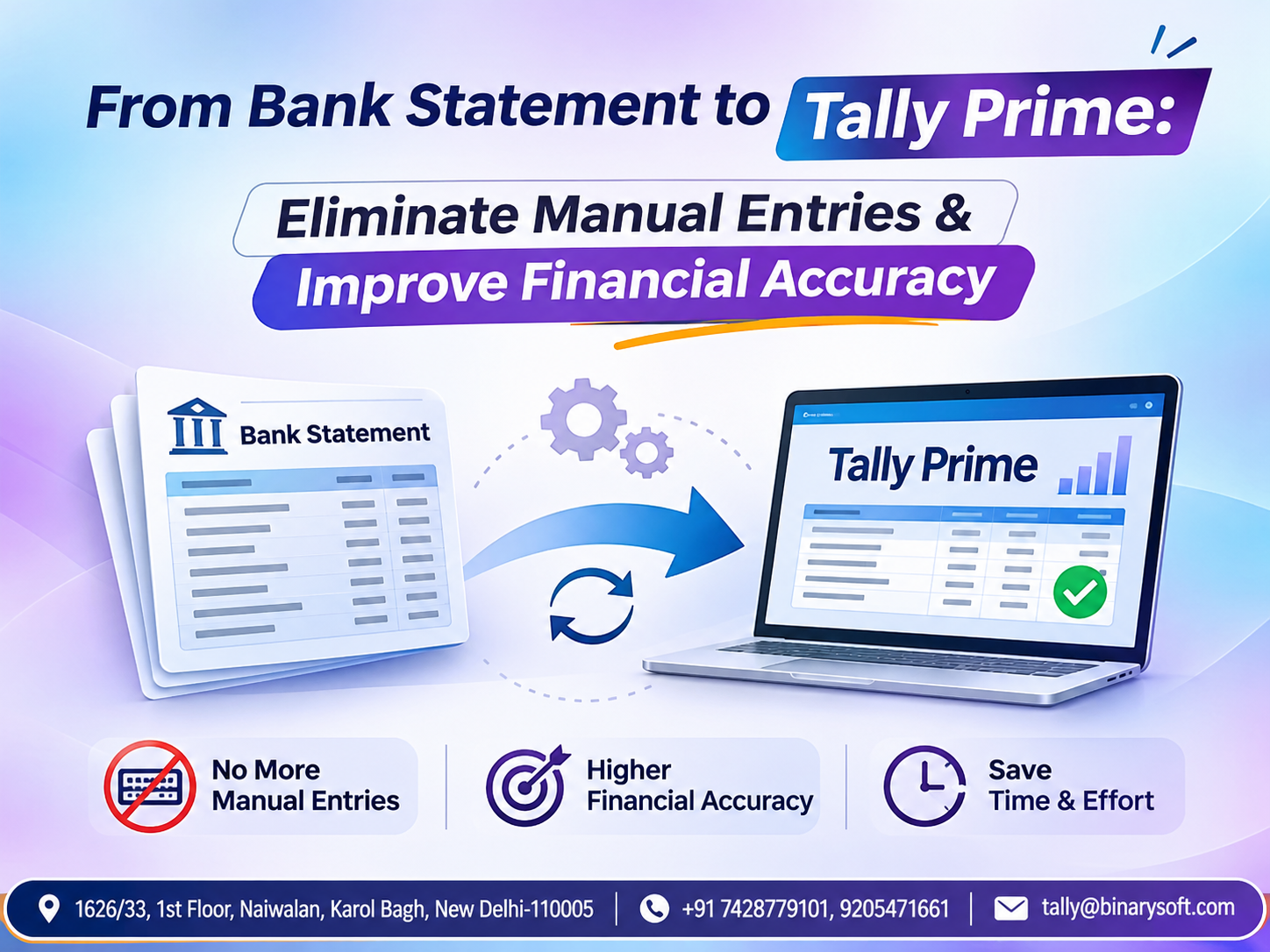
This is where Tally Prime bank statement import and reconciliation features can transform financial management.
Instead of repeatedly typing transaction information, businesses can import supported bank statements, review transaction details, create or match accounting vouchers where supported, and reconcile their books more efficiently.
The result is a more organized accounting process, fewer repetitive tasks and greater confidence in financial information.
1. The Hidden Cost of Manual Bank Entries
Manual banking entries may appear manageable when a business handles only a few transactions daily. However, as operations expand, the volume of transactions increases significantly.
Consider a growing trading business that processes 150 banking transactions every day.
These may include customer payments, supplier transfers, UPI collections, NEFT transactions, RTGS transfers, bank charges, interest credits and loan repayments.
If an accountant spends two minutes entering and checking each transaction, the business may spend approximately five hours daily on this activity alone.
That time could otherwise be used for financial analysis, customer outstanding management and business planning.
Common problems with manual accounting
Data entry errors: Incorrect amounts, transaction dates or ledger selections can create discrepancies.
Duplicate transactions: The same bank transaction may accidentally be recorded more than once.
Delayed reconciliation: Accounting teams may postpone bank reconciliation until the end of the month.
Missing transactions: Bank charges, interest credits and automatic deductions may remain unrecorded.
Limited financial visibility: Business owners may struggle to identify actual bank balances and available funds.
Higher operational costs: Repetitive accounting activities consume employee time and resources.
These challenges highlight why businesses need a structured, technology-supported banking workflow.
2. Understanding Bank Statement Import in Tally Prime
Bank statement import allows businesses to bring transaction information from supported bank statement files into their accounting environment.
Rather than reading every statement line and manually typing its details, accountants can use imported information to review, match, reconcile and, where the supported workflow permits, create accounting vouchers.
Typical statement information includes:
-
Transaction date and description
-
Withdrawal or debit amount
-
Deposit or credit amount
-
Bank reference number
-
Available transaction narration
-
Statement balance, where supplied
For example, suppose a customer transfers ₹45,000 through NEFT.
The bank statement contains the transaction date, amount and reference details. After importing the statement, the accountant can identify the receipt, associate it with the appropriate customer ledger and record or reconcile the transaction using the available banking workflow.
This reduces repetitive typing and helps maintain consistency between bank records and accounting books.
However, bank statement import does not mean every transaction is automatically classified or posted correctly. Ledger selection, transaction interpretation, tax treatment and exceptions may still require human review.
3. How Tally Prime Helps Automate Banking Activities
Tally Prime brings banking-related accounting activities into a structured environment, helping businesses manage transactions without relying entirely on manual processes.
Bank statement import
Businesses can import statements from supported banks and file formats, subject to their Tally Prime release and available banking features.
This allows accountants to work with transaction information directly within their accounting workflow.
Bank reconciliation
Tally Prime helps users compare bank statement transactions with accounting entries.
Matching transactions can be identified, while unmatched items can be investigated and corrected.
Voucher creation from banking information
Supported banking workflows can assist users in creating vouchers using imported transaction details.
This is useful for customer receipts, supplier payments, bank charges and other common banking activities.
Ledger-based accounting
Once transactions are recorded in the correct ledgers, they contribute to the company's accounting reports.
For example, a customer receipt can update the bank ledger and reduce the customer's outstanding balance when allocated correctly.
Financial reporting
Accurately recorded banking transactions improve the usefulness of reports such as:
The objective is not simply faster entry. It is to create reliable accounting information that supports better financial decisions.
4. Step-by-Step Guide: Import Bank Statements into Tally Prime
Businesses can follow a systematic process to import banking transactions and simplify accounting.
Step 1: Prepare your bank statement
Log in to your bank's internet banking portal and download the required statement.
For standard statement import, use an original supported Excel or CSV file. Avoid manually changing column structures or converting a PDF into Excel unless the relevant import workflow specifically supports it.
Certain newer document-processing features also support PDF bank statements, subject to feature availability, setup and permissions.
Step 2: Open Tally Prime
Open your company data and verify that the correct bank ledger has been created.
Ensure the ledger is associated with the appropriate bank account and that the reconciliation beginning date is configured correctly.
Step 3: Import the statement
Navigate to:
Gateway of Tally > Alt+O (Import) > Bank Statement
Select the bank ledger, file location and supported statement file. Enable the preview, where available, and review the information before completing the import.
Step 4: Review imported transactions
Examine the imported statement for missing entries, incorrect dates, duplicate information and unexpected amounts.
Do not assume that every imported transaction is a new accounting entry.
Step 5: Create vouchers where required
Open Banking Activities or the Bank Reconciliation Summary.
Select the appropriate unmatched transactions and use the available voucher creation option, such as F7, to create individual or multiple vouchers.
Verify ledger allocations, bill references, narrations and other relevant accounting details.
Step 6: Reconcile transactions
Match imported bank transactions with existing accounting vouchers.
Review exact matches, potential matches and outstanding differences.
Step 7: Verify reports
After completing reconciliation, examine the bank ledger, outstanding balances, cash flow and other financial reports.
This final verification ensures that imported banking information has been converted into meaningful accounting records.
5. A Story of Relief: How Better Banking Records Changed a Business Owner's Life
The following is an illustrative fictional story.
Rajesh owned a small electrical goods distribution business in Delhi.
For nearly fifteen years, he had built his company through hard work, reliable customer relationships and careful financial management.
As the business expanded, however, managing bank transactions became increasingly difficult.
Every evening, Rajesh's accountant would sit with printed bank statements, manually entering receipts and payments into the accounting system.
During busy months, reconciliation remained incomplete for several weeks.
One afternoon, a long-standing customer called Rajesh.
"Sir, we transferred the payment last Tuesday. Why are we receiving another reminder?"
Rajesh immediately contacted his accountant.
After searching through multiple statements, they discovered that the payment had reached the bank but had not been properly recorded against the customer's outstanding invoice.
Rajesh felt embarrassed.
He had spent years building trust, yet a simple accounting oversight had created unnecessary tension.
That evening, he realized something important: his business was growing, but its financial processes had not grown with it.
He decided to improve the accounting workflow using Tally Prime.
His team began importing supported bank statements, reviewing unmatched transactions and reconciling accounts regularly.
Over time, the process became more organized.
Customer payments were identified sooner, bank charges were recorded consistently and outstanding reports became more reliable.
Most importantly, Rajesh no longer spent every evening worrying about whether a payment had been overlooked.
For him, better accounting was not merely about saving time.
It was about protecting customer relationships, reducing stress and regaining confidence in the business he had worked so hard to build.
6. Case Study One: Wholesale Trading Business Improves Banking Efficiency
Illustrative case study using hypothetical figures.
A wholesale electrical products distributor in Karol Bagh managed approximately 3,000 bank transactions every month.
Its accounting department relied heavily on manual statement checking and voucher entry.
Challenges
The company experienced delayed bank reconciliation, occasional duplicate entries and difficulty identifying customer payments.
Its accountants also spent considerable time comparing banking information with ledger balances.
Solution
The business introduced a structured Tally Prime banking process.
Bank statements were imported regularly. Existing accounting vouchers were matched with statement transactions, while missing entries were reviewed and created using supported voucher workflows.
Customer receipts were allocated against the correct outstanding invoices.
Illustrative results
|
Performance measure
|
Before
|
After
|
|---|
|
Monthly banking work
|
75 hours
|
30 hours
|
|
Reconciliation frequency
|
Monthly
|
Daily
|
|
Unresolved differences at month-end
|
35
|
5
|
|
Manual entry dependency
|
High
|
Reduced
|
The example represents a potential improvement, not a guaranteed outcome.
The most valuable change was the accounting team's ability to focus more time on customer collections, overdue payments and business analysis.
7. Case Study Two: Consultancy Firm Gains Better Financial Control
Illustrative case study using hypothetical figures.
A Delhi-based consultancy firm provided taxation, compliance and business advisory services to approximately 120 clients.
The company received professional fees through NEFT, UPI and bank transfers.
However, many customer payments arrived with incomplete descriptions.
Challenges
The accounting team struggled to identify which invoices had been settled.
Unallocated receipts created confusion in outstanding reports, while monthly reconciliation required several days.
Solution
The firm began importing bank statements into Tally Prime and reviewing banking transactions against customer ledgers.
Accountants used transaction references and customer remittance details to allocate receipts correctly.
Unidentified payments were kept under review instead of being assigned to customers without sufficient evidence.
Illustrative results
The firm reduced its monthly reconciliation effort from approximately three working days to one day.
Outstanding reports became easier to review, and management gained better visibility into collections.
The example demonstrates how accounting automation, combined with disciplined transaction verification, can improve financial control in service businesses.
8. How Automated Bank Reconciliation Improves Financial Accuracy
Bank reconciliation is the process of comparing transactions recorded in accounting books with those appearing in bank statements.
Differences can arise for several reasons.
A cheque may have been issued but not cleared. A customer payment may have reached the bank without being recorded in the books. Bank charges may have been deducted automatically.
Tally Prime helps accountants identify and investigate such differences.
Exact transaction matching
When banking information and accounting records satisfy the configured matching criteria, transactions can be matched and reconciled.
Potential matching
When an exact match is unavailable, accountants can review suggested potential matches and determine whether they represent the same transaction.
Missing transaction identification
Imported bank entries without corresponding accounting vouchers can be identified for further action.
Duplicate entry prevention
Reviewing existing vouchers before creating new entries helps reduce duplicate accounting records.
Improved audit preparation
Regular reconciliation produces clearer transaction histories and reduces the volume of unresolved differences requiring investigation during an audit.
Automation therefore supports financial accuracy, provided the underlying accounting classifications and transaction details are verified.
9. Managing UPI, NEFT, RTGS and Other Banking Transactions
Modern businesses receive and make payments through several banking channels.
Tally Prime can help businesses account for these transactions through appropriate bank ledgers and vouchers.
UPI payments: Businesses can review UPI collections and allocate them against relevant customer invoices or sales transactions.
NEFT transfers: Customer receipts and supplier payments can be identified through available bank references.
RTGS payments: High-value transactions can be recorded with appropriate ledger allocations and supporting documentation.
IMPS transactions: Immediate bank transfers can be incorporated into regular accounting and reconciliation processes.
Bank charges: Service fees and transaction charges can be posted to the relevant expense ledgers.
Interest credits: Interest received can be recorded under the appropriate income ledger.
The critical point is that a bank narration alone may not reveal the correct accounting treatment. Supporting documents and business context remain essential.
10. How Better Banking Data Strengthens Cash Flow Management
Cash flow is one of the most important indicators of business stability.
A company may report strong sales but still experience financial difficulties if customer payments are delayed or unexpected expenses reduce available funds.
Accurate banking records help management understand how money moves through the business.
With properly recorded transactions, Tally Prime can support analysis of customer collections, supplier payments, operating expenses and cash availability.
For example, a business owner planning a ₹5 lakh inventory purchase should understand not only the current bank balance but also upcoming salary payments, GST obligations and outstanding supplier commitments.
A reconciled bank ledger provides a stronger starting point for this decision.
It does not replace cash flow forecasting, but it improves the quality of the information used in that forecast.
11. Reducing Accounting Errors Through Automation and Internal Controls
Automation can reduce repetitive typing, but reliable accounting also requires proper internal controls.
Businesses should establish clear procedures for importing statements, creating vouchers and approving corrections.
Important practices include maintaining regular backups, restricting access to sensitive financial information and reviewing unusual transactions.
Accountants should also verify whether customer receipts have been allocated against the correct invoices.
Bank charges, loan repayments, tax payments and transfers between company bank accounts require appropriate ledger treatment.
A loan repayment, for example, may contain both principal and interest components. Recording the entire amount as an expense would produce inaccurate financial results.
Similarly, a bank deposit does not automatically represent taxable sales revenue.
The combination of automated banking workflows and professional accounting review provides stronger protection against financial reporting errors.
12. Manual Accounting vs. Bank Statement-Based Accounting
|
Feature
|
Manual process
|
Tally Prime banking workflow
|
|---|
|
Transaction entry
|
Repeated typing
|
Assisted voucher creation
|
|
Statement matching
|
Manual comparison
|
Automated matching support
|
|
Missing entries
|
Difficult to identify
|
Easier exception review
|
|
Duplicate risk
|
Higher without checks
|
Reduced through matching and review
|
|
Reconciliation
|
Often time-consuming
|
More structured and efficient
|
|
Financial reporting
|
Dependent on delayed entries
|
Can be updated more promptly
|
|
Audit preparation
|
Extensive manual verification
|
Better-organized reconciliation records
|
The actual efficiency gained depends on transaction volume, statement quality, software configuration and accounting discipline.
13. Best Practices for Successful Bank Statement Automation
To achieve consistent results, businesses should develop a routine rather than treating reconciliation as an occasional month-end activity.
Start by ensuring that all bank ledgers are configured correctly. Import statements at regular intervals and avoid overlapping statement periods unless the imported transactions are carefully reviewed.
Use consistent ledger names and maintain accurate customer and supplier master records.
Review unmatched transactions promptly, especially those involving large amounts or unfamiliar beneficiaries.
Verify the opening reconciliation position when moving from a manual process to statement-based reconciliation.
Most importantly, reconcile banking transactions before relying on bank balances for major financial decisions.
For businesses with substantial transaction volumes, assigning responsibility for statement import, voucher review and reconciliation approval can improve accountability.
14. Why Tally Prime Is Useful for Growing Indian Businesses
Indian businesses operate in an environment where digital payments, GST compliance, supplier credit and customer collections are closely connected.
A reliable accounting system must bring these activities together.
Tally Prime supports accounting, inventory management, taxation-related records, receivables, payables and banking activities within a unified business accounting environment.
This makes it useful for retailers, wholesalers, manufacturers, distributors, service providers and professional firms.
A trading business can connect bank receipts with customer outstanding invoices.
A manufacturing company can monitor supplier payments alongside purchasing and inventory records.
A consultancy can track professional fee collections and operating expenses.
A growing MSME can use updated accounting reports to understand financial performance and identify potential cash shortages.
The greatest benefit comes when bank statement processing becomes part of a complete accounting discipline rather than an isolated data-import activity.
15. How Binarysoft Technologies Can Help Your Business
Implementing an efficient banking workflow requires more than installing accounting software.
Businesses may need assistance configuring bank ledgers, understanding statement compatibility, organizing customer accounts and establishing reliable reconciliation procedures.
Binarysoft Technologies helps businesses use Tally Prime more effectively through implementation assistance, product guidance, training and accounting workflow support.
Whether your company handles a few dozen transactions or thousands of banking entries each month, a structured approach can reduce unnecessary manual effort.
Businesses can seek assistance with bank statement import procedures, reconciliation configuration, voucher workflows and practical accounting processes.
The goal is to make everyday accounting easier, more consistent and more useful for management decisions.
Conclusion: Move from Repetitive Entries to Smarter Financial Management
Every banking transaction tells part of a business's financial story.
Customer receipts reflect collections. Supplier payments reveal operational commitments. Bank charges and interest transactions affect financial performance.
When these activities are recorded late or inaccurately, business owners lose visibility into their financial position.
Moving from manual bank statement entries to Tally Prime's supported import, voucher creation and reconciliation workflows can help businesses save time, reduce avoidable errors and maintain more reliable accounting records.
However, the real transformation comes from combining automation with regular verification, correct ledger allocation and responsible financial management.
For growing Indian businesses, this approach can create a stronger foundation for cash flow planning, customer relationships, audit preparation and long-term growth.
Powered by Binarysoft Technologies
Authorized Tally Partner
Location: 1626/33, 1st Floor, Naiwalan, Karol Bagh, New Delhi – 110005, INDIA
Contact us: +91 7428779101, 9205471661
Email: tally@binarysoft.com
Business Hours: 10:00 AM – 6:00 PM, Monday to Friday
Frequently Asked Questions
Can I import bank statements directly into Tally Prime?
Yes. Tally Prime supports importing statements from supported banks in compatible formats. The available formats and import methods depend on the software release and enabled features.
Can Tally Prime automatically create accounting entries from bank statements?
Yes. Supported workflows allow users to create receipt and payment vouchers from imported bank transactions, including multiple vouchers in one operation. Accounting details should be reviewed before finalization.
CA. Krishiv Bansode works closely with startups and MSMEs on accounting, taxation, and compliance matters. He regularly writes about cloud accounting, automation, and financial management strategies.