Call CA Tally HelpDesk
+91 9205471661,
7428779101

1. Introduction: Why Inventory Management Is Essential for Business Success
Every product-based business depends on inventory.
A retailer needs products available when customers visit. A wholesaler must fulfill large orders on time. A manufacturer needs raw materials to keep production moving.
When inventory information is inaccurate, even a profitable business can face operational difficulties.
Excess stock blocks working capital. Insufficient stock creates missed sales opportunities. Incorrect stock records cause confusion between purchasing, sales and warehouse teams.
For many businesses, these problems begin with disconnected spreadsheets, handwritten registers and delayed transaction recording.
Tally Prime inventory management helps businesses maintain organized records of stock items, purchases, sales and inventory movements.
Instead of depending entirely on manual calculations, organizations can use structured inventory information to review quantities, values and stock availability.
Effective inventory management is not simply about counting products. It is about protecting cash flow, improving customer service and making informed business decisions.
This guide explains how Tally Prime supports inventory management and how Indian businesses can use its features more effectively in 2026.
2. What Is Inventory Management in Tally Prime?
Inventory management is the process of recording, organizing, monitoring and controlling goods held by a business.
Tally Prime supports inventory accounting through stock masters, inventory vouchers and reporting capabilities.
Businesses can maintain stock items, stock groups, stock categories, units of measurement and godowns.
These features help organize inventory according to the nature of the business.
For example, an electrical distributor may maintain separate stock groups for cables, switches, lighting products and accessories.
A garment retailer may use stock categories to analyze products across different classifications.
A manufacturer may maintain raw materials, finished goods and relevant inventory movements.
By maintaining accurate records, businesses can review stock information alongside accounting transactions.
3. Key Inventory Management Features in Tally Prime
Tally Prime provides several features that support everyday stock management.
Stock item management
Each product can be maintained as an individual stock item with relevant details.
Stock groups
Related products can be organized into logical groups for easier reporting.
Stock categories
Businesses can classify products across groups for additional analysis.
Units of measurement
Stock quantities can be maintained in units such as pieces, kilograms, metres, litres or boxes.
Godown management
Businesses can track inventory across configured storage locations.
Batch-wise inventory
Supported batch features help businesses maintain stock information according to batch details.
Reorder levels
Reorder information helps identify products that may require replenishment.
Inventory reports
Stock summaries and related reports help businesses review quantities and recorded values.
Together, these features create a structured foundation for inventory management.
4. How to Create Stock Items in Tally Prime
Creating accurate stock masters is an important first step.
A business should establish a consistent naming convention before entering large numbers of products.
Step-by-step process
-
Open the relevant company in Tally Prime.
-
Navigate to the stock item creation screen through the available master creation options.
-
Enter the stock item name.
-
Select the appropriate stock group.
-
Assign a stock category if required.
-
Select the relevant unit of measurement.
-
Configure applicable inventory details.
-
Enter opening quantities and values where appropriate.
-
Save the stock item.
Example
A hardware dealer creates a stock item named “PVC Pipe 25 mm.”
The item belongs to the “Plumbing Materials” stock group and uses “Metres” as its unit of measurement.
Purchases and sales recorded against this item contribute to its stock information.
Consistent item names and units help reduce confusion during transaction entry.
5. Stock Groups and Stock Categories Explained
Stock groups and categories help businesses organize inventory.
Although they may appear similar, they serve different purposes.
Stock groups
Stock groups organize products into a hierarchy.
For example:
This structure supports grouped stock reporting.
Stock categories
Stock categories provide an additional classification across stock groups.
A garment business may organize products by type while using categories for brands or other relevant classifications.
Business advantage
Proper classification makes it easier to analyze inventory without reviewing every product individually.
Businesses should avoid unnecessary complexity and create only those classifications that provide useful information.
6. Managing Multiple Godowns and Warehouses
Businesses operating from multiple locations need visibility into where goods are stored.
Tally Prime supports godown-based inventory management.
A company can create locations such as:
-
Main Warehouse
-
Retail Store
-
Branch Warehouse
-
Finished Goods Store
-
Raw Material Store
Inventory transactions can be recorded against the appropriate locations.
Practical example
A wholesale distributor operates warehouses in Delhi and Ghaziabad.
By maintaining separate godown information, the company can review recorded stock at each location.
This helps employees identify where goods are available and plan internal transfers.
Important consideration
Godown reports reflect recorded transactions.
Physical stock verification is still necessary to identify damaged, missing or incorrectly recorded goods.
7. Batch-Wise Inventory Management
Batch tracking is particularly useful for businesses dealing with products that require batch identification.
Examples include pharmaceuticals, packaged foods, chemicals and selected manufacturing materials.
Tally Prime supports batch-wise inventory features that can help businesses record stock against specific batches.
Depending on configuration, businesses can maintain relevant batch information and expiry-related details.
Example
A food distributor purchases packaged products with different expiry dates.
By recording batches appropriately, the company can review batch-related inventory information.
This supports more organized stock monitoring.
Why batch tracking matters
Batch identification can help businesses investigate stock discrepancies and locate products associated with particular batches.
However, businesses must establish appropriate physical handling procedures.
Software batch records alone do not guarantee that warehouse employees dispatch products in the correct order.
8. Reorder Levels: Avoid Stock Shortages and Excess Inventory
One of the biggest challenges in inventory management is determining when to purchase additional stock.
Ordering too early may increase storage costs.
Ordering too late may result in lost sales.
Tally Prime supports reorder-level information to assist purchasing decisions.
Understanding reorder levels
A reorder level represents a stock threshold at which replenishment should be considered.
Businesses may also use reorder quantities according to their purchasing requirements.
Example
A retailer sells approximately 10 units of a popular product daily.
If replenishment takes five days, the business should consider expected demand during that period and maintain an appropriate safety buffer.
The reorder threshold should reflect actual demand, supplier lead time and acceptable stockout risk.
Benefits
Reorder monitoring helps purchasing teams identify products requiring attention.
It also encourages more systematic purchasing rather than relying entirely on memory.
9. Inventory Valuation and Stock Reports
Stock quantity alone does not explain the financial impact of inventory.
Businesses also need to understand the recorded value of goods.
Tally Prime supports inventory valuation and reporting according to the configured methods and transactions.
Relevant reports may include stock summaries, stock item information, godown-wise reports and inventory movement details.
How these reports help
Management can review stock positions, investigate unusual balances and identify products requiring attention.
Businesses should apply consistent valuation policies and ensure that accounting treatment follows applicable requirements.
Inventory reports are only as reliable as the underlying transactions and configuration.
10. An Emotional Story: The Missing Stock That Threatened a Family Business
The following story is fictional and illustrates the importance of accurate inventory records.
For more than twenty years, Mahesh operated a small wholesale stationery business in Delhi.
His father had started the shop with a few shelves, limited savings and a strong reputation for honesty.
Mahesh grew up watching customers return because they trusted his father's promises.
After taking responsibility for the business, Mahesh expanded its product range.
He began supplying notebooks, office stationery and school materials to retailers across the city.
Business was growing, but inventory management remained difficult.
Employees maintained handwritten stock records, while purchase and sales information was recorded separately.
One afternoon, a school placed a large order for notebooks before the beginning of the academic session.
Mahesh accepted the order because his records showed sufficient stock.
But when warehouse employees began packing, they discovered that several cartons were missing.
The available stock was far below the recorded quantity.
Mahesh felt helpless.
The school needed the materials urgently, and he feared losing a customer who had trusted his family for years.
That evening, his daughter found him sitting quietly at the dining table.
She asked why he looked worried.
Mahesh explained that he had promised something he could not deliver.
His daughter replied, “Papa, you always tell me that mistakes are lessons. Maybe this is one of those lessons.”
The next morning, Mahesh contacted the customer, explained the situation and arranged a revised delivery plan.
He also decided to improve the business's inventory process.
With professional assistance, the company organized its stock masters, verified opening quantities and introduced structured inventory recording in Tally Prime.
Employees learned to record purchases, sales and stock transfers consistently.
The business also introduced regular physical stock checks.
Over time, Mahesh gained clearer visibility into inventory balances and replenishment needs.
The next school season, he reviewed stock reports before accepting major orders.
He was better prepared.
One evening, his father visited the warehouse and watched employees preparing deliveries.
Mahesh told him about the improvements.
His father smiled and said, “Our customers trusted us because we kept our word. Now you have built a better way to keep it.”
For Mahesh, the greatest benefit was not simply better stock reporting.
It was the confidence to make promises he could fulfill.
11. Case Study One: A Delhi Electronics Retailer Improves Stock Visibility
Illustrative case study; not a verified customer testimonial.
Business background
An electronics accessories retailer in Karol Bagh sells cables, chargers, headphones and computer peripherals.
The business maintains hundreds of product variations.
Challenges
Employees sometimes recorded similar products under inconsistent names.
Stock checks required considerable manual effort.
Management found it difficult to identify products requiring replenishment.
Solution
The retailer organized stock groups and created consistent stock item masters in Tally Prime.
Units of measurement and opening balances were reviewed.
The business introduced regular stock reporting and physical verification.
Illustrative outcome
Employees gained a more organized method for recording stock movements.
Management could review recorded quantities and identify products requiring attention.
Key learning
Accurate inventory management begins with consistent product masters and disciplined transaction recording.
12. Case Study Two: A Food Distributor Uses Batch and Godown Tracking
Illustrative case study; outcomes are hypothetical.
Business background
A packaged food distributor operates two storage facilities in the Delhi NCR region.
Its products include items with different batch numbers and expiry dates.
Challenges
Warehouse employees needed better information about stock locations and batches.
Manual records made stock verification time-consuming.
Solution
The company configured appropriate godown and batch-related features in Tally Prime.
Employees received training on recording receipts, transfers and dispatches.
The business also established physical stock checks and expiry-monitoring procedures.
Illustrative outcome
The distributor developed a more systematic approach to tracking inventory records by location and batch.
Key learning
Batch and godown tracking work best when software records are supported by disciplined warehouse operations.
13. How Inventory Management Connects with GST Billing
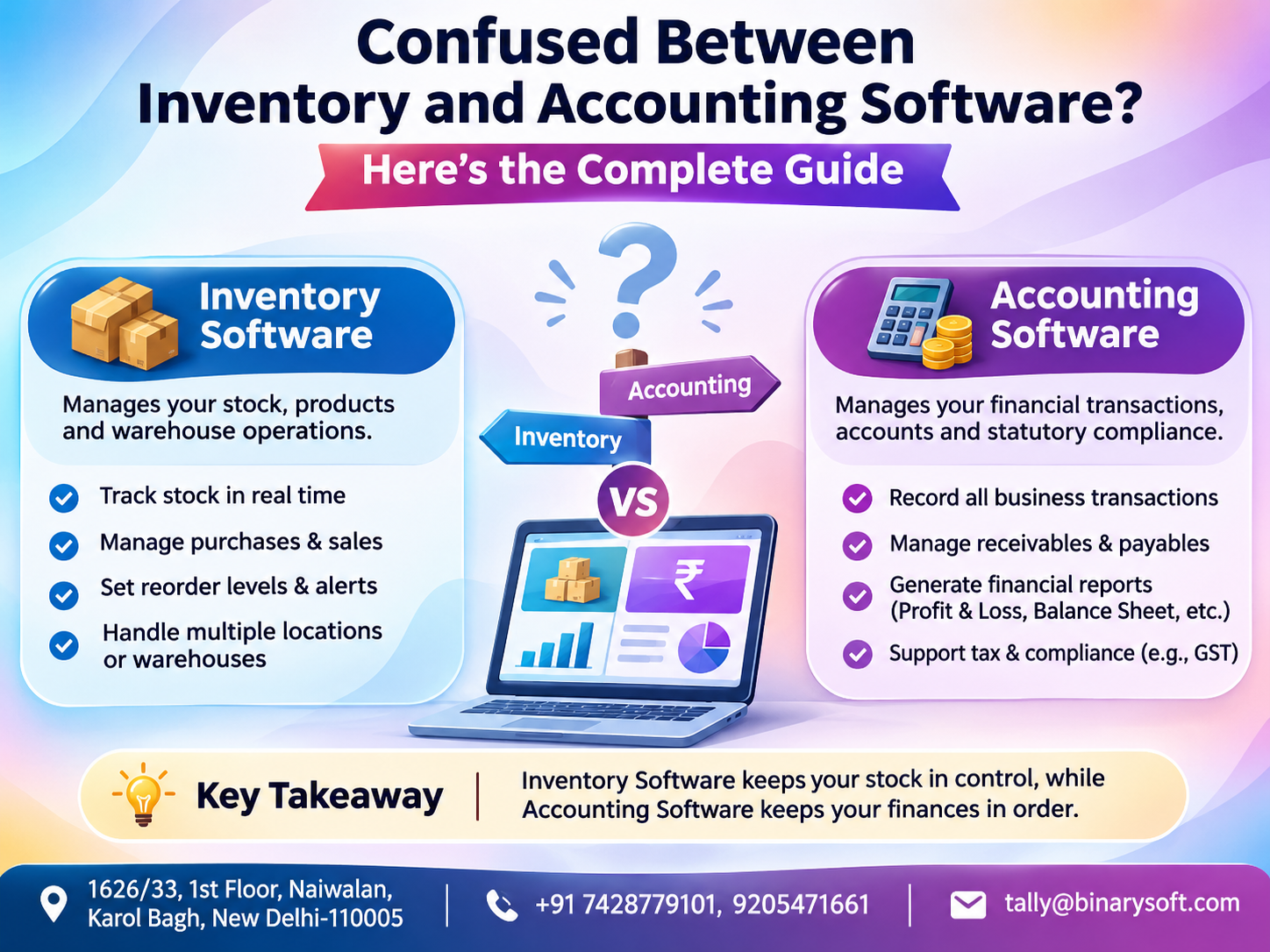
Inventory and accounting are closely related.
When a business records purchases and sales, the transactions may affect both financial accounts and stock information.
Tally Prime supports accounting and inventory integration through appropriate voucher configuration.
Businesses can maintain relevant GST details and prepare applicable tax invoices.
Example
A wholesaler sells 20 units of a product.
The sales transaction records the financial value and relevant tax information.
When properly configured, the inventory information reflects the corresponding quantity movement.
Business benefit
This reduces the need to maintain completely separate records for invoicing and inventory.
However, businesses must verify GST rates, classifications and transaction details before finalizing invoices.
14. Purchase Management and Supplier Coordination
Inventory management is not limited to stock monitoring.
It also involves purchasing decisions.
Businesses can use stock information to identify replenishment needs and plan purchases.
Purchase orders, receipt-related workflows and purchase vouchers can support organized procurement.
Practical approach
Review current stock, expected demand and pending purchase orders before placing additional orders.
Compare supplier delivery times and purchasing conditions.
Record received goods accurately and investigate discrepancies.
This approach can help businesses reduce unnecessary purchases and improve supplier coordination.
15. Stock Transfers, Physical Stock and Adjustments
Businesses with multiple locations often move goods between warehouses.
Tally Prime supports inventory vouchers for relevant stock movement workflows.
A stock journal can be used for applicable stock transfers and other inventory adjustments.
Physical stock verification helps compare actual quantities with recorded balances.
Best practices
Conduct periodic stock counts.
Investigate discrepancies before making adjustments.
Document the reason for each correction.
Restrict adjustment permissions to authorized employees.
Maintain appropriate supporting records.
These controls help improve accountability and inventory reliability.
16. Common Inventory Management Mistakes to Avoid
Even good software cannot compensate for inconsistent business processes.
Common mistakes include creating duplicate stock items, using incorrect units of measurement, failing to record transfers and entering inaccurate opening balances.
Other problems arise when businesses neglect physical verification or ignore negative stock balances.
To reduce these risks, establish standardized item naming rules and train employees thoroughly.
Review unusual transactions regularly and maintain appropriate data backups.
17. Tally Prime Inventory Management for Different Industries
Retail businesses
Retailers can use inventory records to monitor products, sales quantities and replenishment needs.
Wholesale distributors
Wholesalers can organize large product catalogs and maintain stock information across locations.
Manufacturers
Manufacturers can use suitable inventory and production-related features for raw materials, finished goods and stock movements.
Pharmaceutical distributors
Batch and expiry-related information can support organized inventory records.
Automobile parts dealers
Stock groups and item masters can help organize extensive spare-parts catalogs.
Food and beverage businesses
Inventory controls can help monitor product quantities and relevant batch information.
Each industry should configure the software according to its operational and compliance requirements.
18. Inventory Management with Tally Prime Cloud
Businesses with multiple offices may require remote access to their accounting environment.
A suitable Tally Prime cloud hosting arrangement can provide access to a hosted application.
This may help authorized employees review inventory information from different locations.
However, cloud hosting is generally a separate service from the Tally Prime software license.
Businesses should evaluate network performance, user access, backups and hosting security before deployment.
Remote access does not replace proper inventory controls or physical stock verification.
19. Why Choose Binarysoft Technologies for Tally Prime Inventory Solutions?
Binarysoft Technologies, an Authorized Tally Partner in New Delhi, helps businesses evaluate Tally Prime accounting and inventory requirements.
Businesses can enquire about inventory configuration, stock master creation, godown management, batch-related workflows, reporting and employee training.
Organizations may also need assistance with existing data, software configuration and suitable hosting options.
A well-planned implementation should reflect actual business operations and avoid unnecessary complexity.
20. Conclusion: Improve Stock Control and Build a More Profitable Business
Inventory is one of the most important assets of a product-based business.
Without accurate stock information, companies may face unnecessary purchases, delayed deliveries and reduced customer confidence.
Tally Prime inventory management provides tools for organizing stock items, managing godowns, recording batch information, reviewing inventory reports and supporting replenishment decisions.
When combined with accurate accounting and GST-related workflows, these capabilities can improve operational coordination.
However, effective inventory management requires more than software.
Businesses must maintain accurate masters, record transactions promptly, verify physical stock and train employees.
The real value of inventory management is the confidence to know what is available, what needs replenishment and how stock decisions affect business performance.
For retailers, wholesalers, manufacturers and distributors in 2026, Tally Prime can provide a practical foundation for more organized inventory operations and sustainable growth.
Powered by Binarysoft Technologies
Authorized Tally Partner
Location: 1626/33, 1st Floor, Naiwalan, Karol Bagh, New Delhi – 110005, INDIA
Contact Us: +91 7428779101, 9205471661
Email: tally@binarysoft.com
Business Hours: 10:00 AM – 6:00 PM, Monday to Friday
Frequently Asked Questions
Does Tally Prime support inventory valuation?
Yes. Tally Prime provides inventory valuation and reporting features according to the configured methods and transactions.
Can Tally Prime help reduce stock shortages?
Reorder monitoring and accurate inventory reports can help businesses plan replenishment. Results depend on correct records and purchasing practices.
Can I access Tally Prime inventory reports remotely?
Remote access may be available through suitable supported configurations or separately arranged cloud hosting.
Where can I get Tally Prime inventory management assistance in Delhi?
Binarysoft Technologies, an Authorized Tally Partner in Karol Bagh, New Delhi, can assist businesses in evaluating Tally Prime inventory configuration and implementation requirements.
CA. Dhruv Bhandekar works with businesses on bookkeeping controls, GST reporting, and month-end accounting processes. His focus is on creating structured financial workflows that improve accuracy and reduce reconciliation issues.