Call CA Tally HelpDesk
+91 9205471661,
7428779101

Introduction: Why Smart Banking Is Essential for Every Growing Business
Every successful business depends on the smooth movement of money. Customers make payments, suppliers expect timely settlements, employees receive salaries, and banks process hundreds of transactions that must be recorded accurately.
However, managing these activities manually can become challenging as a business grows.
Imagine a wholesaler processing 150 customer payments every week. Some customers pay through NEFT, others through RTGS, IMPS, UPI or cheques. Meanwhile, supplier payments, bank charges and loan instalments must also be recorded.
Without an organized banking system, even a small mismatch can create confusion.
Tally Prime banking features help businesses bring banking transactions and accounting records into a more organized workflow.
From bank reconciliation and statement imports to payment recording, cheque management and cash flow reporting, Tally Prime provides tools that reduce repetitive accounting work.
For Indian MSMEs, retailers, manufacturers, distributors and service providers, these capabilities can improve financial accuracy, reduce administrative effort and support better business decisions.
1. What Is Banking Management in Tally Prime?
Banking management refers to the process of recording, organizing, verifying and monitoring financial transactions between a business and its banks.
In traditional accounting, employees often maintain separate bank registers, spreadsheets and accounting records.
This creates duplication because the same transaction may need to be entered into multiple systems.
Tally Prime helps businesses maintain banking-related accounting information within their regular bookkeeping workflow.
Important capabilities include:
-
Bank ledger management and payment or receipt vouchers.
-
Bank statement imports and transaction reconciliation.
-
Cheque printing and cheque register management.
-
Bank-related reports and outstanding transaction monitoring.
-
Cash flow and fund movement analysis.
-
Supported connected banking and payment workflows.
Some banking capabilities depend on the software release, supported bank, license, configuration and activated services.
The objective is to maintain accurate accounting records while making everyday banking operations easier to manage.
2. A Business Owner's Story: The Payment That Almost Broke His Confidence
For fifteen years, Mahesh had operated a textile distribution business in Gandhi Nagar, Delhi.
He started with a small rented shop and gradually built relationships with manufacturers, retailers and garment wholesalers.
His dream was simple: provide a stable future for his family and eventually expand into a larger warehouse.
Business was growing, but banking activities became increasingly difficult to manage.
Customers transferred payments throughout the day. Some sent screenshots, others shared transaction reference numbers, and several payments arrived without clear invoice details.
Every evening, Mahesh and his accountant spent hours matching bank transactions with customer ledgers.
One Friday, an important supplier called demanding payment for an overdue invoice.
Mahesh believed the amount had already been transferred.
After searching through bank statements, payment registers and messages, he discovered that the transaction had been recorded in the accounts but had not actually been completed through the bank.
The supplier was upset. A shipment was delayed, and Mahesh feared losing a relationship built over many years.
That evening, his daughter found him sitting quietly in the shop after closing time.
He told her, "I have spent my life building this business. I cannot allow confusion in our accounts to destroy the trust we have earned."
They decided to improve the company's banking and accounting processes.
The business began recording payments systematically, importing bank statements, reviewing unreconciled transactions and checking outstanding balances more frequently.
Gradually, the evening confusion reduced.
Mahesh could identify which payments had cleared, which required verification and which customers still had outstanding invoices.
More importantly, he regained confidence in the financial information guiding his business.
The lesson is simple: better banking management protects more than money. It protects relationships, reputation and peace of mind.
This is an illustrative story created to explain common business banking challenges.
3. Bank Reconciliation: Match Your Accounts with Bank Statements
Bank reconciliation is one of the most important accounting activities for any business.
It involves comparing transactions recorded in accounting books with transactions appearing in the bank statement.
Differences can occur because of cheque clearance delays, bank charges, interest credits, unrecorded payments or incorrect entries.
How Tally Prime helps
Tally Prime provides bank reconciliation capabilities that help accountants identify and resolve differences between bank records and accounting entries.
Businesses can review recorded transactions, update bank dates and reconcile entries against the bank statement.
For supported bank formats, statement import and automated matching can reduce manual effort.
Example
Suppose a business records a supplier payment of ₹75,000 on 10 October, but the amount is debited by the bank on 12 October.
The reconciliation process helps identify the timing difference without incorrectly treating it as an additional payment.
Regular reconciliation improves the reliability of bank balances and helps detect missing or duplicate transactions.
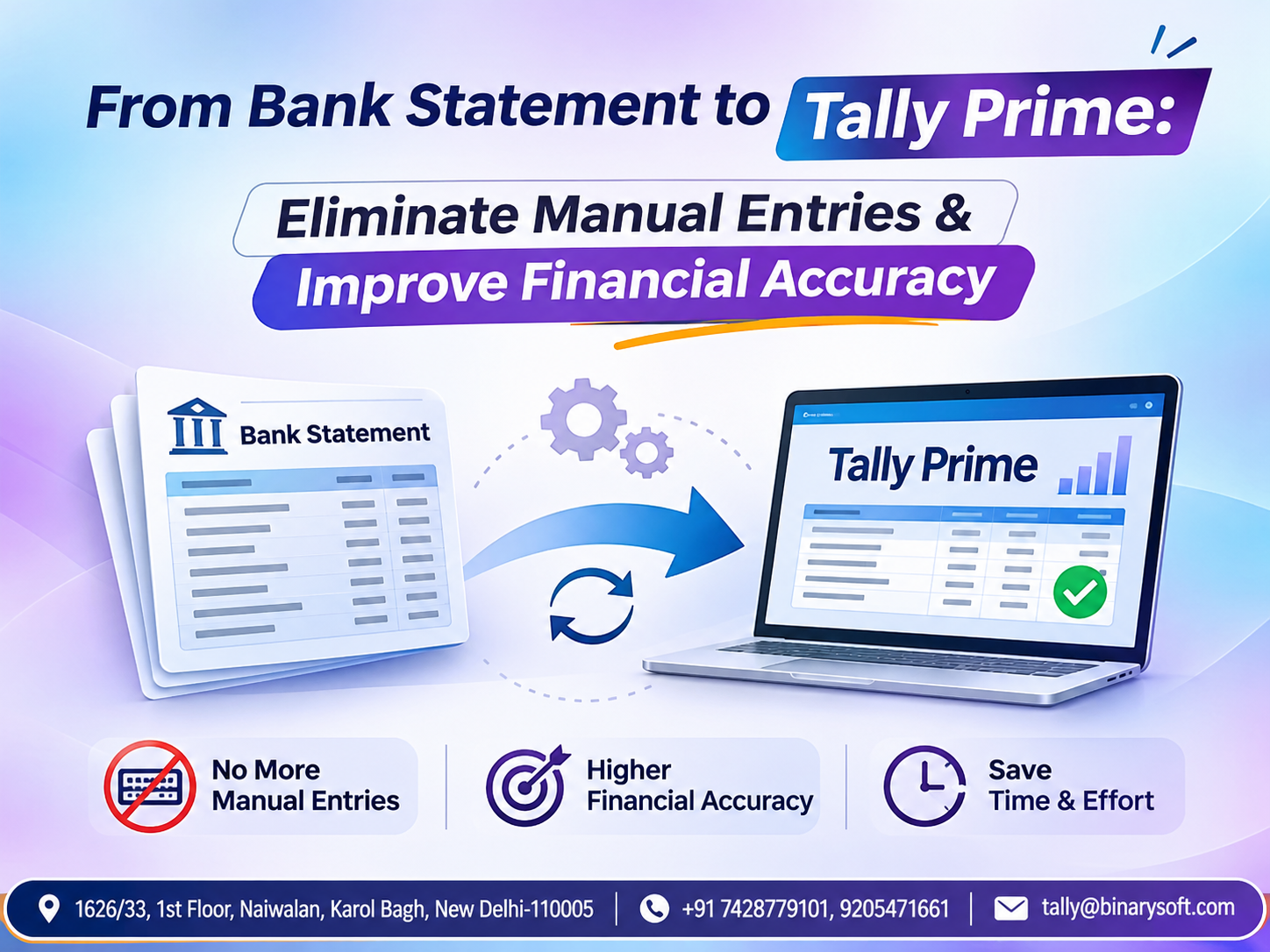
4. Bank Statement Import for Faster Accounting
Manually entering hundreds of banking transactions consumes valuable accounting time.
Tally Prime supports importing bank statements in compatible formats for supported banks and workflows.
This allows accountants to review bank transactions alongside accounting records instead of entering every detail from printed statements.
Advantages of bank statement import
Reduced manual entry: Accountants spend less time copying transaction dates, references and amounts.
Faster reconciliation: Matching transactions can be identified more efficiently.
Improved accuracy: Reduces transcription mistakes associated with repetitive data entry.
Better visibility: Businesses can identify bank charges, interest and other entries that require accounting attention.
Imported statements should still be reviewed carefully. Unsupported formats, unmatched transactions and incorrect ledger allocations may require manual intervention.
5. Digital Payments and Receipts Management
Modern businesses receive and make payments through several banking channels.
Common methods include NEFT, RTGS, IMPS, UPI, cheque and electronic bank transfers.
Tally Prime allows businesses to record these transactions using appropriate accounting vouchers.
For example, when a customer transfers ₹48,000 against an outstanding invoice, the accountant can record the receipt against the relevant customer ledger.
Similarly, supplier payments can be recorded against outstanding purchase bills.
Why this matters
Proper payment recording helps businesses maintain accurate customer balances, supplier outstanding reports and bank ledgers.
Bill-wise allocation also makes it easier to identify which invoices have been settled and which remain unpaid.
Where supported and enabled, connected banking capabilities can further simplify selected banking workflows.
However, recording a payment voucher does not automatically mean the bank has executed or cleared the payment. Businesses should verify actual transaction status.
6. Cheque Printing and Cheque Management
Although digital payments are increasingly common, many businesses continue to use cheques for supplier settlements and other transactions.
Manual cheque preparation can lead to spelling mistakes, incorrect amounts and unnecessary administrative work.
Tally Prime provides cheque-printing capabilities for supported bank cheque formats.
Businesses can configure cheque dimensions and printing arrangements according to their banking requirements.
Benefits
Cheque printing helps maintain consistent formatting, reduces handwriting errors and supports a more organized payment process.
Cheque-related records can also help accountants identify instruments that have been issued but not yet cleared.
Businesses should verify printed details before issuing cheques and maintain appropriate authorization procedures.
7. Connected Banking: Bringing Banking and Accounting Closer
Connected banking represents a more integrated approach to managing financial transactions.
Instead of treating banking and accounting as completely separate activities, supported connected services allow selected banking information and workflows to be accessed through Tally Prime.
Depending on bank compatibility, enabled services and product version, available capabilities may include access to bank-related information, transaction retrieval, reconciliation support and certain payment workflows.
Business advantages
Connected workflows can reduce switching between applications, simplify transaction verification and provide more timely financial information.
However, availability is bank-specific. Businesses should confirm whether their bank and required transactions are supported before implementing connected banking.
8. Case Study One: Delhi Electronics Wholesaler Improves Payment Tracking
Illustrative case study based on a typical Indian wholesale business.
Business background
An electronics wholesaler in Bhagirath Palace, Delhi, supplied products to more than 80 retailers.
The business received frequent payments through NEFT, IMPS and UPI while making regular supplier settlements.
The challenge
Its accountant maintained separate spreadsheets for customer payments and bank transactions.
Several receipts were recorded late because payment references were difficult to identify.
As a result, customers sometimes received reminders even after making payments.
The Tally Prime solution
The business introduced a structured process using customer ledgers, bill-wise receipts, bank statement imports and regular reconciliation.
Accountants reviewed unmatched transactions daily and updated customer allocations after verification.
Illustrative outcome
Payment tracking became more organized, customer disputes reduced and management gained clearer visibility into outstanding balances.
The business also reduced its dependence on separate manual payment registers.
The important improvement was a consistent process for verifying receipts before updating customer accounts.
9. Case Study Two: Manufacturing Company Strengthens Supplier Payment Control
Illustrative case study demonstrating the operational value of banking integration.
Business background
A packaging manufacturer in Faridabad purchased raw materials from multiple suppliers and maintained recurring payments for transport, electricity, wages and equipment maintenance.
The challenge
Management struggled to distinguish scheduled payments from cleared transactions.
Occasionally, payment vouchers were entered before bank transfers were completed, creating confusion about available funds.
The Tally Prime solution
The company standardized payment vouchers, supplier bill allocations and bank reconciliation procedures.
Bank statements were reviewed frequently, while management used cash and bank reports to understand upcoming financial requirements.
Illustrative outcome
The accounts team developed a clearer view of payment obligations and actual bank transactions.
Supplier follow-ups became easier to manage, and the business gained better information for short-term cash planning.
This example highlights why accurate reconciliation is essential even when digital payment systems are already being used.
10. How to Use Tally Prime for Banking Activities
Businesses can establish an organized banking workflow through the following process.
Step 1: Create a bank ledger
Open Tally Prime and create a ledger under the Bank Accounts group. Enter the relevant bank details required for your accounting and payment workflows.
Step 2: Record payment and receipt transactions
Use payment vouchers for outgoing transactions and receipt vouchers for incoming funds. Allocate entries against relevant bills wherever appropriate.
Step 3: Configure banking features
Review the banking configuration, including cheque printing, bank details and supported statement import options.
Step 4: Import bank statements
Download a compatible statement from the bank and import it through the relevant banking or reconciliation workflow supported by your Tally Prime release.
Step 5: Reconcile transactions
Compare accounting entries with bank statement transactions. Review unmatched entries, clearance dates, bank charges and possible duplicates.
Step 6: Review financial reports
Use bank ledgers, cash flow reports, receivables and payables reports to monitor financial activity and outstanding obligations.
Step 7: Maintain regular controls
Reconcile accounts frequently, protect banking credentials, verify payment approvals and back up accounting data.
Menu paths and options may differ depending on the installed version and available banking services.
11. How Banking Features Improve Cash Flow Management
Cash flow represents the movement of money into and out of a business.
A company may generate strong sales but still experience financial pressure when customer payments are delayed.
Tally Prime helps businesses examine cash and bank balances, outstanding receivables, supplier liabilities and relevant cash flow reports.
For example, a business expecting ₹8 lakh in customer collections but facing ₹6 lakh in upcoming supplier payments needs reliable information to plan its commitments.
Accurate accounting records help management evaluate these obligations.
However, accounting reports are only as reliable as the underlying entries. Expected receipts should not be confused with cleared bank funds.
Regular reconciliation, bill-wise tracking and cash flow reviews provide a stronger foundation for financial planning.
12. Banking Security and Internal Financial Controls
Banking efficiency should always be supported by appropriate security.
Businesses should restrict sensitive accounting permissions, use individual user credentials and establish approval procedures for significant payments.
Banking credentials, authentication codes and transaction approvals should never be shared casually.
Additional safeguards include verifying beneficiary details, reviewing unusual transactions, maintaining reliable backups and reconciling bank accounts frequently.
Tally Prime's user-access controls can support internal accounting discipline, while actual bank-side authorization remains subject to the bank's security mechanisms.
13. Why Choose Tally Prime for Business Banking Management?
Tally Prime combines accounting, banking records, inventory information and financial reporting within a unified business-management environment.
This reduces the need to maintain disconnected records and helps management understand how banking transactions affect overall financial performance.
Retailers can track daily collections. Wholesalers can reconcile customer transfers. Manufacturers can monitor supplier payments. Service providers can review client receipts and outstanding invoices.
The greatest benefit comes from maintaining accurate records and following consistent reconciliation procedures.
14. How Binarysoft Technologies Can Help
Binarysoft Technologies assists businesses with Tally Prime implementation, accounting configuration and banking-related workflows.
Support can include bank ledger setup, payment and receipt accounting, reconciliation processes, cheque-printing configuration, user permissions and relevant Tally Prime features.
Businesses can also seek guidance on improving financial reporting and maintaining more organized accounting procedures.
The objective is to help organizations spend less time resolving avoidable accounting differences and more time managing their operations.
Conclusion: Better Banking Management Creates a Stronger Business
Efficient banking management is essential for maintaining financial accuracy, controlling payments and protecting business relationships.
Tally Prime helps businesses organize banking transactions through bank reconciliation, statement imports, payment and receipt accounting, cheque management and financial reporting.
These capabilities can reduce repetitive work, improve transaction visibility and support better cash flow decisions.
For Indian MSMEs and growing enterprises, the real advantage is not simply faster accounting. It is having dependable financial information when important business decisions must be made.
Powered by Binarysoft Technologies
Authorized Tally Partner
Location: 1626/33, 1st Floor, Naiwalan, Karol Bagh, New Delhi – 110005, INDIA
Contact us: +91 7428779101, 9205471661
Email: tally@binarysoft.com
Business Hours: 10:00 AM – 6:00 PM, Monday to Friday
Frequently Asked Questions
Can I track customer payments in Tally Prime?
Yes. Receipt vouchers, customer ledgers and bill-wise allocation help businesses monitor received and outstanding payments.
What are the banking features available in Tally Prime?
Tally Prime provides bank reconciliation, bank statement imports, payment and receipt accounting, cheque printing, banking reports and supported connected banking capabilities.
Is connected banking available for every bank?
No. Availability depends on supported banks, activated services, software versions and the relevant banking fu
How can Binarysoft Technologies help with Tally Prime banking?
Binarysoft Technologies can assist with Tally Prime setup, bank ledger configuration, reconciliation workflows, payment accounting and related support.
CA. Lakshit Chordia works with MSMEs on accounting automation, tax compliance, and financial reporting. His approach focuses on practical solutions that improve accounting accuracy and provide business owners with clearer financial information.