Call CA Tally HelpDesk
+91 9205471661,
7428779101
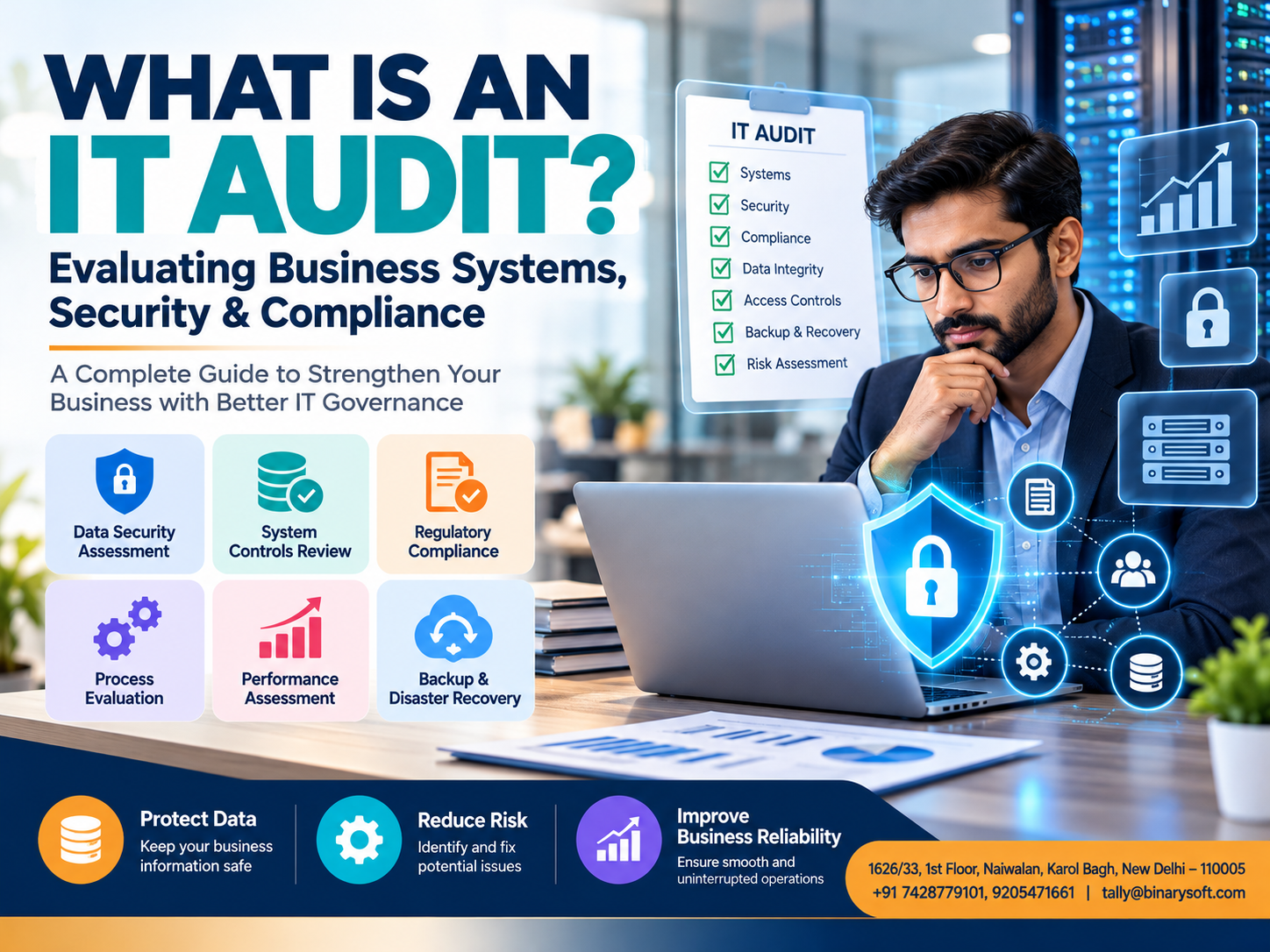
Introduction: Why IT Audits Are Essential for Modern Businesses
Technology has become the foundation of modern business operations. From accounting and inventory management to customer information, online transactions and financial reporting, organizations depend heavily on digital systems.
However, increasing dependence on technology also introduces risks.
Unauthorized access, data loss, incorrect financial records, software vulnerabilities and inadequate backup procedures can disrupt business operations and create significant financial consequences.
This is where an Information Technology Audit (IT Audit) becomes important.
An IT audit is a systematic examination of an organization's technology infrastructure, information systems, security controls and operational procedures.
Its purpose is to evaluate whether business systems operate securely, efficiently and reliably while supporting organizational objectives.
For businesses using accounting software such as Tally Prime, IT auditing can help assess the reliability of financial information, user access permissions, data protection practices and backup arrangements.
A properly conducted IT audit does more than identify technical weaknesses. It helps organizations protect business information, improve operational efficiency and establish stronger internal controls.
This comprehensive guide explains the meaning, objectives, types, procedures and benefits of IT auditing, along with practical examples of how businesses can strengthen their technology environment.
A Business Story: The Morning a Small Business Almost Lost Everything
For twelve years, Amit had operated a successful automobile spare parts distribution company in Delhi.
His business started with a small warehouse and gradually expanded into a distribution network serving workshops and retailers.
Every customer transaction, supplier payment, inventory movement and financial record was maintained digitally.
Amit believed his business information was secure because his accounting software was protected by a password.
One Monday morning, his accountant arrived at the office and discovered that the main computer was not functioning properly.
Several important files were inaccessible.
The company had not tested its backup process for months.
Customer balances, outstanding supplier invoices and inventory records were suddenly difficult to retrieve.
Amit felt helpless.
He had spent years building his business, but a single technology failure threatened to interrupt daily operations.
His employees could not confidently confirm outstanding customer balances, and urgent orders were delayed.
Fortunately, the company recovered much of its information from an older backup, although several recent transactions required manual reconstruction.
The incident changed Amit's understanding of business security.
He realized that protecting business information required more than installing accounting software.
After consulting technology professionals, his company introduced periodic IT audits, controlled user access, scheduled backups and recovery testing.
The business also reviewed its accounting data security procedures and implemented stronger operational controls.
Amit eventually regained confidence in his systems.
More importantly, he understood that technology security was not simply an IT department responsibility. It was essential for protecting the future of his business.
The lesson: businesses spend years building trust and financial stability, but weak technology controls can put both at risk.
This is an illustrative story based on common business technology challenges.
What Is an IT Audit?
An IT audit, also known as an Information Technology Audit or Information Systems Audit, is a structured assessment of an organization's information technology environment.
It examines whether technology systems adequately protect business information, support reliable operations and comply with relevant policies and requirements.
An IT audit may evaluate:
-
Computer hardware and software
-
Business applications and accounting systems
-
User access permissions
-
Cybersecurity controls
-
Data backup and recovery procedures
-
Network infrastructure
-
Financial information processing
-
IT policies and documentation
-
Business continuity arrangements
-
Regulatory and contractual compliance
For example, a manufacturing company using computerized inventory and accounting systems may conduct an IT audit to determine whether employees have appropriate access permissions and whether financial data can be recovered after a system failure.
An IT audit helps management identify weaknesses before they result in operational disruption or financial losses.
What Are the Main Objectives of an IT Audit?
The primary objective of an IT audit is to determine whether technology systems support business operations securely and effectively.
1. Protect Business Information
An IT audit examines whether sensitive financial, customer and operational information is protected against unauthorized access, modification or loss.
2. Evaluate System Reliability
Auditors assess whether important business applications operate consistently and produce reliable information.
3. Identify Security Weaknesses
IT audits help identify inadequate passwords, excessive user privileges, outdated software and other potential security vulnerabilities.
4. Support Regulatory Compliance
Businesses may need to comply with applicable data protection, financial reporting and industry-specific requirements.
An IT audit evaluates relevant controls and highlights areas requiring improvement.
5. Improve Operational Efficiency
Auditors examine whether technology systems support business processes effectively or create unnecessary delays and manual work.
6. Strengthen Business Continuity
An IT audit reviews backup arrangements, disaster recovery procedures and the organization's ability to resume operations after disruption.
Different Types of IT Audits
Organizations may conduct different types of IT audits depending on their technology environment and business requirements.
1. Information Security Audit
An information security audit evaluates controls designed to protect business information.
It may examine password policies, access permissions, security updates, encryption, endpoint protection and incident response procedures.
The objective is to identify security weaknesses and recommend improvements.
2. IT Compliance Audit
A compliance audit examines whether technology practices meet applicable legal, regulatory, contractual and internal policy requirements.
The specific requirements depend on the organization's location, industry and business activities.
3. IT Infrastructure Audit
This audit evaluates servers, computers, networking equipment, operating systems and supporting infrastructure.
It helps identify reliability, maintenance, configuration and availability concerns.
4. Application Systems Audit
An application audit examines software used for accounting, inventory, payroll, sales or other business functions.
It focuses on access controls, transaction processing, data accuracy and application reliability.
5. Data Management Audit
A data management audit reviews how business information is collected, stored, processed, retained and protected.
It may assess data integrity, retention policies, backups and recovery arrangements.
6. Business Continuity and Disaster Recovery Audit
This audit evaluates whether an organization can restore critical operations following hardware failures, cyber incidents or other disruptions.
Auditors review recovery plans, backup schedules and recovery testing evidence.
IT Audit Process: Step-by-Step Guide
A systematic IT audit follows a structured process to identify risks, evaluate controls and recommend improvements.
Step 1: Define the Audit Objectives and Scope
The first step involves identifying which systems and business processes require evaluation.
The audit scope may include accounting software, databases, servers, networks, user accounts and backup systems.
For example, a trading company may prioritize financial data security, supplier transactions and inventory records.
Clearly defined objectives help auditors focus on the most important business risks.
Step 2: Identify Technology Assets and Business Risks
Auditors identify important technology resources and determine how system weaknesses could affect business operations.
Common risks include unauthorized access, data corruption, ransomware, accidental deletion and inadequate backup arrangements.
Risk assessment helps prioritize areas requiring detailed examination.
Step 3: Review IT Policies and Internal Controls
The audit team examines existing technology policies and procedures.
These may include password requirements, employee access rules, backup policies, software update procedures and incident response plans.
Auditors assess whether controls are appropriately designed and consistently followed.
Step 4: Evaluate User Access and Authorization
Access control is one of the most important areas of IT auditing.
Auditors determine whether employees can access only the information and functions necessary for their responsibilities.
For example, an inventory employee may require permission to record stock transactions but should not automatically receive unrestricted access to financial administration settings.
Excessive permissions increase the risk of unauthorized changes and accidental errors.
Step 5: Examine Data Security and Backup Procedures
Auditors review how business information is protected and whether backup arrangements are reliable.
Important questions include:
-
Are backups performed regularly?
-
Are backup copies protected from unauthorized access?
-
Are copies maintained separately from the primary system?
-
Can important information be restored successfully?
-
Are recovery procedures documented and tested?
Backup testing is particularly important because an untested backup may fail when it is needed most.
Step 6: Test Business Applications and Transactions
Auditors evaluate whether business applications process information accurately and consistently.
For accounting systems, this may include reviewing transaction entries, user permissions, financial reports and supporting documents.
The objective is to identify weaknesses that could affect information integrity.
Step 7: Document Audit Findings
After evaluating the systems, auditors prepare a report describing identified risks and control weaknesses.
Findings may be classified according to severity, business impact and likelihood.
The report should explain the issue, supporting evidence, potential consequences and recommended corrective actions.
Step 8: Implement Improvements and Conduct Follow-Up Reviews
Management reviews the audit findings and assigns responsibility for corrective actions.
Improvements may include stronger access controls, updated security procedures, improved backups and additional employee training.
Follow-up reviews help determine whether identified weaknesses have been addressed.
Why IT Auditing Is Important for Business Growth
IT auditing supports business growth by improving the reliability of the systems used to manage operations.
Improved Data Security
Regular audits help organizations identify weaknesses in data protection arrangements.
Better Financial Accuracy
Reviewing accounting systems and transaction controls can reduce the risk of incorrect or unauthorized financial entries.
Reduced Operational Disruption
Backup reviews and business continuity planning help organizations prepare for unexpected technology failures.
Stronger Management Confidence
Reliable information systems help business owners make decisions using accurate and timely information.
Improved Customer and Supplier Trust
Organizations that protect information and maintain dependable systems are better positioned to sustain business relationships.
Better Use of Technology Investments
IT audits can identify inefficient systems, unnecessary access privileges and outdated operational practices.
Common IT Audit Risks and Challenges
Businesses frequently encounter technology weaknesses that remain unnoticed until an incident occurs.
Weak Password Practices: Shared accounts and predictable passwords can increase unauthorized access risks.
Unrestricted User Permissions: Employees may have access to functions unrelated to their responsibilities.
Inadequate Backups: Missing or incomplete backups can make recovery difficult.
Outdated Software: Unsupported or unpatched applications may contain known security vulnerabilities.
Insufficient Documentation: Poor documentation makes it difficult to investigate incidents and maintain consistent procedures.
Lack of Employee Awareness: Employees may unintentionally expose systems through unsafe downloads, phishing messages or careless information handling.
Poor Change Management: Uncontrolled software configuration changes may affect application stability and data integrity.
Regular IT audits help organizations identify these weaknesses and establish appropriate corrective measures.
How Tally Prime Can Support IT Audit Readiness
Accounting systems contain valuable financial information, making them an important component of many IT audits.
Tally Prime provides accounting and administrative capabilities that can support financial data integrity and internal control reviews.
However, Tally Prime is not a substitute for a comprehensive IT audit or cybersecurity assessment.
Its features should be combined with suitable organizational policies and technical security controls.
1. User Access Management
Tally Prime supports security controls that allow authorized administrators to manage user access.
Businesses can configure permissions according to employee responsibilities.
For example, an organization may restrict access to sensitive accounting functions while allowing employees to perform approved routine transactions.
This helps support segregation of duties.
2. Audit Trail and Edit Log
Supported Tally Prime configurations and editions provide Edit Log capabilities that can help businesses review changes to accounting records.
Where enabled and applicable, these records can assist auditors in examining transaction modifications.
Businesses should confirm the capabilities and configuration of their installed edition.
3. Financial Transaction Review
Tally Prime provides accounting reports and transaction details that can support financial verification.
Auditors may review ledger accounts, voucher entries, outstanding balances and financial statements.
These reports can help identify unusual transactions or inconsistencies requiring further investigation.
4. Backup and Data Recovery
Tally Prime supports data backup and restoration procedures.
Businesses should establish regular backup schedules and periodically test restoration.
Backups should be protected and stored according to the organization's data security requirements.
5. GST Accounting and Reporting
Tally Prime supports GST-related accounting and reporting functions.
Businesses can use these reports to review recorded tax transactions and investigate discrepancies.
However, regulatory compliance also depends on accurate source information, proper tax treatment and timely statutory filings.
6. Inventory and Financial Data Integration
For businesses using inventory features, Tally Prime helps connect stock transactions with accounting information.
This can support audits involving purchases, sales, inventory valuation and stock movements.
7. Remote Access Through Tally Prime on Cloud
Businesses using an appropriately configured cloud-hosting environment can access their accounting system remotely.
Cloud deployment can support collaboration between authorized accountants, business owners and auditors.
However, remote access should be protected through appropriate authentication, secure connectivity, access restrictions and backup procedures.
The security of a cloud-hosted environment depends on its overall configuration and operational management.
Case Study 1: Manufacturing Business Strengthens Financial Data Security
Business: Illustrative automobile components manufacturer
Location: Gurugram, Haryana
Challenge: Excessive employee access and inadequate backup procedures
A growing manufacturing company relied on computerized accounting and inventory systems.
Over time, several employees received broad access permissions to simplify daily operations.
Management later discovered that some employees could modify transactions outside their assigned responsibilities.
The company also maintained backups without regularly testing whether they could be restored.
IT Audit Findings
An internal IT review identified several concerns:
-
Excessive user access permissions
-
Inconsistent backup verification
-
Limited documentation of system changes
-
Inadequate periodic access reviews
Corrective Actions
The company introduced role-based access controls and reviewed employee permissions.
Its accounting team configured suitable Tally Prime security settings and strengthened transaction review procedures.
Management also introduced a documented backup schedule and periodic restoration testing.
Illustrative Results
Within six months, the company reported improved accountability for accounting transactions.
Employees had clearer access responsibilities, and management gained greater confidence in backup readiness.
The company also reduced the time required to investigate accounting discrepancies.
Key Lesson: Strong access controls and tested backups are essential for protecting business information.
This case study is illustrative and does not represent verified customer results.
Case Study 2: Retail Distributor Improves Audit Readiness and Operational Reliability
Business: Illustrative electronics distributor
Location: Jaipur, Rajasthan
Challenge: Inconsistent financial records and weak technology procedures
An electronics distribution company managed purchases, sales and inventory across several business locations.
As transaction volumes increased, management experienced difficulties reviewing accounting changes and maintaining consistent operational procedures.
The company decided to conduct an IT audit focused on its accounting environment.
Audit Findings
The review identified inconsistent user permission settings, insufficient documentation and weaknesses in routine backup monitoring.
The business also lacked a formal process for reviewing unusual financial transactions.
Corrective Actions
Management standardized accounting procedures and reviewed user permissions.
The finance team used Tally Prime reports to improve transaction verification and financial reconciliation.
The company introduced scheduled system reviews and documented backup responsibilities.
Illustrative Results
After implementing these changes, the business experienced better visibility into accounting activities.
Management could investigate discrepancies more systematically, and employees followed clearer operational procedures.
The organization also became better prepared for financial and technology-related reviews.
Key Lesson: IT audit readiness improves when accounting controls, technology procedures and employee responsibilities work together.
This case study is illustrative.
IT Audit Checklist for Small and Medium Businesses
A practical IT audit checklist helps organizations evaluate important technology controls.
| Audit Area | Important Verification |
|---|
| User Access |
Are permissions assigned according to responsibilities? |
| Password Security |
Are strong authentication practices followed? |
| Data Backup |
Are backups completed and tested regularly? |
| Accounting Software |
Are transactions recorded and reviewed correctly? |
| Software Updates |
Are supported security updates applied? |
| Network Security |
Are systems protected against unauthorized connections? |
| Financial Records |
Are accounting entries supported by documentation? |
| Data Recovery |
Can critical information be restored after failure? |
| Employee Awareness |
Are employees trained in basic cybersecurity practices? |
| Audit Documentation |
Are findings and corrective actions recorded? |
Businesses should adapt this checklist according to their size, industry, risk exposure and regulatory obligations.
Best Practices for Maintaining Strong IT Controls
A successful IT audit should lead to continuous improvements rather than a one-time review.
Organizations should establish clear responsibilities for technology security and system administration.
User access permissions should be reviewed periodically, particularly when employees change roles or leave the organization.
Critical software should be maintained with appropriate updates and security controls.
Financial transactions should be supported by documentation and reviewed according to established procedures.
Backup arrangements should include secure storage and periodic recovery testing.
Employees should receive regular training on password security, suspicious messages and safe information handling.
Management should also monitor unresolved audit findings and ensure that corrective actions are completed within appropriate timelines.
For businesses using Tally Prime, these practices can complement accounting security settings, financial reporting and data management procedures.
IT Audit vs Financial Audit: Understanding the Difference
Although IT audits and financial audits may examine some of the same systems, their objectives differ.
| Particulars | IT Audit | Financial Audit |
|---|
| Main Focus |
Technology systems and controls |
Financial statements and records |
| Primary Objective |
Evaluate security, reliability and control effectiveness |
Evaluate financial reporting |
| Areas Reviewed |
Applications, networks, access and backups |
Transactions, balances and disclosures |
| Common Risks |
Data breaches, unauthorized access and system failures |
Material financial misstatements |
| Typical Evidence |
System settings, logs and control documentation |
Accounting records and supporting documents |
| Business Benefit |
Improved technology governance |
Greater financial reporting confidence |
Both audit types can complement each other.
For example, reliable accounting information depends partly on the effectiveness of the technology systems used to process financial transactions.
The Future of IT Auditing for Indian Businesses
As organizations adopt digital accounting, cloud services and connected business applications, IT auditing is becoming increasingly important.
Businesses must evaluate not only individual software applications but also the broader environment in which information is stored and processed.
Cloud infrastructure, remote access, third-party integrations and digital payment systems introduce additional areas for review.
Automation and data analytics can help auditors examine larger volumes of transactions and identify unusual patterns.
However, automated tools do not eliminate the need for professional judgment, appropriate evidence and management accountability.
For small and medium businesses, the priority should be establishing reliable controls that match their actual technology risks.
Regular IT audits, supported by accurate accounting information and effective security procedures, can help organizations build more resilient operations.
Conclusion: Protect Your Business with Strong IT Auditing and Reliable Accounting Systems
An IT audit is an essential process for evaluating the security, reliability and effectiveness of business technology systems.
It helps organizations identify weaknesses, protect sensitive information, improve internal controls and prepare for unexpected disruptions.
From user access management and financial transaction verification to backup testing and business continuity planning, every component contributes to stronger operational resilience.
For businesses using Tally Prime, accounting security controls, financial reports, transaction review capabilities and data management features can support audit preparation.
However, effective IT auditing requires a broader approach that includes technology policies, cybersecurity measures, employee training and regular management reviews.
The true value of an IT audit is not simply finding problems. It is helping businesses prevent avoidable losses, protect years of hard work and move forward with greater confidence.
Organizations that invest in reliable systems and disciplined controls are better prepared for sustainable business growth.
Professional Tally Prime Assistance for Your Business
Improve your accounting controls, financial reporting, data management and business efficiency with professional Tally Prime assistance.
Powered by Binarysoft Technologies
Authorized Tally Partner
Location: 1626/33, 1st Floor, Naiwalan, Karol Bagh, New Delhi – 110005, INDIA
Contact Us: +91 7428779101, 9205471661
Email: tally@binarysoft.com
Business Hours: 10:00 AM – 6:00 PM, Monday to Friday
Frequently Asked Questions
How can businesses improve their IT audit readiness?
Businesses can maintain updated software, restrict user permissions, document procedures, test backups, review financial transactions and resolve identified control weaknesses.
Is cloud accounting automatically secure?
No. Cloud accounting security depends on authentication, access permissions, hosting infrastructure, backup procedures, system maintenance and other technical controls.
Can small businesses benefit from IT audits?
Yes. Small businesses also depend on digital systems and may face risks involving data loss, unauthorized access and operational disruption.
What is the difference between an IT audit and a financial audit?
An IT audit evaluates technology systems and controls, while a financial audit focuses on financial reporting and supporting accounting evidence.
CA. Yuvan Rajagopal specializes in accounting advisory, statutory compliance, and financial consulting. He writes extensively on business automation, inventory management, and accounting best practices.









