Call CA Tally HelpDesk
+91 9205471661,
7428779101
Introduction: Why Solving the Right Problem Matters More Than Finding a Quick Solution
Every business faces challenges. Sales may decline, customers may complain, employees may struggle with inefficient processes, or expenses may increase unexpectedly.
The immediate reaction is often to fix the most visible problem.
If deliveries are delayed, management may hire additional employees. If customer complaints increase, a company may introduce new support software. If profits decline, business owners may reduce expenses.
But what happens when these solutions fail to address the actual causes?
The answer often lies in understanding the difference between systems thinking and design thinking.
Systems thinking examines how different components of a business interact and influence one another. Design thinking focuses on understanding people's needs and creating practical, innovative solutions.
Both approaches are valuable, but they solve problems from different perspectives.
For businesses using Tally Prime, combining these methods with accurate accounting, inventory and financial information can support more informed decisions.
Instead of treating business challenges as isolated incidents, organizations can understand underlying relationships and develop solutions that address genuine customer and operational requirements.
1. What Is Systems Thinking?
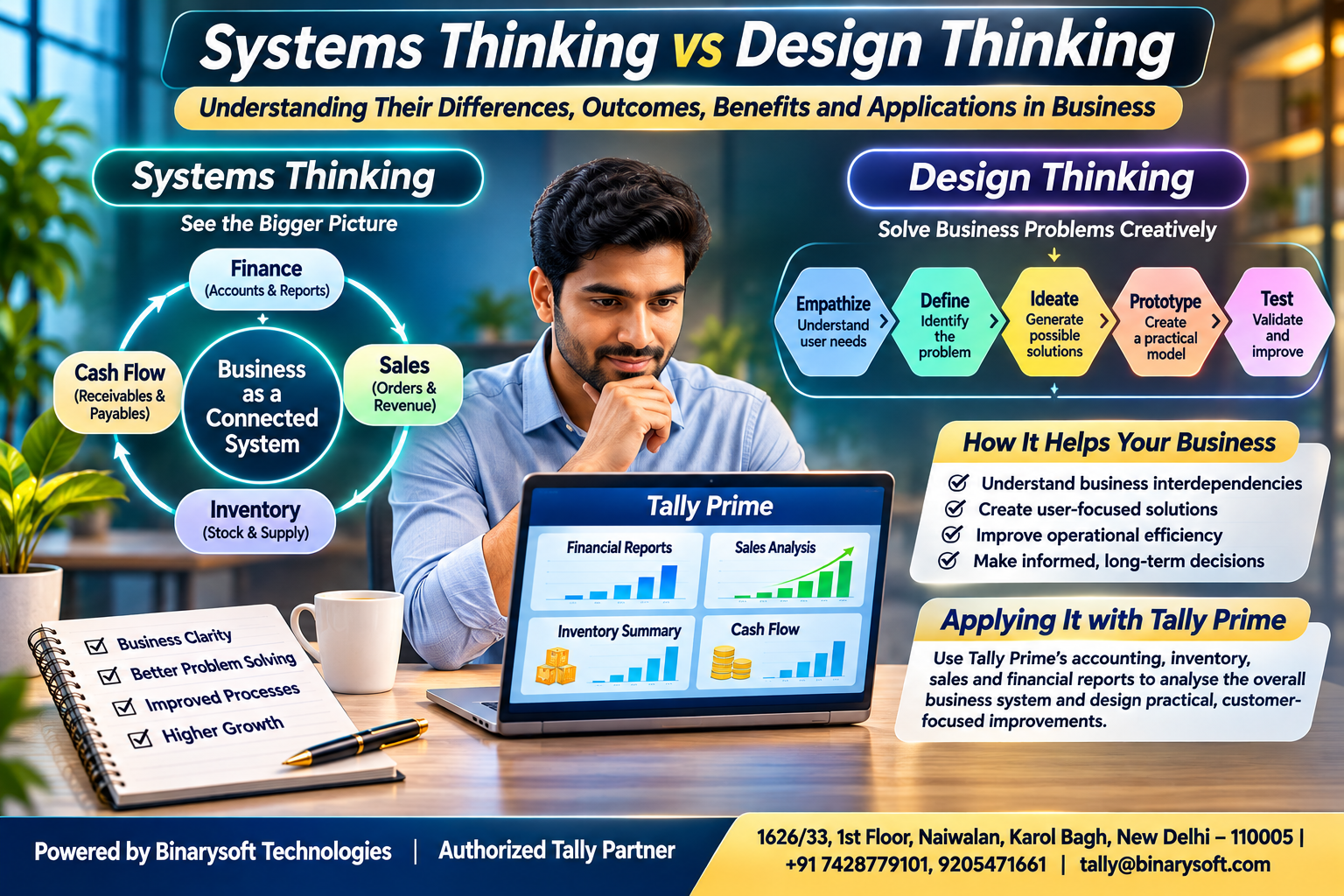
Systems thinking is a problem-solving approach that examines an organization as a collection of interconnected components.
Rather than analyzing each department or activity separately, it considers how changes in one area influence other parts of the business.
A company typically contains several connected functions, including sales, purchasing, inventory, finance, customer service and operations.
These functions rarely operate independently.
For example, increasing sales may require additional inventory. Higher inventory levels may increase working capital requirements. Greater purchasing activity may affect supplier payments and cash flow.
A decision that benefits one department can create unexpected difficulties elsewhere.
Systems thinking helps management recognize these relationships.
Key Principles of Systems Thinking
Interconnectedness: Business activities influence one another.
Feedback Loops: Outcomes can reinforce or reduce the behavior that produced them.
Cause and Effect: Problems may result from multiple interacting factors.
Long-Term Perspective: Immediate improvements should be evaluated against future consequences.
Holistic Understanding: The organization should be examined as a complete system.
Continuous Improvement: Management should monitor results and adjust decisions.
The primary objective is to understand how the overall system behaves before introducing changes.
2. What Is Design Thinking?
Design thinking is a human-centered approach to problem-solving that emphasizes understanding users, exploring possibilities and testing solutions.
It is particularly useful when organizations need to improve customer experiences, employee workflows, products or services.
Instead of beginning with assumptions about what people need, design thinking encourages direct observation and feedback.
For example, a company may believe customers want a more sophisticated billing application.
However, customer interviews might reveal that their actual concern is receiving invoices quickly and understanding payment details clearly.
Design thinking helps businesses discover these needs before investing in solutions.
Five Common Stages of Design Thinking
Empathize: Understand the experiences, expectations and difficulties of users.
Define: Clearly describe the problem that needs attention.
Ideate: Explore multiple possible solutions.
Prototype: Develop a simplified version of a proposed solution.
Test: Collect feedback and improve the solution.
These stages are flexible and iterative rather than strictly sequential.
Businesses may revisit earlier stages when new information becomes available.
3. Systems Thinking vs Design Thinking: Major Differences
Although both approaches improve problem-solving, their primary focus differs.
| Comparison Factor | Systems Thinking | Design Thinking |
|---|
| Primary Focus |
Relationships within a complete system |
Human needs and experiences |
| Main Objective |
Understand complex problems |
Develop useful solutions |
| Perspective |
Holistic and interconnected |
Human-centered and exploratory |
| Key Activities |
Mapping relationships and feedback |
Research, ideation and prototyping |
| Typical Applications |
Operations, supply chains and strategy |
Products, services and user experience |
| Problem Analysis |
Examines structural causes |
Examines user difficulties |
| Main Outcome |
Improved understanding of system behavior |
Tested solutions addressing user needs |
| Time Perspective |
Often emphasizes long-term consequences |
Often emphasizes iterative experimentation |
Neither approach is universally better.
Systems thinking helps organizations understand why problems occur, while design thinking helps them create solutions that people can use effectively.
The strongest business strategies often combine both approaches.
4. Why Systems Thinking Matters in Modern Business
Modern businesses operate within increasingly interconnected environments.
A pricing decision can influence customer demand, profitability, inventory requirements and cash flow.
Similarly, a technology upgrade may affect employee productivity, reporting procedures and customer interactions.
Systems thinking helps organizations understand these dependencies.
Better Root-Cause Analysis
Management can investigate underlying causes instead of repeatedly addressing symptoms.
Improved Resource Allocation
Understanding operational relationships helps businesses distribute resources more effectively.
Stronger Financial Planning
Companies can examine how sales, expenses, inventory and receivables influence liquidity.
Reduced Unintended Consequences
Evaluating connected processes helps identify risks before implementing changes.
Sustainable Business Improvement
Organizations can develop solutions that support long-term performance rather than temporary results.
For example, reducing inventory purchases may improve immediate cash availability but create shortages later.
Systems thinking encourages management to consider both outcomes.
5. Why Design Thinking Matters for Business Innovation
Businesses succeed when their products, services and processes address genuine customer requirements.
Design thinking supports innovation by placing human experiences at the center of problem-solving.
Improved Customer Satisfaction
Organizations can understand customer difficulties and develop more relevant solutions.
Better Employee Experiences
Internal processes can be redesigned to reduce unnecessary effort and confusion.
Faster Learning
Prototypes allow teams to evaluate ideas before making substantial investments.
Greater Collaboration
Employees from different departments can contribute perspectives during solution development.
Reduced Innovation Risk
Testing ideas with users helps identify problems before full implementation.
A business does not necessarily need expensive technology to begin design thinking.
Customer interviews, process observations and simple prototypes can provide valuable insights.
6. Understanding the Outcomes of Both Approaches
The outcomes of systems thinking and design thinking should be evaluated differently.
Outcomes of Systems Thinking
Systems thinking may produce process maps, dependency diagrams, root-cause analysis and improved operating policies.
For example, a company investigating delayed customer deliveries might discover that the actual problem involves inaccurate stock information and poorly coordinated purchasing schedules.
The resulting improvement could involve changes across multiple departments.
Outcomes of Design Thinking
Design thinking may produce customer journey maps, prototypes, redesigned workflows and improved products.
For example, employees struggling with a complicated purchase approval process may help design a simpler approval interface.
Combined Outcomes
When organizations use both approaches, they can develop solutions that address operational complexity while remaining practical for employees and customers.
This combination can improve adoption, efficiency and long-term results.
7. An Emotional Story: How a Family Business Rediscovered Its Direction
Vikram managed a family-owned garment manufacturing business in Delhi.
His father had established the company nearly three decades earlier with a few sewing machines and a determination to provide stable employment.
Over time, the business expanded.
Vikram introduced new machinery, hired additional employees and accepted larger customer orders.
Despite growing sales, financial pressure continued increasing.
Production delays frustrated customers, inventory accumulated in the warehouse, and supplier payments became difficult to manage.
Vikram believed the solution was to increase production capacity.
He considered purchasing another machine.
One evening, while reviewing pending orders, he noticed his father sitting quietly near the workshop entrance.
His father asked whether the employees were working harder because the business was growing or because its processes were becoming inefficient.
The question stayed with Vikram.
Instead of immediately purchasing equipment, he began examining how purchasing, production, inventory and customer orders were connected.
Using systems thinking, he discovered that inconsistent material availability caused production interruptions.
These interruptions created urgent purchases, higher costs and delivery delays.
He then spoke with workers and customers.
Through design thinking, he learned that employees needed clearer production schedules, while customers wanted dependable delivery updates.
The company redesigned its planning process, improved inventory reviews and introduced clearer communication procedures.
Accounting and inventory reports helped management monitor the financial impact of these changes.
Gradually, employees experienced fewer disruptions, and customer communication improved.
One evening, Vikram returned home without carrying unfinished paperwork.
His father smiled and asked whether he had finally purchased the new machine.
Vikram replied that the business had first needed a better way of working.
He realized that sustainable growth begins when businesses understand both their systems and the people who depend on them.
This fictional story illustrates how thoughtful problem-solving can protect financial stability, employee confidence and family relationships.
8. How Tally Prime Supports Systems Thinking in Business
Tally Prime provides accounting, inventory and financial reporting capabilities that can help organizations understand relationships between business activities.
Although systems thinking is a management methodology rather than a built-in Tally Prime feature, the software can provide information needed for systematic analysis.
Financial Performance Analysis
Profit & Loss reports help management understand revenue, expenses and profitability.
These figures can support investigations into changing business performance.
Cash Flow Management
Cash flow reports help organizations examine the relationship between receipts, payments and liquidity.
Inventory Management
Stock summaries and inventory reports help identify stock availability, movement and valuation.
Receivables and Payables
Outstanding reports help businesses understand how customer collections and supplier obligations influence working capital.
Cost Centre Analysis
Properly configured cost centres can help businesses examine departmental or project-related financial performance.
Sales and Purchase Reporting
Transaction reports provide information that supports analysis of purchasing patterns and revenue movements.
By examining these reports together, management can identify relationships that may not be visible when reviewing individual transactions.
9. How Tally Prime Can Support Design Thinking
Design thinking emphasizes understanding users and improving their experiences.
Tally Prime can support business process improvements by providing reliable operational and financial information.
Simplifying Billing Workflows
Businesses can observe how employees prepare invoices and identify repetitive steps.
They can then review available Tally Prime configurations or suitable customizations to simplify approved processes.
Improving Customer Communication
Outstanding receivables reports can support clearer payment follow-ups and customer account discussions.
Designing Better Inventory Procedures
Employee feedback can help identify difficulties in stock entry, item classification or transaction recording.
Improving Management Reports
Organizations can identify which financial information managers need most frequently.
Relevant reports can then be organized around practical decision-making requirements.
Supporting Customization
Where appropriate, authorized TDL customizations may help adapt certain workflows to business requirements.
All changes should be tested carefully before deployment.
Tally Prime provides the underlying business information, while design thinking guides how processes and experiences can be improved.
10. Case Study One: Systems Thinking Improves Inventory and Cash Flow
Illustrative Case Study
Business Background
A wholesale electrical goods distributor maintains accounting and inventory records in Tally Prime.
The company experiences growing sales but frequently faces cash shortages.
The Challenge
Management initially assumes that insufficient revenue is responsible for the problem.
However, sales reports indicate continued business growth.
The Systems Thinking Approach
The management team examines purchasing, inventory, customer receivables and supplier payments together.
Its analysis identifies a possible cycle:
Excess purchasing increases inventory investment.
Higher inventory investment reduces available cash.
Reduced liquidity creates pressure on supplier payments.
Delayed supplier payments can affect purchasing flexibility.
The Solution
The company introduces regular stock reviews, purchasing controls and receivables monitoring.
Tally Prime reports provide the accounting and inventory information needed to evaluate the process.
Expected Outcome
The revised approach can improve visibility into working capital and support more disciplined purchasing decisions.
Business Lesson
A financial problem may originate from interconnected operational decisions rather than a single accounting issue.
11. Case Study Two: Design Thinking Improves Billing Efficiency
Illustrative Case Study
Business Background
A service organization uses Tally Prime for invoicing and accounting.
Employees report that billing preparation takes longer than expected.
The Challenge
Management initially considers introducing additional software.
Before investing, the organization interviews employees and reviews the existing process.
The Design Thinking Approach
The team discovers that employees repeatedly verify customer information and manually coordinate billing approvals.
It maps the user journey and identifies unnecessary steps.
The Solution
The organization standardizes customer master information, reviews billing procedures and evaluates suitable workflow improvements.
Where necessary, authorized customization options are considered.
Expected Outcome
The redesigned process may reduce repetitive work, improve consistency and simplify employee training.
Business Lesson
Understanding employee difficulties before introducing technology can produce more practical and cost-effective solutions.
12. Combining Systems Thinking and Design Thinking: A Practical Framework
Businesses can use both approaches through a structured improvement process.
Step 1: Identify the Business Challenge
Clearly describe the issue using available operational and financial information.
Step 2: Understand the Complete System
Examine departments, workflows, dependencies and feedback relationships.
Step 3: Identify Root Causes
Investigate why the problem occurs rather than focusing only on visible symptoms.
Step 4: Understand Human Needs
Speak with customers, employees and other stakeholders affected by the issue.
Step 5: Generate Possible Solutions
Explore multiple approaches instead of immediately selecting the first idea.
Step 6: Develop a Prototype
Test a limited version of the proposed improvement.
Step 7: Measure Business Impact
Review relevant performance indicators before and after implementation.
Step 8: Refine and Expand
Use feedback and verified results to improve the solution.
This framework helps organizations connect strategic analysis with practical innovation.
13. Common Mistakes Businesses Should Avoid
Treating Symptoms Instead of Causes
Quick fixes may fail when underlying system relationships remain unchanged.
Ignoring Employee Feedback
Solutions developed without user involvement may be difficult to adopt.
Making Decisions Without Reliable Data
Incorrect accounting or operational information can lead to poor conclusions.
Overcomplicating Solutions
Businesses should avoid introducing unnecessary technology when simpler process improvements are sufficient.
Focusing Only on Short-Term Results
Immediate cost reductions may create longer-term operational difficulties.
Failing to Measure Outcomes
Organizations should establish clear performance indicators before implementing changes.
Avoiding these mistakes helps improve the effectiveness of both thinking approaches.
14. The Future of Systems Thinking and Design Thinking
As businesses become increasingly digital, the importance of understanding interconnected processes will continue growing.
Artificial intelligence, advanced analytics and automation may help organizations identify patterns and evaluate alternative solutions.
Systems thinking can guide how these technologies fit into existing business operations.
Design thinking can help ensure that new solutions remain useful, understandable and accessible to employees and customers.
For organizations using Tally Prime, financial and inventory information can provide a foundation for evaluating operational improvements.
Additional analytical tools may help visualize trends and examine more complex relationships.
However, technology alone cannot guarantee better decisions.
Successful transformation requires accurate information, thoughtful planning, employee participation and continuous evaluation.
Conclusion
Systems thinking and design thinking provide complementary approaches to business problem-solving.
Systems thinking helps organizations understand interconnected processes, identify underlying causes and evaluate long-term consequences.
Design thinking focuses on human needs, practical innovation and continuous improvement through feedback.
When combined, these approaches help businesses develop solutions that are operationally effective and valuable to the people who use them.
For businesses using Tally Prime, accounting, inventory and financial reports can support analysis of business performance and operational relationships.
The most sustainable improvements occur when organizations combine reliable information with thoughtful management decisions.
Successful businesses do not simply solve problems faster. They understand problems more deeply and create solutions that continue delivering value.
Powered by Binarysoft Technologies
Authorized Tally Partner
Binarysoft Technologies supports organizations with Tally Prime implementation, accounting software solutions, customization, technical assistance and cloud-based accounting requirements.
We help businesses improve accounting efficiency, strengthen financial visibility and develop more reliable operational processes.
Location:
1626/33, 1st Floor, Naiwalan, Karol Bagh, New Delhi – 110005, INDIA
Contact Us:
+91 7428779101, 9205471661
Email:
tally@binarysoft.com
Business Hours:
10:00 AM – 6:00 PM, Monday to Friday
Frequently Asked Questions
How does design thinking improve customer experience?
It encourages businesses to understand customer difficulties and test solutions based on actual feedback.
Can Tally Prime support systems thinking?
Yes. Its accounting, inventory and financial reports provide information that can support analysis of interconnected business processes.
Can design thinking improve Tally Prime workflows?
Yes. Businesses can use employee feedback and process analysis to identify opportunities for improving billing, reporting and accounting procedures.
Is systems thinking suitable for small businesses?
Yes. Small businesses can use systems thinking to understand relationships between sales, expenses, inventory, customer payments and cash flow.
What is the biggest benefit of combining both approaches?
The main benefit is developing solutions that address underlying business problems while meeting the practical needs of customers and employees.
CA. Aaryan Kanodia focuses on GST reporting, bookkeeping systems, and financial process improvement. He works with businesses to simplify routine accounting activities and maintain records suitable for compliance and internal review.