Call CA Tally HelpDesk
+91 9205471661,
7428779101
Introduction: Why Modern Businesses Cannot Afford to Wait
Imagine running a growing business where hundreds of transactions take place every day.
Your sales department generates invoices, the purchasing team records supplier bills, warehouse employees update inventory information, and accountants prepare financial reports.
All these activities are important, and many need to happen during the same working hours.
Now imagine a computer system that can handle only one task at a time.
Every department would have to wait for another operation to finish.
Invoices could be delayed, financial reports might take longer, and employees could lose valuable working hours.
Modern computing systems address this challenge through a concept known as concurrent computing.
Concurrent computing allows multiple computational tasks to make progress during overlapping periods.
Instead of requiring every operation to finish before another begins, the system coordinates different activities to improve responsiveness and resource utilisation.
This approach has become essential for business applications, operating systems, banking platforms, online services and enterprise software.
For organisations using Tally Prime, understanding concurrent computing can also provide useful insights into multi-user operations, accounting workflows, system performance and digital infrastructure.
1. What Is Concurrent Computing?
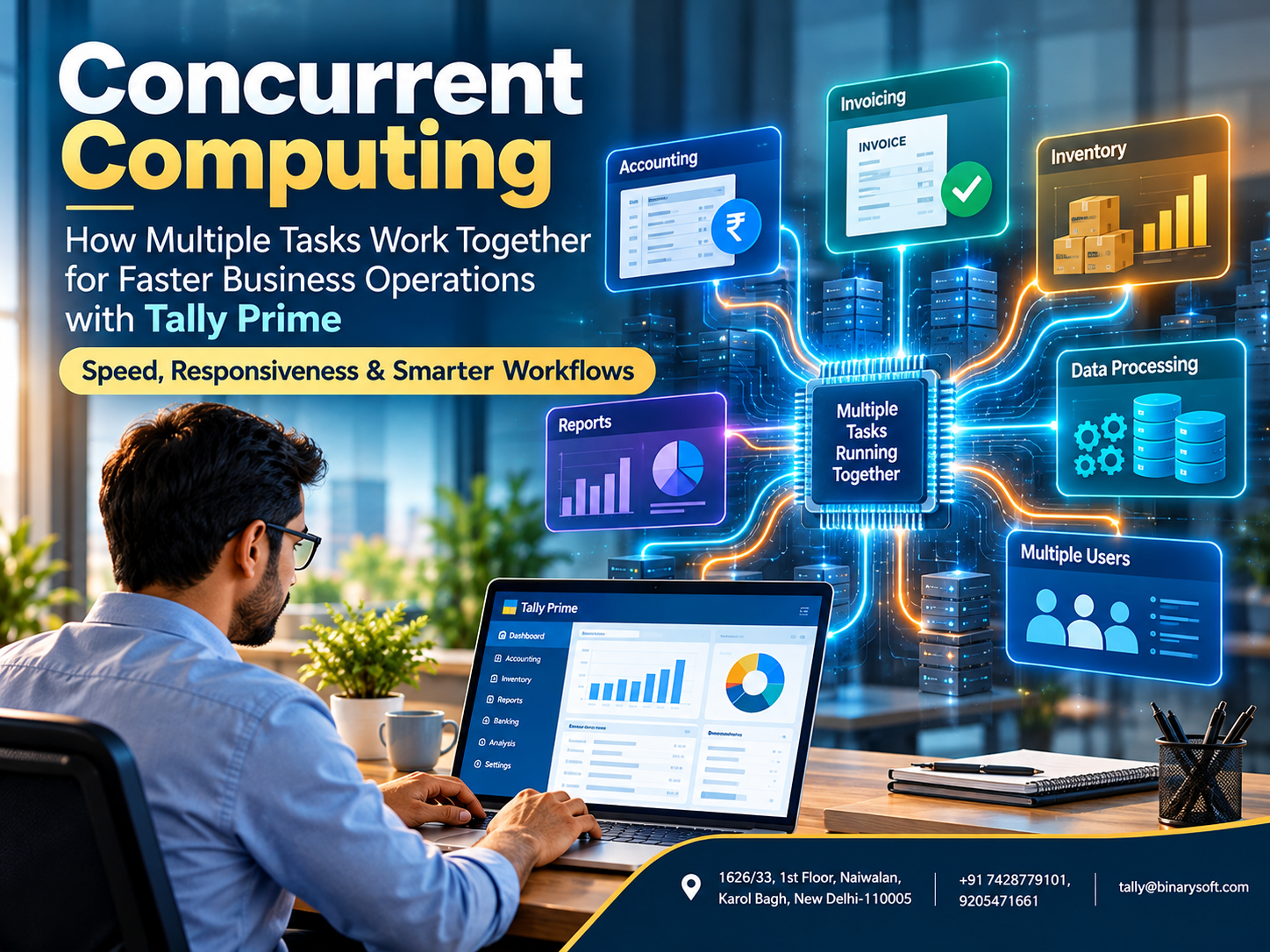
Concurrent computing is a computing approach in which multiple tasks or processes make progress within overlapping time periods.
These tasks may execute simultaneously on different processor cores or take turns using shared computing resources.
The objective is to coordinate activities efficiently while maintaining accurate results.
Consider a business application performing three operations:
-
Processing customer invoices.
-
Updating inventory information.
-
Generating financial reports.
In a strictly sequential system, each operation must finish before the next begins.
In a concurrent system, the application can coordinate these activities so that progress on one task does not necessarily prevent progress on another.
For example, while one task waits for information from a database, another task may continue processing.
This improves overall responsiveness.
However, concurrency does not automatically mean that every task runs at exactly the same moment.
That distinction is important when comparing concurrent computing with parallel computing.
2. An Emotional Story: The Day a Business Almost Lost Its Biggest Customer
Amit operated a wholesale electronics distribution business in Delhi.
After spending fifteen years building relationships with retailers, he had finally secured a major institutional customer.
The order was worth several lakh rupees.
For Amit, it represented more than revenue.
It was an opportunity to expand his business and provide greater financial security for his family.
On the day the customer expected dispatch confirmation, his office was unusually busy.
The sales team was preparing invoices, warehouse employees were checking inventory, and the accounts department was working on monthly reports.
The company's outdated business application struggled under the workload.
Employees repeatedly complained that screens were freezing and transactions were taking too long.
The warehouse team could not obtain updated stock information quickly enough.
Meanwhile, the customer continued calling for confirmation.
By late afternoon, Amit was worried.
He had worked for years to earn the customer's trust, but inefficient technology was putting the relationship at risk.
The customer eventually warned that the order might be transferred to another supplier.
Amit realised that business growth required more than additional employees.
His technology infrastructure also needed improvement.
Over the following weeks, he worked with technical professionals to modernise the company's systems, improve database performance and introduce better support for multiple business operations.
His team also organised its accounting workflows using Tally Prime.
Employees received appropriate access to the information required for their responsibilities.
The improvement was noticeable.
Sales, inventory and accounting teams could coordinate their work more efficiently.
Amit learned an important lesson:
When technology cannot keep pace with business growth, even strong customer relationships can become vulnerable.
This fictional illustration highlights the importance of responsive applications, efficient resource management and properly designed concurrent systems.
3. How Concurrent Computing Works
Concurrent computing relies on several technical mechanisms.
Task Scheduling
An operating system or application scheduler determines when different tasks receive computing resources.
Tasks may be paused, resumed or assigned to available processor cores.
Context Switching
A processor can switch between tasks by saving the current execution state and restoring another task's state.
This allows multiple activities to make progress even when processor resources are limited.
Multithreading
A thread is a unit of execution within a process.
Multithreaded applications can organise different operations into separate execution paths.
For example, one thread may handle user interaction while another performs background processing.
Multiprocessing
Multiprocessing uses multiple processes, potentially running on different processor cores.
It can improve isolation and enable genuinely parallel execution when sufficient hardware resources are available.
Asynchronous Processing
Asynchronous programming allows applications to continue useful work while waiting for operations such as network responses or database queries.
Synchronisation
When tasks access shared information, synchronisation mechanisms help coordinate their operations.
These mechanisms include locks, semaphores and other concurrency-control techniques.
Correct synchronisation is essential for protecting data consistency.
4. Concurrent Computing vs Parallel Computing
Concurrent computing and parallel computing are related concepts, but they are not identical.
| Feature | Concurrent Computing | Parallel Computing |
|---|
| Primary objective |
Coordinate overlapping tasks |
Execute multiple computations simultaneously |
| Execution |
Tasks may alternate or overlap |
Tasks execute at the same time |
| Hardware requirement |
Can work on a single processor core |
Requires multiple execution resources |
| Main benefit |
Responsiveness and task coordination |
Potentially faster computational execution |
| Example |
Handling several user requests |
Processing different portions of a large dataset simultaneously |
A concurrent application may also use parallel computing.
For example, a server may coordinate thousands of requests concurrently while processing selected requests in parallel across multiple processor cores.
The two approaches frequently complement one another.
5. Major Types of Concurrent Computing
Process-Based Concurrency
Different processes operate independently while sharing available system resources.
This approach can provide stronger isolation between activities.
Thread-Based Concurrency
Multiple threads operate within a process.
Threads may share memory, making communication efficient but requiring careful coordination.
Event-Driven Concurrency
Applications respond to events such as user actions, incoming requests or completed operations.
Event-driven architectures are common in web servers and interactive applications.
Asynchronous Concurrency
Tasks can continue without blocking while waiting for certain operations to complete.
This approach is particularly useful for applications involving frequent network or database communication.
Distributed Concurrency
Multiple computers or servers coordinate activities across a network.
Distributed systems may improve scalability and availability, although they introduce additional communication and consistency challenges.
6. Why Concurrent Computing Is Important for Businesses
Improved Application Responsiveness
Concurrent applications can remain responsive while handling multiple operations.
This is valuable for customer-facing systems and internal business applications.
Better Resource Utilisation
Processors, memory and network resources can be used more effectively when tasks are coordinated appropriately.
Support for Multiple Users
Concurrent systems can serve requests from several users without requiring every user to wait for all other operations to finish.
Faster Workflow Completion
Independent activities can make progress during overlapping periods, reducing unnecessary waiting.
Improved Scalability
Well-designed concurrent architectures can help applications accommodate increasing workloads.
Better Customer Experience
Responsive applications reduce delays during activities such as order placement, payment processing and customer support.
However, these benefits depend on application design, hardware capacity and workload characteristics.
Concurrency can also introduce overhead when implemented poorly.
7. Real-World Applications of Concurrent Computing
Banking and Financial Services
Banking platforms process account enquiries, payments and transaction requests from many customers.
Concurrent processing helps these systems handle overlapping requests while transaction controls protect financial accuracy.
E-Commerce Platforms
Online marketplaces coordinate product searches, shopping carts, payments and order updates.
Concurrency helps applications respond to multiple customers.
Healthcare Systems
Hospital applications may manage appointments, patient records and laboratory information during overlapping periods.
Manufacturing Operations
Manufacturing systems coordinate production monitoring, inventory updates and equipment information.
Cloud Computing
Cloud platforms use concurrency to serve applications, process requests and coordinate distributed workloads.
Accounting and Business Management
Business applications may need to support simultaneous activities involving invoicing, inventory, purchases and reporting.
Proper concurrency controls are especially important when different users access shared financial information.
8. How Tally Prime Helps Businesses Manage Multiple Accounting Operations
Tally Prime provides accounting, inventory management, invoicing, reporting and business management capabilities.
Its multi-user capabilities, available with appropriate licensing and configuration, allow authorised employees to work with shared company data.
However, multi-user accounting should not be confused with a guarantee that every internal operation executes simultaneously or that concurrency automatically improves performance.
Multi-User Accounting
Businesses using a suitable Tally Prime configuration can enable multiple authorised users to access company information.
For example, the sales department may record invoices while the accounts department works with payment information.
Inventory Management
Tally Prime helps businesses maintain stock records, track inventory movements and review stock reports.
This supports coordination between purchasing, sales and warehouse activities.
Sales and Purchase Processing
Employees can record sales and purchase transactions using structured accounting workflows.
Financial Reporting
Tally Prime provides reports such as Balance Sheet, Profit and Loss Account, Cash Flow Statement and outstanding statements.
These reports support business decisions without requiring separate manual report preparation.
User Access Management
Businesses can configure appropriate user permissions to help protect sensitive financial information.
Centralised Business Records
Maintaining organised accounting information reduces the need for departments to maintain disconnected records.
TallyPrime Server
For organisations with demanding multi-user requirements, TallyPrime Server is a separately licensed product designed to support more intensive data access and management requirements.
Businesses should evaluate compatibility, licensing, infrastructure and actual workload before choosing a deployment configuration.
9. Case Study 1: A Trading Company Improves Multi-User Accounting Efficiency
Illustrative case study
A wholesale trading company operated from three locations and employed 25 people.
Its accounting department frequently experienced delays because employees depended on disconnected spreadsheets and repeated manual updates.
The Challenge
Sales invoices, purchase records and inventory information were maintained through separate workflows.
Management struggled to obtain timely consolidated information.
The Solution
The company introduced a properly configured multi-user accounting environment using Tally Prime.
Employees received access according to their responsibilities.
The business also upgraded its network infrastructure and established consistent data-entry procedures.
Illustrative Results
During an internal evaluation, management estimated that routine reporting preparation time decreased by approximately 30%.
Employees spent less time consolidating spreadsheets.
Accounting information became easier to review across departments.
Key Learning
Efficient multi-user business operations require reliable software, appropriate infrastructure and disciplined workflows.
The improvement should not be attributed to concurrency alone.
10. Case Study 2: A Manufacturing Business Reduces Operational Delays
Illustrative case study
A manufacturing company managed raw materials, finished products and customer orders.
Its employees frequently waited for updated inventory information before confirming orders.
The Challenge
Different departments maintained information independently.
Purchase planning and sales confirmation often required repeated communication.
The Solution
The company improved its accounting and inventory processes using Tally Prime.
It established consistent stock recording procedures and provided authorised users with access to relevant business information.
Its technical team also improved workstation performance, network reliability and data-management practices.
Illustrative Results
The company estimated a 25% reduction in administrative delays associated with order verification.
Warehouse employees gained clearer visibility into recorded stock movements.
Management could review purchasing and sales information more consistently.
Key Learning
Concurrent business activity becomes more manageable when applications, employees and infrastructure operate through coordinated processes.
11. Challenges of Concurrent Computing
Although concurrent computing offers significant advantages, it also introduces technical challenges.
Race Conditions
A race condition occurs when a result depends on the timing of operations accessing shared resources.
Without proper controls, different tasks may produce inconsistent results.
Deadlocks
A deadlock occurs when tasks wait indefinitely for resources held by one another.
Data Inconsistency
Poorly coordinated updates may create conflicting or incomplete information.
Resource Contention
Multiple tasks may compete for processor time, memory, database connections or network bandwidth.
Debugging Complexity
Concurrency-related problems can be difficult to reproduce because their behaviour may depend on timing.
Security Risks
Improper access controls and unsafe shared-resource handling can expose sensitive information.
Businesses should rely on professionally designed applications and appropriate infrastructure rather than attempting unsafe modifications to accounting data.
12. Best Practices for Efficient Concurrent Business Systems
Organisations should begin by evaluating their actual workloads.
The number of employees, transaction volume and reporting requirements influence infrastructure needs.
Applications should use appropriate concurrency controls to maintain data consistency.
Businesses should also monitor system performance and identify bottlenecks.
Reliable networking is important when employees access shared company information.
Regular backups help protect business records against operational failures.
User permissions should follow employee responsibilities.
Software updates and compatibility checks should be performed through supported procedures.
For Tally Prime environments, businesses should consult qualified implementation professionals before changing server configurations, data-access methods or deployment architecture.
13. Concurrent Computing and Cloud-Based Business Operations
Cloud infrastructure can support concurrent workloads by providing computing resources, networking and centralised application access.
However, cloud hosting alone does not guarantee better concurrency or faster application performance.
Actual results depend on server capacity, application architecture, network latency and the number of active users.
For businesses considering hosted Tally Prime environments, important factors include secure remote access, appropriate licensing, reliable connectivity, backup arrangements and service availability.
A properly planned environment can help geographically distributed employees access business applications more conveniently.
Businesses should evaluate hosting arrangements carefully and verify compatibility with their accounting software.
14. The Future of Concurrent Computing
Concurrent computing will continue to influence modern application development.
Multi-core processors, distributed systems, cloud platforms and artificial intelligence workloads increasingly depend on coordinated execution.
Future business applications will require efficient handling of large numbers of requests, real-time information and complex computational tasks.
At the same time, developers must balance performance with security, reliability and data consistency.
For accounting and financial management, this means businesses should prioritise dependable systems rather than speed alone.
Accurate records, controlled access and reliable transaction processing remain essential.
Conclusion
Concurrent computing is a fundamental concept behind responsive modern software.
It enables multiple tasks to make progress during overlapping periods, improving the ability of applications to coordinate work and serve users.
Its applications extend across banking, e-commerce, manufacturing, healthcare and business management.
For organisations using Tally Prime, the practical opportunity lies in building efficient multi-user accounting workflows, maintaining reliable records and selecting infrastructure appropriate for business requirements.
Tally Prime can support organised financial operations, while suitable networking, deployment configurations and user-access controls help businesses manage growing workloads.
Successful digital transformation is not simply about completing tasks faster. It is about ensuring that people, processes and technology work together reliably as a business grows.
Powered by Binarysoft Technologies
Authorized Tally Partner
Location: 1626/33, 1st Floor, Naiwalan, Karol Bagh, New Delhi – 110005, INDIA
Contact Us: +91 7428779101, 9205471661
Email: tally@binarysoft.com
Business Hours: 10:00 AM – 6:00 PM, Monday to Friday
Binarysoft Technologies helps businesses implement Tally Prime, organise accounting operations, improve inventory management and evaluate suitable business software environments.
Frequently Asked Questions
Why is concurrent computing important for the future?
Modern digital systems increasingly need to coordinate multiple requests, users and computational activities efficiently.
How can businesses improve multi-user accounting performance?
Businesses can evaluate network reliability, hardware capacity, application configuration, user access and data-management practices.
Does cloud hosting automatically improve concurrent computing performance?
No. Performance depends on application architecture, hosting resources, network quality and workload characteristics.
Can Tally Prime improve accounting workflow efficiency?
Yes. Its accounting, invoicing, inventory and reporting features can reduce manual consolidation and help employees maintain organised business records.
CA. Ankit Vardiya works closely with traders, wholesalers, and service businesses on accounting automation, GST reporting, and audit readiness. His professional exposure to day-to-day business operations allows him to translate complex accounting concepts into practical guidance for Indian business owners.