Call CA Tally HelpDesk
+91 9205471661,
7428779101
Introduction: Why Choosing the Right AI Model Matters
Artificial intelligence is no longer limited to large technology companies. Small businesses, manufacturers, retailers, accountants and service providers are exploring AI to simplify daily operations.
From answering customer questions to analyzing financial information, AI-powered systems are changing how organizations work.
However, businesses often face an important question:
Should they use a Small Language Model (SLM) or a Large Language Model (LLM)?
Both technologies understand and generate language, but their capabilities, infrastructure requirements, operating costs and ideal applications can differ significantly.
A large language model may be suitable for complex research, advanced reasoning and conversations involving multiple subjects. A small language model may be more practical for focused tasks such as document classification, customer support or extracting information from invoices.
For organizations using Tally Prime, understanding these differences can help identify suitable AI-assisted workflows without unnecessarily increasing technology costs.
The objective is not always to select the most powerful AI model. It is to choose technology that delivers dependable results for a specific business requirement.
1. What Is a Small Language Model (SLM)?
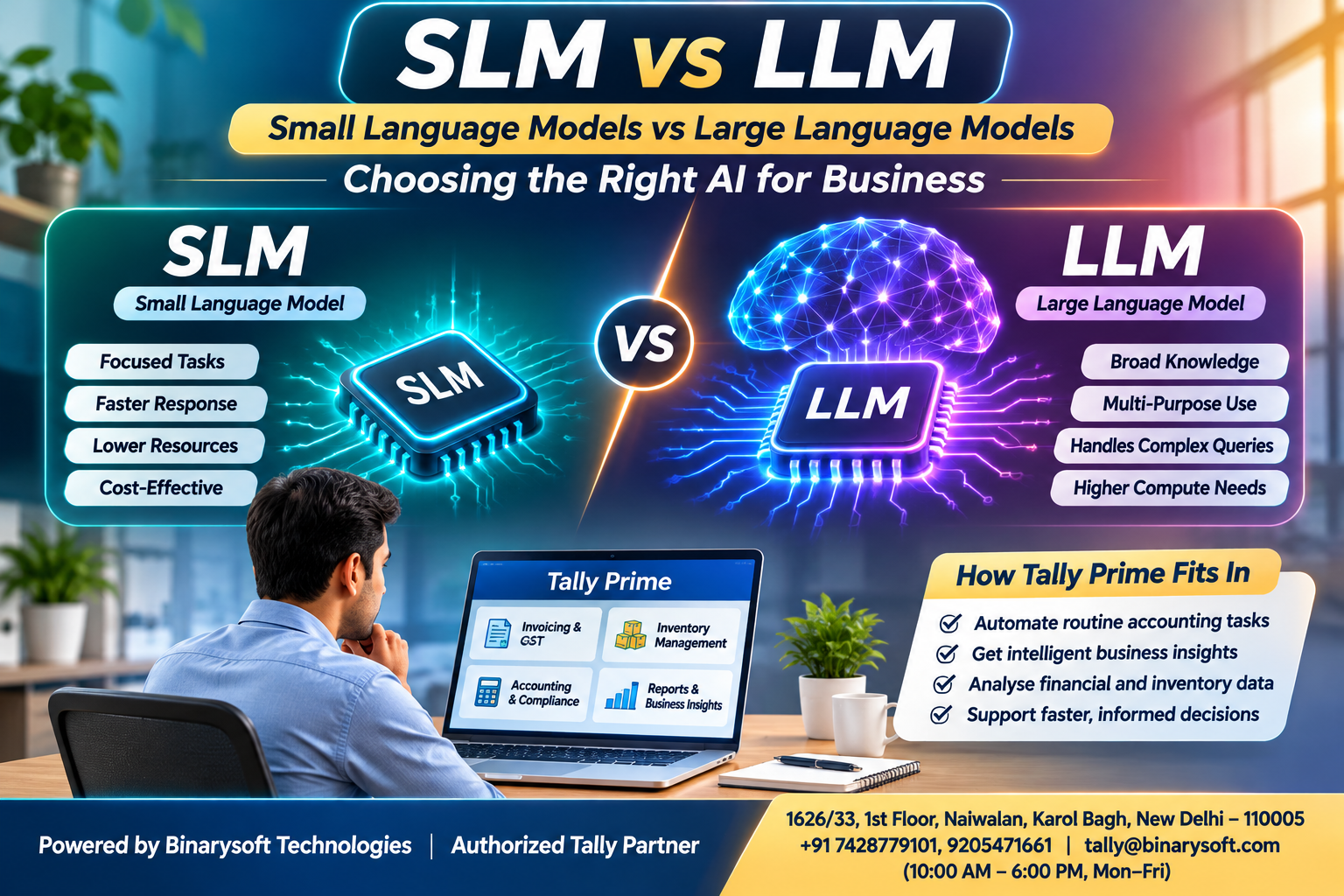
A Small Language Model is an artificial intelligence model designed to process and generate language using a relatively compact number of parameters.
Parameters are numerical values learned during training that influence how a model processes information.
Compared with many large language models, SLMs generally require fewer computational resources.
They are often developed or optimized for focused tasks, specific industries or controlled environments.
Key Characteristics of SLMs
Lower Resource Requirements: Smaller models can often operate using less memory and processing power.
Faster Responses: For suitable workloads and hardware, SLMs may deliver responses with lower latency.
Specialized Applications: They can be adapted for particular business processes or terminology.
Deployment Flexibility: Some models can operate on local servers, private infrastructure or compatible edge devices.
Potential Cost Savings: Lower infrastructure requirements can reduce operating expenses.
For example, a business may use an SLM to classify customer inquiries into billing, payment, delivery and support categories.
Such a task may not require the extensive general-purpose capabilities of a much larger model.
However, model size alone does not guarantee accuracy, speed or lower total cost.
2. What Is a Large Language Model (LLM)?
A Large Language Model is an AI system trained on substantial amounts of data to perform a broad range of language-related tasks.
LLMs can generate content, summarize documents, answer questions, assist with programming and analyze complex instructions.
Their extensive training enables them to handle diverse subjects and adapt to different contexts.
Key Characteristics of LLMs
Broad Knowledge: LLMs can assist with many subjects and business functions.
Complex Language Processing: They can interpret detailed instructions and generate comprehensive responses.
Content Generation: Businesses can use them for reports, customer communications and documentation.
Advanced Analysis: Suitable models can assist with multi-step reasoning and information synthesis.
Flexible Applications: A single model may support several departments.
These capabilities can require considerable computing resources, particularly for large-scale deployment.
Some LLM services operate through cloud-based APIs, while others support private deployment depending on licensing and infrastructure.
Importantly, LLMs can still generate incorrect information. Their outputs should be verified before being used for important financial or operational decisions.
3. SLM vs LLM: Understanding the Major Differences
Although both technologies use artificial intelligence, their practical characteristics differ.
| Comparison Factor | Small Language Model | Large Language Model |
|---|
| Model Size |
Relatively compact |
Generally larger |
| Computing Requirements |
Usually lower |
Often higher |
| Response Speed |
Potentially faster for focused tasks |
Depends on model and infrastructure |
| Operating Cost |
Often lower for suitable workloads |
Can be higher |
| General Knowledge |
Usually more limited |
Typically broader |
| Specialized Tasks |
Often well suited |
Also capable |
| Complex Reasoning |
May have limitations |
Often stronger |
| Local Deployment |
Frequently more practical |
May require substantial infrastructure |
| Business Applications |
Classification, extraction, focused assistance |
Research, analysis, content and complex assistance |
| Customization |
May be easier to adapt with limited resources |
Can require greater resources |
These differences are general tendencies rather than universal rules.
A carefully optimized LLM may outperform an SLM in efficiency for certain workloads, while a specialized SLM may outperform a larger model on a narrow task.
Therefore, organizations should evaluate models using real business requirements instead of relying only on parameter counts.
4. How Small and Large Language Models Work
Both SLMs and LLMs commonly use transformer-based neural network architectures.
These systems learn statistical relationships between words, phrases and other tokens during training.
When users submit instructions, the model processes the input and generates an appropriate sequence of output tokens.
Training and Optimization
LLMs typically receive extensive training across diverse information sources.
This supports broad language capabilities and general-purpose applications.
SLMs may use smaller architectures, carefully selected training data, knowledge distillation or task-specific fine-tuning.
Knowledge distillation involves training a smaller model to learn useful behavior from a larger model or another source of supervision.
Inference
Inference is the process of generating a response after training.
Smaller models generally require less memory, although actual performance depends on hardware, model architecture, quantization and input length.
Retrieval-Augmented Generation
Both SLMs and LLMs can be connected to approved business documents using retrieval-augmented generation, commonly called RAG.
This approach retrieves relevant information and supplies it to the model before generating an answer.
RAG can improve access to business-specific information, but it does not automatically guarantee factual accuracy.
5. Major Benefits of Small Language Models for Businesses
Small language models offer several potential advantages for organizations with clearly defined requirements.
Affordable AI Adoption
Businesses with limited technology budgets may find smaller models easier to deploy.
Faster Routine Processing
Focused applications such as ticket classification or document categorization can benefit from efficient processing.
Greater Deployment Control
Organizations may operate compatible models within controlled infrastructure.
This can support data governance when appropriate security measures are implemented.
Industry-Specific Adaptation
An SLM can be adapted to recognize terminology associated with accounting, manufacturing, retail or customer service.
Reduced Infrastructure Dependence
Certain smaller models can run without continuously sending every request to a third-party cloud service.
However, organizations must still consider maintenance, security updates, monitoring and technical support.
6. Major Benefits of Large Language Models
Large language models are particularly useful when organizations require flexibility across different tasks.
Comprehensive Content Creation
LLMs can assist with articles, product descriptions, business proposals and internal documentation.
Complex Information Analysis
They can summarize lengthy documents and help identify patterns across supplied information.
Advanced Customer Assistance
LLMs can support conversational assistants that understand varied customer questions.
Programming and Technical Support
Development teams can use LLMs to explain code, suggest improvements and prepare testing scenarios.
Business Decision Support
When connected to accurate, authorized data, LLMs can help explain reports and prepare management summaries.
Nevertheless, financial calculations and critical decisions should rely on verified records and appropriate controls.
7. An Emotional Story: A Small Business Owner's Journey Toward Smarter AI
Meera operated a family-owned textile distribution business in Delhi.
Her father had established the company with limited savings and a determination to provide dependable service.
After taking responsibility for daily operations, Meera worked hard to modernize the business.
Every morning, she reviewed customer orders, pending payments, stock availability and supplier communications.
By evening, unanswered customer messages and unfinished administrative tasks continued to accumulate.
She worried that the business her father had spent decades building might struggle to meet changing customer expectations.
One day, a customer complained about a delayed response concerning an outstanding invoice.
Meera realized that her team was spending too much time answering repetitive questions.
She consulted a technology specialist who explained the difference between small and large language models.
Instead of immediately investing in an expensive general-purpose AI system, the company considered a focused assistant for classifying inquiries and preparing draft responses.
A smaller model could help organize routine questions, while a larger model could assist with more complex correspondence and business analysis.
The team also continued using Tally Prime as its accounting system, ensuring that financial records remained under established controls.
Gradually, employees spent less time sorting repetitive messages and more time assisting customers.
One evening, Meera closed her laptop earlier than usual.
She sat with her father and described how technology was helping preserve the personal service that had made their business successful.
Her father smiled and reminded her that customers remember how a business treats them.
Meera understood that AI was not simply about replacing manual tasks.
It was about giving people more time to focus on relationships, responsibility and growth.
This fictional illustration shows why selecting appropriate technology can matter as much as adopting technology itself.
8. How SLMs and LLMs Can Complement Tally Prime
Tally Prime supports accounting, invoicing, inventory management, taxation and financial reporting.
Businesses can explore external AI applications that complement these functions through authorized data access and carefully designed integrations.
SLMs and LLMs are not automatically built into Tally Prime, and using them does not independently enable AI functionality inside the software.
Their practical value depends on the integration architecture, permissions and implementation.
AI-Assisted Invoice Classification
An SLM could classify incoming invoice documents according to supplier, transaction type or processing category.
Authorized personnel would verify extracted information before recording transactions.
Financial Report Explanation
An LLM could help explain trends in approved reports exported from Tally Prime.
For example, it might prepare a plain-language summary of changes in sales, expenses or receivables.
GST Documentation Assistance
AI could help organize GST-related documentation, identify missing fields and prepare review checklists.
Tax calculations and compliance decisions must still be validated against current legal requirements.
Inventory Management Insights
Businesses could use AI to summarize inventory reports and highlight items requiring investigation.
Stock quantities and valuation figures should remain grounded in verified accounting records.
Customer Payment Follow-Ups
An AI assistant could draft payment reminders using authorized outstanding-balance reports.
Employees should review the messages before sending them to customers.
Management Reporting
LLMs can help transform structured accounting information into understandable management commentary.
The accounting system remains the authoritative source for transaction records.
9. Case Study One: Using an SLM for Invoice Processing
Illustrative Case Study
Business Background
A wholesale distributor handles approximately 2,000 purchase invoices every month.
Its accounting team uses Tally Prime to maintain supplier accounts, purchases and inventory information.
The Challenge
Employees spend considerable time reviewing invoice documents and identifying the appropriate processing categories.
Different supplier formats increase the workload.
The Proposed Solution
The company evaluates an SLM-based document classification workflow.
An approved document-processing component extracts invoice text, while the SLM helps classify documents and identify relevant fields.
The proposed workflow includes:
-
Receiving supplier invoices through approved channels.
-
Extracting text using suitable document-processing tools.
-
Classifying invoice information with an SLM.
-
Flagging incomplete or unusual records.
-
Presenting extracted information for human verification.
-
Recording approved transactions through supported Tally Prime workflows.
Expected Benefits
The approach could reduce repetitive classification work and improve document organization.
It may also help employees concentrate on exceptions requiring professional judgment.
Business Lesson
An SLM can be a practical choice when the task is narrow, repetitive and supported by clear validation rules.
Actual savings must be measured through a controlled pilot rather than assumed.
10. Case Study Two: Using an LLM for Financial Reporting
Illustrative Case Study
Business Background
A manufacturing company operates multiple product divisions and maintains its financial records in Tally Prime.
Management regularly reviews profitability, expenses and customer receivables.
The Challenge
Preparing narrative explanations from multiple reports requires substantial manual effort.
Managers want clearer summaries without compromising financial accuracy.
The Proposed Solution
The organization evaluates an LLM-assisted reporting workflow.
Authorized financial reports are exported from Tally Prime and supplied to an approved analysis environment.
The LLM helps prepare summaries describing sales movements, expense patterns and potential areas for management attention.
Accountants verify all numerical statements against the original reports.
Expected Benefits
The proposed workflow could improve report readability, reduce drafting time and help management identify questions for further investigation.
Business Lesson
LLMs can support complex communication and analysis, but they should not replace accounting controls or professional review.
11. Choosing Between SLM and LLM for Your Organization
Selecting an appropriate AI model requires evaluating practical requirements.
Identify the Business Problem
Clearly define whether the objective involves document classification, customer communication, report analysis or another activity.
Evaluate Task Complexity
Routine classification may be suitable for an SLM.
Complex analysis involving diverse instructions may benefit from an LLM.
Consider Infrastructure
Review available servers, memory, computing capacity and deployment requirements.
Understand Data Sensitivity
Financial records, customer details and employee information require appropriate safeguards.
Compare Total Costs
Consider licensing, computing, integration, maintenance and monitoring expenses.
Test Accuracy
Evaluate models using representative business scenarios and independently verified expected results.
Plan Human Oversight
Define which activities require employee approval.
For financial operations, this is particularly important.
12. Challenges and Limitations of SLMs and LLMs
Both model categories present risks that businesses must understand.
Hallucinations: Models may generate incorrect statements that sound convincing.
Data Privacy: Sensitive information requires controlled access and suitable processing arrangements.
Model Bias: Training data and system design can influence outputs.
Integration Complexity: Connecting AI to accounting systems requires technical planning.
Maintenance: Models, prompts and supporting systems may need periodic updates.
Regulatory Requirements: Businesses must ensure their AI workflows comply with applicable obligations.
Performance Variability: Accuracy and response speed depend on model selection, infrastructure and task complexity.
A successful implementation requires ongoing evaluation rather than a one-time installation.
13. The Future of SLMs and LLMs in Business Automation
The future of enterprise AI is unlikely to depend exclusively on one model category.
Organizations may increasingly use hybrid architectures.
An SLM could handle routine classification, while an LLM processes complex questions requiring broader capabilities.
For example, an accounting support system might use a small model to identify the type of customer inquiry.
A larger model could then prepare a detailed explanation when necessary.
Deterministic software components would continue handling calculations, permissions and transaction validation.
Such an approach can balance performance, flexibility and operational costs.
For Tally Prime users, future opportunities may include more sophisticated external reporting assistants, document-processing workflows and integration monitoring.
Any implementation should prioritize accuracy, security and reliable accounting records.
Conclusion
Small Language Models and Large Language Models offer different approaches to artificial intelligence.
SLMs can be attractive for focused, resource-efficient applications, while LLMs provide broader capabilities for complex language processing and analysis.
Neither approach is automatically superior.
The correct choice depends on business requirements, infrastructure, data sensitivity, accuracy expectations and operating costs.
For organizations using Tally Prime, external AI solutions can potentially improve document processing, financial reporting and operational communication.
However, AI should complement verified accounting workflows rather than replace them.
Businesses that evaluate AI carefully can build practical automation strategies while maintaining confidence in their financial information.
Powered by Binarysoft Technologies
Authorized Tally Partner
Binarysoft Technologies supports organizations with Tally Prime implementation, accounting solutions, customization, technical assistance and cloud-based accounting requirements.
Our objective is to help businesses strengthen financial management, improve operational efficiency and adopt suitable technology solutions.
Location:
1626/33, 1st Floor, Naiwalan, Karol Bagh, New Delhi – 110005, INDIA
Contact Us:
+91 7428779101, 9205471661
Email:
tally@binarysoft.com
Business Hours:
10:00 AM – 6:00 PM, Monday to Friday
Frequently Asked Questions
Can AI models integrate with Tally Prime?
External AI applications can potentially connect through supported interfaces, approved exports or custom integrations. Appropriate authorization and technical implementation are required.
Can an SLM automatically enter invoices into Tally Prime?
An SLM alone cannot perform this function. Additional document-processing, validation and integration components would be necessary.
Are SLMs and LLMs secure for financial information?
Security depends on deployment architecture, access controls, data handling and provider arrangements. Neither category is automatically secure.
What is the future of SLMs and LLMs?
Businesses are likely to use both technologies, selecting smaller models for focused tasks and larger models for complex requirements.
CA. Shivesh Khandelwaal is a practicing Chartered Accountant experienced in accounting automation, compliance management, and audit support. He has worked with trading and distribution businesses to improve inventory visibility and financial reporting. His articles focus on real-world applicability.