Call CA Tally HelpDesk
+91 9205471661,
7428779101
Introduction: Why Speed Matters in Modern Accounting Software
Imagine managing a business that processes thousands of invoices, purchase transactions, inventory movements and customer payments every month.
Your accounting team works continuously to maintain accurate financial records.
Everything appears manageable until the end of the month, when employees need to generate GST reports, reconcile transactions and prepare financial statements.
Suddenly, processing large volumes of information becomes a challenge.
Reports must reflect the latest transactions and changes in accounting masters. At the same time, employees expect the software to respond quickly.
This creates an important technological question:
How can accounting software process enormous quantities of financial information without repeatedly examining every transaction?
The answer involves intelligent data structures, efficient indexing and optimized storage techniques.
One particularly interesting technology is RangeTree.
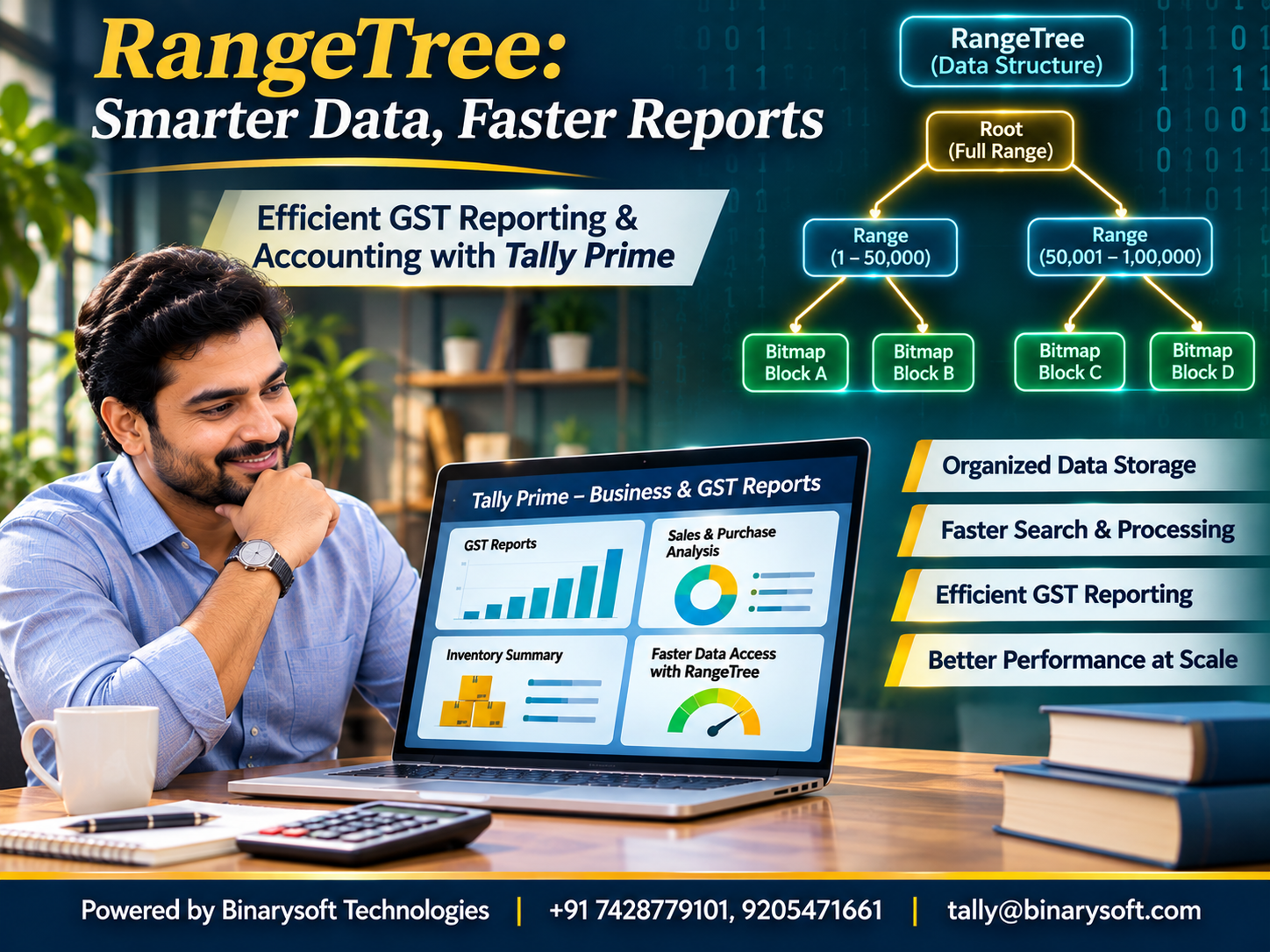
RangeTree combines hierarchical indexing with compact bitmap representations to help identify records requiring additional processing.
In accounting systems, this approach can support efficient handling of transactions affected by changes in master information.
Understanding RangeTree reveals how sophisticated software engineering can improve everyday accounting experiences.
1. What Is a RangeTree Data Structure?
A RangeTree is a hierarchical data structure designed to organize information associated with identifiers or ranges.
In the accounting use case discussed here, it helps maintain a compact representation of transaction identifiers requiring recalculation.
Instead of repeatedly scanning every transaction, the system can maintain references to affected records.
Consider a business containing 100,000 accounting vouchers.
A change to a stock item's tax classification might affect only 2,000 vouchers.
Recalculating all 100,000 transactions would create unnecessary processing.
A suitable indexing structure can help identify the relevant subset.
RangeTree addresses this challenge by organizing identifiers through a hierarchy of blocks.
The structure is particularly useful when records occupy a large possible identifier range but only selected identifiers require attention.
2. Why Accounting Databases Need Specialized Storage Structures
Accounting information differs from many ordinary digital records.
A transaction may reference several related entities, including:
These relationships create dependencies.
Changing information in one master record can influence calculations associated with multiple transactions.
For example, modifying tax-related details for a stock item may require affected GST computations to be refreshed.
A database engine must therefore manage both the original transactions and the relationships between them.
Efficient data structures help minimize unnecessary disk access while preserving accurate results.
3. Understanding Masters and Vouchers
Two fundamental concepts in accounting data management are masters and vouchers.
What Are Masters?
Masters contain reusable business information.
Examples include customer ledgers, supplier accounts, stock items and relevant tax details.
What Are Vouchers?
Vouchers record business transactions.
Examples include sales, purchases, receipts, payments and journal entries.
A voucher may reference several masters.
Consider a sales invoice involving a customer ledger and multiple stock items.
If important master information changes, calculations associated with relevant vouchers may need to be reviewed or refreshed.
This creates a dependency-management challenge.
The system must determine which transactions are affected without unnecessarily processing unrelated records.
4. The Challenge of Generating GST Reports
GST reporting requires accounting software to evaluate transactions according to applicable tax rules and recorded information.
Relevant calculations may depend on voucher details and master configurations.
One approach is to calculate all required information whenever a report is opened.
This can provide current results but may require substantial processing.
Another approach is to calculate information earlier and store the results.
This is commonly called precomputation.
Precomputation can make subsequent report generation faster because some calculations are already available.
However, stored results may become outdated when relevant master information changes.
This creates a trade-off between processing speed and data freshness.
An efficient system must identify which previously calculated results require updating.
5. What Happens When Master Information Changes?
Suppose a company maintains 50,000 vouchers.
A stock master is modified, potentially affecting 800 transactions.
A straightforward approach would be to open each affected voucher and mark it for recalculation.
However, updating hundreds of records immediately may slow down the master modification.
Another approach would be to scan every voucher later to determine whether recalculation is necessary.
That could also create unnecessary disk operations.
A better strategy is to maintain a compact list of affected voucher identifiers.
When several masters change, their affected voucher identifiers can be combined.
This avoids unnecessarily repeating work for transactions affected by multiple changes.
RangeTree provides an efficient way to represent and retrieve these identifiers.
6. Understanding Bitmap Indexing
A bitmap represents information using individual binary digits.
Each bit can have one of two values:
0 = Not marked
1 = Marked
Suppose voucher identifiers range from 1 to 8.
A simplified bitmap might contain:
00101001
The marked positions represent selected voucher identifiers.
Instead of storing a complete transaction record for each selection, the system stores compact binary information.
Because eight bits occupy one byte, bitmap representations can be memory-efficient.
However, a large identifier range creates another problem.
If identifiers can extend into billions, maintaining one complete bitmap may consume substantial storage even when only a small number of records are marked.
A hierarchical structure can address this limitation.
7. How RangeTree Uses Hierarchical Storage
RangeTree organizes identifier information using different levels of blocks.
Leaf Blocks
Leaf blocks contain the bitmap information representing selected identifiers.
In the filesystem design underlying this discussion, a block occupies 512 bytes.
After allowing approximately 12 bytes for header information, about 500 bytes remain for data.
Therefore:
500 bytes × 8 bits = 4,000 bits.
A leaf block can represent approximately 4,000 voucher identifiers.
Non-Leaf Blocks
Non-leaf blocks contain references to other blocks.
These references allow the system to navigate toward the relevant identifier range.
If each reference occupies four bytes, a 500-byte data area can hold approximately 125 references.
Root Block
The root provides the starting point for navigating the hierarchy.
The system follows the appropriate references until it reaches the required leaf block.
This avoids examining unrelated sections of the structure.
The important advantage is targeted access.
8. Why Sparse Storage Matters
A complete bitmap covering a 32-bit identifier space would require approximately 512 MiB of storage.
However, a business may use only a small portion of the possible identifier range.
Allocating the entire bitmap immediately would be inefficient.
RangeTree can create blocks only when they are needed.
This approach is known as sparse allocation.
For example, suppose marked vouchers exist only within three widely separated identifier ranges.
The structure needs to maintain the relevant paths and leaf blocks rather than allocate every possible leaf block.
This reduces unnecessary storage consumption.
It also allows the data structure to grow according to actual requirements.
9. How RangeTree Supports Faster GST Reporting
RangeTree is especially useful when previously calculated information must be refreshed after master changes.
A simplified workflow looks like this:
Step 1: A user modifies relevant master information.
Step 2: The system identifies voucher identifiers potentially affected by the change.
Step 3: Those identifiers are marked in the RangeTree structure.
Step 4: Additional master changes may mark more identifiers.
Step 5: Repeated identifiers remain represented without requiring duplicate entries.
Step 6: When updated calculations are required, the affected vouchers are identified and processed.
Step 7: Refreshed information becomes available for report generation.
This approach can reduce redundant calculations and unnecessary disk operations.
Actual performance depends on transaction volumes, storage conditions, system configuration and other software components.
RangeTree is one optimization among several that can contribute to efficient reporting.
10. An Emotional Story: The Accountant Who Wanted to Reach Home Before Dinner
For twenty years, Mahesh had worked as an accountant for a manufacturing business in Delhi.
He had witnessed the transition from handwritten registers to computerized accounting.
The company gradually expanded from a small workshop into a busy manufacturing operation.
With growth came thousands of monthly transactions.
During reporting periods, Mahesh frequently stayed late to review vouchers, verify tax details and prepare financial statements.
His daughter often called to ask when he would return home.
"Just another hour," he would reply.
But one hour frequently became three.
Mahesh believed that accuracy required endless manual effort.
Over time, the company improved its accounting processes, maintained cleaner master records and upgraded its technology environment.
The accounting team also learned to use available reporting and reconciliation capabilities more effectively.
Mahesh began understanding how modern database systems could process information intelligently rather than repeatedly examining everything.
He realized that good technology was not simply about entering transactions faster.
It was also about retrieving the right information efficiently.
The improvements did not eliminate every reporting challenge.
However, better workflows and reliable systems reduced unnecessary repetition.
One evening, Mahesh completed his review earlier than expected.
When his daughter called, he answered, "I am already on my way."
For Mahesh, the most meaningful benefit of efficient technology was not measured only in seconds.
It was measured in the time he could finally spend with his family.
This is a fictional illustrative story about accounting efficiency and work-life balance.
11. Case Study One: Manufacturing Company Improves GST Reporting Workflow
Business Background
A hypothetical manufacturing company records approximately 80,000 vouchers annually.
Its accounting records include numerous stock items with different tax-related configurations.
The Challenge
During a financial review, the company identifies master information requiring correction.
Management wants the accounting team to review affected transactions without repeatedly checking unrelated records.
Technology Perspective
Efficient dependency tracking and selective recalculation can reduce unnecessary processing.
RangeTree illustrates how a database engine can organize identifiers associated with affected vouchers.
How Tally Prime Helps
The company uses Tally Prime to maintain sales, purchases, stock masters and GST-related accounting information.
Employees review relevant reports and verify the impact of corrected master details.
Illustrative Outcome
Suppose 1,500 of the company's 80,000 vouchers require attention.
The affected set represents:
1,500 ÷ 80,000 × 100 = 1.875%.
Selective processing can avoid unnecessary work on unaffected records.
This percentage does not represent a measured performance improvement.
Business Lesson
Efficient data structures and accurate master maintenance can support responsive accounting workflows.
This case study is hypothetical.
12. Case Study Two: Wholesale Distributor Manages Growing Transaction Volumes
Business Background
A hypothetical distributor operates across several locations.
The business records large numbers of invoices, receipts and inventory transactions.
The Challenge
As transaction volumes increase, management becomes concerned about report responsiveness and data maintenance.
The company wants to improve its overall accounting environment.
Improvement Strategy
The organization reviews computer performance, storage health, master data quality and operational procedures.
It also establishes regular backups and controlled access.
How Tally Prime Helps
Tally Prime supports structured transaction recording, inventory management and financial reporting.
The team uses appropriate reports to review accounting information and monitor business activity.
Illustrative Outcome
Management establishes more consistent reporting procedures and reduces avoidable manual reconciliation work.
The organization also gains a clearer understanding of the importance of software architecture and reliable infrastructure.
Business Lesson
Efficient database technology works best when combined with accurate records and disciplined business processes.
This case study is illustrative and does not claim independently measured software performance gains.
13. RangeTree Versus Traditional Record Scanning
Traditional scanning examines records sequentially.
For small datasets, this may be sufficient.
However, scanning large collections repeatedly can become expensive.
RangeTree uses hierarchical navigation to identify relevant portions of an identifier space.
This provides several potential advantages.
Reduced Unnecessary Reads: Unrelated identifier ranges may be skipped.
Compact Representation: Bitmaps store membership information efficiently.
Selective Processing: Only marked records need further attention.
On-Demand Allocation: Storage is created where required.
Efficient Duplicate Handling: A marked identifier does not need repeated entries.
Nevertheless, RangeTree is not suitable for every database problem.
Its effectiveness depends on access patterns, identifier distribution and implementation requirements.
14. How Businesses Can Improve Tally Prime Performance
Businesses do not need to modify internal data structures to benefit from efficient accounting operations.
Instead, they should focus on maintaining a dependable working environment.
Maintain Accurate Masters
Review ledgers, stock items and tax-related information before recording large transaction volumes.
Use Supported Software Versions
Keep the application appropriately updated after reviewing compatibility requirements.
Maintain Healthy Storage
Use reliable storage devices and monitor available disk space.
Protect Accounting Data
Maintain regular, verified backups.
Review Network Performance
For multi-user environments, ensure that connectivity and infrastructure are suitable for the workload.
Avoid Unnecessary Customizations
Review third-party extensions and integrations for performance and compatibility.
Use Reports Effectively
Train employees to apply appropriate filters, periods and reconciliation procedures.
These practices can improve operational efficiency without requiring access to internal database mechanisms.
15. The Relationship Between Database Design and Business Productivity
Database optimization may appear to be a purely technical subject.
However, its effects extend into everyday business operations.
Faster access to relevant information can reduce employee waiting time.
Efficient recalculation can help accounting teams work with updated results.
Well-organized records support reconciliation and financial review.
Responsive reporting can help management obtain information when decisions are required.
For small businesses, these benefits are especially important because accounting teams often have limited resources.
A few minutes saved during repeated activities can contribute to meaningful productivity improvements over time.
The broader lesson is that software architecture influences the quality of the user experience.
16. The Future of Intelligent Accounting Data Management
Accounting applications will continue to manage increasingly complex information.
Businesses expect responsive reports, dependable calculations and support for changing operational requirements.
Advanced indexing, selective processing, caching and optimized storage techniques can help software systems meet these expectations.
Future improvements may also involve better concurrency, smarter resource management and more efficient analytical processing.
However, sophisticated technology must remain dependable.
Performance improvements should not compromise accounting accuracy, transaction integrity or data protection.
For businesses using Tally Prime, the practical objective remains straightforward:
Maintain reliable records, use suitable infrastructure and ensure that financial information is available when needed.
Conclusion
RangeTree demonstrates how carefully designed data structures can address complex accounting performance challenges.
By combining hierarchical indexing, bitmap representations and on-demand storage allocation, systems can efficiently identify selected transaction records without scanning every possible identifier.
In GST-related processing, this approach can help manage vouchers affected by changes in master information and reduce redundant recalculation.
For businesses, the benefits of intelligent software architecture are reflected in more responsive workflows and better access to financial information.
Tally Prime supports everyday accounting through transaction recording, inventory management and financial reporting.
When its capabilities are combined with accurate master data, reliable infrastructure and disciplined accounting procedures, businesses can create a stronger foundation for operational efficiency.
The most valuable technology often works quietly in the background, helping people complete complex work with greater confidence and less unnecessary effort.
Powered by Binarysoft Technologies
Authorized Tally Partner
Binarysoft Technologies helps businesses implement and use Tally Prime for accounting, GST-related workflows, inventory management and financial reporting.
Organizations seeking to improve accounting processes, maintain accurate financial records and strengthen business reporting can benefit from appropriate software configuration and professional guidance.
Location:
1626/33, 1st Floor, Naiwalan, Karol Bagh, New Delhi – 110005, INDIA
Contact Us:
+91 7428779101, 9205471661
Email:
tally@binarysoft.com
Business Hours:
10:00 AM – 6:00 PM, Monday to Friday
Frequently Asked Questions
Does RangeTree automatically correct GST errors?
No. RangeTree is a data-management optimization, not a substitute for accurate tax configurations, transaction reviews or compliance checks.
How can businesses improve Tally Prime reporting performance?
Businesses should maintain accurate masters, use suitable infrastructure, keep software appropriately updated and review unnecessary customizations.
Does faster report generation guarantee accounting accuracy?
No. Performance and accuracy are different requirements. Businesses must still verify transactions, reconcile balances and review tax-related information.
How can Binarysoft Technologies help businesses using Tally Prime?
Binarysoft Technologies can assist with Tally Prime implementation, accounting workflows, inventory management and financial reporting to support efficient business operations.
CA. Tanishq Saraf works with traders and service businesses on GST compliance, ledger scrutiny, and accounting automation. His focus is on simplifying financial processes and improving the quality of business accounting records.