Call CA Tally HelpDesk
+91 9205471661,
7428779101
Introduction: Why Fast Access to Business Records Matters
Imagine running a wholesale business that processes hundreds of invoices every day.
Your accounting team regularly creates sales vouchers, records purchases, updates inventory and checks customer balances.
After several years, the business has accumulated thousands of transactions.
One afternoon, an important customer calls requesting details of an old invoice. Your accountant needs to retrieve the relevant record immediately.
How can accounting software locate a particular transaction without examining every stored record individually?
The answer involves database organization, indexing and efficient information retrieval.
Embedded indexing is a data organization technique that maintains references within stored data structures, helping software locate relevant records efficiently.
It is one of the techniques used within the proprietary data storage architecture underlying Tally accounting software.
Understanding this technology provides insight into how business applications manage growing transaction volumes.
For Tally Prime users, the practical value lies in efficient access to vouchers, masters, financial information and business reports.
This article explains embedded indexing, its benefits, important technical concepts and how businesses can maintain dependable accounting environments.
1. Understanding the Tally File System
Every accounting application needs a mechanism for storing and retrieving information.
When users create invoices, purchase entries, ledger accounts or inventory transactions, the software must preserve those records for future use.
The Tally file system refers to the proprietary storage architecture used to manage company accounting information.
It is different from the general-purpose file system provided by an operating system.
For example, Windows may use NTFS to organize files and folders.
NTFS understands where files are stored, their sizes, permissions and other file-level characteristics.
However, the operating system does not inherently understand that a particular accounting record represents a sales invoice or customer payment.
The application's database layer understands the business meaning and relationships of stored information.
This distinction is important.
The operating system manages files, while the accounting data engine manages business records within its supported storage format.
2. What Is Embedded Indexing?
Embedded indexing is a method of maintaining references to data records as part of the database's storage structure.
An index helps software identify where relevant information can be found.
Consider a large reference book.
Without an index, finding a specific topic might require checking numerous pages.
With an index, readers can identify the relevant location much more efficiently.
Database indexing follows a similar principle.
Suppose a company has recorded 50,000 vouchers.
A manager wants to examine transactions from a particular date.
Without a suitable access structure, retrieving the required information could involve examining many unrelated records.
An index provides an organized path toward relevant data.
In an embedded indexing design, indexing references are integrated with the underlying record structures rather than necessarily maintained as completely separate index files.
The objective is to support efficient retrieval while accommodating changes in stored information.
3. How Accounting Records Are Stored
Accounting information is more complex than a simple list of numbers.
A sales voucher may contain several components:
-
Voucher number and date.
-
Customer ledger information.
-
Stock items and quantities.
-
Taxable amounts and applicable taxes.
-
Discount details.
-
References to related masters.
-
Additional transaction information.
Depending on the underlying storage design, an accounting transaction may involve one or more stored records.
These records occupy locations on a storage device.
Importantly, records do not always remain arranged in the same order in which users created them.
When information changes, the database may need to allocate additional storage or reuse available space.
This is where intelligent record management becomes valuable.
4. Why Records Do Not Always Remain in Order
Consider a business that creates ten invoices during the morning.
Initially, the storage engine allocates space for those records.
Later, an employee modifies one invoice by adding additional stock items.
The revised record may require more storage than its original location provides.
The database may therefore need to use another available location.
Similarly, deleting or modifying records can leave unused space.
An efficient storage engine attempts to manage such space without unnecessarily increasing storage requirements.
Consequently, the physical arrangement of records may differ from their logical sequence.
A voucher created earlier might occupy a later storage location.
The important question becomes:
How can software retrieve records in the required business order when their physical storage locations are different?
Indexing helps solve this problem.
5. How Embedded Indexing Works
Embedded indexing uses organized references to connect relevant records.
These references help the storage engine navigate toward information matching a requested access pattern.
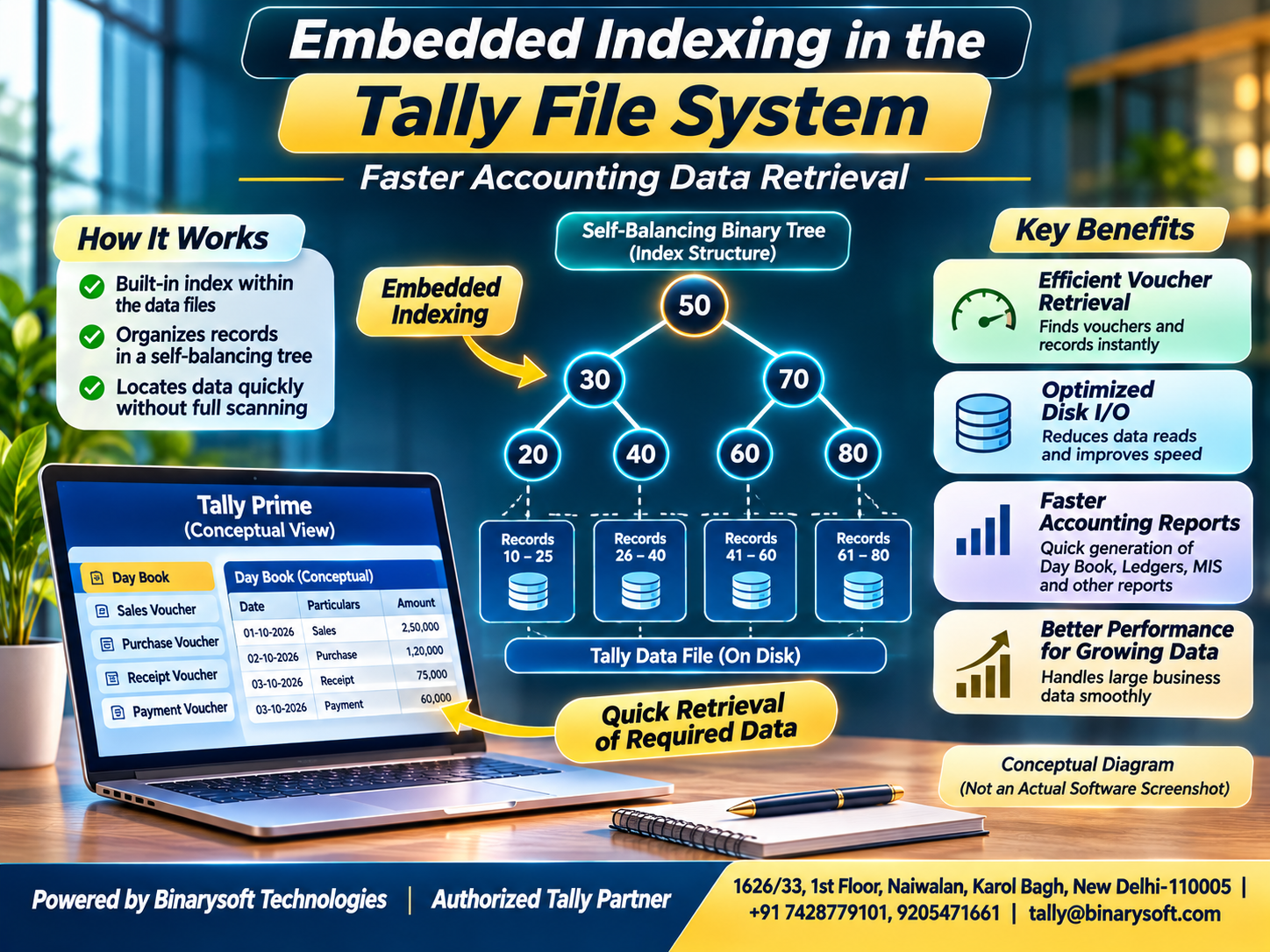
For example, a Day Book report may require vouchers associated with a selected date range.
The database does not necessarily need to read every physical record in sequence.
Instead, suitable indexing structures can guide retrieval toward the required records.
The architecture described for the Tally file system uses embedded links maintained through a self-balancing binary tree.
A self-balancing tree organizes relationships so that its structure does not become excessively uneven as records change.
This can support efficient navigation as data grows.
The references are maintained within the persistent storage architecture, rather than existing only temporarily in memory.
This distinction matters because accounting information must remain available across application sessions.
Actual retrieval performance still depends on factors such as workload, storage speed, data volume and system configuration.
6. Understanding Self-Balancing Binary Trees
A binary tree is a data structure in which each node can connect to two child nodes.
A self-balancing binary tree maintains structural balance as information is inserted, modified or removed.
Imagine searching for a transaction in a collection of records.
A poorly organized structure might require following a long sequence of references.
A balanced structure can reduce the number of navigation steps required to locate relevant information.
In database systems, this principle supports efficient searching and ordered traversal.
For accounting applications, ordered retrieval is particularly important.
Users frequently request transactions by date, voucher sequence or other supported criteria.
A suitable indexing structure helps the database locate records without relying entirely on their physical arrangement.
The exact performance depends on implementation details and the requested operation.
7. Why Disk Input and Output Operations Matter
Database performance is strongly influenced by how frequently information must be read from or written to storage.
These activities are called input/output operations, commonly abbreviated as I/O.
When an application needs information that is not already available in memory, it may need to retrieve data from the storage device.
Repeated unnecessary reads can increase processing time.
Efficient indexing aims to reduce avoidable storage operations.
For example, retrieving vouchers from a selected date range should ideally focus on relevant records rather than scanning unrelated information.
Embedded indexing supports this objective through organized record references.
However, indexing is only one component of application performance.
Processor capacity, memory, storage latency, network conditions and application workload also influence responsiveness.
8. Benefits of Embedded Indexing for Accounting Systems
Embedded indexing provides several architectural advantages.
Efficient Record Retrieval
Organized references help the database locate relevant information without requiring a complete sequential examination of every record.
Support for Changing Data
Accounting transactions are frequently created, altered, cancelled or deleted.
Indexing structures can be maintained as these changes occur.
Logical Ordering
Records can be retrieved according to supported business criteria even when they occupy different physical storage locations.
Reduced Unnecessary Disk Activity
Efficient access paths can reduce avoidable storage reads.
Better Support for Growing Records
Appropriate indexing structures help applications manage increasing transaction volumes.
Improved Report Responsiveness
Efficient retrieval can contribute to faster access to reports such as the Day Book.
These are architectural benefits, not guarantees that every report will always open instantly.
9. An Emotional Story: The Invoice That Protected a Family's Reputation
Rajesh managed a family-owned stationery distribution business in Delhi.
His father had established the company more than twenty-five years earlier.
From a small rented shop, the business had grown into a trusted supplier for schools and offices.
Rajesh had gradually computerized its accounting operations.
One afternoon, a long-standing customer called about a payment disagreement involving an older invoice.
The customer believed the amount had already been adjusted.
Rajesh knew the relationship was important.
His father had always taught him that trust was more valuable than any single transaction.
The accounting team began reviewing the customer's ledger and historical vouchers.
The records were available, but the experience reminded Rajesh how dependent the business had become on accurate digital information.
He imagined what would happen if an important invoice could not be located when needed.
That evening, he discussed the issue with his father.
His father remembered the old days when every invoice had to be located manually in large registers.
Rajesh explained how modern accounting systems organize and retrieve stored information.
Together, they recognized that dependable records required both capable software and disciplined accounting practices.
Rajesh introduced regular backup checks, improved voucher documentation and a monthly review of important customer balances.
The business also ensured that employees understood how to navigate accounting reports.
When the customer's transaction was reconciled, the relationship remained intact.
Rajesh's father smiled and reminded him that technology should help businesses honor their commitments.
For Rajesh, reliable accounting information was no longer just a technical convenience. It was part of protecting his family's reputation.
This fictional story illustrates the human value of accurate, accessible business records.
10. How Tally Prime Uses Accounting Data for Business Operations
Tally Prime provides accounting, invoicing, inventory management and financial reporting capabilities.
Its underlying data management architecture supports the storage and retrieval of business information.
Users interact with accounting features rather than directly managing internal database indexes.
Sales and Purchase Vouchers
Businesses can record transactions and retrieve them through relevant accounting reports.
Ledger Management
Customer, supplier, expense and other ledger information can be maintained through accounting masters.
Day Book
The Day Book allows users to review transactions for selected periods.
Inventory Management
Stock items, quantities and related transactions can be managed through supported inventory features.
Financial Statements
Balance Sheet and Profit & Loss reports summarize accounting information for management review.
GST-Related Reporting
Businesses can review supported GST-related information using the appropriate features and configurations.
Efficient data retrieval contributes to the overall experience of working with these records.
11. Case Study One: Managing Growing Voucher Volumes
Illustrative Case Study
Business Background
A wholesale electronics distributor uses Tally Prime for sales, purchases and customer accounting.
Its transaction history has expanded significantly over several financial years.
The Challenge
Employees regularly need to retrieve historical vouchers while responding to customer queries.
Management also wants to maintain reliable reporting as transaction volumes increase.
The Approach
The business standardizes voucher entry procedures and trains employees to use the Day Book and ledger reports effectively.
Its technical team reviews system resources, storage performance and backup practices.
The organization avoids unnecessary manual interference with accounting data files.
The Expected Outcome
Employees can follow a more consistent process for locating transactions.
The business also develops a better understanding of the infrastructure needed to support growing accounting records.
Business Lesson
Efficient indexing is valuable, but accurate entries, appropriate hardware and disciplined maintenance remain essential.
12. Case Study Two: Improving Reporting in a Manufacturing Business
Illustrative Case Study
Business Background
A manufacturing company maintains purchase, sales, inventory and financial information in Tally Prime.
Managers regularly review transaction history and stock movements.
The Challenge
As business operations expand, employees need dependable access to records across several reporting periods.
The Approach
The company reviews its accounting workflows and ensures that masters and vouchers are maintained consistently.
Technical staff evaluate storage performance and supported multi-user configurations.
The finance team establishes regular reconciliation and backup verification procedures.
The Expected Outcome
The organization gains a more dependable reporting process and clearer procedures for maintaining its accounting environment.
Business Lesson
Database architecture, infrastructure planning and accounting discipline work together to support business reporting.
Neither case study represents a verified customer engagement or a measured performance improvement.
13. Practical Ways to Improve Tally Prime Performance
Businesses can support dependable accounting performance through several practical measures.
Maintain Suitable Hardware
Use storage, memory and processors appropriate for the company's transaction volumes and workload.
Review Multi-User Requirements
Ensure that the deployment architecture and licensing match the number of users and their activities.
Keep Software Updated
Use supported releases and follow appropriate update procedures.
Maintain Reliable Backups
Schedule backups and periodically verify that important data can be restored.
Use Reports Effectively
Apply relevant date ranges and supported filters when examining transactions.
Monitor Storage Health
Review available disk space, storage reliability and infrastructure performance.
Protect Company Data
Restrict unauthorized access and avoid manually modifying proprietary accounting data files.
Seek Technical Assistance
If performance deteriorates unexpectedly, investigate the cause before attempting repairs.
Internal indexing structures should be managed through supported application mechanisms, not manual file editing.
14. Embedded Indexing vs Search Indexing
A useful distinction exists between the storage-engine indexing discussed here and indexing used for application search features.
Embedded indexing helps the database navigate stored business records efficiently.
Search indexing may maintain separate structures that allow users to locate information through keywords or search expressions.
Both approaches improve information retrieval, but they address different requirements.
A search index should not be assumed to be identical to the embedded tree links used in the underlying storage engine.
Likewise, a search-index repair operation should not be treated as a general solution for every database performance issue.
Businesses should use only documented maintenance procedures appropriate to their software release and problem.
15. Embedded Indexing and Cloud-Hosted Tally Prime
Some businesses use suitable cloud-hosted environments to access Tally Prime remotely.
In such arrangements, the accounting application's data architecture remains important.
However, user experience also depends on server resources, storage latency, network connectivity and remote-access configuration.
Embedded indexing does not eliminate delays caused by insufficient server capacity or unreliable internet connections.
Businesses evaluating cloud hosting should review workload requirements, licensing, security controls, backups and technical support.
A well-configured environment can help users work with accounting records from supported locations.
The objective should be reliable access to business information rather than assuming that cloud hosting automatically accelerates every operation.
16. The Future of Efficient Accounting Data Management
Businesses continue generating larger volumes of financial and operational information.
Accounting applications must manage this growth while preserving accuracy and dependable access.
Efficient indexing, appropriate caching, storage optimization and careful data organization remain important database engineering techniques.
Future improvements may involve better use of hardware resources, optimized retrieval methods and more responsive reporting workflows.
For business owners, the practical objective remains straightforward.
They need accurate invoices, accessible transaction histories, reliable inventory information and financial reports that support timely decisions.
Understanding database architecture helps explain why software performance depends on more than the speed of a computer.
It depends on how intelligently information is organized, maintained and retrieved.
Conclusion
Embedded indexing is an important technique for organizing references to stored accounting records.
By supporting efficient navigation between records, it helps database engines retrieve relevant information without relying entirely on physical storage order.
Within the Tally file system, embedded indexing contributes to efficient access patterns used by accounting operations and reports.
For Tally Prime users, the practical benefits are reflected in the ability to work with vouchers, masters and business information through familiar accounting features.
However, dependable performance also requires appropriate infrastructure, accurate data entry, regular backups and supported maintenance procedures.
The real value of efficient data management is not simply faster technology. It is helping businesses access trustworthy information when important decisions depend on it.
Powered by Binarysoft Technologies
Authorized Tally Partner
Binarysoft Technologies supports businesses with Tally Prime implementation, accounting software solutions, customization, technical assistance and cloud-based accounting requirements.
Our focus is to help organizations maintain reliable accounting environments, improve operational efficiency and make better use of their business information.
Location:
1626/33, 1st Floor, Naiwalan, Karol Bagh, New Delhi – 110005, INDIA
Contact Us:
+91 7428779101, 9205471661
Email:
tally@binarysoft.com
Business Hours:
10:00 AM – 6:00 PM, Monday to Friday
Frequently Asked Questions
Does embedded indexing make every Tally Prime report faster?
No. Report performance also depends on calculations, transaction volumes, hardware and system configuration.
Can users manually change embedded indexes?
Users should not manually edit proprietary data files or internal indexing structures. Supported maintenance procedures should be used.
Can cloud hosting improve Tally Prime performance?
A suitable hosting environment may improve certain infrastructure limitations, but performance depends on configuration and connectivity.
How can businesses maintain reliable accounting data?
They should maintain accurate records, use appropriate infrastructure, protect access, keep verified backups and follow supported maintenance procedures.
CA. Naksh Bafna works on bookkeeping, financial controls, and taxation for small and growing enterprises. His focus is on making accounting processes systematic, understandable, and easier to manage throughout the financial year.