Call CA Tally HelpDesk
+91 9205471661,
7428779101
Introduction: What If Powerful Artificial Intelligence Could Work Directly on Your Computer?
Imagine running a business where intelligent software helps employees understand invoices, identify accounting errors, organise financial information and complete repetitive tasks without sending every piece of information to an external cloud server.
For many Indian business owners, this represents an exciting possibility.
Artificial intelligence has already transformed how organisations communicate, analyse information and automate everyday activities. However, traditional AI systems often depend on large computing infrastructure, powerful servers and continuous internet connectivity.
These requirements can create challenges for small and medium-sized businesses.
A wholesale trader in Delhi may want faster invoice processing but remain concerned about sharing confidential customer records. A manufacturer may need intelligent inventory assistance but operate in an area with inconsistent internet connectivity.
A chartered accountant may wish to use AI while protecting sensitive financial documents.
On-device artificial intelligence offers a promising approach by allowing suitably designed AI models to process information directly on local computers, smartphones and other devices.
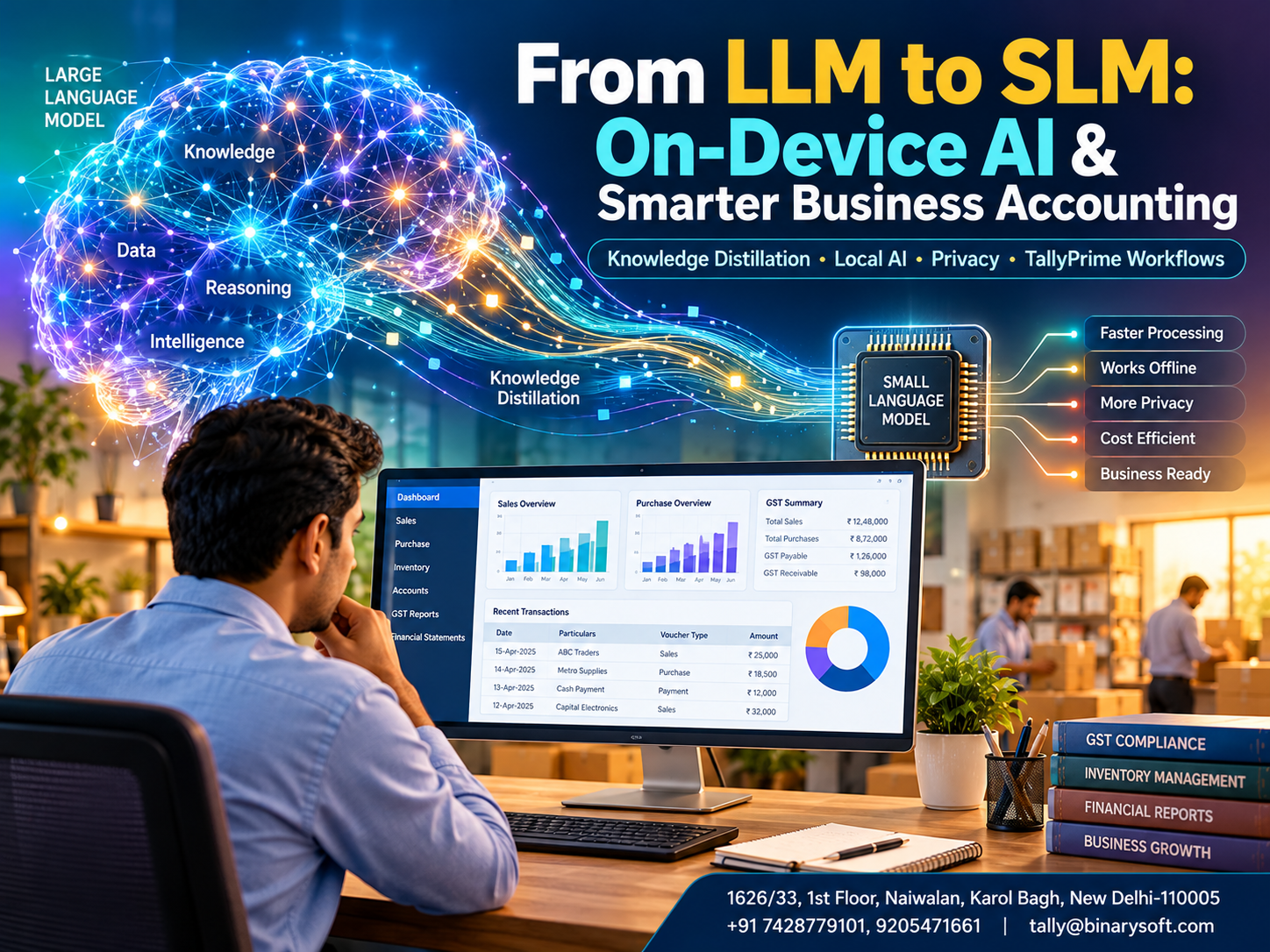
One important technology behind this development is knowledge distillation, which helps transfer useful capabilities from a large AI model into a smaller, more efficient model.
This guide explains how the technology works, its business benefits and how TallyPrime's existing accounting capabilities can complement emerging AI solutions.
1. Understanding Large Language Models and Small Language Models
Artificial intelligence models differ significantly in size, complexity and computing requirements.
What Is a Large Language Model?
A Large Language Model, commonly called an LLM, is an AI system trained on extensive datasets to recognise language patterns, generate responses and perform various language-related tasks.
LLMs can support document analysis, information extraction, translation, summarisation and conversational assistance.
However, larger models often require considerable processing power and memory.
Depending on their architecture, they may be hosted on powerful servers or cloud infrastructure.
What Is a Small Language Model?
A Small Language Model, or SLM, is a comparatively compact AI model designed to perform selected tasks with fewer computational resources.
SLMs can be suitable for devices with limited memory and processing capacity.
Their potential applications include document classification, short-text summarisation, structured data extraction and specialised business assistance.
The key difference is not simply intelligence versus simplicity.
It is the balance between model capability, resource requirements and the specific tasks being performed.
2. What Is Knowledge Distillation in Artificial Intelligence?
Knowledge distillation is a machine-learning technique in which a smaller model learns useful behaviour from a larger, more capable model.
The larger model acts as a teacher, while the smaller model acts as a student.
Instead of independently learning everything from the beginning, the student receives additional training signals derived from the teacher's predictions.
This helps the smaller model capture useful patterns while operating with fewer parameters.
Understanding the Teacher–Student Approach
Consider an experienced accountant training a new employee.
The experienced accountant understands accounting principles, transaction classification and common errors.
The trainee learns by observing examples, receiving explanations and practising similar tasks.
Over time, the trainee becomes capable of handling routine responsibilities independently.
Knowledge distillation follows a related principle.
A powerful teacher model produces predictions or other training signals, and the student model learns to reproduce useful aspects of that behaviour.
The student does not necessarily acquire every capability of the teacher, but it may become highly effective for a narrower set of tasks.
3. How Knowledge Is Transferred from LLMs to SLMs
The knowledge transfer process generally involves several stages.
Large Teacher Model
Provides predictions, probabilities and useful patterns
Knowledge Distillation
Training data, soft labels and model optimisation
Compact Student Model
Optimised for a specific task and target hardware
Step 1: Train or Select a Teacher Model
The process begins with a capable model that performs the intended task accurately.
The teacher must demonstrate reliable behaviour because its weaknesses may also influence the student.
Step 2: Prepare Training Examples
Developers prepare representative examples that reflect the real-world tasks the student will perform.
For an invoice-processing model, examples may include invoice descriptions, supplier information and document classifications.
Step 3: Generate Soft Labels
Traditional training may use hard labels representing a single correct category.
Knowledge distillation can additionally use soft labels, which communicate the teacher's probability distribution across possible outcomes.
These probabilities provide information about similarities and uncertainty.
Step 4: Train the Student Model
The student learns from the teacher's outputs and, where available, verified correct answers.
Training adjusts the smaller model to reproduce useful predictions.
Step 5: Evaluate Performance
Developers test the student for accuracy, speed, memory consumption and reliability.
The model may require further optimisation before deployment.
Step 6: Deploy on Suitable Devices
Once validated, the smaller model may be deployed on supported computers or mobile devices.
Whether it can operate fully offline depends on the model, application design and hardware.
4. Why On-Device AI Matters for Indian Businesses
Better Control Over Sensitive Information
Businesses regularly handle customer details, supplier records, pricing agreements and financial transactions.
Locally processed AI tasks can reduce the need to transmit sensitive information to external services.
However, privacy depends on the complete application architecture, including logging, updates, telemetry and connected services.
Reduced Internet Dependency
An offline-capable AI model can perform supported tasks without continuous internet connectivity.
This can be valuable for businesses operating in locations with unreliable networks.
Faster Responses for Selected Tasks
Local processing can reduce network-related delays.
For lightweight workloads, a properly optimised model may provide faster responses than a remote service.
Lower Repeated Processing Costs
On-device processing may reduce recurring cloud inference charges.
However, businesses must still consider hardware, maintenance, implementation and software licensing costs.
Greater Operational Flexibility
Local AI can be useful in retail counters, warehouses, manufacturing facilities and accounting departments.
These benefits make smaller AI models an important area of technological development.
5. Hard Labels and Soft Labels: The Foundation of Knowledge Distillation
Understanding hard labels and soft labels helps explain how a smaller AI model learns from a larger one.
A hard label represents a definite classification.
For example, a business document may be classified as a purchase invoice.
A soft label provides additional information about the probability of different classifications.
An AI model might assign the following probabilities to a document:
|
Document classification
|
Model probability
|
|---|
|
Purchase invoice
|
85%
|
|
Expense receipt
|
10%
|
|
Delivery challan
|
5%
|
Instead of learning only that the document is a purchase invoice, the student model learns that it shares some characteristics with other document categories.
This additional information can help the smaller model recognise more complex patterns.
For business applications, such learning can be useful when documents contain inconsistent formatting or similar terminology.
However, probability scores are not guarantees of accuracy. Important accounting decisions still require verification.
6. Different Techniques Used in Knowledge Distillation
Knowledge distillation is not limited to one training method.
Response-Based Distillation
The student learns to reproduce the teacher's output probabilities or responses.
This is one of the most common approaches.
Feature-Based Distillation
The student learns from intermediate representations generated by the teacher.
This can help transfer useful information beyond the final prediction.
Relation-Based Distillation
The student learns relationships between examples or internal representations.
This approach can help preserve structural information.
Self-Distillation
A model uses its own internal representations or predictions to improve another part or version of itself.
Multi-Teacher Distillation
Multiple teacher models provide training signals to one student.
This may help combine complementary capabilities.
Quantisation and Model Optimisation
Quantisation reduces the numerical precision used to represent model parameters.
It is distinct from knowledge distillation, but the techniques can be combined to reduce memory and processing requirements.
The correct approach depends on accuracy requirements, available training data and deployment hardware.
7. How TallyPrime Can Help Businesses Prepare for Intelligent Accounting
TallyPrime already provides structured accounting, inventory management, GST-related functionality and financial reporting.
These capabilities are valuable foundations for organisations exploring AI-assisted business workflows.
It is important to distinguish between existing TallyPrime functionality and potential applications of on-device AI.
Knowledge distillation does not mean that TallyPrime automatically includes a locally running Small Language Model. Such functionality would require a supported product feature or separately developed integration.
Structured Accounting Data
TallyPrime maintains sales, purchase, receipt, payment and journal transactions in organised accounting records.
Structured data can make it easier to develop reliable reporting and analytical workflows.
GST Billing and Reporting
Businesses can use TallyPrime to record GST transactions and prepare relevant reports.
AI-assisted systems could potentially help users identify unusual patterns or review documents, provided appropriate integration and verification controls exist.
Inventory Management
TallyPrime supports stock item management, inventory transactions and relevant reporting.
An external AI system could analyse authorised exports to identify trends or potential stock anomalies.
Financial Analysis
Profit and Loss Accounts, Balance Sheets, ledger reports and outstanding statements provide information for management decisions.
These reports can support AI-assisted analysis when handled through secure, authorised workflows.
Automation Opportunities
Supported integrations and customisation tools may allow businesses to build additional workflows.
However, any AI-generated accounting recommendation should be reviewed before it changes financial records.
8. Emotional Story: A Small Business Owner Who Wanted Technology Without Losing Trust
Consider the illustrative story of Sandeep, who operates a family-owned electrical components business in Delhi's Bhagirath Palace.
His father started the business with a small amount of capital and built its reputation through honest dealings.
As the company expanded, Sandeep introduced digital accounting to manage increasing transaction volumes.
He wanted to explore artificial intelligence to simplify document handling and reporting.
However, one concern troubled him.
His customer records contained negotiated prices, payment histories and confidential business arrangements.
He wondered whether using AI meant sharing all that information with external servers.
One evening, while reviewing supplier accounts, his father asked a simple question:
“If our customers trust us with their information, shouldn't we protect it as carefully as their money?”
Sandeep realised that technological progress and responsible data management should work together.
He began exploring privacy-conscious automation, including systems capable of processing selected information locally.
He also reviewed the company's existing TallyPrime accounting procedures, user permissions and backup arrangements.
The business adopted a cautious approach: test new technology, verify its accuracy and disclose sensitive information only when necessary.
For Sandeep, innovation was no longer about adopting every new feature.
It was about building a stronger business without compromising the trust earned over generations.
The lesson is that responsible technology should strengthen customer confidence rather than force businesses to choose between efficiency and privacy.
9. Case Study 1: Wholesale Distributor Evaluates Local AI for Invoice Classification
Illustrative scenario — not a verified implementation
Business Background
A wholesale electronics distributor in Nehru Place receives approximately 3,000 supplier documents monthly.
The documents include purchase invoices, delivery challans, expense receipts and credit notes.
Business Challenge
Employees spend considerable time identifying document types and organising files before accounting entry.
The company wants to reduce repetitive classification work while maintaining control over confidential supplier information.
Proposed Solution
The distributor evaluates a locally deployed Small Language Model trained for document classification.
The model identifies document categories and proposes suitable processing queues.
Verified documents are then entered into TallyPrime through existing accounting procedures or an appropriately tested integration.
Illustrative Efficiency Comparison
|
Performance indicator
|
Manual workflow
|
Target with local AI
|
|---|
|
Monthly documents
|
3,000
|
3,000
|
|
Average classification time
|
45 seconds
|
15 seconds
|
|
Monthly classification effort
|
37.5 hours
|
12.5 hours
|
|
Potential time saving
|
—
|
25 hours
|
These are hypothetical planning figures, not measured performance claims.
Business Benefits
A successful implementation could reduce repetitive document sorting and help employees focus on accounting verification.
The organisation would still need to assess model accuracy, document quality, hardware costs and integration security.
10. Case Study 2: Manufacturing MSME Explores AI-Assisted Inventory Analysis
Illustrative scenario — proposed use case
Business Background
A packaging manufacturer in Bawana Industrial Area maintains hundreds of raw-material and finished-goods stock items.
Management wants to identify unusual consumption patterns and improve inventory review.
Existing Challenges
Inventory reports require regular manual examination.
Employees may overlook unexpected changes in material consumption or stock movement.
Proposed Implementation
The company uses TallyPrime for inventory accounting and generates authorised stock reports.
A separately developed local analytical application processes selected report data to identify unusual patterns.
The system highlights potential exceptions for review by inventory and accounting personnel.
Expected Benefits
The company establishes targets to reduce manual report screening and identify stock anomalies earlier.
The AI system does not independently alter inventory balances or approve accounting transactions.
Key Learning
Local AI may complement accounting software by providing additional analysis while retaining business control over important decisions.
However, the accuracy of the results depends on data quality, model validation and suitable business rules.
11. On-Device AI vs Cloud AI: Which Is Better for Business?
Both approaches have advantages.
|
Feature
|
On-device AI
|
Cloud AI
|
|---|
|
Data processing
|
On local hardware
|
On remote infrastructure
|
|
Internet dependency
|
Can be low
|
Usually required
|
|
Computing capacity
|
Limited by device
|
Can use powerful servers
|
|
Privacy control
|
Potentially greater local control
|
Depends on provider and configuration
|
|
Maintenance
|
Local deployment responsibility
|
Often provider-managed
|
|
Model capabilities
|
Task and hardware dependent
|
Often supports larger models
|
|
Cost
|
Hardware and maintenance
|
Usage or subscription charges
|
Businesses do not necessarily need to choose only one approach.
A hybrid architecture can process sensitive or routine tasks locally while using cloud services for approved, more demanding workloads.
The decision should depend on confidentiality, accuracy, cost and operational requirements.
12. Challenges of Implementing Small Language Models
Although smaller AI models offer important benefits, businesses should understand their limitations.
Reduced Capability
A smaller model may perform well on specialised tasks but struggle with complex reasoning or unfamiliar situations.
Hardware Constraints
Even compact models require sufficient memory and processing resources.
Accuracy and Reliability
AI-generated information can be incorrect.
Businesses should validate outputs before using them for financial decisions.
Model Maintenance
Models may require updates, retraining or additional evaluation as business requirements change.
Data Security
Local deployment reduces some transmission risks but does not automatically protect against malware, unauthorised access or insecure integrations.
A successful implementation requires technical planning and appropriate safeguards.
13. The Future of AI, Accounting and TallyPrime
Artificial intelligence is expected to become increasingly integrated into business software.
Potential applications include document understanding, accounting assistance, transaction classification, financial anomaly detection and intelligent report interpretation.
Knowledge distillation can make some of these applications more practical on devices with limited computing resources.
For businesses using TallyPrime, the immediate priority should be maintaining accurate accounting records, organised masters, reliable backups and appropriate user controls.
These practices establish a foundation for evaluating future automation.
Businesses should distinguish between features currently available in their installed software and capabilities that require additional applications, development or future releases.
14. How Binarysoft Technologies Can Help
Binarysoft Technologies supports businesses with TallyPrime accounting, GST billing, inventory management, financial reporting and related implementation requirements.
Organisations considering AI-assisted workflows can begin by reviewing their existing accounting processes and identifying repetitive activities suitable for automation.
A practical evaluation should include data security, technical compatibility, implementation cost and the level of human verification required.
The objective is to introduce technology that improves productivity while preserving financial accuracy and business control.
Conclusion
Knowledge distillation is helping make artificial intelligence more efficient and accessible.
By transferring useful capabilities from larger models into smaller models, developers can create systems suitable for selected on-device applications.
This approach offers potential advantages in privacy, speed, offline operation and computing efficiency.
For Indian businesses, the opportunities extend to document processing, inventory analysis and financial workflows.
TallyPrime provides established accounting and business management capabilities that can complement appropriately designed automation solutions.
However, reliable implementation requires careful integration, testing and human oversight.
The future of business technology is not simply about building bigger AI models. It is about delivering the right intelligence, on the right device, with the right level of security and control.
Powered by Binarysoft Technologies Authorized Tally Partner
Location: 1626/33, 1st Floor, Naiwalan, Karol Bagh, New Delhi – 110005, INDIA
Contact us: +91 7428779101, 9205471661
Email: tally@binarysoft.com
Business Hours: 10:00 AM – 6:00 PM, Monday to Friday
Frequently Asked Questions
What is knowledge distillation in artificial intelligence?
Knowledge distillation is a technique where a smaller AI model learns useful behaviour from a larger model through additional training signals.
What is the difference between LLM and SLM?
An LLM is generally a larger language model with substantial computational requirements. An SLM is comparatively compact and may be optimised for specific tasks and limited hardware.
Can knowledge distillation improve accounting automation?
Potentially. It can help developers create smaller models for tasks such as document classification, information extraction and specialised accounting assistance.
Does TallyPrime automatically provide an on-device AI language model?
Not necessarily. TallyPrime's existing accounting features should be distinguished from separately developed or specifically supported local AI integrations.
CA. Anand Tirpathi is a Chartered Accountant with experience in statutory compliance, internal controls, and accounting process optimization. He has advised multiple businesses on improving operational efficiency through structured accounting and inventory systems. His writing focuses on clarity, compliance, and risk reduction for MSMEs.