Call CA Tally HelpDesk
+91 9205471661,
7428779101
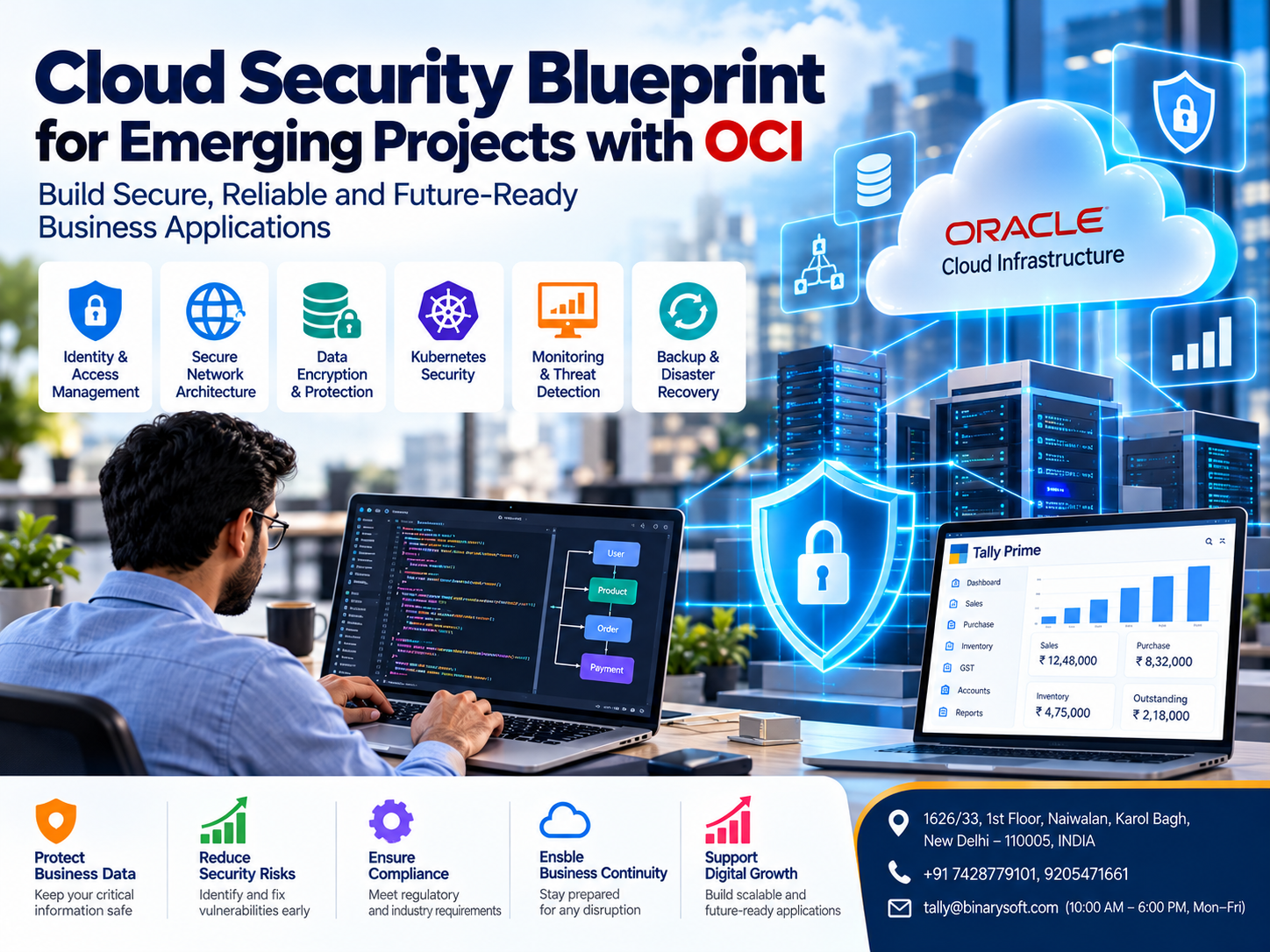
Introduction: Why Cloud Security Must Begin Before a Project Goes Live
Businesses are rapidly adopting cloud technology to manage accounting, customer information, inventory, digital transactions and enterprise applications.
Cloud platforms offer flexibility, scalability and opportunities to reduce infrastructure management responsibilities.
However, moving business operations to the cloud also introduces security challenges.
Unauthorized access, exposed applications, incorrect cloud configurations, vulnerable software components and inadequate monitoring can place valuable business information at risk.
For emerging digital projects, security cannot remain an activity performed only after development is complete.
A successful cloud security blueprint must protect applications from the initial design stage through development, deployment and ongoing operations.
Oracle Cloud Infrastructure (OCI) provides cloud services that organizations can use to establish security controls around applications, networks, identities and data.
When combined with secure development practices and Kubernetes security mechanisms, these capabilities can help businesses build more resilient digital environments.
For organizations using Tally Prime, understanding cloud security is particularly relevant when accounting information is accessed remotely or hosted in a managed environment.
This guide explains how businesses can develop a layered cloud security strategy, strengthen operational controls and protect critical information while supporting digital growth.
A Business Story: The Night a Growing Company Almost Lost Its Financial Future
For more than a decade, Vikram had operated a successful wholesale electronics business in New Delhi.
His company began with a small office and gradually expanded into multiple warehouses serving retailers across northern India.
As the business grew, Vikram invested in digital systems for accounting, inventory and customer management.
Eventually, he decided to move selected business applications to cloud infrastructure so employees could work from different locations.
The transition initially appeared successful.
His finance team could access information remotely, warehouse managers could review operational data, and management gained better visibility into daily activities.
But one evening, Vikram received an alarming call from his technology consultant.
An application configuration had unintentionally exposed an administrative service to the internet.
Although the team had not established that any data had been stolen, the potential risk was serious.
The company's systems contained years of financial records, supplier information and customer transaction details.
Vikram immediately thought about his employees, customers and suppliers.
He had spent years earning their trust.
The possibility of exposing confidential information made him realize how much responsibility came with digital growth.
The technology team restricted the exposed service, reviewed access logs and assessed the affected systems.
Following the incident, the company introduced a formal cloud security program.
It strengthened identity controls, implemented network restrictions, reviewed encryption settings and established continuous monitoring.
Regular security assessments and recovery testing became part of normal operations.
Vikram learned that moving to the cloud was not simply about making software available from anywhere.
It was about protecting the information that kept his business running.
The lesson: business growth creates opportunities, but long-term success depends on protecting the trust and information behind that growth.
This is an illustrative story created to explain a common cloud security challenge.
What Is a Cloud Security Blueprint?
A cloud security blueprint is a structured framework describing how an organization will protect its cloud-based applications, infrastructure, networks and information.
It establishes security principles, technical controls, operational responsibilities and monitoring procedures.
Rather than treating security as a collection of unrelated tools, a blueprint connects different safeguards into a coordinated strategy.
A comprehensive cloud security blueprint generally covers:
-
Identity and access management
-
Network segmentation
-
Application security
-
Data encryption
-
Secrets management
-
Infrastructure configuration
-
Vulnerability management
-
Continuous monitoring
-
Incident response
-
Backup and disaster recovery
-
Compliance and governance
For example, a business hosting a customer portal on OCI may need to protect its database, restrict administrator access, encrypt sensitive information and monitor unusual activities.
A properly designed blueprint ensures that these controls support one another.
Why Is Cloud Security Important for Emerging Projects?
New digital projects often prioritize rapid development and early deployment.
While speed is valuable, security weaknesses introduced during development can become expensive to correct later.
Cloud security planning helps businesses establish reliable foundations before applications begin processing sensitive information.
1. Protects Sensitive Business Data
Cloud applications may store financial records, customer information, employee details and confidential operational documents.
Security controls help prevent unauthorized access and accidental exposure.
2. Reduces Operational Risks
Misconfigurations, software vulnerabilities and excessive permissions can interrupt business operations.
A structured security strategy reduces exposure to these risks.
3. Supports Regulatory Compliance
Organizations must evaluate applicable data protection, financial reporting and industry-specific requirements.
Cloud security controls can support compliance efforts when implemented appropriately.
4. Improves Business Continuity
Secure backup and recovery arrangements help businesses prepare for system failures and other disruptions.
5. Builds Customer Confidence
Businesses that demonstrate responsible information handling are better positioned to maintain customer and supplier trust.
Core Principles of a Strong Cloud Security Architecture
1. Zero Trust Security
Zero Trust is based on the principle that access should not be trusted automatically simply because a user or system operates within a particular network.
Every access request should be evaluated according to identity, authorization and relevant security conditions.
For example, an employee accessing a financial application should receive only the permissions necessary for assigned responsibilities.
Zero Trust strategies can include strong authentication, limited privileges, network segmentation and continuous verification.
2. Least Privilege Access
The principle of least privilege ensures that users and applications receive only the access required to perform their tasks.
A warehouse employee may need inventory information but should not automatically receive unrestricted access to financial administration settings.
Limiting permissions reduces the potential impact of compromised accounts and accidental changes.
3. Defense in Depth
Defense in depth involves implementing multiple security layers.
These may include identity verification, network restrictions, application controls, encryption and monitoring.
If one security measure fails, additional controls can help limit the consequences.
4. Secure-by-Design Development
Security requirements should influence software architecture from the beginning.
Developers should consider authentication, authorization, input validation and data protection while designing applications.
5. Continuous Security Monitoring
Cloud environments change frequently.
New applications, users and infrastructure resources may introduce risks.
Continuous monitoring helps organizations detect unusual activity and configuration changes.
Building a Cloud Security Blueprint with Oracle Cloud Infrastructure
Oracle Cloud Infrastructure provides several services that can support a layered security strategy.
Step 1: Establish Secure Identity and Access Management
Identity and Access Management (IAM) controls who can access cloud resources and what actions they can perform.
Organizations should define clear user roles and administrative responsibilities.
Important practices include:
-
Assigning permissions according to job responsibilities
-
Avoiding unnecessary administrator access
-
Reviewing access permissions regularly
-
Using multifactor authentication where supported
-
Removing access when employees leave
-
Monitoring privileged account activities
OCI compartments can help organize resources and establish administrative boundaries.
Properly configured IAM policies help control access across these resources.
Step 2: Design Secure Network Architecture
Cloud network security controls how applications and infrastructure communicate.
OCI Virtual Cloud Networks provide logical network environments for cloud resources.
Network Security Groups and security rules help control permitted traffic.
Organizations should avoid exposing internal databases and administrative services directly to the public internet.
Private subnets can be used for systems that do not require public accessibility.
Secure connectivity options can help organizations communicate with approved private networks and cloud services.
A well-designed network architecture reduces unnecessary exposure.
Step 3: Protect Applications and APIs
Modern applications frequently communicate through APIs.
These interfaces can become targets for unauthorized requests, malicious traffic and application-level attacks.
Businesses should implement appropriate authentication, authorization and input validation.
Web Application Firewalls can help filter certain malicious web requests.
Rate limiting and monitoring can further strengthen protection.
However, application firewalls do not eliminate the need for secure programming and vulnerability testing.
Step 4: Implement Data Encryption
Encryption helps protect information from unauthorized disclosure.
Businesses should evaluate encryption for both stored information and data transmitted between systems.
Sensitive credentials and encryption keys should be managed securely.
OCI Vault can support the management of secrets and cryptographic keys.
Access to these resources should be restricted and monitored.
Step 5: Introduce Vulnerability Management
Software vulnerabilities can create opportunities for attackers.
Organizations should regularly review operating systems, application dependencies and container images.
Security scanning can help identify known weaknesses before applications are deployed.
Critical vulnerabilities should be prioritized according to business impact and exposure.
Step 6: Establish Continuous Monitoring
Security monitoring helps organizations identify unusual activities and configuration weaknesses.
OCI Cloud Guard can assist with detecting certain cloud security concerns.
Organizations can configure alerts and response procedures according to their operational requirements.
Automated remediation may be appropriate for carefully defined situations.
However, potentially disruptive actions should be tested and controlled.
Kubernetes Security: Protecting Modern Cloud Applications
Kubernetes is widely used to manage containerized applications.
Oracle Kubernetes Engine (OKE) provides a managed Kubernetes environment on OCI.
Although Kubernetes supports application scalability and orchestration, it also requires careful security configuration.
Namespace Isolation
Namespaces help organize Kubernetes resources.
They can support separation between applications or operational environments.
However, namespaces alone do not provide complete security isolation.
Additional controls are required.
Workload Identity
Workload identity mechanisms allow applications to access approved cloud services without relying unnecessarily on long-lived credentials.
Permissions should be restricted to the services required by each workload.
Network Policies
Kubernetes Network Policies can help control communication between workloads when supported by the cluster networking configuration.
For example, an application service may need access to a database, while unrelated workloads should be blocked.
Container Security
Container images should be scanned for known vulnerabilities.
Applications should avoid unnecessary privileges and run with appropriately restricted permissions.
Admission Controls
Kubernetes admission policies can help enforce security requirements before workloads are deployed.
Policy engines such as Kyverno can be used to validate configurations and prevent certain unsafe deployment patterns.
These controls help make security requirements repeatable.
Integrating Security into Software Development
Security becomes more effective when it is incorporated throughout the software development lifecycle.
This approach is often called shift-left security.
Rather than waiting until deployment to identify problems, development teams evaluate security during coding, testing and integration.
Secure Coding
Developers should use appropriate input validation, authentication and authorization controls.
Dependency Scanning
Third-party software libraries should be checked for known vulnerabilities.
Secrets Management
Passwords, API keys and other sensitive credentials should not be stored directly in application source code.
Automated Security Testing
Development pipelines can include security checks that identify potential weaknesses before deployment.
Infrastructure as Code
Tools such as Terraform allow infrastructure configurations to be maintained as code.
This can improve consistency and support configuration reviews.
Software Bill of Materials
A Software Bill of Materials identifies components used in an application.
Maintaining this information can help organizations understand dependency-related security risks.
How OCI Security Services Support Business Protection
| OCI Capability | Primary Security Purpose |
|---|
| Identity and Access Management |
Control user and service permissions |
| Compartments |
Organize resources and administrative boundaries |
| Virtual Cloud Networks |
Establish network architecture |
| Network Security Groups |
Restrict network communication |
| OCI Vault |
Manage secrets and encryption keys |
| OCI Cloud Guard |
Identify selected security risks and configuration concerns |
| OCI Bastion |
Provide controlled access to private resources |
| Web Application Firewall |
Help protect web applications from certain malicious requests |
| Security Zones |
Enforce supported security configuration policies |
| Vulnerability Scanning |
Identify certain known software vulnerabilities |
| Oracle Kubernetes Engine |
Manage containerized workloads |
These capabilities should be configured according to business requirements and evaluated as part of a broader security program.
How Tally Prime Can Benefit from Secure Cloud Infrastructure
Businesses increasingly require access to accounting information from different offices and locations.
Tally Prime supports accounting, inventory, taxation and financial reporting activities.
When businesses use cloud-hosted access, infrastructure security becomes an important consideration.
However, Tally Prime application security and OCI infrastructure security are separate layers.
The availability of particular cloud security services depends on the hosting solution and its architecture.
1. Secure Access to Financial Information
Tally Prime supports user-level security controls that can help restrict access to accounting information.
Businesses should configure permissions according to employee responsibilities.
Cloud-hosting environments should provide additional authentication and access protection.
2. Protection of Accounting Data
Financial information may include customer balances, supplier records, inventory values and confidential business transactions.
Secure hosting arrangements should protect stored information and data transmitted between systems.
Encryption, access controls and secure infrastructure management contribute to this protection.
3. Backup and Recovery
Accounting data is essential for daily business operations.
Organizations should maintain appropriate backup procedures and periodically verify that information can be restored.
Cloud-hosting providers may offer managed backup services, but businesses should confirm backup frequency, retention and recovery responsibilities.
4. Remote Accounting Operations
Secure remote access can support accountants and business owners working from different locations.
Access should be limited to authorized users and protected through suitable authentication measures.
5. Financial Audit Readiness
Tally Prime provides accounting reports and security features that can support transaction reviews.
Supported editions also provide Edit Log capabilities.
These application-level features can complement infrastructure security monitoring.
6. Inventory and Business Management
Businesses using Tally Prime can maintain stock records, purchase transactions and sales information.
Secure access helps protect the availability and confidentiality of this operational information.
7. Tally Prime Cloud Access
Tally Prime Cloud Access is available as a cloud-hosted access solution using Oracle Cloud Infrastructure.
Its security capabilities include access controls and authentication measures designed for remote use.
Businesses should distinguish between an official managed cloud-access offering and independently configured hosting arrangements, because their features and responsibilities may differ.
8. Business Continuity
A reliable cloud-hosting strategy should consider system availability, data recovery and operational continuity.
Appropriate infrastructure design can help reduce the impact of certain hardware failures and service disruptions.
No cloud environment can guarantee uninterrupted operation or complete protection from cyber threats.
Case Study 1: Manufacturing Company Strengthens Cloud Security
Business: Illustrative automotive components manufacturer
Location: Gurugram, Haryana
Challenge: Inconsistent access permissions and exposed cloud services
A growing manufacturing company used cloud applications to manage procurement, production planning and operational reporting.
As additional departments adopted digital tools, its technology environment became more complex.
An internal review identified several concerns.
Some employees had broader access permissions than necessary.
Certain administrative services were accessible through insufficiently restricted network configurations.
The organization also lacked centralized security monitoring.
Solution
The company introduced a layered cloud security strategy.
Its technology team reviewed IAM policies, restricted unnecessary network access and improved application security controls.
The organization also introduced vulnerability scanning and documented incident response procedures.
Accounting information maintained in Tally Prime was protected through appropriate user permissions and backup practices.
Illustrative Results
After implementation, management gained better visibility into cloud resources and administrative responsibilities.
The company improved its ability to identify configuration weaknesses and investigate unusual activity.
Employee access became more closely aligned with job responsibilities.
Key Lesson: Cloud security becomes more effective when identity, network and application controls are managed together.
This case study is illustrative and does not represent verified customer results.
Case Study 2: Distribution Business Improves Remote Accounting Security
Business: Illustrative electronics distributor
Location: New Delhi
Challenge: Remote accounting access and inadequate backup monitoring
An electronics distribution company operated from several business locations.
Its accounting team needed access to financial records from different offices.
Initially, the organization relied on inconsistent remote-access procedures.
Management became concerned about unauthorized access and potential data loss.
Solution
The company adopted a structured security approach for its hosted accounting environment.
It reviewed user permissions, strengthened authentication procedures and established clearer backup responsibilities.
The finance team used Tally Prime security settings to restrict access to sensitive accounting functions.
The technology team also introduced regular monitoring and recovery testing.
Illustrative Results
The business achieved more consistent access management and improved confidence in its data recovery procedures.
Employees could perform approved accounting activities remotely while following standardized security practices.
Management also gained clearer responsibilities for maintaining financial data protection.
Key Lesson: Secure remote accounting requires both application-level controls and reliable hosting infrastructure.
This case study is hypothetical.
Common Cloud Security Mistakes Businesses Should Avoid
Even well-funded technology projects can experience security problems when basic controls are overlooked.
Excessive Administrator Permissions: Unnecessary privileges increase the potential impact of compromised accounts.
Publicly Exposed Databases: Internal databases should not be accessible from the internet unless there is a justified, securely controlled requirement.
Hardcoded Credentials: Passwords and API keys should not be embedded directly in source code.
Missing Security Updates: Outdated software may contain vulnerabilities that attackers can exploit.
Unverified Backups: Backup procedures should be tested regularly.
Insufficient Monitoring: Organizations need visibility into suspicious activity and important configuration changes.
Weak Employee Awareness: Staff should understand common phishing and credential security risks.
Lack of Incident Response Planning: Businesses should know how to investigate and respond to potential security incidents.
Avoiding these mistakes can substantially improve overall security readiness.
Cloud Security Best Practices for Indian Businesses
Businesses adopting cloud infrastructure should begin with a documented risk assessment.
Security responsibilities must be clearly assigned.
Sensitive information should be classified according to its business importance.
Access permissions should follow the principle of least privilege.
Multifactor authentication should be implemented wherever appropriate.
Applications and infrastructure should be maintained with suitable updates.
Organizations should review relevant data protection and regulatory obligations.
Backup arrangements must be supported by restoration testing.
Security monitoring should include clear procedures for investigating alerts.
Finally, businesses should review their security controls regularly as applications, users and operational requirements change.
Cloud Security vs Traditional IT Security
| Particulars | Cloud Security | Traditional IT Security |
|---|
| Infrastructure |
Cloud-hosted resources |
Primarily organization-managed infrastructure |
| Scalability |
Flexible resource allocation |
Often requires hardware expansion |
| Access |
Network-based and remote access |
Frequently focused on local environments |
| Security Controls |
Cloud IAM, network policies and monitoring |
Firewalls, local access controls and endpoint protection |
| Maintenance |
Shared between provider and customer |
Primarily managed by the organization or service provider |
| Backup |
Cloud-based or hybrid options |
Local, offsite or hybrid options |
| Responsibilities |
Defined by the shared responsibility model |
Depend on internal and outsourced arrangements |
Neither approach is automatically secure.
Security depends on appropriate design, configuration, monitoring and operational discipline.
The Future of Cloud Security and Business Applications
Cloud technology will continue to influence how businesses develop and operate digital systems.
Containerized applications, automated deployment pipelines and remote work environments require security controls that can adapt to changing infrastructure.
Organizations are increasingly exploring policy-based governance, automated security assessments and continuous monitoring.
Artificial intelligence may also assist security teams in analyzing alerts and identifying unusual patterns.
However, automated security tools require careful configuration and human oversight.
For businesses using accounting applications such as Tally Prime, the priority remains protecting financial information while maintaining reliable access for authorized users.
A successful cloud security strategy should support business innovation without exposing critical information to unnecessary risk.
Conclusion: Build Security into Every Stage of Your Cloud Journey
A cloud security blueprint provides a structured foundation for protecting modern business applications and digital infrastructure.
From identity management and network segmentation to encryption, vulnerability scanning and continuous monitoring, every security layer contributes to a more resilient environment.
Oracle Cloud Infrastructure offers capabilities that organizations can use to establish and maintain these controls.
Kubernetes security mechanisms further support the protection of containerized applications.
For businesses using Tally Prime, secure hosting arrangements, appropriate user permissions and reliable backup procedures can help protect important accounting information.
However, technology alone cannot guarantee security.
Effective protection requires clear responsibilities, employee awareness, continuous reviews and well-designed operational procedures.
The strongest businesses are not those that assume their systems will never fail. They are those that prepare carefully, protect what matters and build the resilience to recover when challenges arise.
A secure cloud foundation helps organizations pursue digital growth with greater confidence.
Strengthen Your Business Accounting and Cloud Access
Improve accounting efficiency, financial reporting, inventory management and remote business operations with professional Tally Prime assistance.
Powered by Binarysoft Technologies
Authorized Tally Partner
Location: 1626/33, 1st Floor, Naiwalan, Karol Bagh, New Delhi – 110005, INDIA
Contact Us: +91 7428779101, 9205471661
Email: tally@binarysoft.com
Business Hours: 10:00 AM – 6:00 PM, Monday to Friday
Frequently Asked Questions
Does Tally Prime automatically provide OCI security features?
No. Tally Prime application features and OCI infrastructure services are different components. Available cloud security controls depend on the hosting environment and service configuration.
Can cloud security prevent every cyberattack?
No security framework can guarantee complete protection. Layered controls, monitoring and incident response procedures help reduce risk and improve resilience.
Is cloud hosting suitable for small businesses?
Cloud hosting can be suitable for small businesses when costs, security requirements, connectivity, support and operational needs are evaluated carefully.
How often should businesses review cloud security?
Security controls should be monitored continuously where appropriate and reviewed periodically, particularly after major infrastructure changes, security incidents or changes in business requirements.
CA. Arvindh Khetwaani is a Chartered Accountant with experience in financial reporting, compliance management, and accounting software implementation. He has assisted businesses in adopting structured inventory and billing practices, and his articles focus on accuracy, controls, and sustainable business growth.