Call CA Tally HelpDesk
+91 9205471661,
7428779101
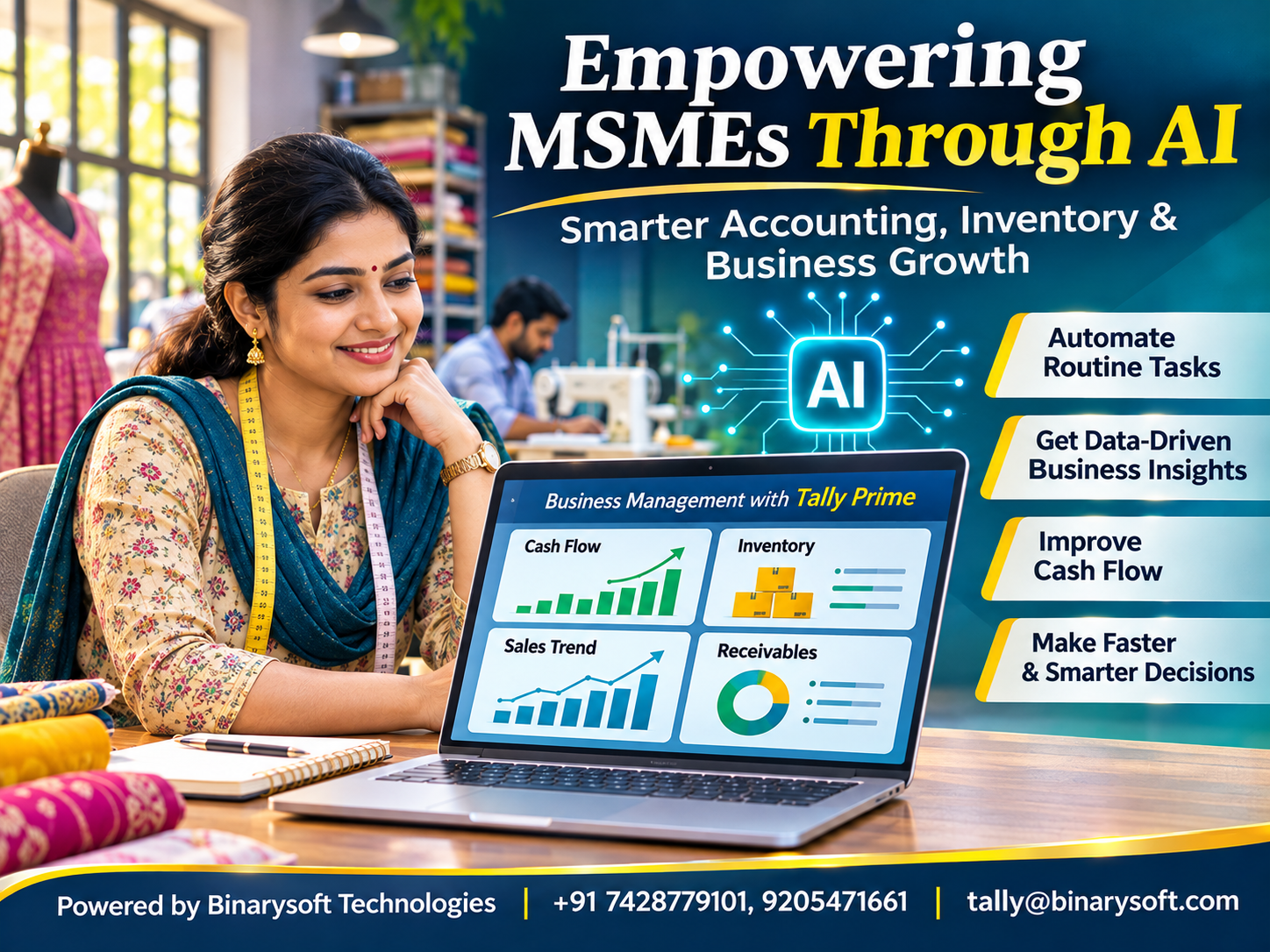
Introduction: A New Era of Opportunities for Small Businesses
Imagine a small business owner who begins every morning by reviewing yesterday's sales, checking customer payments, monitoring inventory and planning upcoming purchases.
By the time these activities are completed, several productive hours have already passed.
Now imagine a business environment where technology helps identify overdue payments, highlights slow-moving inventory, forecasts demand and prepares useful financial insights.
This is the opportunity artificial intelligence offers micro, small and medium enterprises (MSMEs).
For years, advanced business analytics and intelligent automation were associated primarily with large corporations. Today, increasingly accessible AI tools allow smaller organizations to explore similar capabilities without maintaining extensive technology departments.
Artificial intelligence can help MSMEs reduce repetitive work, understand business information and make faster, better-informed decisions.
However, AI works best when supported by reliable data and appropriate human oversight.
Accounting software such as Tally Prime can provide structured financial information that businesses may use with compatible analytical tools.
Together, accurate accounting and responsible AI adoption can support sustainable business growth.
1. What Is Artificial Intelligence for MSMEs?
Artificial intelligence refers to technologies that perform tasks commonly associated with human intelligence.
These tasks may include recognizing patterns, analyzing information, generating content, interpreting language and predicting possible outcomes.
For MSMEs, AI applications can support several business activities.
Financial Analysis: Identifying trends in revenue, expenses and payment collections.
Inventory Forecasting: Estimating future product demand using historical information.
Customer Support: Assisting with frequently asked questions and routine communication.
Sales Planning: Analyzing purchasing patterns and identifying potential opportunities.
Document Processing: Extracting information from invoices and business documents.
Operational Automation: Reducing repetitive administrative activities.
AI does not automatically understand every business requirement.
Its effectiveness depends on suitable information, clear objectives, appropriate software integration and continuous evaluation.
2. Why MSMEs Need AI-Powered Digital Transformation
Small businesses frequently operate with limited financial resources, small teams and increasing competition.
Employees often perform several responsibilities simultaneously.
A business owner may personally supervise purchasing, customer relationships, collections and financial planning.
This creates operational pressure.
AI can support digital transformation by helping organizations use their existing resources more effectively.
Reducing Manual Work
Suitable automation tools can assist with repetitive activities, allowing employees to focus on higher-value responsibilities.
Improving Decision-Making
AI-based analysis can highlight patterns that may not be immediately visible in routine reports.
Understanding Customers
Customer communication and transaction trends can help businesses identify changing preferences.
Supporting Financial Planning
Forecasting models can estimate possible future sales, expenses and cash requirements.
Increasing Operational Efficiency
Businesses can identify delays, unusual patterns and opportunities to improve workflows.
The objective should not be adopting AI simply because it is popular.
Businesses should begin with specific operational problems that technology can realistically address.
3. How AI Can Transform Accounting and Financial Management
Accounting provides essential information about business performance.
However, reviewing large quantities of financial data can become time-consuming.
AI-powered analytical tools may help organizations examine accounting information more efficiently.
Expense Pattern Analysis
AI models can identify unusual changes in expense categories.
For example, a sudden increase in transportation expenses may deserve investigation.
Revenue Forecasting
Historical sales data can support estimates of future revenue under different assumptions.
Payment Collection Analysis
Businesses can identify customers with repeated payment delays.
Financial Anomaly Detection
Analytical systems may highlight unusual transaction patterns for human review.
Management Reporting
AI tools can help prepare explanations and summaries based on verified financial information.
These applications require reliable data and careful validation.
AI-generated conclusions should never replace reconciliation, professional accounting judgment or required compliance checks.
4. How Tally Prime Supports AI-Driven Business Analysis
Tally Prime helps organizations maintain accounting, inventory and financial reporting information.
Although Tally Prime should not be described as a complete AI analytics platform, its records can support external analytical workflows.
Structured Financial Records
Businesses can maintain sales, purchases, receipts, payments and expenses.
Financial Statements
Profit and Loss Accounts and Balance Sheets help management understand financial performance and position.
Outstanding Management
Customer and supplier outstanding reports provide information about receivables and payables.
Inventory Reports
Stock information helps businesses review quantities, movements and valuation.
Cost Centre Analysis
Where configured appropriately, cost centres help organizations examine expenses and performance across activities.
Data Export and Analysis
Relevant reports can be exported using supported formats and analyzed in compatible spreadsheet or analytics applications.
A practical approach is to use Tally Prime as a reliable accounting information source while applying AI through separately configured, appropriately secured tools.
Advanced AI capabilities may require additional software, integration development and data preparation.
5. AI-Powered Inventory Management for MSMEs
Inventory management is a major challenge for manufacturers, wholesalers and retailers.
Excess stock increases storage costs and ties up working capital.
Insufficient inventory can result in delayed deliveries and lost sales.
AI-based forecasting can help estimate demand using historical sales and relevant external factors.
Consider a distributor selling electrical equipment.
Demand may change according to seasonal construction activity, customer requirements and regional market conditions.
An analytical model can examine historical quantities and estimate future requirements.
Tally Prime inventory reports can provide useful inputs, including stock quantities and transaction history.
However, management should also consider supplier lead times, product availability and unusual market events.
AI forecasts are estimates, not guaranteed outcomes.
6. Improving Cash Flow Forecasting with AI
Cash flow is essential for business survival.
An organization may generate substantial sales while experiencing difficulty collecting payments.
AI-supported forecasting can help businesses evaluate possible future cash requirements.
Consider the following monthly estimates:
Opening Cash Balance: ₹3,00,000
Expected Customer Collections: ₹6,00,000
Supplier Payments: ₹4,50,000
Operating Expenses: ₹2,00,000
Projected Closing Cash:
₹3,00,000 + ₹6,00,000 − ₹4,50,000 − ₹2,00,000
Projected Closing Cash = ₹2,50,000
AI models may refine such forecasts by examining historical collection patterns and recurring expenses.
Tally Prime provides accounting records that can support this analysis.
Management must still review assumptions and consider unexpected payment delays.
7. An Emotional Story: A Small Business Owner's Journey from Anxiety to Confidence
For sixteen years, Meena had operated a garment manufacturing business in Delhi.
She started with two sewing machines and a dream of providing financial stability for her family.
Over time, the business expanded.
She employed twelve workers and supplied garments to several retailers.
But growth brought new challenges.
Inventory records became complicated. Customer payments were frequently delayed. Demand changed unexpectedly.
Meena spent long evenings reviewing notebooks, spreadsheets and accounting reports.
Her son often waited for her to return home for dinner.
One evening, he asked, "Mummy, why do you work so hard if the business is doing well?"
Meena had no simple answer.
The business was growing, but she felt increasingly uncertain about its financial future.
A consultant suggested that she begin using her existing accounting information more systematically.
She organized her financial records, reviewed product-wise sales and introduced basic forecasting tools.
With suitable analytical assistance, she identified garments that consistently remained unsold and customers whose payments were frequently delayed.
She also began planning purchases according to historical demand rather than intuition alone.
The changes did not eliminate every problem.
However, they helped her make decisions with greater confidence.
One evening, Meena completed her work earlier than usual.
She returned home while her family was still preparing dinner.
Her son smiled and asked whether something special had happened.
She replied, "Nothing special. I finally understand my business better."
For Meena, technology was not about replacing people. It was about creating more time for the people who mattered most.
This is a fictional illustrative story inspired by common challenges faced by growing MSMEs.
8. Case Study One: Manufacturing MSME Improves Inventory Planning
Business Background
A hypothetical auto-components manufacturer supplies products to regional distributors.
The company struggles with excess inventory and unexpected shortages.
Initial Situation
Average Inventory Investment: ₹20,00,000
Estimated Slow-Moving Inventory: ₹5,00,000
Monthly Sales: ₹12,00,000
Management wants to improve purchasing decisions.
AI-Based Approach
The company organizes historical sales and inventory information.
A forecasting model examines product demand and identifies items requiring closer monitoring.
The purchasing team combines these estimates with supplier delivery schedules.
How Tally Prime Helps
Tally Prime provides stock movement, purchase and sales information.
Relevant data is exported for additional analysis.
Management reviews the resulting recommendations before changing purchase quantities.
Illustrative Outcome
Suppose the business reduces slow-moving inventory by 20%.
Potential Inventory Reduction:
₹5,00,000 × 20% = ₹1,00,000.
This may release working capital if purchasing commitments are reduced or existing stock is sold.
Business Lesson
AI-supported inventory planning can improve decision-making when forecasts are based on reliable records and reviewed by experienced employees.
This case study is hypothetical.
9. Case Study Two: Wholesale Distributor Improves Customer Collections
Business Background
A hypothetical electronics distributor sells products to retailers on credit.
The business experiences recurring payment delays.
Initial Situation
Total Outstanding Receivables: ₹15,00,000
Overdue Receivables: ₹6,00,000
Management wants to prioritize collection activities.
AI-Based Approach
Historical payment patterns are analyzed to identify accounts requiring attention.
The company introduces structured payment reminders and reviews customers with repeated delays.
Employees remain responsible for customer communication and final decisions.
How Tally Prime Helps
Outstanding reports provide customer balances and overdue information.
Accounting records support reconciliation of collections.
Illustrative Outcome
Suppose the business collects an additional 25% of its overdue receivables.
Additional Collections:
₹6,00,000 × 25% = ₹1,50,000.
This improves available cash, assuming the collections are additional to those otherwise expected during the period.
Business Lesson
Better collection visibility can strengthen liquidity without requiring additional borrowing.
This case study is illustrative and does not represent a verified customer result.
10. AI in Customer Service and Business Communication
Customer relationships are essential for MSME growth.
AI-powered communication tools can help businesses respond to routine questions and organize customer requests.
Potential applications include product information assistance, order status communication and frequently asked questions.
AI can also help employees prepare professional messages and summarize customer feedback.
However, businesses should avoid allowing automated systems to make unsupported commitments about pricing, delivery dates or payment terms.
Sensitive customer information must be handled according to applicable privacy and security requirements.
Human review remains important for complaints, disputes and complex commercial decisions.
11. AI for Sales Forecasting and Business Expansion
Sales forecasting helps businesses prepare for future demand.
AI models can analyze historical transactions and identify recurring patterns.
For example, a retailer may experience higher sales during festive periods.
A forecasting model can estimate potential demand based on earlier seasons.
Management can use these estimates to plan inventory, staffing and marketing activities.
Tally Prime sales reports can provide historical transaction information.
However, forecasts should also consider market conditions, competitor activity and unusual events.
Businesses should compare predicted results with actual performance and improve their models over time.
12. Automating Repetitive Business Activities
Repetitive administrative work consumes valuable employee time.
Suitable automation can assist with document classification, report preparation, payment reminder scheduling and data organization.
AI may also help interpret information from invoices or purchase documents.
However, extracted information must be verified before it becomes an accounting record.
For example, an incorrectly recognized invoice amount could affect financial statements or tax calculations.
Businesses should establish approval procedures for important transactions.
Automation should improve efficiency without weakening financial controls.
13. Challenges MSMEs Face When Adopting AI
AI adoption involves practical difficulties.
Limited Technical Knowledge
Employees may need training to understand and use analytical tools.
Poor Data Quality
Incomplete or inconsistent records can produce misleading results.
Implementation Costs
Software subscriptions, integrations and training may require investment.
Data Privacy
Financial and customer information must be protected against unauthorized disclosure.
Incorrect AI Outputs
AI systems may generate inaccurate explanations or recommendations.
Integration Complexity
Connecting AI applications with accounting systems may require technical development.
Successful adoption depends on selecting manageable projects and evaluating measurable business benefits.
14. Building a Practical AI Adoption Strategy
MSMEs should approach AI implementation gradually.
Step 1: Identify a Business Problem
Choose a measurable challenge such as overdue payments or excess inventory.
Step 2: Review Available Information
Ensure relevant accounting records are accurate and complete.
Step 3: Select Suitable Tools
Compare functionality, security, costs and integration requirements.
Step 4: Begin with a Pilot Project
Test the solution on a limited dataset or business process.
Step 5: Measure Results
Evaluate accuracy, time savings and operational improvements.
Step 6: Train Employees
Explain how the technology works and when human intervention is required.
Step 7: Expand Carefully
Introduce additional applications only after the initial project demonstrates value.
This approach reduces unnecessary investment and implementation risk.
15. Data Security and Responsible AI Adoption
Financial information is among a business's most valuable assets.
Organizations should establish clear rules before sharing accounting information with external AI services.
Sensitive customer details, bank information and confidential transactions should not be uploaded without appropriate authorization and safeguards.
Businesses should evaluate data retention, access permissions and service-provider security practices.
Where possible, use anonymized or aggregated information for analytical experiments.
AI-generated financial recommendations should be reviewed by responsible employees.
Compliance-related decisions must follow applicable laws and professional guidance.
Responsible AI adoption requires accountability, transparency and ongoing monitoring.
16. The Future of AI-Powered MSMEs
Artificial intelligence may increasingly support forecasting, customer communication, operational planning and financial analysis.
For MSMEs, the greatest opportunity is not necessarily sophisticated technology.
It is practical access to insights that previously required substantial time and resources.
A retailer may use demand forecasts to plan purchases.
A manufacturer may analyze production costs.
A distributor may identify overdue customer balances.
A service provider may automate routine communication.
These improvements become more valuable when supported by accurate accounting information.
Tally Prime can contribute through structured transaction records, inventory visibility and financial reporting.
The combination of reliable data, suitable analytical tools and human judgment can help smaller businesses compete more effectively.
Conclusion
Artificial intelligence offers MSMEs opportunities to improve productivity, financial planning, inventory management and customer service.
However, successful adoption requires more than installing new software.
Businesses need accurate information, clear objectives, suitable security controls and employees who understand how to evaluate AI-generated results.
Tally Prime supports this foundation by helping organizations maintain accounting records, monitor inventory, review outstanding balances and understand financial performance.
When these records are used responsibly with compatible AI tools, businesses can identify patterns, evaluate opportunities and improve operational decisions.
The future of MSME growth is not about replacing human experience with artificial intelligence. It is about combining human judgment, reliable financial information and intelligent technology to build stronger businesses.
Powered by Binarysoft Technologies
Authorized Tally Partner
Binarysoft Technologies helps businesses implement and use Tally Prime for accounting, inventory management, financial reporting and efficient business operations.
Accurate financial records and organized accounting processes provide a strong foundation for modern business analytics and responsible digital transformation.
Location:
1626/33, 1st Floor, Naiwalan, Karol Bagh, New Delhi – 110005, INDIA
Contact Us:
+91 7428779101, 9205471661
Email:
tally@binarysoft.com
Business Hours:
10:00 AM – 6:00 PM, Monday to Friday
Frequently Asked Questions
How does AI support cash flow forecasting?
AI can examine payment patterns, recurring expenses and historical collections to help estimate possible future cash requirements.
Can AI replace accountants?
AI can assist with analysis and repetitive activities, but professional judgment, reconciliation, compliance review and financial accountability remain essential.
Is business financial data safe with AI tools?
Safety depends on the provider, configuration and data-handling practices. Businesses should assess privacy, security and access controls before sharing sensitive information.
How can Binarysoft Technologies help MSMEs use Tally Prime?
Binarysoft Technologies can assist with Tally Prime implementation, accounting workflows, inventory management and financial reporting to help businesses maintain organized information for better decision-making.
CA. Priya Tanvi specializes in accounting compliance, GST advisory, and business reporting for small and growing enterprises. She works with business owners to improve record-keeping and financial clarity. Her articles focus on practical compliance solutions and operational discipline.