Call CA Tally HelpDesk
+91 9205471661,
7428779101
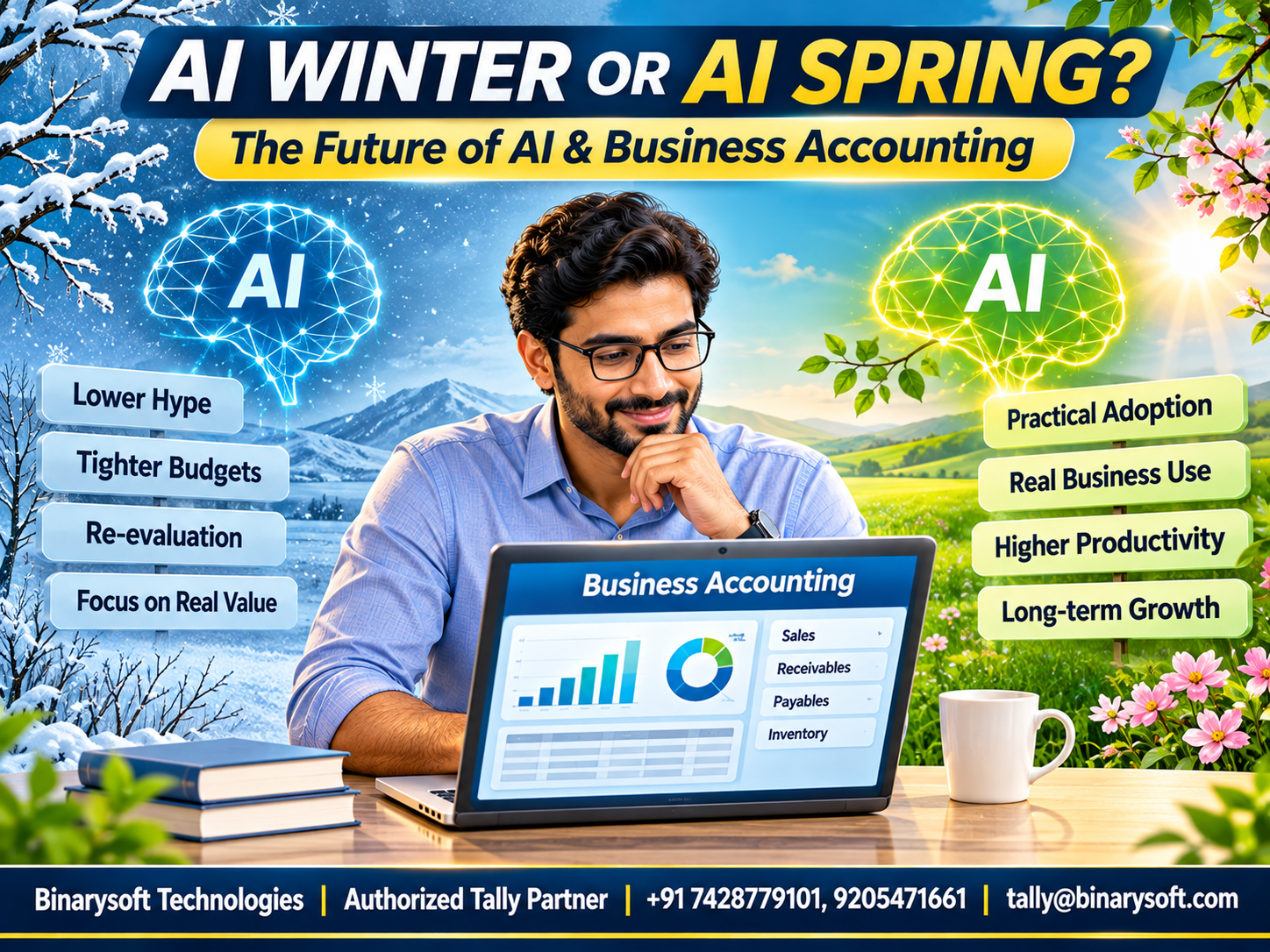
Introduction: Is Artificial Intelligence Entering a Golden Age or Another Period of Disappointment?
Artificial intelligence is changing how people work, communicate and make decisions.
Businesses are exploring AI-powered customer support, automated document processing, financial forecasting and intelligent data analysis.
Technology companies are investing heavily in advanced AI systems, while organizations of every size are evaluating potential applications.
Yet an important question remains.
Are we experiencing a lasting AI Spring, or could today's excitement eventually lead to another AI Winter?
The history of artificial intelligence contains remarkable breakthroughs alongside periods of reduced investment and disappointed expectations.
Understanding these cycles helps business owners distinguish genuine technological progress from unrealistic promises.
For Indian businesses, particularly those using accounting applications such as Tally Prime, this distinction matters.
AI can help organizations analyze information and streamline selected processes. However, accurate accounting, reliable business controls and human judgment remain essential.
The future of AI is not simply about replacing human effort. It is about identifying where intelligent technology can deliver measurable value.
1. What Is Artificial Intelligence?
Artificial intelligence refers to computer systems designed to perform tasks associated with human intelligence.
These tasks may include recognizing patterns, understanding language, generating content, making predictions and supporting decisions.
AI includes several related technologies.
Machine Learning: Systems learn statistical patterns from data to make predictions or classifications.
Natural Language Processing: Software processes and generates human language.
Computer Vision: Systems analyze images and visual information.
Generative AI: Models create text, images, code and other content based on learned patterns.
Predictive Analytics: Statistical and machine-learning methods estimate possible future outcomes.
These technologies have different capabilities and limitations.
Not every automated process is artificial intelligence.
For example, a predefined accounting rule that calculates a tax amount is conventional automation, even though it may save considerable time.
Understanding this distinction helps businesses evaluate software claims more accurately.
2. What Is an AI Spring?
An AI Spring describes a period of renewed progress, investment and optimism in artificial intelligence.
During these periods, researchers achieve significant breakthroughs and organizations explore new commercial applications.
AI Springs often emerge when improvements in computing power, algorithms and available data make previously difficult tasks more practical.
Recent advances in machine learning and generative AI have encouraged widespread experimentation.
Businesses can now use AI tools to summarize documents, assist with software development and analyze selected information.
However, an AI Spring does not guarantee that every proposed application will succeed.
Technological capability must still translate into dependable business outcomes.
3. What Is an AI Winter?
An AI Winter is a period when enthusiasm, funding or research momentum declines because artificial intelligence fails to meet expectations.
Historically, AI researchers sometimes promised capabilities that available technology could not deliver reliably.
When progress proved slower than anticipated, investors and institutions reduced support.
AI Winters did not mean that all artificial intelligence research stopped.
Instead, they reflected a mismatch between ambitious expectations and practical achievements.
Several factors can contribute to such periods:
-
Unrealistic predictions about technological capabilities.
-
High implementation and operating costs.
-
Limited computing resources.
-
Insufficient or unsuitable training data.
-
Poor reliability in real-world environments.
-
Difficulty demonstrating commercial value.
The central lesson is that excitement alone cannot sustain technological adoption.
4. A Brief History of AI Winters and Springs
Artificial intelligence emerged as a formal research field during the 1950s.
Early researchers explored whether computers could perform reasoning and problem-solving tasks.
Initial demonstrations generated considerable optimism.
However, many systems struggled with complex real-world situations.
During the 1970s, limitations in computing resources and unmet expectations contributed to reduced support for some AI research.
Interest later increased through expert systems, which attempted to encode specialist knowledge as rules.
These systems demonstrated commercial possibilities but were often expensive to maintain and difficult to adapt.
Another period of disappointment followed during the late 1980s and early 1990s.
Subsequent improvements in computing power, data availability and machine-learning techniques supported renewed progress.
Deep learning achieved notable results in image recognition, speech processing and other areas.
More recently, large language models and generative AI have expanded public awareness of artificial intelligence.
The historical pattern demonstrates that progress is rarely linear.
Periods of rapid advancement may be followed by necessary reassessment.
5. Why Artificial Intelligence Is Growing Rapidly
Several developments have contributed to modern AI capabilities.
Greater Computing Power
Specialized processors and distributed computing infrastructure support increasingly complex models.
Larger Datasets
Digital systems generate substantial amounts of information that can support suitable machine-learning applications.
Improved Algorithms
Research advances have improved performance across language, vision and prediction tasks.
Cloud Infrastructure
Cloud services make certain computing resources accessible without requiring every organization to own specialized hardware.
Business Demand
Organizations are interested in reducing repetitive work and improving decision-making.
These developments create opportunities, but they also introduce concerns involving cost, privacy, reliability and governance.
Businesses should evaluate both benefits and limitations before adopting AI.
6. Why Another AI Winter Remains Possible
Modern AI systems are powerful, but they are not universally reliable.
Generative models may produce convincing information that is factually incorrect.
AI implementations can also face substantial operating costs.
Some organizations struggle to move from impressive demonstrations to dependable production workflows.
Data protection requirements and regulatory obligations may complicate deployment.
Businesses may discover that certain AI applications provide less financial value than initially expected.
These challenges could reduce enthusiasm for specific technologies or investment approaches.
However, disappointment in one category does not necessarily mean that the entire field will enter a prolonged winter.
Artificial intelligence contains many distinct research areas and practical applications.
Its future will depend on continued technical progress and demonstrated usefulness.
7. An Emotional Story: A Small Business Owner's Fear of Being Left Behind
Rajesh operated a stationery distribution business in Delhi.
His father had started the company with a small rented shop and limited savings.
Over the years, Rajesh expanded operations, hired employees and introduced computerized accounting.
He believed in technology, but the rapid rise of artificial intelligence made him uncertain.
Everywhere he looked, advertisements promised that AI would transform business operations.
Some suggested that traditional accounting methods would soon become unnecessary.
Rajesh began worrying about his employees.
His senior accountant had worked with the family for nearly twenty years.
Would new technology make that experience irrelevant?
One evening, Rajesh discussed his concerns with his daughter, who was studying computer science.
She explained that AI could assist with certain tasks, but dependable business decisions still required accurate information and experienced people.
Together, they reviewed the company's processes.
They discovered that the immediate challenge was not a lack of artificial intelligence.
It was inconsistent inventory records and delayed customer payment follow-ups.
Rajesh decided to improve the company's accounting discipline first.
The team reviewed customer ledgers, corrected master-data inconsistencies and established regular financial reporting.
They also began exploring AI tools for low-risk activities, such as drafting internal communications and summarizing non-confidential information.
The senior accountant became an important part of the improvement process.
His experience helped identify practical risks that technology demonstrations had overlooked.
Several months later, Rajesh felt more confident.
He no longer viewed artificial intelligence as a threat that had to be adopted immediately.
He saw it as another tool that could support his business when used thoughtfully.
For Rajesh, the real breakthrough was realizing that technology should strengthen the people who built the business, not make them feel replaceable.
This fictional story reflects a concern shared by many business owners navigating technological change.
8. How AI Can Support Small and Medium Businesses
Artificial intelligence offers several potential applications for small and medium enterprises.
Customer Communication
AI tools can help prepare draft responses to routine enquiries.
Employees should review important communications before sending them.
Document Processing
Suitable systems may extract information from invoices and other documents.
Extracted values still require validation.
Sales Analysis
Predictive models can help identify patterns in historical sales data.
Inventory Planning
Forecasting tools may estimate future demand based on relevant information.
Expense Analysis
Analytics applications can highlight unusual spending patterns for investigation.
Administrative Support
AI assistants can summarize non-sensitive documents and support routine writing tasks.
The usefulness of each application depends on data quality, implementation cost and operational requirements.
9. How Tally Prime Supports Data-Driven Business Management
Tally Prime is primarily accounting and business management software.
It provides capabilities for recording transactions, managing inventory, maintaining ledgers and preparing financial reports.
These functions are important because reliable business analysis depends on trustworthy underlying information.
Financial Record Management
Businesses can maintain organized records of income, expenses, assets and liabilities.
Sales and Purchase Accounting
Transactions can be recorded and reviewed through appropriate vouchers and reports.
Inventory Management
Stock information helps organizations monitor quantities and movements.
Receivables and Payables
Outstanding reports support payment monitoring and follow-up planning.
Financial Reporting
Profit & Loss statements, Balance Sheets and other reports provide information for management review.
GST-Related Workflows
Supported features assist businesses with relevant GST accounting and reporting requirements.
These capabilities help establish a dependable foundation for financial analysis.
Tally Prime should not be described as automatically providing every advanced AI capability discussed in this article.
10. Can Artificial Intelligence Work Alongside Tally Prime?
Businesses may explore combining accounting information with external analytics or AI applications.
For example, authorized financial data could be analyzed to identify historical sales patterns.
An external forecasting model might estimate future inventory demand.
However, such workflows require suitable data extraction, technical design, security controls and validation.
AI-generated recommendations should not automatically alter accounting records without appropriate authorization.
Organizations must also consider confidentiality when transferring financial information to external services.
A responsible implementation separates accounting accuracy from AI-generated interpretation.
Tally Prime can maintain the underlying business records, while suitable external tools may support additional analysis.
11. Case Study One: AI-Assisted Inventory Planning
Illustrative Case Study
Business Background
A wholesale electronics distributor maintains sales and inventory information in Tally Prime.
The Challenge
Demand varies throughout the year, making inventory planning difficult.
Management wants to explore whether historical information can improve purchasing decisions.
The Approach
The company first reviews the accuracy of its stock and sales records.
Authorized historical data is then prepared for analysis using a separate forecasting application.
Management compares forecasts with actual demand and evaluates their reliability.
Expected Outcome
The business may identify useful demand patterns and improve its purchasing discussions.
However, forecasts remain estimates rather than guarantees.
Business Lesson
AI forecasting becomes more useful when supported by accurate accounting records and experienced management judgment.
12. Case Study Two: Improving Financial Review Processes
Illustrative Case Study
Business Background
A professional services company uses Tally Prime to maintain accounting records and prepare financial statements.
The Challenge
Management spends considerable time examining expenses and preparing periodic financial commentary.
The Approach
The finance team standardizes ledger classifications and reviews transaction accuracy.
Approved financial summaries are analyzed using an external reporting tool.
AI assistance is explored for drafting explanations of selected financial trends.
The accountant verifies every interpretation against the underlying records.
Expected Outcome
Management may reduce time spent preparing preliminary commentary while retaining human control over financial conclusions.
Business Lesson
AI can assist with analysis, but financial accountability must remain with qualified personnel.
Both case studies are illustrative and do not represent verified customer results.
13. The Importance of Data Quality in AI Adoption
Artificial intelligence depends heavily on the quality and relevance of information.
Incomplete or inaccurate records can produce misleading results.
For example, an inventory forecasting model may perform poorly if historical stock movements contain errors.
Similarly, financial analysis may be unreliable when expenses are classified inconsistently.
Businesses should establish clear data-management practices before adopting AI.
Important activities include reviewing duplicate records, maintaining consistent classifications and reconciling transactions.
Tally Prime can support organized accounting records, but employees remain responsible for entering and reviewing information correctly.
Reliable data is not a guarantee of accurate AI predictions.
Nevertheless, poor-quality data significantly weakens the foundation of meaningful analysis.
14. Human Intelligence vs Artificial Intelligence
AI systems can process large amounts of information and identify patterns.
However, they do not possess the same practical understanding, responsibility or judgment as experienced professionals.
An accountant understands the commercial context behind unusual transactions.
A business owner may recognize why customer demand changes during a local festival.
A finance manager can consider contractual obligations and operational risks.
These contextual judgments remain important.
Artificial intelligence is most useful when its outputs can be evaluated by knowledgeable people.
Businesses should therefore develop workflows that combine computational assistance with human oversight.
The objective is not to create competition between people and technology.
It is to use each where it provides the greatest value.
15. Risks of Using AI in Accounting and Finance
Financial information requires particular care.
Incorrect Outputs
AI tools may generate inaccurate calculations or explanations.
Confidentiality Risks
Uploading sensitive financial records to external services can create privacy and security concerns.
Overreliance
Employees may accept AI-generated recommendations without sufficient verification.
Inconsistent Results
Some models may produce different responses to similar questions.
Regulatory Concerns
Financial and personal information must be handled according to applicable requirements.
Integration Complexity
Connecting AI systems with accounting workflows may require specialized technical expertise.
Businesses should establish appropriate approval procedures, access controls and validation processes.
AI should assist financial professionals rather than replace essential accounting controls.
16. How Businesses Can Prepare for the Next AI Spring
Organizations do not need to adopt every new technology immediately.
A practical approach begins with identifying genuine business problems.
Identify Repetitive Activities
Look for tasks that consume time without requiring complex judgment.
Improve Data Accuracy
Review accounting records and master-data consistency.
Select Low-Risk Use Cases
Begin with applications where errors can be identified and corrected easily.
Evaluate Costs
Consider implementation, training, maintenance and ongoing usage expenses.
Train Employees
Explain the capabilities and limitations of AI tools.
Establish Human Review
Require appropriate verification of important outputs.
Measure Results
Compare actual improvements against the original business objective.
This approach helps organizations avoid technology investments driven entirely by market excitement.
17. Will AI Replace Accountants?
Artificial intelligence may change how accounting professionals perform certain tasks.
Routine document processing, information classification and preliminary analysis may become increasingly automated.
However, accounting involves more than processing data.
Professionals interpret financial information, apply judgment, investigate discrepancies and maintain accountability.
Tax compliance, financial controls and management decisions require careful consideration.
AI-generated outputs may assist with selected activities, but they still need appropriate verification.
For accounting professionals, developing analytical skills and technological awareness can be valuable.
Businesses should focus on helping employees adapt rather than assuming that entire roles will disappear.
18. The Future: AI Winter, AI Spring or Continuous Evolution?
Predicting the exact future of artificial intelligence is difficult.
Some technologies may experience reduced investment as organizations reassess their commercial value.
Other applications may continue improving and become standard business tools.
Both developments can occur simultaneously.
The most important question for business owners is not whether the entire industry is entering winter or spring.
It is whether a particular technology solves a real problem safely and economically.
For organizations using Tally Prime, reliable accounting remains essential regardless of technological trends.
AI may provide new ways to interpret business information, but financial accuracy and responsible decision-making will continue to matter.
Sustainable innovation comes from combining useful technology with sound business fundamentals.
Conclusion
The history of artificial intelligence demonstrates a recurring pattern of optimism, technical progress and reassessment.
AI Springs emerge when new capabilities create opportunities.
AI Winters occur when expectations exceed practical results.
Today's AI technologies offer meaningful possibilities for business automation, forecasting and analysis, but they also present challenges involving reliability, cost and data protection.
For Indian businesses, the most effective approach is neither unconditional enthusiasm nor complete resistance.
Organizations should evaluate practical use cases, maintain accurate records and establish appropriate human oversight.
Tally Prime supports the accounting and financial information management that businesses need before exploring advanced analytics.
The future belongs not simply to businesses that adopt artificial intelligence first, but to those that use technology responsibly to solve meaningful problems.
Powered by Binarysoft Technologies
Authorized Tally Partner
Binarysoft Technologies helps businesses strengthen their accounting processes through Tally Prime implementation, configuration, customization, technical support and cloud-based accounting solutions.
Our services support organizations seeking accurate financial records, improved reporting and dependable business operations.
Location:
1626/33, 1st Floor, Naiwalan, Karol Bagh, New Delhi – 110005, INDIA
Contact Us:
+91 7428779101, 9205471661
Email:
tally@binarysoft.com
Business Hours:
10:00 AM – 6:00 PM, Monday to Friday
Frequently Asked Questions
How can Tally Prime support AI-related business analysis?
It can help maintain organized accounting, sales, purchase and inventory records that may be used in appropriately designed analytical workflows.
What are the main risks of AI in accounting?
Important risks include incorrect outputs, confidentiality concerns, overreliance and insufficient verification.
How should businesses prepare for the future of AI?
They should improve data quality, identify practical applications, train employees, evaluate costs and maintain appropriate human oversight.
Does Tally Prime automatically provide advanced AI forecasting?
Not as a general built-in capability. Advanced forecasting may require suitable external tools, technical integration and validation.
CA. Arinav Chakraborty advises businesses on taxation, accounting systems, and financial planning. His professional interests include digital transformation, compliance management, and improving business efficiency through technology.