Introduction: Why Modern Businesses Need More Than Traditional Accounting
Running a successful business in 2026 requires more than maintaining sales registers and preparing annual financial statements. Indian entrepreneurs must manage GST compliance, customer payments, inventory availability, banking transactions, operating expenses and business profitability while responding to growing competition.
For many small and medium businesses, the real challenge is not generating sales. It is understanding whether those sales are profitable, whether customers will pay on time and whether sufficient working capital is available for the next business cycle.
Traditional manual accounting and disconnected spreadsheets often make these questions difficult to answer.
This is where TallyPrime becomes valuable.
TallyPrime is business management software designed to bring accounting, invoicing, inventory, banking, taxation and financial reporting into a coordinated system.
Whether a business operates a retail store, wholesale distribution network, manufacturing unit or professional services organization, accurate financial information can support faster and more confident decisions.
The objective is not simply to automate bookkeeping. It is to create a business environment where owners understand their operations, identify financial risks early and plan sustainable growth.
1. What Is TallyPrime and Why Is It Important for Businesses?
TallyPrime is accounting and business management software that helps organizations record financial transactions, manage stock, generate invoices, monitor outstanding payments and prepare financial reports.
Instead of maintaining separate records for purchases, sales, inventory and customer balances, businesses can organize these activities within a single accounting environment.
For example, when a wholesale trader records a properly configured inventory sales invoice, the transaction can update the customer's account, sales figures, applicable tax records and inventory quantities.
This reduces duplicate recording and improves consistency.
Major business activities supported by TallyPrime
-
Financial accounting and bookkeeping.
-
GST invoicing and statutory reporting.
-
Purchase and sales management.
-
Inventory and warehouse tracking.
-
Banking and reconciliation.
-
Customer credit and outstanding management.
-
Manufacturing-related inventory records.
-
Payroll and cost centre accounting.
-
Financial statements and management reports.
-
Data security, user access and backup management.
The exact capabilities available depend on the product release, license, configuration and applicable connected services.
2. A Business Owner's Story: The Night One Question Changed Everything
At 9:45 PM, Amit was still sitting inside his trading office in Karol Bagh, New Delhi.
His employees had gone home. The market was quiet. Yet his desk remained covered with supplier invoices, payment reminders and handwritten stock calculations.
Amit had inherited the business from his father and worked hard to expand it.
Over the years, the company had gained new customers, increased its product range and started supplying retailers outside Delhi.
From the outside, everything appeared successful.
But Amit was worried.
Customers were taking longer to make payments. Suppliers expected timely settlements. His warehouse contained expensive products that had not sold for months.
Every time he asked for an accurate outstanding statement, his accountant needed additional time to reconcile different records.
One evening, his young son asked, "Papa, why do you work so much if you are always worried about the business?"
The question stayed with him.
Amit realized that he was managing transactions without having a complete understanding of his financial position.
He decided to reorganize his business records using TallyPrime.
Customer balances were reviewed, inventory items were classified and daily transactions were entered systematically.
He began checking cash flow, outstanding receivables and stock reports regularly.
The business did not become problem-free overnight. However, Amit could finally identify where money was blocked and which activities required attention.
For the first time in years, he could plan supplier payments with greater confidence.
He also started leaving the office earlier.
His greatest achievement was not simply improved accounting. It was regaining control over the business he had worked so hard to build.
This fictional story illustrates financial and operational challenges commonly faced by Indian entrepreneurs.
3. Financial Accounting: Building a Reliable Foundation
Accurate accounting is essential for understanding business performance.
Every organization must record income, expenditure, assets, liabilities and financial transactions consistently.
Poor accounting practices can result in incorrect profit calculations, overlooked expenses and unreliable financial statements.
TallyPrime supports double-entry accounting through ledgers, groups and different voucher types.
Important accounting vouchers
Sales Voucher: Records sales of goods or services.
Purchase Voucher: Records purchases from suppliers.
Receipt Voucher: Records money received from customers and other sources.
Payment Voucher: Records payments made by cash or bank.
Contra Voucher: Records applicable transfers between cash and bank accounts.
Journal Voucher: Records adjustments and other appropriate accounting entries.
Practical example
A trader purchases goods worth ₹80,000 before GST on credit.
The purchase voucher records the transaction against the supplier, with applicable inventory and tax details.
When the trader makes payment, a payment voucher records the settlement against the supplier's outstanding balance.
This creates a consistent transaction history.
Financial reports in TallyPrime
Business owners can examine the Profit & Loss Account, Balance Sheet, Trial Balance, Day Book, Cash Flow and ledger statements.
These reports help identify profitability, financial obligations and operational expenditure.
4. GST Billing and Compliance Management
GST compliance is an important responsibility for registered businesses in India.
Incorrect tax classification, incomplete invoices, missing GSTIN details and unreconciled transactions can create administrative and financial difficulties.
TallyPrime supports GST-related accounting and invoicing through configurable tax information.
Businesses can maintain customer and supplier GST details, relevant HSN/SAC classifications and applicable tax rates.
GST billing example
Consider a business selling taxable goods worth ₹50,000, assuming an applicable GST rate of 18%.
|
Particulars
|
Amount
|
|---|
|
Taxable value
|
₹50,000
|
|
CGST at 9%
|
₹4,500
|
|
SGST at 9%
|
₹4,500
|
|
Invoice total
|
₹59,000
|
This is an illustrative intra-state transaction. Actual GST treatment depends on the product or service, place of supply and prevailing rules.
How TallyPrime helps
Businesses can prepare GST invoices, review tax calculations, maintain GST ledgers and generate relevant reports.
Supported releases also provide connected GST workflows for activities such as downloading return data, reconciliation, uploading information and filing through configured services.
Regular reconciliation helps identify discrepancies before finalizing returns.
Accounting software supports compliance processes, but businesses must still verify applicable legal requirements and return information.
5. Inventory Management: Better Stock Visibility and Purchasing Decisions
Inventory represents a substantial investment for many businesses.
Maintaining excessive stock blocks working capital, while insufficient stock can result in lost sales.
TallyPrime provides inventory features for tracking goods, quantities, stock values and movement between locations.
Important inventory features
Stock Groups: Classify products into meaningful categories.
Stock Items: Maintain individual product records.
Units of Measurement: Track quantities using pieces, kilograms, metres or other relevant units.
Godowns: Monitor stock across warehouses or storage locations.
Batch Management: Track batches where appropriate.
Reorder Levels: Help identify products that may require replenishment.
Stock Summary: Review available quantities and valuations.
Practical application
A distributor selling electrical products may handle hundreds of switches, cables, lighting products and accessories.
Using stock groups and inventory reports, management can identify which products are selling regularly and which items are occupying warehouse space unnecessarily.
Better inventory information helps reduce purchasing mistakes and supports customer service.
6. Banking and Reconciliation for Financial Accuracy
Banking activities influence almost every business operation.
Organizations receive customer payments, settle supplier invoices, pay salaries and manage operating expenses through bank accounts.
When accounting records do not match bank statements, financial reporting becomes unreliable.
TallyPrime provides banking utilities and reconciliation functionality.
Depending on the configured bank and supported services, businesses may use statement imports, automated reconciliation assistance and connected banking or payment features.
Benefits of regular reconciliation
Regular reconciliation helps identify missing entries, bank charges, duplicate records and transactions requiring investigation.
It also improves confidence in cash and bank balances.
A business that reconciles accounts frequently can identify discrepancies earlier rather than waiting until the financial year ends.
7. Customer Credit and Cash Flow Management
Increasing sales does not always result in stronger cash flow.
A business may generate substantial credit sales while struggling to pay suppliers.
Customer credit management therefore plays an important role in financial stability.
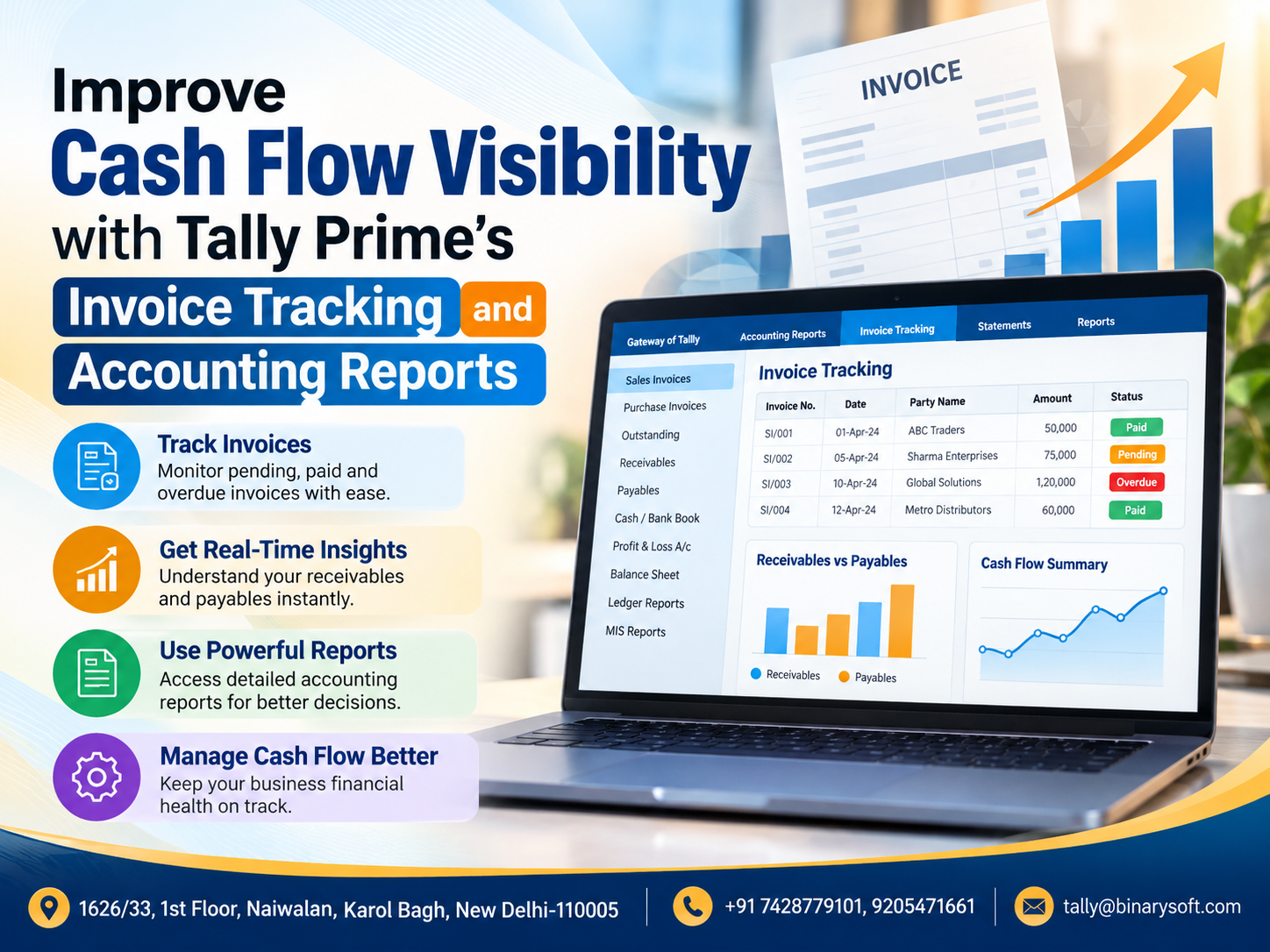
TallyPrime supports bill-wise outstanding tracking and customer ledger analysis.
Business owners can review unpaid invoices, overdue balances and credit exposure.
Example
A wholesaler generates ₹15 lakh in monthly sales, but ₹9 lakh remains unpaid beyond agreed credit periods.
Without regular outstanding monitoring, management may continue extending credit without understanding the financial risk.
Using customer outstanding reports, the business can prioritize collections and review future credit decisions.
This helps maintain a better balance between sales growth and working capital requirements.
8. Manufacturing and Production Management with TallyPrime
Manufacturing businesses require accurate information about raw materials, production activities and finished goods.
TallyPrime supports inventory-related manufacturing processes through Bills of Materials and manufacturing journals.
A Bill of Materials identifies the components required to manufacture a product.
For example, a furniture manufacturer can define the quantity of wood, hardware and other materials required for a particular product.
When configured correctly, manufacturing-related stock entries help record material consumption and finished goods production.
This provides better visibility into stock movement and material costs.
Businesses should supplement these records with physical verification and appropriate production controls.
9. Case Study One: A Delhi Wholesale Business Improves Accounting and Inventory Control
Illustrative case study based on common wholesale trading operations.
Business background
A wholesale electronics distributor operating in Nehru Place, Delhi, supplied computer accessories and electronic products to retailers.
The company managed approximately 600 products and regularly provided goods on credit.
Challenges
Inventory information was maintained in spreadsheets, while accounting transactions were recorded separately.
Management frequently experienced differences between physical and recorded stock.
Customer collections were delayed, and identifying overdue invoices required considerable manual work.
TallyPrime implementation
The business organized customer and supplier ledgers, introduced stock groups and configured inventory tracking.
Bill-wise accounting was used to monitor unpaid customer invoices.
The accounts team also established weekly outstanding reviews and regular bank reconciliation procedures.
Business outcomes
The new process improved visibility into inventory availability and customer balances.
Management could identify slow-moving products, review overdue invoices and plan purchases using more consistent information.
The business also reduced dependence on manually combining separate records.
Key learning
Reliable accounting and inventory information can help wholesale businesses improve operational discipline and working capital management.
10. Case Study Two: A Manufacturing Company Strengthens Production Accounting
Illustrative case study demonstrating manufacturing-related business improvements.
Business background
A small manufacturing company in Faridabad produced metal components for industrial customers.
The organization purchased raw materials, processed them and supplied finished goods against customer orders.
Challenges
Management experienced difficulty tracking raw material consumption and understanding production-related stock movements.
Different departments maintained separate records, resulting in reconciliation delays.
TallyPrime implementation
The company introduced stock classification, Bills of Materials and appropriate manufacturing journals.
Accounting ledgers were reorganized, and cost centres were configured for selected expense tracking requirements.
The accounts team began reviewing inventory valuation and production-related records regularly.
Business outcomes
The company gained clearer visibility into material usage and finished goods availability.
Management could investigate stock differences more efficiently and use recorded cost information to support pricing decisions.
Key learning
Manufacturing businesses benefit when inventory transactions and financial accounting are maintained systematically.
11. Financial Reporting and Business Decision-Making
Financial reports transform recorded transactions into useful business information.
TallyPrime provides reports that help entrepreneurs understand profitability, assets, liabilities and cash requirements.
Important reports for management
|
Report
|
Business benefit
|
|---|
|
Profit & Loss Account
|
Understand income, expenses and profitability
|
|
Balance Sheet
|
Review assets, liabilities and capital
|
|
Cash Flow
|
Examine cash movement
|
|
Stock Summary
|
Monitor inventory quantities and values
|
|
Outstanding Receivables
|
Identify customer collection requirements
|
|
Outstanding Payables
|
Plan supplier settlements
|
|
Trial Balance
|
Review ledger balances
|
|
Cost Centre Reports
|
Analyze allocated income and expenses
|
Regularly reviewing these reports can help identify problems before they become serious.
For example, increasing sales accompanied by declining profit margins may indicate rising costs, discounting pressure or changes in the product mix.
Business owners should investigate these patterns instead of relying exclusively on turnover figures.
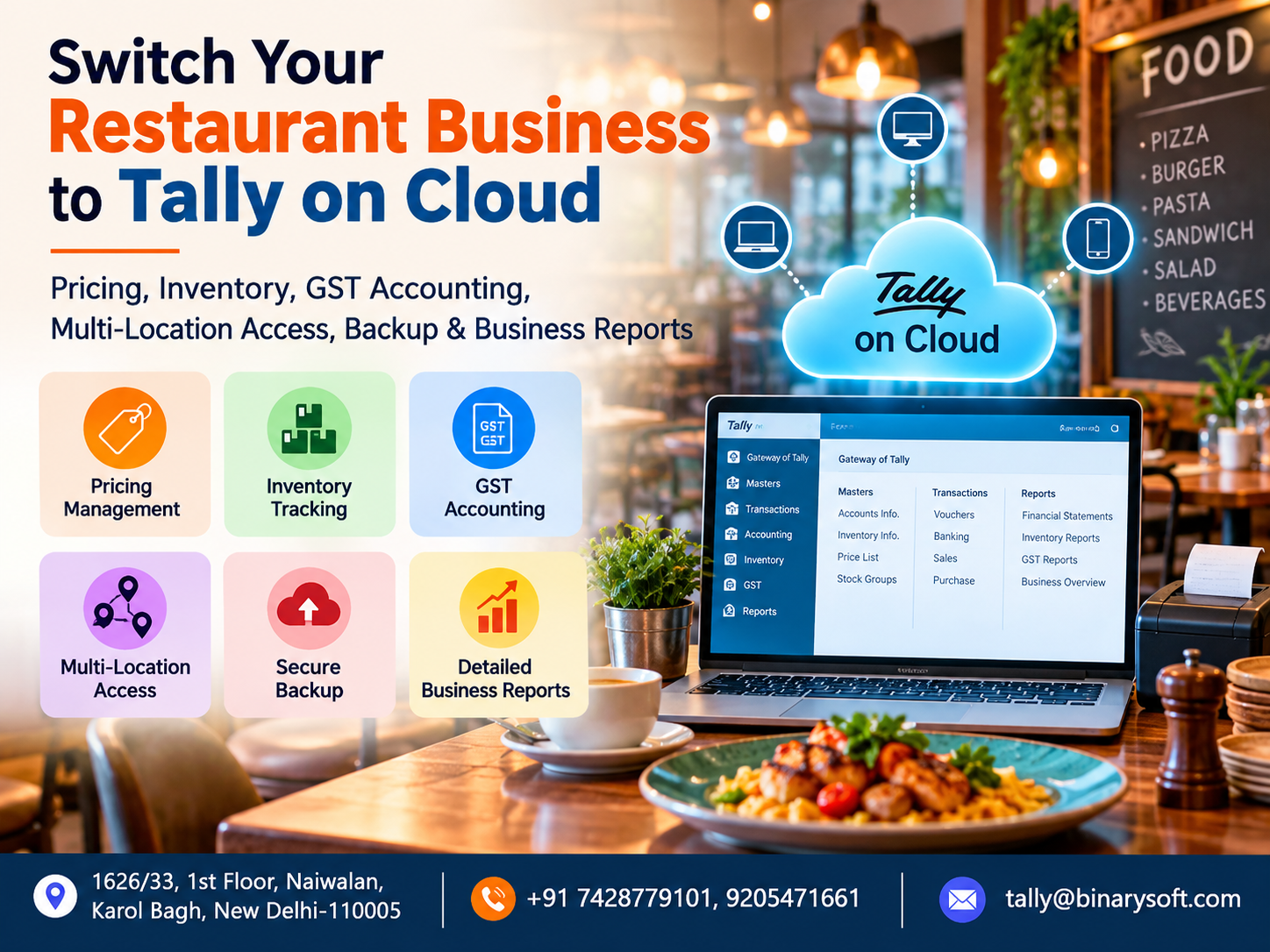
12. TallyPrime on Cloud: Supporting Flexible Business Operations
Businesses with multiple locations or remote working requirements may benefit from an appropriately configured cloud-hosted environment.
TallyPrime on Cloud generally refers to running the desktop application through a hosted Windows environment, rather than converting it into a browser-native application.
Depending on the hosting arrangement, authorized users may access the configured environment remotely.
Potential benefits
Cloud hosting can support flexible access, centralized infrastructure management and collaboration between authorized employees.
It may also reduce dependence on a single office computer.
However, performance, backup arrangements, security, concurrent access and availability depend on the hosting provider, licensing and technical configuration.
Businesses should verify data protection arrangements, backup restoration procedures and user permissions before selecting a hosting solution.
13. How to Start Using TallyPrime: Step-by-Step Guide
A structured implementation helps businesses maintain accurate information from the beginning.
Step 1: Create the company
Enter the company name, financial year, address and relevant statutory information.
Step 2: Configure accounting features
Set up accounting options, required voucher types and financial controls.
Step 3: Create ledgers and groups
Organize customers, suppliers, banks, expenses, income and other accounts.
Step 4: Configure GST
Enter registration details and appropriate tax information according to business requirements.
Step 5: Create inventory masters
Define stock items, groups, units and godowns where applicable.
Step 6: Enter opening balances
Record verified opening ledger balances and inventory quantities.
Step 7: Record transactions
Enter daily purchases, sales, receipts, payments and other relevant vouchers.
Step 8: Review reports
Check accounting, inventory, banking and GST-related reports regularly.
Step 9: Configure security
Establish suitable user permissions and data protection procedures.
Step 10: Maintain backups
Implement scheduled backups, test restoration periodically and retain secure copies according to business requirements.
14. Best Practices for Getting Maximum Value from TallyPrime
Software implementation is only the beginning.
Businesses should establish disciplined operating procedures to maintain accurate information.
Employees should receive appropriate training before entering live transactions.
Accounting masters should follow consistent naming and classification practices.
Customer and supplier balances should be reconciled regularly.
Inventory quantities should be physically verified at suitable intervals.
GST-related information should be reviewed before return submission.
Management should examine financial reports at least monthly, with more frequent reviews for cash flow and outstanding collections.
These practices help ensure that accounting information remains reliable and useful.
15. Why TallyPrime Can Support Long-Term Business Growth
As businesses expand, transaction volumes, inventory complexity and reporting requirements often increase.
A structured accounting environment can help manage these changes.
TallyPrime supports organizations by maintaining financial records, inventory information, customer balances and management reports within a coordinated system.
Its usefulness extends beyond statutory bookkeeping.
Business owners can use financial information to evaluate pricing, monitor expenditure, review stock investments and assess expansion plans.
The greatest benefit comes when management regularly acts on the information available.
Conclusion: Build a More Organized and Financially Confident Business
Successful business management requires accurate records, reliable financial information and disciplined operational practices.
TallyPrime can help Indian businesses simplify accounting, manage GST-related transactions, track inventory, reconcile banking activities and monitor financial performance.
For retailers, wholesalers, manufacturers and service providers, these capabilities can reduce repetitive administrative work and improve decision-making.
However, software cannot replace sound business judgment, employee training or regular financial reviews.
Organizations achieve better results when technology supports clearly defined processes.
By combining structured accounting with inventory control, cash flow monitoring and financial analysis, entrepreneurs can build stronger foundations for sustainable business growth.
Powered by Binarysoft Technologies
Authorized Tally Partner
Location: 1626/33, 1st Floor, Naiwalan, Karol Bagh, New Delhi – 110005, INDIA
Contact us: +91 7428779101, 9205471661
Email us: tally@binarysoft.com
Business Hours: 10:00 AM – 6:00 PM, Monday to Friday