Call CA Tally HelpDesk
+91 9205471661,
7428779101
Introduction: Why Accurate TDS Accounting Has Become Essential for Indian Businesses
Managing Tax Deducted at Source (TDS) is an important responsibility for businesses making payments to contractors, professionals, employees and other eligible recipients. As transaction volumes increase, manually calculating deductions, maintaining challan details and preparing quarterly returns can become time-consuming and difficult.
In 2026, businesses face increasing pressure to maintain accurate financial records, meet statutory deadlines and avoid unnecessary interest, penalties and compliance notices.
Even a small mistake in a deductee's PAN, tax rate, payment date or challan information can create reconciliation problems.
This is why many businesses prefer using Tally Prime for TDS accounting.
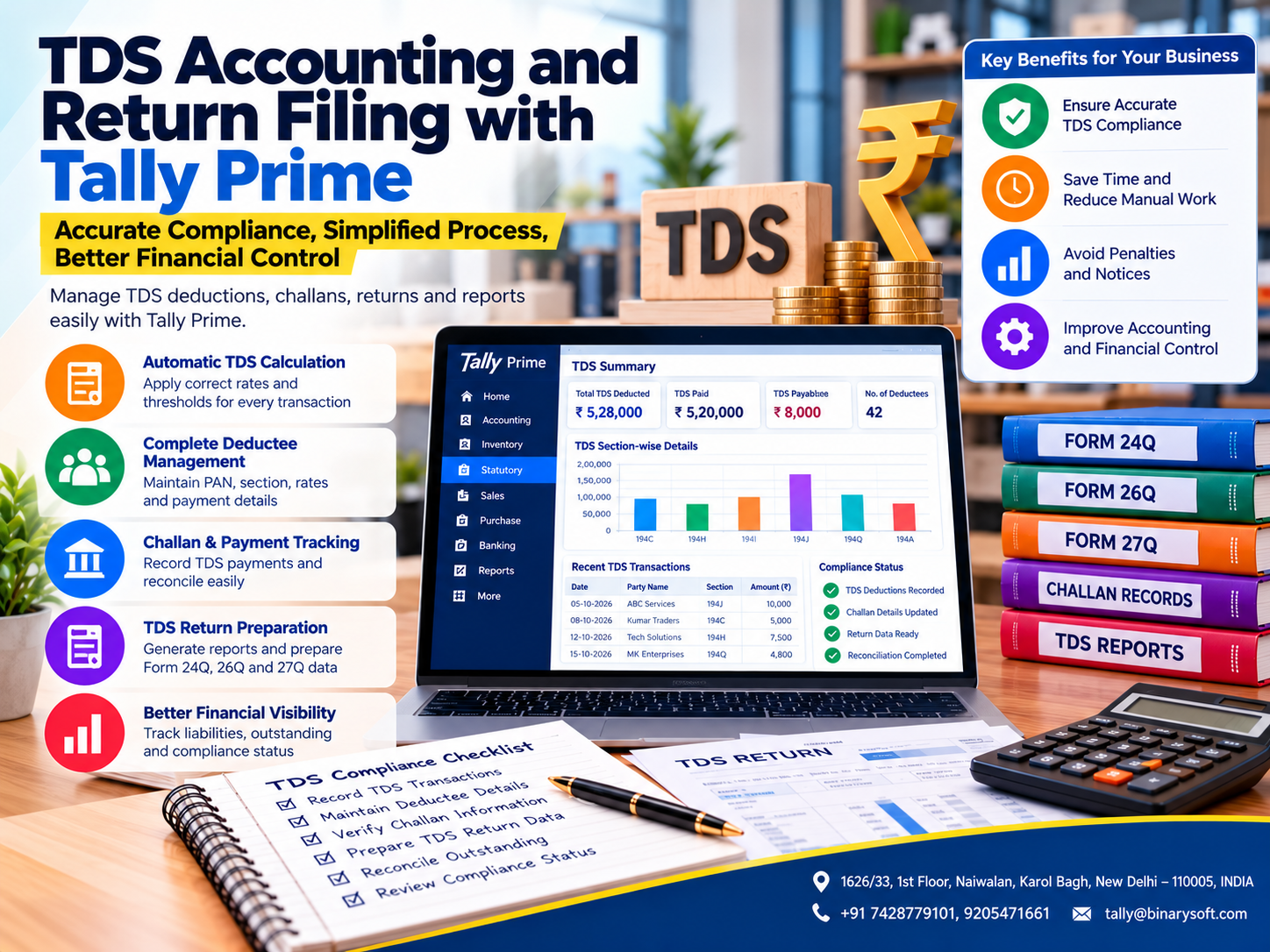
Tally Prime helps organizations configure applicable TDS provisions, record deductions, track tax liabilities and prepare information required for statutory returns.
Instead of relying entirely on spreadsheets and manual calculations, accountants can maintain TDS information alongside regular business transactions.
This article explains the advantages of TDS accounting in Tally Prime, practical configuration steps, return preparation, common mistakes and how businesses can improve compliance through organized accounting processes.
1. What Is TDS and Why Is It Important?
Tax Deducted at Source is a mechanism under Indian income tax law through which a person making specified payments deducts tax when the applicable conditions are satisfied.
The deducted amount is deposited with the government and generally credited against the recipient's tax liability.
TDS applies to various categories of payments, including salaries, professional fees, contractor payments, rent, interest and certain purchases of goods.
The applicable deduction depends on the relevant legal provision, threshold, recipient status and transaction details.
Example of TDS deduction
Suppose a company receives a professional consultancy invoice for ₹1,00,000, excluding GST separately indicated on the invoice.
Assume the applicable TDS rate under Section 194J is 10% and all statutory conditions are satisfied.
|
Particulars
|
Amount
|
|---|
|
Professional fees
|
₹1,00,000
|
|
TDS at 10%
|
₹10,000
|
|
Net professional fee payable
|
₹90,000
|
|
TDS payable to government
|
₹10,000
|
The business records the full professional expense, recognizes the TDS liability and pays the balance to the professional.
The deducted amount must subsequently be deposited and reported according to applicable requirements.
2. An Emotional Story: When a Small Accounting Mistake Became a Business Problem
Amit managed a growing marketing services company in Delhi.
His business worked with freelancers, consultants, advertising agencies and technology vendors.
As the company expanded, the number of monthly payments increased significantly.
Initially, Amit's accountant maintained TDS calculations in spreadsheets.
Every month, payment information was collected from invoices, bank statements and accounting registers.
One afternoon, Amit received a call from a consultant who was unable to identify the expected tax credit in his records.
The accountant began checking earlier transactions.
He discovered that incorrect deductee information had been entered in a quarterly statement.
The error required additional verification and correction.
Amit became worried.
He had always tried to pay his vendors on time, yet an administrative mistake had created uncertainty for someone who trusted his business.
That evening, he discussed the problem with his accountant.
They decided to strengthen their TDS accounting process by maintaining complete deductee information, using appropriate tax configurations and reviewing compliance reports before filing.
With Tally Prime, the team began recording TDS-related transactions through a more structured workflow.
They also introduced monthly reconciliations and a quarterly return-review checklist.
Amit realized that accurate accounting was not merely about avoiding penalties.
It was also about protecting business relationships, maintaining trust and ensuring that every transaction was recorded responsibly.
This is an illustrative story designed to explain the importance of accurate TDS compliance.
3. Why Manual TDS Accounting Creates Challenges
Businesses processing numerous transactions may experience difficulties when TDS calculations are handled manually.
Incorrect tax rates
Different payment categories may attract different deduction rates.
Applying an incorrect rate can create short-deduction or excess-deduction problems.
Missing deductee information
Incomplete PAN or party details can cause errors in return preparation.
Threshold monitoring
Some TDS provisions apply only after specified payment or transaction thresholds are crossed.
Manual tracking becomes difficult when payments are spread across multiple invoices.
Challan mismatches
Incorrect challan details can complicate reconciliation between deductions, deposits and quarterly statements.
Delayed return preparation
Accountants may spend significant time consolidating information from different records.
Difficult correction procedures
Incorrectly filed statements may require correction returns and additional documentation.
Using structured accounting software can reduce repetitive work and improve record consistency.
4. Why Businesses Prefer Tally Prime for TDS Accounting
Tally Prime allows businesses to maintain TDS-related information within their regular accounting system.
This integration is particularly valuable because tax deduction is directly connected with business expenses, purchases and payments.
Major advantages
-
Centralized accounting and statutory records.
-
TDS calculation based on configured provisions and transaction information.
-
Deductee-wise transaction tracking.
-
Monitoring of outstanding TDS liabilities.
-
Challan and payment information management.
-
Reports for reviewing deductions and exceptions.
-
Support for preparing quarterly TDS statement data.
-
Reduced repetitive manual data entry.
-
Easier reconciliation with accounting ledgers.
-
Better visibility for accountants and business owners.
These benefits depend on accurate configuration, correct master data and periodic review.
Tally Prime does not eliminate the business's responsibility to comply with applicable tax law.
5. Important TDS Sections Businesses Should Understand
Different types of payments are covered under different statutory provisions.
The following table provides common examples of TDS sections and generally applicable rates under the traditional section references.
|
Section
|
Nature of payment
|
Indicative rate
|
|---|
|
192
|
Salary
|
Applicable slab-based calculation
|
|
194C
|
Contractor payments
|
1% or 2%, as applicable
|
|
194H
|
Commission or brokerage
|
2%
|
|
194I
|
Rent
|
2% or 10%, depending on payment type
|
|
194J
|
Professional or technical services
|
2% or 10%, as applicable
|
|
194Q
|
Purchase of goods
|
0.1% on applicable amount above threshold
|
Rates, thresholds, exceptions and section references must be verified for the relevant transaction and tax year. The Income Tax Act, 2025 became applicable from 1 April 2026, so businesses should also verify the corresponding provisions under the current statutory framework.
For example, contractor payments may attract different rates depending on whether the recipient is an individual, HUF or another eligible entity.
Similarly, professional and technical service payments can be subject to different rates.
The correct deduction should always be determined from the applicable law and transaction circumstances.
6. How to Enable TDS in Tally Prime
TDS accounting begins with proper statutory configuration.
Step 1: Open the company
Select the relevant company in Tally Prime.
Step 2: Enable TDS
Open the statutory and taxation features and enable Tax Deducted at Source.
Step 3: Enter company information
Provide relevant statutory details, including TAN and other required information.
Step 4: Configure deductee information
Maintain the correct PAN, deductee type and other required party information.
Step 5: Create appropriate ledgers
Create expense, party and TDS-related ledgers according to the transaction requirements.
Step 6: Select the relevant TDS nature of payment
Configure the appropriate payment classification for the transaction.
Step 7: Record transactions
Enter eligible expenses, purchases or payments through the relevant accounting vouchers.
Step 8: Review deductions
Check TDS reports and transaction details before depositing the tax.
The precise menu names and available settings may vary by software release.
7. How Tally Prime Helps Calculate TDS
Tally Prime can calculate TDS on eligible transactions using configured statutory details.
For example, suppose a business records professional fees of ₹50,000.
Assume the applicable TDS rate is 10%.
The calculation would be:
\[ \text{TDS} = ₹50,000 \times 10\% = ₹5,000 \]
The net professional fee payable would be ₹45,000.
The accounting system can help recognize the relevant expense, vendor liability and TDS payable amount.
However, businesses must verify whether the deduction applies, whether any threshold has been crossed and whether the selected rate is correct.
Automated calculation is only as reliable as the underlying configuration.
8. Recording TDS Transactions in Tally Prime
A typical TDS transaction involves three stages.
Stage 1: Record the expense
The business records the expense or purchase and recognizes the applicable TDS deduction.
Stage 2: Pay the deductee
The vendor or service provider receives the net amount after deduction.
Stage 3: Deposit the TDS
The deducted tax is deposited with the government through the applicable payment process.
Tally Prime helps maintain the accounting entries associated with these stages.
Illustrative accounting entries
For professional fees of ₹1,00,000 with TDS of ₹10,000:
At the time of expense recognition:
Professional Fees A/c Dr. ₹1,00,000
To Consultant A/c ₹90,000
To TDS Payable A/c ₹10,000
When paying the consultant:
Consultant A/c Dr. ₹90,000
To Bank A/c ₹90,000
When depositing TDS:
TDS Payable A/c Dr. ₹10,000
To Bank A/c ₹10,000
These entries are simplified illustrations. Actual voucher treatment may vary depending on the invoice, GST, accounting method and software configuration.
9. TDS Payment and Challan Management
Deducting TDS is only one part of compliance.
The deducted tax must also be deposited within the applicable deadline.
Businesses should maintain complete information about each tax payment.
Important details include the payment date, amount, challan identification information and the relevant tax period.
Tally Prime supports recording TDS payments and maintaining related challan details.
This helps accountants reconcile deducted amounts against payments.
Why challan reconciliation matters
A business may deduct tax correctly but enter incorrect challan information while preparing a quarterly statement.
Such errors can create mismatches and require correction.
Accountants should therefore reconcile TDS payable ledgers, payment vouchers and challan information before return preparation.
10. Understanding TDS Return Filing
TDS returns are periodic statements containing details of tax deducted, deposited and associated deductees.
Different statement forms apply to different transaction categories.
Form 24Q
Generally used for reporting salary-related TDS.
Form 26Q
Generally used for specified payments to resident deductees other than salary.
Form 27Q
Generally used for reporting applicable payments to non-resident deductees.
Form 27EQ
Used for applicable TCS reporting rather than TDS.
Tally Prime can help prepare relevant TDS statement information and supported export files.
The final statutory submission may require prescribed utilities, validation procedures and authorized filing channels.
Businesses should not assume that generating a report in Tally Prime automatically completes government return filing.
11. How to Prepare TDS Returns Using Tally Prime
A structured return preparation process helps reduce errors.
Step 1: Complete accounting entries
Ensure all relevant transactions for the quarter have been recorded.
Step 2: Verify deductee information
Review PAN, deductee classification and other required details.
Step 3: Review TDS calculations
Confirm the applicable provisions, rates and deduction amounts.
Step 4: Reconcile TDS payments
Match TDS liabilities with tax deposits and challan information.
Step 5: Review TDS reports
Identify incomplete, incorrect or exceptional transactions.
Step 6: Generate supported statement data
Prepare the relevant return information or export using the supported Tally Prime functionality.
Step 7: Validate the statement
Use the applicable statutory validation process and prescribed utilities.
Step 8: Submit the return
File through the authorized government system using the required procedure.
Step 9: Preserve acknowledgement
Maintain filing acknowledgements and relevant compliance records.
This process improves traceability and helps businesses prepare for future reviews.
12. TDS Return Filing Due Dates
For many regular quarterly TDS statements, the established filing schedule has been:
|
Quarter
|
Period
|
Standard filing due date
|
|---|
|
Q1
|
April–June
|
31 July
|
|
Q2
|
July–September
|
31 October
|
|
Q3
|
October–December
|
31 January
|
|
Q4
|
January–March
|
31 May
|
These are the commonly established deadlines for regular TDS statements. Businesses should verify the applicable filing calendar, transitional rules and any official extensions for the relevant year, particularly following the implementation of the Income Tax Act, 2025.
Deposit deadlines can differ from return-filing deadlines.
13. Case Study One: A Delhi Trading Company Improves TDS Accuracy
Illustrative case study
A trading company in Karol Bagh, Delhi, regularly paid transport contractors, consultants and other service providers.
The challenge
The accounts team maintained TDS calculations in spreadsheets.
As transaction volumes increased, employees occasionally selected incorrect payment classifications.
Quarterly return preparation required substantial manual checking.
The solution
The company introduced a more structured TDS accounting process in Tally Prime.
Relevant party information, expense ledgers and TDS classifications were reviewed.
The accounting team began examining deduction reports and challan information every month.
The outcome
The business gained better visibility into TDS liabilities and transactions requiring correction.
Quarter-end return preparation became more organized.
The example demonstrates how structured accounting records can support compliance efficiency.
14. Case Study Two: A Technology Company Simplifies Professional Fee Deductions
Illustrative case study
A technology services company in Noida engaged multiple independent consultants.
The challenge
The company processed numerous professional fee invoices every month.
Different service categories required careful review of applicable TDS provisions.
The accounts team also needed to maintain accurate PAN and payment records.
The solution
The company used Tally Prime to maintain deductee information and record relevant TDS transactions.
Accountants introduced monthly checks of vendor balances, tax deductions and challan details.
Before quarterly filing, they reviewed exceptional transactions and reconciled tax deposits.
The outcome
The company improved the consistency of its TDS accounting records.
The finance team could identify missing information earlier and prepare return data more systematically.
The example illustrates potential benefits rather than guaranteed compliance outcomes.
15. Common TDS Accounting Mistakes Businesses Should Avoid
Incorrect PAN
Incorrect deductee information can create return-processing problems.
Wrong nature of payment
Selecting the wrong payment category can result in an incorrect tax rate.
Ignoring deduction thresholds
Businesses must evaluate applicable transaction limits and cumulative payments.
Delayed TDS deposits
Late deposits can result in interest and other consequences.
Incorrect challan information
Errors in challan details can cause reconciliation mismatches.
Missing transactions
Unrecorded expenses or payments may lead to incomplete TDS statements.
Failure to reconcile
TDS records should be checked against accounting ledgers, tax deposits and available statutory information.
Regular review is essential even when accounting software performs calculations automatically.
16. How Tally Prime Helps with TDS Reconciliation
TDS reconciliation involves comparing deductions, payments and return information.
Businesses should verify that amounts deducted from transactions agree with the TDS payable records.
They should also confirm that deposits are properly recorded and allocated.
Tally Prime provides relevant reports and accounting records that can support this review.
Accountants can examine party-wise transactions, deduction information and payment entries.
External statutory records and acknowledgements should also be checked where applicable.
Reconciliation helps identify differences before they become more difficult to correct.
17. TDS Accounting and Cash Flow Management
TDS affects business cash flow because the deducted amount creates a statutory liability.
For example, when a business deducts ₹25,000 from a professional payment, that amount remains payable to the government.
The company should not treat the deduction as unrestricted working capital.
A cash flow plan should include expected TDS deposits alongside GST, salaries, supplier payments and other obligations.
Tally Prime can help maintain the relevant liabilities and accounting balances.
Businesses may use these records to prepare payment schedules and short-term cash flow forecasts.
This is particularly important for organizations processing large numbers of contractor and professional payments.
18. TDS Accounting in Tally Prime vs Manual Accounting
|
Activity
|
Manual accounting
|
Tally Prime-supported accounting
|
|---|
|
Deduction calculation
|
Often spreadsheet-based
|
Based on configured statutory information
|
|
Deductee records
|
Separate registers
|
Integrated party information
|
|
Transaction recording
|
Multiple manual entries
|
Connected with accounting vouchers
|
|
Liability monitoring
|
Manual consolidation
|
TDS-related accounting reports
|
|
Challan details
|
Separate records
|
Supported payment and challan records
|
|
Return preparation
|
Manual data compilation
|
Supported statement preparation and export
|
|
Error checking
|
Manual review
|
Reports and exception review
|
|
Financial reporting
|
Separate consolidation
|
Integrated accounting records
|
Tally Prime improves process organization, but statutory accuracy still depends on correct data and professional review.
19. How Tally on Cloud Can Support TDS Accounting
Businesses with multiple offices may require accountants to access financial records from different locations.
A suitably configured Tally on Cloud environment can provide authorized users with remote access to hosted accounting data.
For example, a company may have its accounts team in Delhi and management in another city.
Cloud access can help employees review transactions, prepare records and coordinate compliance activities.
However, businesses should implement appropriate permissions, backups and security controls.
Cloud hosting does not automatically submit TDS returns or replace the required statutory filing process.
20. Best Practices for Accurate TDS Compliance
Businesses should establish a regular TDS compliance process rather than waiting until the end of each quarter.
Maintain complete deductee information and verify PAN details.
Review applicable provisions and deduction thresholds.
Record transactions promptly.
Check TDS calculations and exceptions.
Reconcile TDS payable accounts with tax deposits.
Verify challan information.
Review quarterly statement data before filing.
Preserve statutory acknowledgements and supporting records.
Keep accounting software updated and review relevant changes in tax law.
Where transactions are complex, seek guidance from a qualified tax professional.
These practices can reduce avoidable mistakes and improve financial accountability.
21. Why Tally Prime Is Valuable for Growing Businesses
As businesses expand, the number of statutory transactions often increases.
A small organization may initially process only a few TDS deductions each month.
Later, it may engage numerous contractors, consultants, service providers and other vendors.
Without organized accounting, compliance work can become difficult to manage.
Tally Prime helps maintain relevant TDS records alongside financial transactions.
This can reduce duplication and improve the consistency of information used for statutory reporting.
For growing businesses, the main advantage is not simply automation.
It is the ability to maintain a structured accounting process that supports accuracy, review and timely compliance.
Conclusion
TDS accounting is an essential responsibility for businesses making payments covered by applicable income tax provisions.
Manual processes can create difficulties involving tax calculations, deductee information, challan reconciliation and quarterly statement preparation.
Tally Prime helps businesses organize TDS-related accounting through statutory configuration, transaction recording, liability monitoring and relevant reports.
It can also support preparation of information required for TDS returns.
However, businesses must continue verifying legal requirements, effective rates, filing deadlines and statutory submission procedures.
With accurate master data, regular reconciliations and appropriate professional review, Tally Prime can help organizations maintain more efficient and reliable TDS accounting processes.
Powered by Binarysoft Technologies
Authorized Tally Partner
Location: 1626/33, 1st Floor, Naiwalan, Karol Bagh, New Delhi – 110005, INDIA
Contact Us: +91 7428779101, 9205471661
Email: tally@binarysoft.com
Business Hours: 10:00 AM – 6:00 PM, Monday to Friday
Frequently Asked Questions
How can Binarysoft Technologies help businesses with TDS accounting?
Binarysoft Technologies can assist with Tally Prime implementation, TDS configuration, deductee and ledger setup, transaction recording, statutory reporting workflows, accounting reconciliation and employee training.
Is Tally on Cloud useful for TDS accounting?
A suitable Tally on Cloud setup can help authorized users access accounting records remotely, subject to appropriate security and hosting arrangements.
Can Tally Prime help identify TDS accounting errors?
Tally Prime provides relevant reports and exception information that can help accountants review incomplete or incorrect transactions.
Is TDS applicable to every business payment?
No. TDS applies only when the relevant statutory conditions are satisfied, including the applicable payment category, threshold and other requirements.
CA. Dhruv Bhandekar works with businesses on bookkeeping controls, GST reporting, and month-end accounting processes. His focus is on creating structured financial workflows that improve accuracy and reduce reconciliation issues.