Call CA Tally HelpDesk
+91 9205471661,
7428779101

Introduction: Why Smart Business Decisions Matter More Than Ever in 2026
In 2026, Indian small and medium businesses are facing a new reality. Customers expect faster service, digital payments have become routine, GST compliance demands accurate records, and competition continues to challenge traditional business models. For many entrepreneurs, working harder is no longer enough. The real difference comes from making smarter decisions using reliable financial information, better inventory planning and efficient technology.
A business may generate impressive sales but still struggle to pay suppliers, maintain stock or collect outstanding payments. Another business with comparatively modest turnover may grow steadily because its owner understands cash flow, controls expenses and makes informed decisions.
This is why smart business management is becoming essential for MSMEs. With structured accounting, financial discipline and business management software such as TallyPrime, entrepreneurs can transform everyday business information into practical growth opportunities.
1. Understanding Smart Business Growth in the Modern Indian Economy
Smart business growth means expanding operations without unnecessarily increasing financial risks, administrative costs or operational complexity.
Traditional business expansion often focused on increasing sales, opening additional branches or attracting more customers. Modern business growth requires a more balanced approach.
Successful entrepreneurs now evaluate profitability, working capital, customer relationships, technology adoption and operational efficiency before making important decisions.
A business generating ₹50 lakh in monthly sales may appear successful. However, if customers delay payments, inventory remains unsold and operating expenses increase, the business could experience serious financial pressure.
Smart growth focuses on building a financially stable organization rather than simply increasing turnover.
Important elements of smart business growth
-
Accurate accounting and financial reporting.
-
Effective cash flow and working capital management.
-
Inventory optimization and stock visibility.
-
Timely GST compliance and documentation.
-
Customer retention and credit management.
-
Technology adoption and process automation.
-
Data-driven planning and business forecasting.
-
Employee productivity and operational control.
When these activities work together, entrepreneurs gain greater confidence in their business decisions.
2. The Emotional Reality of Running a Small Business: A Story of Determination
At 10:30 PM, Rajesh was still sitting inside his wholesale trading office in Delhi. The market had closed hours earlier, but he was surrounded by invoices, supplier statements and handwritten payment reminders.
His business had been operating for almost fifteen years.
Customers trusted him, employees respected him and suppliers appreciated his commitment. Yet something had changed.
Sales were increasing, but available cash was decreasing.
Several customers had outstanding balances. Popular products were frequently unavailable, while slow-moving items occupied valuable warehouse space. His accountant required additional time every month to reconcile transactions.
One evening, Rajesh's daughter asked him a simple question.
"Papa, if business is growing, why are you always worried?"
He had no immediate answer.
That question changed the way he looked at his business.
Instead of concentrating exclusively on sales, Rajesh decided to understand his financial position.
He organized customer ledgers, reviewed inventory reports, introduced payment follow-ups and started monitoring business performance through TallyPrime.
Gradually, he gained clearer visibility into outstanding receivables, purchase requirements and monthly profitability.
His problems did not disappear overnight. However, he could identify them earlier and take corrective action.
The biggest change was not simply better accounting.
It was peace of mind.
Rajesh finally understood that business success should provide financial stability and personal confidence, not constant uncertainty.
This is an illustrative story representing challenges commonly experienced by small business owners.
3. Financial Planning: The Foundation of Sustainable Business Growth
Financial planning helps entrepreneurs understand where money comes from, how it is spent and whether the business can support future expansion.
Without structured planning, even profitable businesses may struggle with liquidity.
Budgeting and expense control
Every business should prepare a practical operating budget covering:
-
Rent, salaries and administrative expenses.
-
Inventory purchases and supplier payments.
-
Electricity, transportation and logistics.
-
Marketing and customer acquisition.
-
GST and other applicable statutory obligations.
-
Technology, maintenance and unexpected expenses.
A budget should not remain a static document.
Business owners should compare planned expenditure with actual expenditure regularly and investigate significant differences.
Understanding profitability
Revenue and profit are different financial measurements.
For example, consider a business with the following monthly figures:
|
Particulars
|
Amount
|
|---|
|
Sales revenue
|
₹12,00,000
|
|
Cost of goods sold
|
₹8,00,000
|
|
Gross profit
|
₹4,00,000
|
|
Operating expenses
|
₹2,50,000
|
|
Operating profit
|
₹1,50,000
|
The business generates an operating profit of ₹1,50,000 before interest, taxes and other applicable adjustments.
However, this does not necessarily mean ₹1,50,000 is available in the bank.
Customer credit, supplier payments, loan obligations and inventory investments influence actual cash availability.
How TallyPrime helps
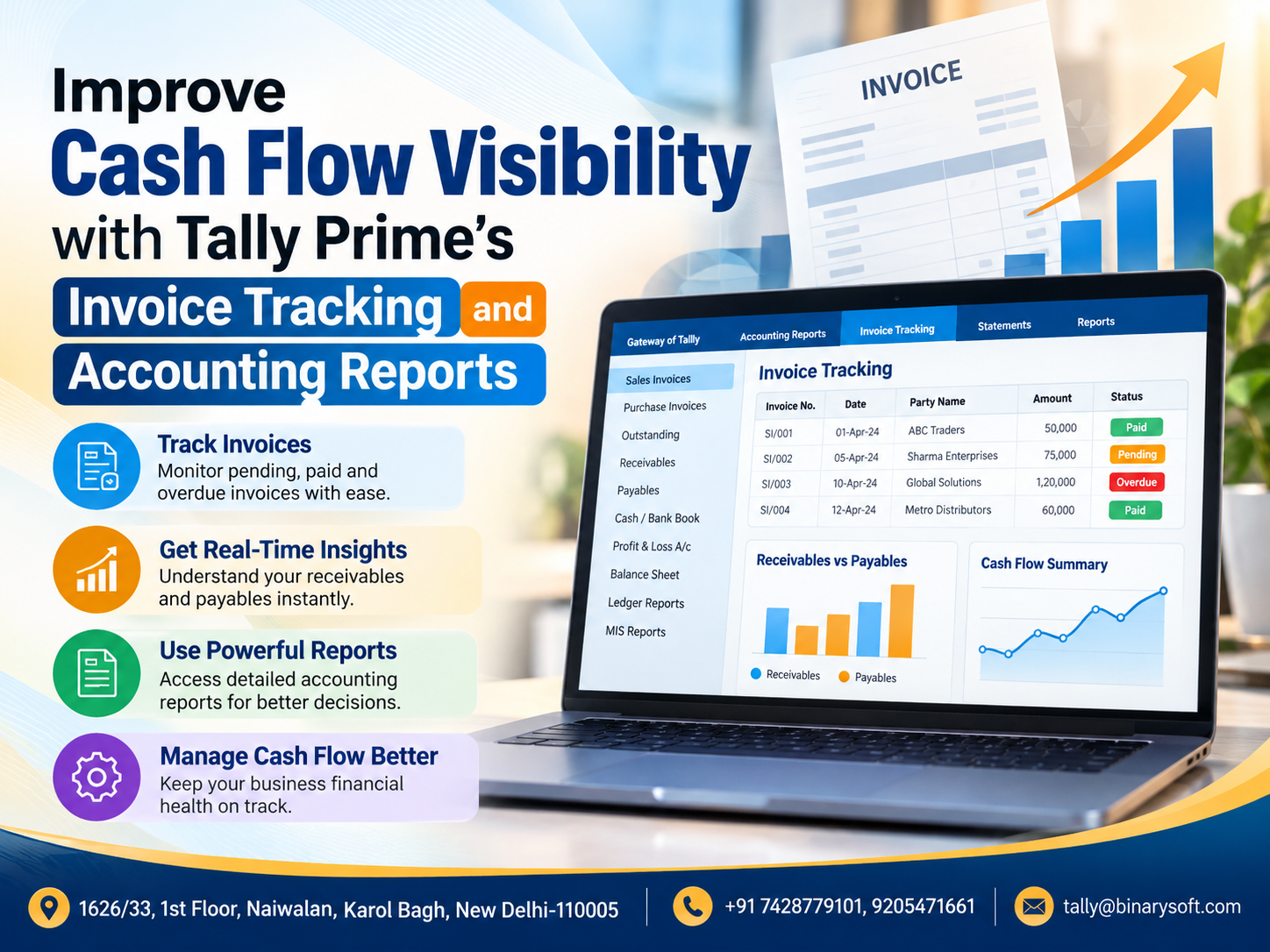
TallyPrime provides financial reports such as Profit & Loss Account, Balance Sheet, Cash Flow, receivables and payables statements.
Business owners can use these reports to identify expenditure patterns, evaluate profitability and understand their overall financial position.
4. Cash Flow Management: Why Profitable Businesses Still Face Financial Problems
Cash flow management is one of the most important responsibilities of an entrepreneur.
A company may record substantial sales while struggling to meet immediate payment obligations.
This happens when revenue is recognized before customers actually pay.
Common causes of cash flow problems
Delayed customer payments, excessive inventory purchases, unexpected expenses, weak credit policies and poor financial forecasting can create working capital shortages.
Businesses should therefore monitor cash inflows and outflows rather than relying exclusively on sales figures.
Practical strategies for improving cash flow
Establish clear customer credit periods and communicate payment terms before completing transactions.
Review outstanding invoices weekly and follow up on overdue payments professionally.
Avoid purchasing excessive inventory without analyzing actual demand.
Negotiate reasonable supplier payment terms while maintaining strong business relationships.
Maintain a financial reserve where practical to manage unexpected operating requirements.
TallyPrime for cash flow control
TallyPrime supports bill-wise accounting, outstanding receivables, payable reports and cash and bank transaction tracking.
Entrepreneurs can examine which customers owe money, which suppliers require payment and how upcoming obligations may affect liquidity.
Its reporting capabilities help businesses prepare more realistic cash flow forecasts using current balances and expected collections.
5. GST Compliance: Turning a Business Obligation into Better Financial Discipline
GST compliance is an essential part of managing a registered business in India.
Incorrect invoices, mismatched input tax credit, missing transaction details and delayed reconciliations may create financial and administrative difficulties.
Businesses should adopt systematic accounting procedures rather than waiting until the return filing deadline.
Important GST management practices
Maintain accurate GSTIN details for registered customers and suppliers.
Apply appropriate HSN or SAC classifications and applicable tax rates.
Record purchase and sales transactions promptly.
Review credit notes, debit notes and adjustments.
Reconcile eligible input tax credit with relevant GST records.
Verify return information before submission and retain supporting documentation.
Using TallyPrime for GST management
TallyPrime helps businesses create GST-compliant invoices, maintain tax ledgers and generate GST-related reports.
Depending on the release, configuration and connected services available, businesses can use GST return preparation, reconciliation, validation and filing-related capabilities.
For example, a wholesale trader can review sales transactions, identify incomplete tax information and correct eligible accounting errors before finalizing returns.
This improves record quality and reduces unnecessary last-minute pressure.
Importantly, software-generated reports should still be reviewed against applicable GST rules and portal records before filing.
6. Inventory Management: The Smart Way to Reduce Stock Losses
Inventory represents a significant financial investment for retailers, wholesalers, distributors and manufacturers.
Poor stock management can create two major problems.
Excess inventory blocks working capital and increases storage expenses.
Insufficient inventory causes lost sales and dissatisfied customers.
The objective is to maintain an appropriate stock balance based on demand, supplier lead times and available working capital.
Inventory strategies for growing businesses
Stock classification: Organize products according to categories, brands, sizes, specifications or other relevant attributes.
Reorder planning: Establish minimum stock levels and replenishment procedures for important products.
Stock ageing analysis: Identify products that have remained unsold for extended periods.
Warehouse monitoring: Track stock across different storage locations or branches.
Physical verification: Compare actual stock with recorded quantities and investigate discrepancies.
How TallyPrime supports inventory management
TallyPrime provides stock groups, stock categories, godown management, stock valuation, inventory vouchers and stock movement reports.
Businesses can also use reorder levels and batch-related functionality where applicable.
A distributor handling hundreds of products can monitor stock availability and identify slow-moving items before committing additional money to purchases.
Better inventory visibility supports improved customer service and stronger working capital control.
7. Smart Technology Adoption for MSMEs
Digital transformation does not necessarily require expensive infrastructure or complicated enterprise software.
For many small businesses, the first step is replacing disconnected spreadsheets, manual registers and repetitive data entry with organized business processes.
Technology should solve actual operational problems.
A retailer may need faster billing and stock control.
A distributor may prioritize customer credit management and inventory tracking.
A service organization may require expense monitoring, invoicing and financial reporting.
The most suitable system is one that supports current business requirements while allowing future expansion.
Evaluating business management software
Before adopting new software, entrepreneurs should examine functionality, ease of use, reporting capabilities, security, training requirements and long-term operating costs.
They should also consider integration requirements and whether the system supports their industry's transaction processes.
Artificial intelligence and automation may improve document processing and reduce repetitive tasks, but businesses should maintain human review for financial accuracy, tax treatment and sensitive transactions.
TallyPrime provides an integrated environment for accounting, invoicing, inventory, banking and reporting, helping businesses reduce dependence on disconnected records.
8. Customer Relationships and Credit Management for Long-Term Success
Customers are the foundation of every successful business. However, sustainable growth requires more than acquiring new customers.
Businesses must build trust, maintain consistent service quality and establish financially responsible customer relationships.
Providing unlimited credit without monitoring outstanding balances can create serious financial difficulties.
Smart customer management strategies
Businesses should establish credit limits based on customer history, payment behavior and financial capacity.
Regular communication helps resolve disputes before they affect business relationships.
Customer purchase patterns can also reveal opportunities for repeat sales, personalized offers and improved product planning.
TallyPrime for customer management
TallyPrime enables businesses to maintain individual customer ledgers, track bill-wise outstanding amounts, configure credit limits and review overdue balances.
These features help sales and accounts teams coordinate their activities.
A customer relationship becomes more sustainable when both service quality and payment discipline receive appropriate attention.
9. Case Study One: How a Delhi Wholesale Distributor Improved Financial Visibility
Illustrative case study based on common wholesale business challenges.
Business background
A wholesale electrical goods distributor operating in Bhagirath Palace, Delhi, handled approximately 450 products and supplied goods to retailers across North India.
The business relied on spreadsheets for inventory monitoring and separate accounting records for financial transactions.
Challenges
The company experienced delayed customer collections, inconsistent stock information and difficulty identifying profitable product categories.
Management also struggled to understand which customers regularly exceeded agreed credit periods.
Solution using TallyPrime
The distributor introduced structured accounting and inventory management through TallyPrime.
Customer accounts were organized using bill-wise tracking. Products were classified into stock groups, and management started reviewing stock movement and outstanding receivables every week.
The accounts team also implemented regular bank reconciliation and monthly GST verification procedures.
Illustrative results
After several months, the business had a clearer view of overdue customer balances and stock requirements.
Management could identify slow-moving inventory, review customer credit exposure and make purchasing decisions using recorded transaction data.
The most significant improvement was operational visibility.
Instead of waiting for month-end summaries, the owner could examine important business information more frequently.
Key learning
Smart business growth begins when owners understand their existing operations before making new investments.
10. Case Study Two: A Manufacturing MSME Builds Better Inventory and Cost Control
Illustrative case study demonstrating practical manufacturing improvements.
Business background
A small manufacturing enterprise in Faridabad produced metal components for industrial customers.
Its production activities required raw materials, work-in-progress monitoring, finished goods management and timely customer deliveries.
Business challenges
The company frequently experienced differences between recorded and physical inventory.
Production expenses were difficult to allocate, and management lacked timely information about material consumption.
Occasional raw material shortages delayed customer orders.
TallyPrime implementation
The business introduced structured inventory records and appropriate manufacturing-related accounting processes.
Stock items were created for raw materials and finished goods. Bills of Materials were configured for suitable products, and manufacturing journals were used to record production-related stock movements.
Management reviewed consumption, stock availability and inventory valuation reports.
Business improvements
The new process provided better visibility into raw material requirements and finished goods availability.
Production planning became more systematic, while accounting records offered a clearer picture of material costs.
Although the company still required proper supervision and physical stock verification, management could identify operational problems more efficiently.
Key learning
Manufacturing businesses benefit when inventory records, production information and financial reporting operate within a coordinated system.
11. How to Implement Smart Business Management with TallyPrime
Introducing business management software should follow a structured process.
Step 1: Create and configure the company
Set up the business in TallyPrime with the appropriate financial year, accounting information and statutory details.
Configure GST and other relevant features according to business requirements.
Step 2: Organize accounting masters
Create ledgers for customers, suppliers, banks, expenses, income and relevant tax accounts.
Proper classification improves reporting accuracy.
Step 3: Configure inventory
Create stock items, stock groups, units of measurement and godowns where required.
Enter verified opening stock quantities and valuations.
Step 4: Record daily transactions
Use appropriate vouchers to record sales, purchases, receipts, payments, journals and inventory movements.
Ensure employees understand the correct transaction procedures.
Step 5: Monitor financial reports
Review the Profit & Loss Account, Balance Sheet, Cash Flow, outstanding statements and inventory reports.
Use this information to identify problems and opportunities.
Step 6: Strengthen internal controls
Configure user permissions, implement appropriate backup procedures and periodically review accounting records.
Where available and suitable, use edit-log functionality to improve transaction accountability.
Step 7: Review performance regularly
Conduct weekly operational reviews and monthly financial reviews.
Compare actual results with business targets and take corrective action.
12. Important Business Performance Indicators Every Entrepreneur Should Monitor
Smart management requires measuring the right information.
|
Performance indicator
|
Business importance
|
|---|
|
Sales growth
|
Measures changes in business revenue
|
|
Gross profit margin
|
Evaluates profitability after direct costs
|
|
Net profit margin
|
Measures overall profitability
|
|
Outstanding receivables
|
Identifies customer collection requirements
|
|
Inventory turnover
|
Indicates how efficiently stock is sold
|
|
Cash flow
|
Shows liquidity and payment capacity
|
|
Operating expenses
|
Helps identify unnecessary expenditure
|
|
Customer retention
|
Indicates relationship stability
|
These indicators should be interpreted together.
For example, increasing sales accompanied by declining profit margins may indicate rising costs or excessive discounting.
Similarly, strong profitability combined with growing overdue receivables may suggest future cash flow difficulties.
TallyPrime reports can provide much of the accounting and inventory information needed to calculate and monitor these indicators.
13. Preparing Your Business for Future Growth
Businesses preparing for expansion should strengthen their existing systems before increasing operational complexity.
Financial records must be accurate, inventory information should be reliable and customer payment practices must be clearly defined.
Entrepreneurs should also assess whether additional employees, branches or product categories will improve profitability.
Technology investments should support measurable business objectives rather than simply following market trends.
A practical growth plan should include revenue targets, expense budgets, working capital requirements, inventory projections and periodic performance reviews.
With consistent financial monitoring and disciplined decision-making, MSMEs can pursue expansion while maintaining better control over their resources.
Conclusion: Smart Decisions Create Stronger Businesses
The future of Indian MSMEs depends not only on entrepreneurial ambition but also on financial discipline, operational efficiency and informed decision-making.
Businesses that understand their cash flow, manage inventory carefully, maintain accurate accounting records and follow appropriate GST procedures are better positioned to respond to changing market conditions.
TallyPrime can support this journey by bringing important accounting, inventory, banking and reporting functions into a coordinated business management environment.
However, technology alone does not guarantee success. Reliable data, trained employees, regular reviews and responsible management decisions remain essential.
The objective is not simply to build a bigger business.
It is to build a stronger, more profitable and more sustainable organization that creates long-term financial confidence.
Powered by Binarysoft Technologies
Authorized Tally Partner
Location: 1626/33, 1st Floor, Naiwalan, Karol Bagh, New Delhi – 110005, INDIA
Contact us: +91 7428779101, 9205471661
Email us: tally@binarysoft.com
Business Hours: 10:00 AM – 6:00 PM, Monday to Friday
Frequently Asked Questions
How does TallyPrime help small businesses grow?
TallyPrime supports accounting, invoicing, inventory management, GST reporting, banking and financial analysis. These capabilities help businesses organize records and improve operational visibility.
TallyPrime supports accounting, invoicing, inventory management, GST reporting, banking and financial analysis. These capabilities help businesses organize records and improve operational visibility.
Yes. TallyPrime provides receivables, payables, cash and bank reports that help businesses monitor collections, payment obligations and available financial resources.
What is the first step toward smarter business management?
Start by organizing accounting records, identifying major financial and operational problems, and establishing regular reporting procedures. Once reliable information is available, businesses can introduce automation and make better-informed decisions.
Can business owners access TallyPrime information remotely?
TallyPrime supports remote reporting and access options, subject to the relevant product capabilities, subscriptions, configuration and security requirements.
CA. Krishiv Bansode works closely with startups and MSMEs on accounting, taxation, and compliance matters. He regularly writes about cloud accounting, automation, and financial management strategies.