Call CA Tally HelpDesk
+91 9205471661,
7428779101
Introduction: Why HSN Validation Is Essential for GST Return Filing
For many Indian businesses, GST compliance has become increasingly dependent on accurate product classification, organised accounting records and systematic return verification.
A business may prepare hundreds of invoices every month, but even a small error in an HSN code can create complications during GST reporting.
Imagine a wholesale trader handling electrical products, hardware materials and electronic accessories.
The accountant records purchases and sales correctly, but several stock items contain outdated or incomplete HSN information.
When the business prepares its GSTR-1 return, discrepancies appear in the HSN-wise summary.
The accountant must investigate product classifications, verify tax rates and correct the underlying records before finalising the return.
Such situations can increase administrative workload and create unnecessary pressure near filing deadlines.
HSN validation helps businesses identify classification problems before they affect GST reporting.
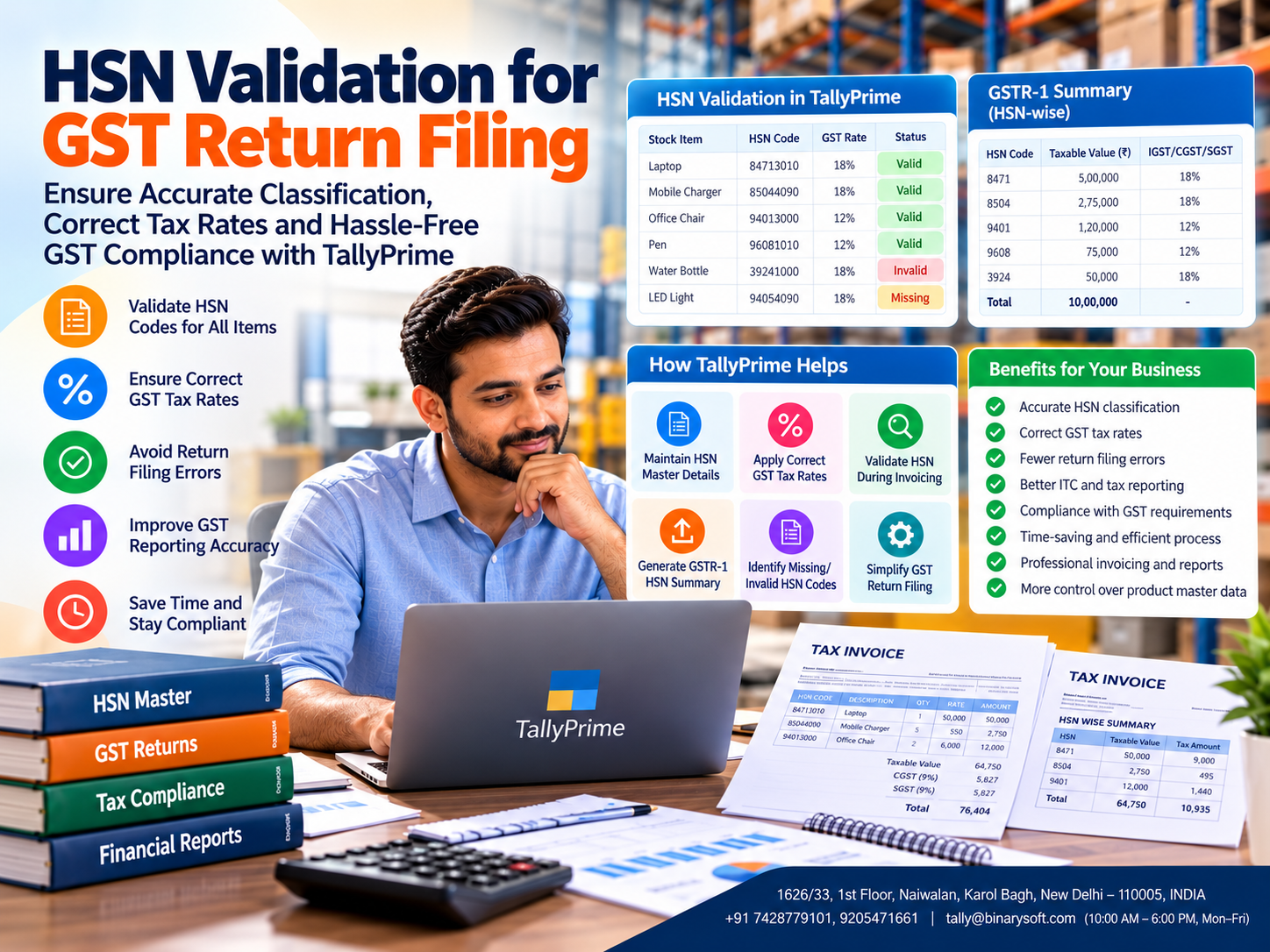
With accounting software such as TallyPrime, businesses can maintain stock item information, configure applicable GST details and review HSN-related reporting information.
The objective is to create a reliable connection between product masters, sales invoices and GST return data.
Accurate HSN validation is not simply a technical requirement. It is an important part of responsible tax compliance and efficient business management.
1. What Is an HSN Code Under GST?
HSN stands for Harmonised System of Nomenclature.
It is an internationally recognised system used to classify goods into standardised categories.
In India, HSN codes help identify goods for GST classification and reporting purposes.
Different goods are classified under relevant headings and subheadings based on their characteristics and applicable tariff provisions.
For example, electrical equipment, garments, machinery and furniture may fall under different HSN classifications.
The correct classification depends on the nature of the product and the relevant legal provisions.
Why HSN codes are important
-
Help identify goods consistently.
-
Support accurate GST classification.
-
Improve invoice and return reporting.
-
Enable HSN-wise summaries.
-
Reduce classification-related discrepancies.
-
Support product master standardisation.
-
Assist businesses in maintaining reliable tax records.
HSN classification should be determined carefully because similar-looking products may have different classifications depending on their composition, function or intended use.
2. What Is HSN Validation?
HSN validation is the process of checking whether the HSN codes used in accounting records, invoices and GST reports are appropriate and meet applicable reporting requirements.
The process may involve verifying the existence of a code, checking its permitted length, reviewing the product classification and confirming the applicable tax treatment.
A code can be structurally valid but still be incorrect for a particular product.
Therefore, technical validation and legal classification review are not identical.
Important HSN validation checks
|
Validation Check
|
Purpose
|
|---|
|
Missing HSN
|
Identify products without required classification
|
|
Invalid HSN
|
Detect codes that fail applicable validation
|
|
Incorrect code length
|
Check required reporting digits
|
|
Wrong product classification
|
Identify potentially unsuitable codes
|
|
GST rate mismatch
|
Review tax treatment against the product
|
|
Inconsistent master data
|
Prevent repeated errors across invoices
|
|
HSN summary mismatch
|
Verify return totals against accounting records
|
Businesses should perform these checks before finalising GST return information.
3. HSN Code Requirements for GST Reporting
HSN reporting requirements depend on applicable GST provisions, aggregate turnover, transaction type and the relevant reporting period.
Under the established turnover-based framework for outward supply reporting, taxpayers with aggregate turnover up to ₹5 crore generally use four-digit HSN reporting for applicable B2B supplies, while taxpayers above ₹5 crore generally use six-digit HSN reporting.
Additional requirements and exemptions can apply depending on the transaction and current notifications.
For example, certain B2C reporting requirements differ from B2B requirements for taxpayers within the lower turnover category.
Businesses should also account for applicable GSTR-1 Table 12 validation rules and portal functionality.
Important: HSN reporting requirements can change through notifications and portal updates. Businesses should verify the rules applicable to the specific tax period rather than relying on outdated configurations.
4. An Emotional Business Story: The GST Error That Kept a Shop Owner Awake
Sandeep owned a small hardware distribution business in Delhi.
His father had started the shop many years earlier, supplying tools, electrical accessories and industrial materials to local contractors.
After taking responsibility for the business, Sandeep worked hard to expand its customer base.
The company gradually began supplying products to larger commercial customers.
One month, the accounts team prepared the GST return after processing hundreds of sales invoices.
Everything appeared normal until the accountant discovered inconsistencies in the HSN-wise reporting information.
Several products had been assigned incomplete classifications, and a few stock items required verification of their applicable GST treatment.
The accountant explained that the errors needed to be reviewed before the return could be finalised.
Sandeep became worried.
The business had recently invested in additional inventory, supplier payments were approaching, and he wanted to avoid unnecessary compliance problems.
That evening, he remained in the office examining invoices and product records.
His father called and asked why he had not returned home.
Sandeep replied, “The business is growing, but every month I worry that one small accounting mistake will create a bigger problem.”
His father reminded him that growth required stronger systems, not just longer working hours.
The next day, Sandeep decided to improve the company's product master management.
His team reviewed HSN classifications, standardised stock item creation and introduced regular GST reporting checks.
Instead of waiting until the return-filing deadline, the accounts department began reviewing classification information throughout the month.
Gradually, the business developed a more organised compliance process.
Sandeep realised that accurate accounting records were not merely paperwork. They helped protect the stability of the business his family had spent years building.
This is an illustrative story created to demonstrate the financial and emotional impact of GST classification errors.
5. Common HSN Validation Errors During GST Return Filing
5.1 Missing HSN codes
Some businesses create stock items without entering the appropriate HSN code.
When these items are used in sales transactions, the missing classification may affect invoice and return reporting.
5.2 Incorrect HSN length
A business may use a four-digit classification where six-digit reporting is required.
This can result in validation problems under applicable return-filing requirements.
5.3 Incorrect product classification
Products may be classified under unsuitable headings because of insufficient information about their composition or use.
A valid HSN code does not necessarily mean the product has been classified correctly.
5.4 Incorrect GST rates
An incorrect classification may be associated with an unsuitable GST rate.
However, tax rates must be verified independently because classification alone does not determine every aspect of tax treatment.
5.5 Outdated product masters
Businesses may continue using old product information even after relevant classification or tax changes.
Periodic master reviews help reduce this risk.
5.6 Inconsistent invoice information
Different employees may use different classifications for the same product.
Centralised stock master management can improve consistency.
6. How TallyPrime Helps Businesses with HSN Validation
TallyPrime provides GST accounting and inventory management capabilities that support consistent product classification and reporting.
Stock item master management
Businesses can maintain HSN information in relevant stock item and GST configurations.
This reduces the need to repeatedly enter classification details during invoice preparation.
GST tax configuration
TallyPrime allows businesses to configure applicable GST details for transactions.
Correctly maintained tax information supports more consistent invoice preparation.
Sales invoice integration
When invoices are recorded using appropriately configured stock items and ledgers, the relevant GST information can flow into accounting and reporting records.
GST exception identification
Supported GST reports can highlight transactions requiring review or correction.
The exact validation checks depend on the installed TallyPrime release and configuration.
HSN-wise reporting
TallyPrime supports HSN/SAC-related reporting that helps businesses examine supplies according to classification.
Such reports can assist in preparing the applicable HSN-wise information required for GST returns.
GSTR-1 preparation
Businesses can use TallyPrime GST reports and supported connected GST functionality to prepare outward supply information.
Correct classification and tax configuration reduce the likelihood of avoidable reporting errors.
Centralised accounting records
Maintaining inventory, invoicing and accounting information within the same system helps reduce inconsistencies caused by disconnected records.
7. Step-by-Step HSN Validation Process in TallyPrime
Businesses can follow a practical workflow to improve HSN accuracy.
Step 1: Review GST registration details
Open the relevant company and verify the applicable GST configuration.
Step 2: Examine stock item masters
Review products and their assigned HSN classifications.
Step 3: Verify applicable HSN requirements
Check the reporting requirements for the relevant turnover category, supply type and tax period.
Step 4: Review tax classifications
Confirm that products have been classified correctly and that the applicable GST treatment has been determined.
Step 5: Check sales vouchers
Examine transactions containing missing or inconsistent classification information.
Step 6: Review HSN/SAC summary information
Open the relevant GST report and review HSN-wise taxable values and tax amounts.
Step 7: Investigate exceptions
Correct errors in product masters or transactions where appropriate.
Step 8: Recompute or refresh reports
After making corrections, regenerate or refresh the relevant report using the available functionality.
Step 9: Verify GSTR-1 information
Compare the HSN-wise summary with the underlying sales records and applicable return requirements.
Step 10: Finalise return preparation
Complete the necessary checks before filing through the supported process.
The exact menu paths, validation messages and connected filing features may vary by TallyPrime release.
8. Practical Example: HSN-Wise GST Reporting
Consider a business selling office equipment and accessories.
The company prepares an illustrative HSN-wise sales summary.
|
HSN Group
|
Taxable Value
|
Illustrative GST
|
|---|
|
Product Group A
|
₹5,00,000
|
₹90,000
|
|
Product Group B
|
₹2,75,000
|
₹49,500
|
|
Product Group C
|
₹1,50,000
|
₹27,000
|
|
Product Group D
|
₹75,000
|
₹13,500
|
|
Total
|
₹10,00,000
|
₹1,80,000
|
For simplicity, this example assumes an 18% GST rate for every group.
Actual classification codes, rates, cess and tax treatment must be determined according to the goods and transactions involved.
The accountant should verify that the taxable values and tax amounts agree with the underlying accounting records.
The HSN summary should also be reviewed against applicable return requirements.
9. Case Study One: Electrical Distributor Improves HSN Accuracy
Illustrative case study using hypothetical figures.
A wholesale electrical distributor operating in Bhagirath Palace maintained approximately 1,200 stock items.
The company handled switches, wires, lighting products and industrial accessories.
Initial challenges
Several stock items contained incomplete HSN information.
Different employees had also used inconsistent classification details for similar products.
The accounts department frequently spent additional time investigating these differences during GST return preparation.
Improvement strategy
Management reviewed product masters and introduced a standard process for creating new stock items.
HSN classifications were verified, and employees were trained to maintain consistent GST information.
Illustrative results
|
Performance Metric
|
Before
|
After
|
|---|
|
Stock items reviewed
|
1,200
|
1,200
|
|
Items with identified issues
|
90
|
12
|
|
Monthly review effort
|
15 hours
|
6 hours
|
|
Master verification
|
Irregular
|
Scheduled
|
Illustrative reduction in HSN issues
Number of stock items with identified classification issues.
The hypothetical reduction from 90 to 12 affected items represents an improvement of approximately 87%.
Role of TallyPrime
TallyPrime helped the business maintain organised stock item information and prepare relevant GST reports.
The results came from combining software configuration with accurate classification reviews and disciplined master management.
10. Case Study Two: Garment Manufacturer Reduces GST Reporting Corrections
Illustrative case study based on a hypothetical garment manufacturing business.
A garment manufacturer operating in Gandhi Nagar supplied clothing products to wholesalers and retailers.
The company maintained numerous product categories involving different materials, styles and price ranges.
Business challenges
The accounts department faced classification questions involving different garment products.
Employees occasionally selected unsuitable tax information while preparing invoices.
Corrective measures
Management introduced a classification review process involving the accounts and product teams.
The company verified product characteristics, reviewed applicable tax provisions and standardised stock master information.
Employees were instructed to obtain approval before creating new classifications for unfamiliar products.
Illustrative outcome
Suppose the business previously identified 30 invoice classification issues during a monthly review.
After improving its controls, the number of issues decreased to 5 in a comparable period.
This represents an illustrative reduction of approximately 83%.
Role of TallyPrime
TallyPrime supported consistent stock item information, sales invoicing and GST reporting.
However, the legal determination of the correct HSN classification remained a separate responsibility requiring appropriate verification.
11. HSN Validation vs GST Rate Validation
Although closely related, HSN validation and GST rate validation serve different purposes.
|
Particulars
|
HSN Validation
|
GST Rate Validation
|
|---|
|
Primary purpose
|
Check goods classification
|
Check applicable tax treatment
|
|
Main focus
|
HSN code
|
GST rate and related provisions
|
|
Common issue
|
Missing or unsuitable code
|
Incorrect tax percentage
|
|
Reporting impact
|
HSN-wise summary errors
|
Tax liability errors
|
|
Review basis
|
Product characteristics and tariff
|
Classification, notifications and supply facts
|
Businesses should perform both checks rather than assuming that a valid HSN code guarantees the correct GST rate.
12. Best Practices for Accurate HSN Reporting
Businesses should establish a consistent process for maintaining product classifications.
New stock items should be reviewed before being used in live transactions.
HSN information should be verified against appropriate classification references and applicable legal requirements.
Employees responsible for billing should receive training on product master selection.
GST rates should be reviewed separately from HSN code validation.
Businesses should also examine relevant GST reports before return filing and investigate unusual classifications or tax amounts.
For companies with large product catalogues, periodic master audits can help identify errors before they affect numerous invoices.
Where classification is uncertain, qualified GST professionals should review the relevant facts and legal provisions.
13. Why Accurate HSN Validation Supports Business Growth
As a business expands, its product catalogue often becomes more complex.
A retailer may begin with a few hundred products and later manage thousands of stock items.
Manufacturers may introduce new materials, components and finished goods.
Without a structured classification process, the risk of inconsistent information increases.
Accurate HSN validation helps businesses maintain reliable product records and improve GST reporting.
It can also reduce repetitive corrections, strengthen internal controls and support smoother coordination between billing, inventory and accounting teams.
TallyPrime provides a useful foundation for these activities through integrated inventory and GST accounting.
However, businesses should recognise that software validation and legal classification review are complementary processes.
14. Conclusion
HSN validation is an important part of accurate GST return filing for Indian businesses.
Missing, invalid or incorrectly assigned HSN codes can create invoice discrepancies, return preparation difficulties and potential tax classification issues.
By maintaining accurate stock item masters, reviewing applicable reporting requirements and verifying GST information regularly, businesses can reduce avoidable errors.
TallyPrime supports these efforts through integrated inventory management, GST accounting, HSN-related information and reporting features.
For retailers, wholesalers, manufacturers and distributors, the most effective approach combines suitable accounting software with accurate classification and disciplined compliance procedures.
Accurate HSN validation begins with the correct product master and continues through every invoice and GST return.
Powered by Binarysoft Technologies Authorized Tally Partner
Location: 1626/33, 1st Floor, Naiwalan, Karol Bagh, New Delhi – 110005, INDIA
Contact us: +91 7428779101, 9205471661
Email us: tally@binarysoft.com
Business Hours: 10:00 AM – 6:00 PM, Monday–Friday
Frequently Asked Questions
What is HSN validation in GST?
HSN validation is the process of checking whether goods are assigned appropriate classification codes and whether those codes meet applicable GST reporting requirements.
Why is HSN validation important for GSTR-1 filing?
It helps businesses prepare accurate HSN-wise outward supply information and identify missing or inconsistent classifications before filing.
Can TallyPrime help with HSN validation?
Yes. TallyPrime supports HSN-related master information, GST reporting and relevant validation checks, depending on the installed release and configuration.
Is HSN mandatory for every GST invoice?
HSN reporting requirements depend on the taxpayer's aggregate turnover, supply type, applicable exemptions and current GST provisions.
CA. Ankit Vardiya works closely with traders, wholesalers, and service businesses on accounting automation, GST reporting, and audit readiness. His professional exposure to day-to-day business operations allows him to translate complex accounting concepts into practical guidance for Indian business owners.