Call CA Tally HelpDesk
+91 9205471661,
7428779101
Introduction: Why Online Marketing ROI Matters More Than Ever for Indian Businesses
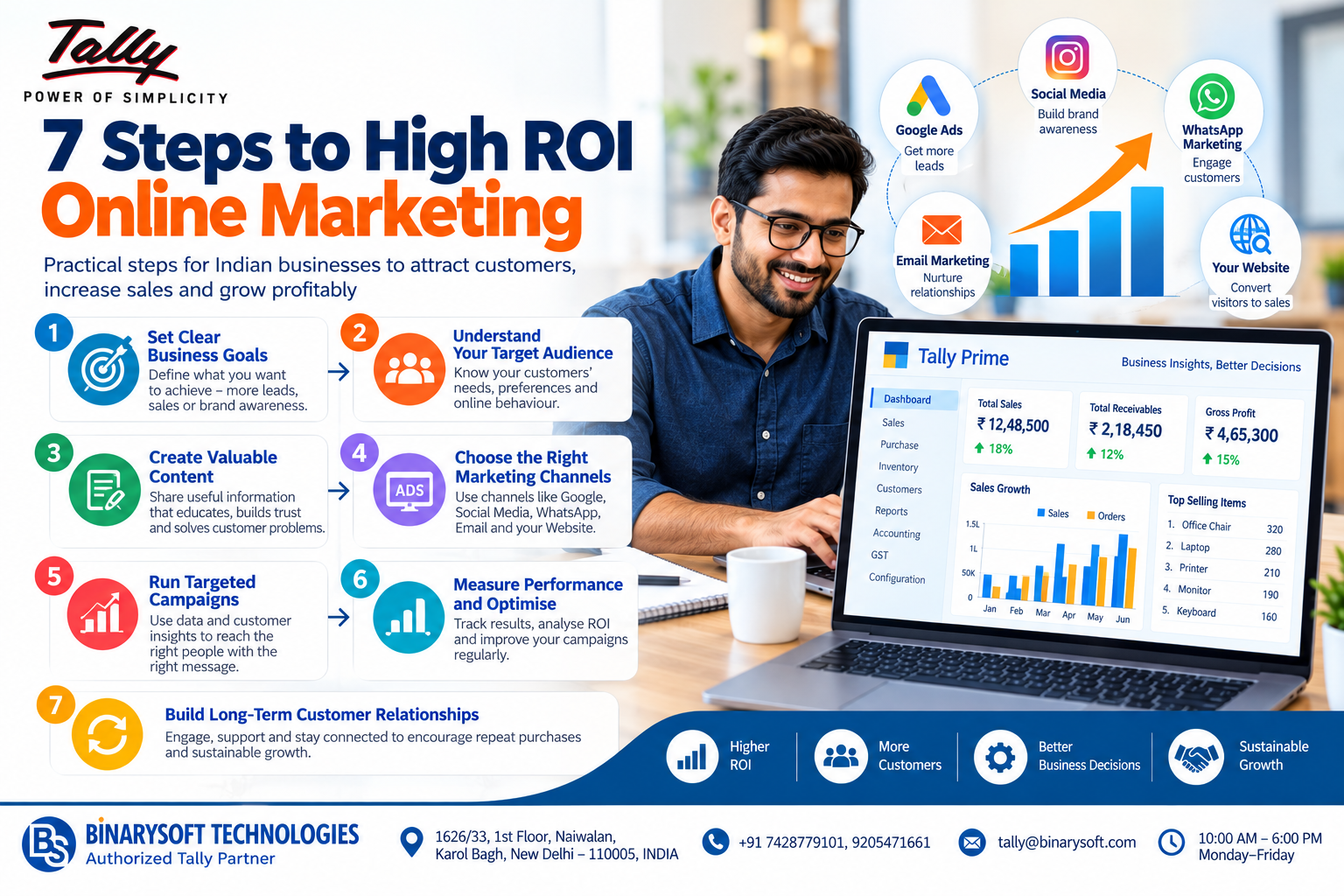
Online marketing has become an important growth channel for Indian businesses, but spending money on advertisements does not automatically produce profitable sales.
Many small businesses invest in Google Ads, Facebook, Instagram, websites and WhatsApp promotions without clearly understanding which activities generate actual revenue.
A campaign may attract thousands of visitors and hundreds of enquiries while producing only a few paying customers.
In a competitive digital environment, business owners need to focus on measurable outcomes rather than impressions, clicks or followers alone.
High ROI online marketing means generating meaningful financial returns from marketing expenditure while maintaining customer satisfaction and long-term profitability.
For manufacturers, wholesalers, retailers, distributors and service providers, a structured marketing strategy can help improve lead quality, reduce customer acquisition costs and strengthen repeat sales.
When marketing performance is combined with accurate sales, expense and accounting information from Tally Prime, businesses can make more informed financial decisions.
This guide explains seven practical steps to improve online marketing ROI and build a stronger foundation for sustainable business growth.
A Story: How a Delhi Business Owner Stopped Losing Money on Digital Advertising
Amit operated a growing electronics distribution business in Nehru Place, Delhi.
His company supplied computer accessories, networking equipment, printers and office electronics to retailers and corporate customers.
For several years, Amit depended mainly on referrals and repeat customers.
As competition increased, he decided to invest heavily in digital advertising.
He hired an agency, launched social media campaigns and started running paid advertisements.
During the first month, the reports looked impressive.
His advertisements received thousands of impressions, website traffic increased and customer enquiries started arriving.
However, when Amit reviewed his financial records, he discovered a worrying problem.
The company had spent ₹80,000 on marketing, but many enquiries came from people who were not interested in purchasing.
Some wanted products outside his delivery area. Others were comparing prices without any immediate requirement.
Meanwhile, supplier payments were approaching, inventory was accumulating and available cash was becoming limited.
One evening, Amit sat with his accountant and reviewed the numbers.
He realised that he had been celebrating website traffic instead of actual business results.
The accountant suggested comparing marketing expenditure with confirmed sales, gross profit and customer acquisition costs.
Amit changed his approach.
He focused on relevant search keywords, improved product pages, followed up with qualified enquiries and used WhatsApp to maintain relationships with interested customers who had agreed to receive messages.
He also began reviewing sales and expense records through Tally Prime.
Over time, his marketing decisions became more disciplined.
Instead of asking, "How many people saw our advertisement?" Amit began asking, "How many profitable customers did this campaign bring?"
That change transformed how he evaluated business growth.
The most important marketing result is not how many people notice your business, but how much sustainable value those interactions create.
This is an illustrative business story created to demonstrate common digital marketing challenges.
1. What Is High ROI Online Marketing?
High ROI online marketing refers to digital marketing activities that generate measurable financial returns relative to their cost.
ROI stands for Return on Investment.
It helps business owners understand whether their marketing expenditure is producing sufficient financial benefits.
Online marketing includes several channels, such as search engine optimisation, paid search advertising, social media marketing, email campaigns, content marketing and WhatsApp communication.
However, each channel has different costs, customer behaviour and conversion opportunities.
A business should evaluate marketing performance based on revenue, profit and customer acquisition costs rather than relying only on traffic statistics.
How to Calculate Marketing ROI
A simplified profit-based marketing ROI formula is:
Marketing ROI = [(Gross Profit Attributable to Marketing − Marketing Cost) ÷ Marketing Cost] × 100
For example:
|
Particulars
|
Amount
|
|---|
|
Marketing expenditure
|
₹50,000
|
|
Revenue from attributable sales
|
₹2,00,000
|
|
Cost of goods sold
|
₹1,20,000
|
|
Gross profit
|
₹80,000
|
|
Marketing cost
|
₹50,000
|
|
Profit after marketing cost
|
₹30,000
|
|
Marketing ROI
|
60%
|
This example excludes other operating expenses and assumes the sales can reasonably be attributed to the campaign.
Businesses should include relevant agency fees, software subscriptions and creative expenses when calculating the true cost of marketing.
2. Step One: Set Clear and Measurable Marketing Goals
Successful online marketing begins with clear business objectives.
Many companies start advertising without defining what they want to achieve.
Some businesses want more website visitors, while others need customer enquiries, product sales or repeat purchases.
Without measurable goals, evaluating marketing performance becomes difficult.
Common Marketing Objectives
Lead Generation: Attract potential customers who are genuinely interested in products or services.
Sales Growth: Increase confirmed orders and revenue.
Customer Retention: Encourage existing customers to purchase again.
Brand Awareness: Improve recognition among relevant audiences.
Market Expansion: Reach customers in additional cities or industries.
Set SMART Goals
A SMART goal should be specific, measurable, achievable, relevant and time-bound.
For example, instead of saying, "We want more customers," a business could define:
"Generate 100 qualified customer enquiries within 30 days while keeping the cost per qualified lead below ₹500."
This creates a measurable performance target.
How Tally Prime Helps
Tally Prime supports sales and financial reporting that can help businesses evaluate whether commercial objectives are being achieved.
Business owners can review sales figures, customer transactions and profitability information.
Marketing-specific goals and campaign performance should be maintained through suitable marketing analytics or CRM tools.
3. Step Two: Understand Your Target Audience
One of the biggest reasons online marketing campaigns fail is poor audience targeting.
A business may spend money advertising to people who have little interest in purchasing its products.
Understanding customer requirements helps businesses create more relevant campaigns.
Identify Your Ideal Customer
Businesses should consider customer location, industry, purchasing requirements, budget, decision-making process and common problems.
For example, a company selling Tally Prime and accounting services may target accountants, retailers, wholesalers, manufacturers and business owners.
A business offering Tally on Cloud may focus on organisations requiring remote access, centralised accounting or suitable multi-user environments.
Create Customer Segments
Different customer groups require different messages.
A small retailer may prioritise affordable billing and GST invoicing.
A manufacturer may require inventory tracking and material consumption records.
A distributor may need outstanding payment management and multiple godown reporting.
Marketing content should explain how a product or service addresses each group's specific challenges.
Benefits of Better Targeting
Relevant targeting can reduce wasted advertising expenditure and improve the quality of customer enquiries.
It also helps businesses create more useful content and communicate benefits more clearly.
4. Step Three: Create Valuable and Search-Optimised Content
Content marketing helps businesses attract potential customers by answering questions and explaining solutions.
Instead of relying exclusively on paid advertisements, businesses can publish educational articles, product guides, tutorials and case studies.
Why SEO Matters
Search Engine Optimisation, or SEO, helps search engines understand website content and its relevance to user searches.
A properly structured website can attract visitors searching for information about products, services or business problems.
For example, a business providing accounting software services could publish articles about GST billing, inventory management, customer outstanding tracking and cloud accounting.
Important SEO Practices
-
Use descriptive titles that match search intent.
-
Include relevant keywords naturally.
-
Write original, useful and accurate content.
-
Organise articles using clear headings.
-
Improve website loading speed and mobile usability.
-
Add relevant internal links and descriptive image text.
-
Review and update information when necessary.
Optimising Content for Google Discover
Google Discover can surface content based on user interests.
Businesses should focus on useful information, clear headlines, relevant images and trustworthy content.
Stories involving genuine business challenges can make articles more engaging.
However, Google Discover visibility is not guaranteed, and content should not rely on exaggerated claims or misleading headlines.
Role of Tally Prime
Tally Prime does not directly improve website search rankings.
However, its business reports can help identify products, customer segments and operational topics worth explaining through educational content.
5. Step Four: Choose the Right Online Marketing Channels
Not every digital platform is suitable for every business.
Marketing channel selection should depend on customer behaviour, product type, budget and purchasing requirements.
|
Marketing Channel
|
Primary Business Use
|
|---|
|
Google Search Ads
|
Reach customers actively searching for solutions
|
|
Search Engine Optimisation
|
Build organic search visibility
|
|
Facebook and Instagram
|
Product discovery and audience engagement
|
|
LinkedIn
|
Professional and B2B communication
|
|
WhatsApp Business
|
Customer conversations and follow-ups
|
|
Email Marketing
|
Relationship nurturing and repeat communication
|
|
YouTube
|
Product demonstrations and educational videos
|
Google Ads for High-Intent Customers
Search advertising can help businesses reach customers who are actively looking for specific products or services.
For example, someone searching for "GST billing software for wholesalers" may have a more immediate requirement than a person casually browsing social media.
Businesses should select relevant keywords, use appropriate geographic targeting and exclude irrelevant searches where possible.
Social Media Marketing
Social media can help businesses demonstrate products, share customer experiences and build recognition.
Visual products such as clothing, furniture and consumer electronics may benefit from image-based content.
Professional services may use educational posts and demonstrations to communicate expertise.
WhatsApp Marketing
WhatsApp can support customer enquiries, order-related communication and permission-based promotional updates.
Businesses should avoid unsolicited bulk messages and respect customer privacy.
Email Marketing
Email campaigns can help maintain relationships with existing customers through educational updates, service information and relevant offers.
The best channel mix should be determined through actual results rather than assumptions.
6. Step Five: Run Targeted Marketing Campaigns
Once a business understands its audience and selects suitable channels, it can begin running focused campaigns.
A campaign should communicate a clear value proposition.
Customers need to understand what the business offers, how it solves their problem and why they should consider purchasing.
Create Effective Advertisements
An effective advertisement generally includes a relevant headline, clear benefit, suitable visual and meaningful call to action.
For example, an accounting services provider might use:
Headline: Simplify GST Billing and Inventory Management
Message: Manage invoicing, stock records and business accounting through an integrated Tally Prime workflow.
Call to Action: Request a Product Demonstration.
Use Dedicated Landing Pages
A landing page should match the advertisement's promise.
If an advertisement promotes inventory management, the destination page should explain inventory features rather than redirecting visitors to an unrelated homepage.
Important landing page elements include clear service descriptions, relevant benefits, contact information and simple enquiry forms.
Test Campaign Variations
Businesses can compare different headlines, images, audience segments and landing pages.
This is commonly called A/B testing.
Tests should use sufficient data and consistent measurement before conclusions are drawn.
Avoid Common Advertising Mistakes
Campaigns often waste money because of broad targeting, unclear offers, weak landing pages or poor follow-up processes.
Businesses should review campaign performance regularly and make adjustments based on qualified leads and actual sales.
7. Step Six: Measure Marketing Performance and Optimise ROI
Marketing measurement helps businesses identify which campaigns are producing useful results.
Without reliable tracking, business owners may continue spending money on ineffective advertisements.
Important Digital Marketing Metrics
Cost Per Lead (CPL)
Cost per lead measures the average expenditure required to generate an enquiry.
CPL = Total Campaign Cost ÷ Number of Leads
For example, ₹20,000 spent to generate 100 leads produces a CPL of ₹200.
Customer Acquisition Cost (CAC)
Customer acquisition cost measures the average cost of obtaining a new customer.
CAC = Total Acquisition Expenditure ÷ New Customers Acquired
Conversion Rate
Conversion rate measures the percentage of visitors or prospects who complete a defined action.
Conversion Rate = (Conversions ÷ Relevant Visitors or Prospects) × 100
Return on Ad Spend (ROAS)
ROAS measures revenue attributed to advertising relative to advertising expenditure.
ROAS = Attributable Revenue ÷ Advertising Cost
A campaign generating ₹3,00,000 in attributable revenue from ₹75,000 in advertising expenditure has a ROAS of 4.
This does not mean the campaign generated four times its cost in profit.
How Tally Prime Supports Financial Analysis
Tally Prime provides financial and sales-related reports that can support business performance reviews.
Businesses can record marketing expenses under appropriate ledgers and review sales, gross profit and net profitability.
Campaign attribution, website traffic and advertising conversions generally require separate analytics or CRM systems.
Combining these records gives management a more complete view of marketing effectiveness.
8. Step Seven: Build Long-Term Customer Relationships
Acquiring a customer is only one part of business growth.
Repeat purchases and customer loyalty can make marketing expenditure more productive over time.
Existing customers may already understand the company's products, pricing and service quality.
Maintaining these relationships can create opportunities for repeat orders and referrals.
Practical Customer Retention Strategies
Provide Reliable Service: Deliver products and services according to commitments.
Maintain Communication: Share relevant updates through channels customers have agreed to use.
Offer Useful Support: Help customers resolve problems after purchasing.
Encourage Feedback: Understand customer concerns and improve business processes.
Recognise Repeat Customers: Provide appropriate service attention and relevant offers.
Maintain Accurate Records: Track customer transactions and payment obligations systematically.
Tally Prime for Customer Relationships
Tally Prime supports customer ledger management, bill-wise outstanding tracking and sales-related reporting.
Businesses can review customer transaction history and outstanding amounts.
These records help accounting and sales teams coordinate financial follow-ups.
However, dedicated customer engagement features such as automated marketing journeys, campaign tracking and behavioural segmentation may require additional CRM tools.
9. How Tally Prime Helps Improve Marketing and Business Profitability
Marketing creates demand, but accounting helps businesses understand whether that demand is financially worthwhile.
Tally Prime can support important operational and financial processes.
Sales Tracking
Businesses can review recorded sales transactions and analyse revenue patterns.
Expense Management
Marketing expenditure, agency fees and other business expenses can be recorded under suitable accounting ledgers.
Customer Outstanding Management
Bill-wise receivables reports help identify unpaid customer invoices.
Inventory Management
Stock reports can help businesses verify product availability before launching promotional campaigns.
Profitability Analysis
Financial reports support reviews of business income, expenditure and profitability.
GST Accounting
Applicable GST transactions can be recorded and reported through configured accounting workflows.
By combining marketing analytics with reliable accounting information, businesses can make better decisions about advertising budgets and customer acquisition.
10. Case Study One: Electronics Distributor Improves Advertising Efficiency
Illustrative case study
An electronics distributor in Nehru Place, Delhi, supplied computer accessories and networking products.
The business invested regularly in online advertisements but struggled to identify which campaigns generated profitable orders.
Business Challenges
The company received enquiries from customers outside its service area.
Sales employees did not consistently record lead sources.
Marketing expenditure was reviewed separately from financial performance.
Implementation
The distributor improved geographic targeting, created product-specific landing pages and introduced a lead tracking process.
Its accounting team used Tally Prime to maintain sales and expense records.
Management compared campaign costs with confirmed orders and gross profit.
Outcome
The company gained clearer visibility into marketing expenditure and sales performance.
It could identify campaigns producing more relevant enquiries and make better-informed budget decisions.
The case demonstrates the importance of connecting digital marketing data with financial information.
11. Case Study Two: Garment Wholesaler Develops Repeat Online Sales
Illustrative case study
A garment wholesaler in Gandhi Nagar, Delhi, supplied clothing products to retailers across several Indian states.
The company relied on seasonal promotions and direct sales representatives.
Business Challenges
Many existing customers were unaware of new collections.
Product enquiries were handled inconsistently.
Management had limited visibility into repeat purchasing patterns.
Implementation
The wholesaler introduced a digital catalogue, improved its website content and established permission-based WhatsApp communication with interested retailers.
The company also standardised sales and inventory records in Tally Prime.
Outcome
Customers could access product information more conveniently.
The sales team developed a more structured follow-up process.
Management gained better visibility into recorded sales, product movement and customer balances.
The example illustrates how online marketing and accounting systems can complement one another.
12. Creating a Practical Digital Marketing Budget
A marketing budget should reflect business objectives, financial capacity and expected customer value.
Businesses should avoid allocating excessive expenditure before testing campaign performance.
Consider a hypothetical monthly budget of ₹50,000.
|
Marketing Activity
|
Budget
|
|---|
|
Google Ads
|
₹20,000
|
|
SEO and content creation
|
₹10,000
|
|
Social media campaigns
|
₹8,000
|
|
Email and customer communication
|
₹4,000
|
|
Landing page improvements
|
₹5,000
|
|
Testing and optimisation
|
₹3,000
|
|
Total
|
₹50,000
|
This allocation is illustrative, not a universal recommendation.
A business selling industrial machinery may require a different channel mix from a fashion retailer.
Marketing expenditure should be reviewed against gross profit, cash flow and customer acquisition performance.
13. Common Mistakes That Reduce Online Marketing ROI
Businesses frequently make marketing decisions based on incomplete information.
One common mistake is focusing on website traffic without considering lead quality.
Another is measuring advertising revenue without accounting for product costs.
Businesses may also invest in too many marketing channels simultaneously, making it difficult to identify effective activities.
Other problems include weak landing pages, slow enquiry responses, inconsistent follow-ups and unrealistic expectations.
Marketing campaigns require ongoing evaluation.
Businesses should stop or revise underperforming activities when reliable evidence shows that they are not commercially sustainable.
14. A 30-Day Action Plan for Better Online Marketing ROI
A structured plan can help businesses improve their marketing processes without attempting too many changes simultaneously.
|
Period
|
Main Activity
|
Expected Deliverable
|
|---|
|
Days 1–7
|
Review current marketing performance
|
Baseline metrics and clear goals
|
|
Days 8–14
|
Improve targeting and content
|
Revised audience segments and landing pages
|
|
Days 15–21
|
Launch controlled campaigns
|
Initial lead and conversion data
|
|
Days 22–30
|
Analyse results and optimise
|
Performance review and next-month priorities
|
During the first week, businesses should review existing advertising costs, lead sources and sales performance.
The second week should focus on improving messaging, website content and targeting.
The third week can introduce controlled campaigns with defined budgets.
During the final week, management should compare qualified enquiries, confirmed sales and attributable gross profit against marketing expenditure.
Thirty days may not be sufficient to evaluate longer sales cycles or SEO performance, but it can establish a useful measurement process.
15. How Tally on Cloud Can Support Growing Businesses
Businesses operating from multiple locations may need access to centralised accounting information.
A properly configured Tally on Cloud environment can allow authorised employees to work with centrally hosted Tally Prime data.
For example, a business with sales offices in Delhi and Gurugram may use centralised accounting records to review invoices, customer outstanding amounts and relevant financial reports.
Benefits for Business Operations
Remote access can improve collaboration between authorised employees.
Centralised records can reduce dependence on separate accounting files.
Appropriate multi-user arrangements can support coordinated accounting activities.
Managed hosting may provide backup and security services, depending on the selected plan and provider.
Tally on Cloud is not itself an online marketing automation platform. Its value lies in supporting financial and operational visibility alongside separate marketing tools.
16. The Future of High ROI Online Marketing for Indian MSMEs
Online marketing continues to evolve as businesses adopt new communication tools, analytics systems and digital sales processes.
Automation can help with repetitive marketing activities, while analytics can improve campaign measurement.
Artificial intelligence may assist with content preparation, audience analysis and customer support workflows.
However, technology cannot replace accurate business information or genuine customer relationships.
Businesses must continue to evaluate marketing activities against revenue, profitability, cash flow and customer satisfaction.
For Indian MSMEs, the strongest strategy is often a combination of useful content, focused advertising, reliable customer communication and disciplined financial management.
Marketing success should ultimately be measured through sustainable business outcomes rather than temporary increases in online visibility.
Conclusion
High ROI online marketing requires more than advertising expenditure and attractive promotional content.
Businesses need clear objectives, relevant customer targeting, valuable content, suitable marketing channels, focused campaigns, reliable performance measurement and long-term customer relationships.
The seven steps outlined in this guide provide a practical foundation for improving marketing effectiveness.
Tally Prime can support these efforts by helping businesses maintain accurate sales, expense, customer outstanding and inventory records.
When digital marketing analytics are combined with financial information, business owners can make more informed decisions about customer acquisition and advertising budgets.
For manufacturers, retailers, wholesalers, distributors and service providers, profitable growth depends on balancing customer acquisition with operational efficiency and financial discipline.
The goal of online marketing should not simply be to generate more clicks. It should be to attract the right customers, deliver meaningful value and build a financially sustainable business.
Powered by Binarysoft Technologies Authorized Tally Partner
Location: 1626/33, 1st Floor, Naiwalan, Karol Bagh, New Delhi – 110005, INDIA
Contact: +91 7428779101, 9205471661
Email: tally@binarysoft.com
Business Hours: 10:00 AM – 6:00 PM, Monday–Friday
Frequently Asked Questions
What is the biggest mistake in digital marketing?
One of the biggest mistakes is evaluating campaigns only through impressions, clicks or leads without measuring confirmed sales, acquisition costs and profitability.
Why is customer retention important for marketing ROI?
Repeat customers may generate additional revenue without requiring the same level of acquisition expenditure as entirely new customers.
Can Tally on Cloud help businesses manage sales information remotely?
Yes. A properly configured hosted Tally Prime environment can support authorised remote access to centralised accounting and sales records.
How much should a small business spend on online marketing?
Marketing budgets should depend on business profitability, available cash flow, growth objectives and measured campaign performance.
CA. Arvindh Khetwaani is a Chartered Accountant with experience in financial reporting, compliance management, and accounting software implementation. He has assisted businesses in adopting structured inventory and billing practices, and his articles focus on accuracy, controls, and sustainable business growth.