Call CA Tally HelpDesk
+91 9205471661,
7428779101
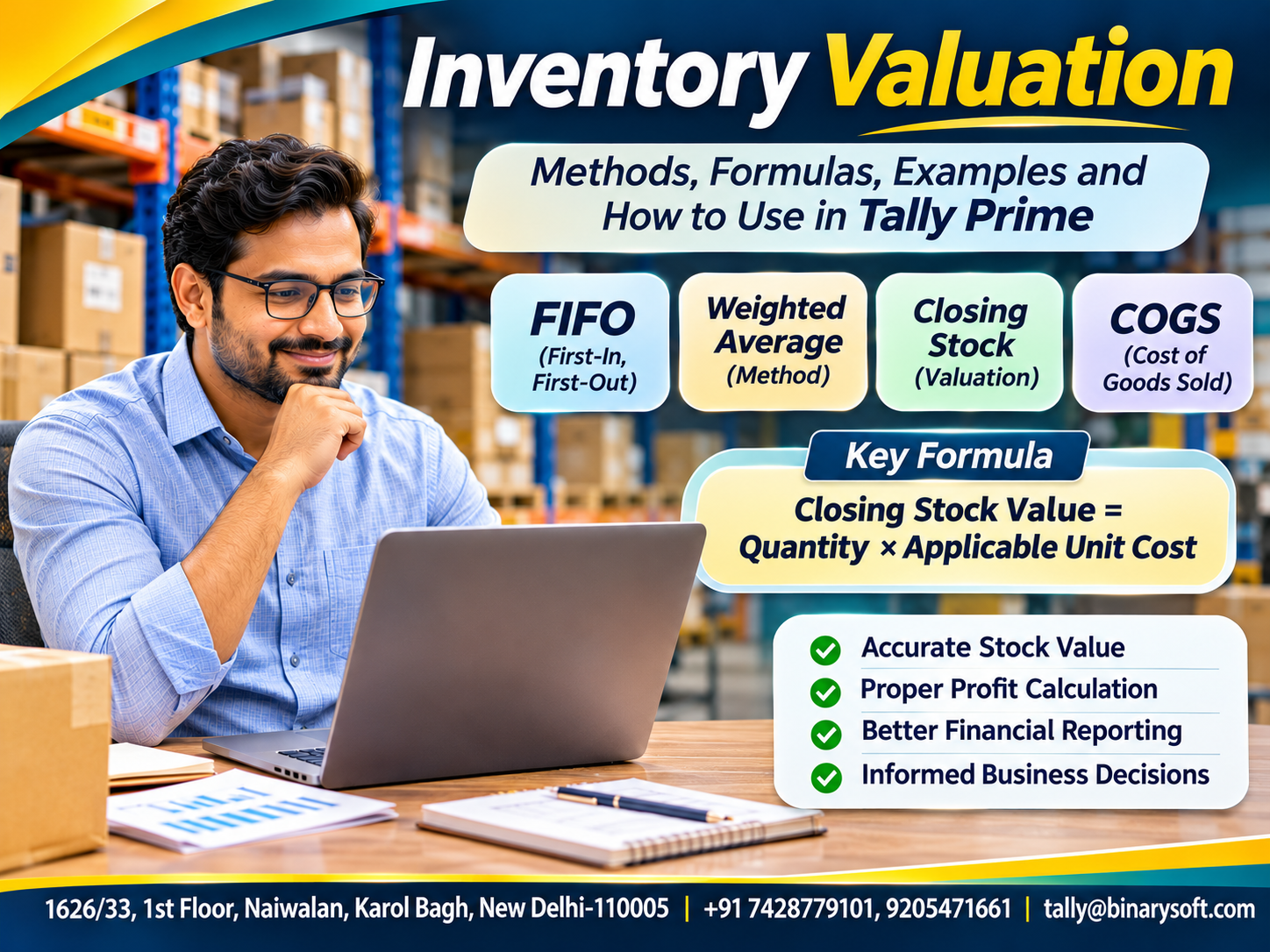
Introduction: Why Inventory Valuation Matters for Every Business
Imagine owning a successful wholesale business with thousands of products stored across multiple warehouses.
Sales are increasing, customers are satisfied, and purchase orders arrive regularly.
However, when your accountant prepares the financial statements, an important question arises:
What is the actual value of the inventory remaining in your business?
Some products were purchased at lower prices, while others were acquired recently at higher rates. Certain items may be damaged, outdated or difficult to sell.
Simply counting products cannot provide a complete answer.
This is where inventory valuation becomes essential.
Inventory valuation determines the monetary value of goods and materials held by a business at a particular date.
It directly affects the cost of goods sold, gross profit, closing stock and financial reporting.
For Indian retailers, wholesalers, manufacturers and distributors, accurate valuation is important for understanding profitability and making purchasing decisions.
Tally Prime supports inventory accounting through stock records, valuation methods and financial reports.
1. What Is Inventory Valuation?
Inventory valuation is the accounting process of assigning monetary values to inventory held by a business.
Inventory may include raw materials, work-in-progress, finished goods and merchandise purchased for resale.
For example, an electronics distributor may have 500 mobile accessories remaining in stock.
Determining their value requires more than multiplying the quantity by the latest selling price.
The business must apply an appropriate inventory-costing method and consider relevant accounting requirements.
Inventory valuation establishes the carrying amount of inventory for financial reporting.
It also helps management understand how much capital is invested in unsold goods.
Different valuation methods can produce different results when purchase costs change.
Therefore, businesses should select suitable methods and apply them consistently.
2. Why Is Inventory Valuation Important?
Inventory valuation influences several important business measurements.
Accurate Financial Statements
Closing inventory is generally reported as a current asset in the Balance Sheet.
Reliable Profit Calculation
Inventory values influence the cost of goods sold and reported gross profit.
Better Purchasing Decisions
Management can assess how much money is invested in stock.
Working Capital Management
Excess inventory may restrict funds available for other business activities.
Cost Control
Valuation reports help identify changes in inventory costs.
Business Planning
Reliable inventory information supports budgeting and financial analysis.
Accounting Compliance
Businesses must follow applicable accounting standards and valuation policies.
Incorrect inventory valuation can distort financial performance, even when sales and purchases are recorded correctly.
3. What Types of Inventory Require Valuation?
Inventory differs according to the nature of the business.
Raw Materials: Materials purchased for manufacturing products.
Work-in-Progress: Partially completed products undergoing production.
Finished Goods: Completed products available for sale.
Trading Goods: Merchandise purchased for resale.
Consumable Production Materials: Relevant supplies consumed during manufacturing.
For example, a furniture manufacturer may maintain timber, unfinished cabinets and completed furniture.
Each category may require appropriate cost accumulation and valuation procedures.
Businesses should maintain clear inventory classifications to improve reporting accuracy.
4. Understanding the Inventory Valuation Formula
A basic inventory-cost relationship is:
Closing Inventory = Opening Inventory + Net Purchases and Other Applicable Inventory Costs − Cost of Goods Sold
This relationship assumes that relevant inventory adjustments are appropriately accounted for.
Consider a trading business with the following figures:
| Particulars | Amount |
|---|
| Opening inventory |
₹2,00,000 |
| Net purchases |
₹8,00,000 |
| Cost of goods sold |
₹7,20,000 |
| Closing inventory |
₹2,80,000 |
The calculation is:
₹2,00,000 + ₹8,00,000 − ₹7,20,000 = ₹2,80,000.
For individual stock items, a simplified calculation is:
Stock Value = Quantity × Applicable Unit Cost
The applicable unit cost depends on the selected costing method.
Financial reporting may also require adjustments when net realisable value is lower than cost.
5. Major Inventory Valuation Methods
Several methods are used to assign costs to inventory.
The appropriate method depends on product characteristics and applicable accounting standards.
First-In, First-Out (FIFO)
FIFO assumes that the earliest inventory costs are assigned to goods sold first.
Remaining inventory generally reflects more recent acquisition costs.
Weighted Average Cost
This method calculates an average unit cost using the total relevant inventory cost and quantity.
It is useful for interchangeable goods purchased at varying prices.
Specific Identification
This method assigns the actual cost of a particular identifiable inventory item.
It is suitable for certain unique or individually identifiable products.
Other Costing Approaches
Businesses may encounter methods such as standard costing or retail inventory methods.
Their use for financial reporting depends on whether they appropriately approximate cost and satisfy relevant accounting requirements.
Not every method available for internal analysis is acceptable for statutory inventory valuation.
6. FIFO Inventory Valuation with Example
FIFO stands for First-In, First-Out.
Suppose a business purchases identical products as follows:
| Purchase | Quantity | Unit Cost |
|---|
| First purchase |
100 |
₹50 |
| Second purchase |
100 |
₹60 |
| Third purchase |
100 |
₹70 |
Total inventory cost is ₹18,000.
If 200 units are sold, FIFO assigns the earliest costs first.
Cost of goods sold:
100 × ₹50 = ₹5,000.
100 × ₹60 = ₹6,000.
Total Cost of Goods Sold = ₹11,000.
The remaining 100 units are valued at ₹70 each.
Closing Inventory = ₹7,000.
FIFO is straightforward but requires accurate purchase quantities and cost records.
7. Weighted Average Inventory Valuation
The weighted average method calculates a common cost for interchangeable inventory units.
The formula is:
Weighted Average Cost = Total Cost of Goods Available ÷ Total Units Available
Using the previous example:
Total cost = ₹18,000.
Total quantity = 300 units.
Average cost = ₹60 per unit.
If 200 units are sold:
Cost of goods sold = ₹12,000.
Closing inventory = 100 × ₹60 = ₹6,000.
This is a periodic weighted average example.
A moving-average system recalculates the average after relevant new receipts, so transaction timing can affect results.
Businesses should distinguish these approaches when configuring inventory accounting.
8. FIFO vs Weighted Average: Which Is Better?
Both methods can be appropriate for interchangeable inventory.
FIFO uses historical cost layers in chronological order.
Weighted average combines relevant inventory costs into an average.
During periods of rising prices, FIFO may produce lower cost of goods sold and higher closing inventory values than weighted average.
However, the outcome depends on transaction timing and quantities.
Weighted average can simplify costing when businesses purchase large quantities of similar goods.
FIFO may be easier to relate to chronological purchase records.
Neither method is universally superior.
The selection should reflect inventory characteristics, accounting requirements and consistent business policies.
9. An Emotional Story: The Business Owner Who Mistook Stock for Profit
Rajiv owned a small electrical accessories distribution company in Delhi.
His father had started the business with modest savings and a single rented shop.
Over the years, Rajiv expanded operations into wholesale distribution.
The warehouse became larger, and the number of products increased.
Rajiv felt proud whenever he saw shelves filled with merchandise.
He believed that a warehouse full of goods represented business success.
However, one financial year brought unexpected difficulties.
Purchase prices increased, and several products stopped selling as quickly as before.
Rajiv continued purchasing stock because he feared disappointing customers.
When his accountant prepared the annual financial statements, Rajiv discovered that a significant amount of working capital was tied up in inventory.
Some products had also lost market value.
The business appeared busy, but available cash was limited.
Rajiv worried about employee salaries and his daughter's upcoming college expenses.
One evening, he visited the warehouse after everyone had left.
Looking at the boxes, he remembered his father's advice:
“Business success is not measured by how much you buy, but by how wisely you manage what you own.”
The next morning, Rajiv met his accountant.
They reviewed inventory quantities, valuation policies and slow-moving products.
The team improved stock records and began monitoring inventory values regularly.
Rajiv also established a more disciplined purchasing process.
Over time, he gained clearer visibility into stock investment and business profitability.
One evening, his daughter noticed that he was no longer carrying accounting files home.
He smiled and explained that understanding the numbers had helped him make better decisions.
For Rajiv, inventory valuation was not merely an accounting requirement. It became a way to protect his family's future and preserve the business his father had built.
This fictional story illustrates the emotional and financial importance of reliable inventory information.
10. How Tally Prime Helps with Inventory Valuation
Tally Prime provides inventory accounting features that support stock valuation and financial reporting.
Stock Item Management
Businesses can create stock items with appropriate names, units and classifications.
Inventory Valuation Methods
Supported stock item settings allow businesses to apply suitable costing methods.
Purchase and Sales Recording
Accurate transaction entries provide the quantities and costs needed for inventory valuation.
Stock Summary
The Stock Summary helps users review inventory quantities and values.
Godown Management
Businesses can maintain location-wise stock information when godowns are configured.
Batch-Wise Inventory
Supported batch features help businesses maintain additional information for suitable products.
Financial Reports
Inventory values contribute to relevant accounting reports according to the company's configuration.
Tally Prime supports these processes, but accurate results depend on correct master data and transactions.
11. How to Configure Inventory Valuation in Tally Prime
Businesses can follow a structured configuration process.
Step 1: Create Stock Items
Create appropriate stock masters for the products or materials maintained.
Step 2: Configure Units
Define suitable units of measurement.
Step 3: Review Valuation Settings
Open the relevant stock item configuration and locate supported costing options.
Step 4: Select the Method
Choose an appropriate method, such as FIFO or average costing, according to the business's accounting policy.
Step 5: Enter Opening Stock
Record verified opening quantities and values.
Step 6: Record Transactions
Enter purchases, sales, returns and relevant inventory movements accurately.
Step 7: Review Reports
Examine the Stock Summary and related inventory information.
Step 8: Reconcile Records
Compare recorded stock with physical inventory and investigate discrepancies.
Exact navigation depends on the Tally Prime release and enabled features.
12. Inventory Valuation and Cost of Goods Sold
Cost of goods sold, commonly called COGS, represents the inventory cost assigned to goods sold during a period.
It is an important component of gross profit.
The basic relationship is:
Gross Profit = Net Sales Revenue − Cost of Goods Sold
Suppose a business earns ₹12 lakh in net sales.
Its cost of goods sold is ₹8 lakh.
Gross profit is ₹4 lakh.
If inventory costs are assigned incorrectly, the reported gross profit may also be incorrect.
This is why valuation methods should be applied consistently.
Businesses should also remember that gross profit is not the same as net profit.
Administrative, selling, finance and other relevant expenses may still need to be considered.
13. Case Study One: Inventory Valuation for an Electronics Wholesaler
Illustrative Case Study
Business Background
A Delhi-based electronics wholesaler purchases accessories from several suppliers.
Purchase rates fluctuate throughout the year.
The Challenge
Management struggles to understand the value of remaining inventory and the effect of changing costs on profitability.
The Approach
The business reviews its inventory accounting policy with its accountant.
Stock items and purchase records are standardized in Tally Prime.
The team applies an appropriate valuation method and reviews inventory reports regularly.
Physical stock is reconciled with recorded quantities.
Expected Outcome
Management can gain more consistent information about inventory values and the cost of goods sold.
Business Lesson
Accurate valuation requires reliable purchase records, appropriate costing methods and regular reconciliation.
14. Case Study Two: Inventory Valuation for a Furniture Manufacturer
Illustrative Case Study
Business Background
A furniture manufacturer purchases timber, hardware and finishing materials.
The Challenge
Material prices change frequently, while some finished products remain unsold for extended periods.
The Approach
The company maintains separate stock records for raw materials and finished goods.
Relevant purchases and manufacturing transactions are recorded in Tally Prime.
Management reviews inventory costs and identifies items requiring further valuation assessment.
Expected Outcome
The manufacturer can improve visibility into material investment and support more dependable financial reporting.
Business Lesson
Manufacturing inventory valuation requires both accurate material records and appropriate treatment of production costs.
Both case studies are illustrative rather than verified customer results.
15. Inventory Valuation and Indian Accounting Standards
Indian businesses should apply the financial reporting framework relevant to their organization.
Under Accounting Standard 2, inventories are generally valued at the lower of cost and net realisable value, subject to the standard's requirements.
Ordinarily interchangeable inventory items may use FIFO or weighted average cost formulas.
Entities applying Ind AS 2 must follow the corresponding requirements under that framework.
Specific identification may be appropriate for qualifying non-interchangeable items.
Inventory cost may include purchase costs, conversion costs and other qualifying costs incurred to bring inventory to its present location and condition.
Businesses should seek professional guidance when selecting valuation policies or evaluating unusual inventory items.
16. Understanding Net Realisable Value
Net realisable value, or NRV, is generally the estimated selling price in the ordinary course of business less estimated costs of completion and costs necessary to make the sale.
Consider a product with an inventory cost of ₹1,000.
Suppose its estimated selling price is ₹900 and selling costs are ₹50.
NRV is ₹850.
If the relevant accounting requirements call for measurement at the lower of cost and NRV, the carrying amount would be ₹850.
This example demonstrates why inventory cannot always remain valued at its original cost.
Damaged, obsolete and slow-moving inventory may require particular attention.
17. Common Inventory Valuation Mistakes
Businesses should avoid several common errors.
Incorrect Opening Stock: Wrong opening quantities or values affect subsequent calculations.
Missing Purchase Costs: Incomplete cost information can understate inventory values.
Incorrect Valuation Method: An unsuitable method may distort financial reporting.
Unrecorded Returns: Purchase and sales returns can affect inventory quantities and costs.
Ignoring Damaged Goods: Unsaleable inventory may require adjustments.
Duplicate Stock Items: Inconsistent item masters create reporting confusion.
Unrecorded Manufacturing Consumption: Missing material issues can distort stock records.
Inadequate Physical Verification: Recorded quantities may differ from actual inventory.
Regular reviews help identify and correct these problems.
18. Best Practices for Accurate Inventory Valuation
Businesses can strengthen inventory accounting through consistent procedures.
Maintain clear stock item classifications.
Use appropriate units of measurement.
Record purchases and sales promptly.
Apply valuation policies consistently.
Review stock quantities regularly.
Conduct physical inventory verification.
Investigate negative stock and unusual valuations.
Monitor slow-moving and obsolete inventory.
Assess net realisable value where required.
Maintain documentation for inventory adjustments.
Review inventory reports before finalizing financial statements.
These practices improve the reliability of stock and financial information.
19. How Inventory Valuation Improves Business Decisions
Inventory valuation provides information beyond statutory reporting.
Management can assess how much working capital is invested in stock.
It can identify products requiring further review because of high carrying values or slow movement.
Cost information can also support pricing analysis.
However, inventory valuation should not be confused with market demand forecasting.
A product may have a high accounting value but limited customer demand.
Businesses should combine valuation reports with sales trends, stock movement analysis and purchasing information.
Tally Prime's accounting and inventory reports can support these reviews when records are maintained correctly.
20. The Future of Inventory Valuation
Inventory accounting is becoming increasingly data-driven.
Businesses are exploring integrated inventory systems, barcode workflows, automated reporting and analytical tools.
These technologies can improve visibility and reduce repetitive manual work.
However, accurate valuation still depends on sound accounting policies and reliable transaction records.
For Tally Prime users, properly configured inventory masters, transaction entries and stock reports provide a practical foundation.
Businesses with complex manufacturing or warehouse requirements may evaluate additional tools or suitable integrations.
The objective remains consistent: maintain reliable information about the quantities and values of goods held by the business.
Conclusion
Inventory valuation is essential for determining closing stock, calculating the cost of goods sold and preparing reliable financial statements.
Methods such as FIFO and weighted average costing help businesses assign costs to interchangeable inventory.
The appropriate method depends on inventory characteristics and applicable accounting standards.
Businesses must also assess whether inventory requires adjustment to net realisable value.
Tally Prime supports inventory accounting through stock masters, purchase and sales transactions, valuation settings and stock reports.
However, dependable results require accurate data entry, consistent accounting policies and regular reconciliation.
Inventory valuation is not simply about calculating the worth of products in a warehouse. It is about understanding business costs, protecting working capital and making decisions with greater financial confidence.
Powered by Binarysoft Technologies
Authorized Tally Partner
Binarysoft Technologies helps businesses improve inventory accounting and financial management through Tally Prime implementation, configuration, customization, technical support and cloud-based accounting solutions.
Our services support retailers, wholesalers, manufacturers and distributors seeking reliable stock records, accurate inventory valuation and improved financial reporting.
Location:
1626/33, 1st Floor, Naiwalan, Karol Bagh, New Delhi – 110005, INDIA
Contact Us:
+91 7428779101, 9205471661
Email:
tally@binarysoft.com
Business Hours:
10:00 AM – 6:00 PM, Monday to Friday
Frequently Asked Questions
What is the difference between FIFO and weighted average costing?
FIFO assigns the earliest available inventory costs first, while weighted average costing calculates an average unit cost using relevant quantities and costs.
How does inventory valuation affect profit?
The valuation method influences the cost of goods sold and closing stock, which can affect reported gross profit.
Is inventory valuation important for small businesses?
Yes. Accurate valuation helps small businesses understand stock investment, profitability and financial performance.
How can businesses improve inventory valuation accuracy?
Maintain accurate transaction records, apply consistent valuation policies, verify physical stock, review inventory reports and assess required valuation adjustments.
CA. Ankit Vardiya works closely with traders, wholesalers, and service businesses on accounting automation, GST reporting, and audit readiness. His professional exposure to day-to-day business operations allows him to translate complex accounting concepts into practical guidance for Indian business owners.









