Call CA Tally HelpDesk
+91 9205471661,
7428779101
Introduction: Why Every Growing Business Needs an Inventory Management Process
Imagine a wholesale business receiving hundreds of products every week. Employees are busy preparing invoices, customers are placing orders and suppliers are delivering new stock.
Everything appears to be running smoothly.
Yet the owner repeatedly faces three problems: popular products are unavailable, slow-moving goods occupy warehouse space and supplier payments are becoming difficult to manage.
The business is generating sales, but inventory is consuming too much working capital.
This situation is common when purchasing, stock storage, sales and accounting operate without a coordinated system.
An effective inventory management process helps businesses control the movement of goods from procurement to final sale.
It provides visibility into available stock, pending orders, purchasing requirements, warehouse locations and inventory costs.
For Indian businesses, where price fluctuations, seasonal demand and supplier lead times can significantly affect profitability, systematic inventory management is particularly valuable.
Tally Prime helps connect inventory transactions with purchasing, sales, manufacturing and accounting records, enabling businesses to monitor operations more consistently.
This guide explains the complete inventory management process, its importance, practical techniques and implementation strategies.
What Is Inventory Management?
Inventory management refers to the activities involved in planning, purchasing, receiving, storing, tracking and controlling goods held by a business.
Inventory may include raw materials, work-in-progress, finished goods, merchandise, packaging materials and maintenance supplies.
The objective is to maintain sufficient inventory to meet business requirements without unnecessarily increasing storage expenses or blocking working capital.
For example, a retailer should maintain enough popular products to satisfy customer demand while avoiding excessive purchases of slow-selling merchandise.
Similarly, a manufacturer must ensure that essential raw materials are available when production begins.
Inventory management combines operational planning with accurate financial information.
What Is the Inventory Management Process?
The inventory management process is a structured sequence of activities used to control stock throughout its business lifecycle.
It generally begins with demand planning and continues through procurement, receipt, storage, stock movement, order fulfilment and reporting.
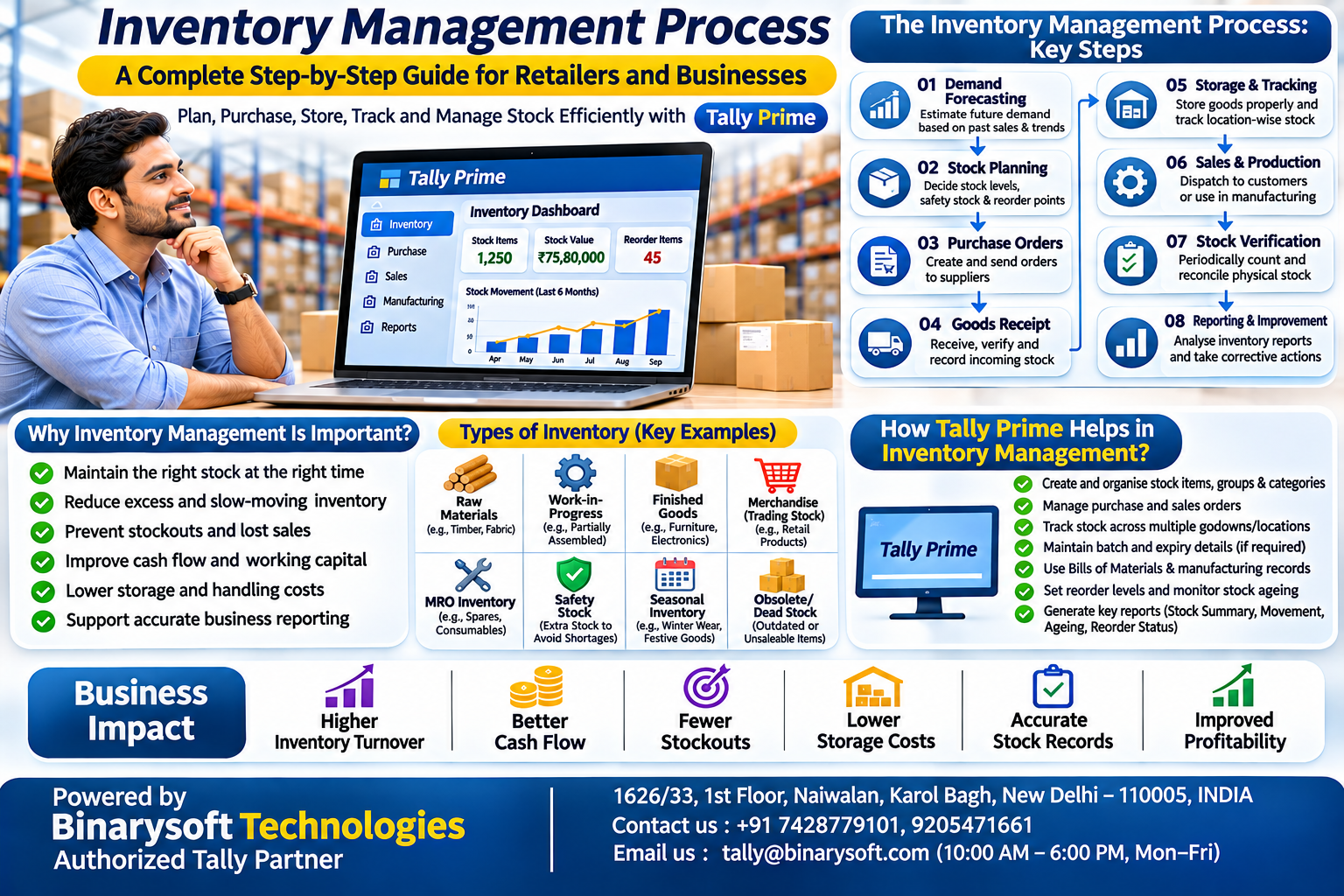
Inventory management workflow
Each stage depends on accurate information from the previous stage. Reporting feeds the next purchasing and demand-planning cycle.
8 Essential Steps in the Inventory Management Process
Step 1: Demand Forecasting and Inventory Planning
The first step is estimating future demand.
Businesses should examine previous sales, seasonal trends, customer orders and market conditions.
A school stationery distributor, for example, may experience higher demand before the academic year begins.
Forecasting helps determine which products to purchase and in what quantities.
Businesses should also consider supplier lead times and unexpected demand fluctuations.
Tally Prime's sales and stock movement reports can provide historical information to support these decisions.
Step 2: Determine Stock Levels and Reorder Requirements
After estimating demand, businesses should establish appropriate inventory levels.
Maintaining too little stock can cause lost sales. Maintaining too much stock increases carrying costs.
A common reorder point formula is:
\[ \text{Reorder Point}=(\text{Daily Demand}\times\text{Lead Time})+\text{Safety Stock} \]
Suppose a business sells 20 units daily, supplier delivery takes seven days and safety stock is 40 units.
Reorder point = (20 × 7) + 40 = 180 units.
When the inventory position reaches 180 units, replenishment should be considered.
Tally Prime supports reorder levels and reorder status reporting to assist stock planning.
Step 3: Create Purchase Orders and Coordinate With Suppliers
Purchasing should follow approved inventory requirements rather than guesswork.
A structured purchase order identifies the supplier, product, quantity, agreed rate and delivery requirements.
Businesses should evaluate supplier reliability, purchase prices, payment terms and expected delivery times.
Tally Prime supports purchase order recording and tracking, helping businesses maintain organised procurement records.
Step 4: Receive and Verify Goods
When products arrive, employees should compare delivered quantities with purchase orders and supplier documents.
They should inspect product condition, identify shortages and verify batch or expiry details where applicable.
Goods should be accepted and recorded according to the company's receiving procedures.
Tally Prime supports Receipt Note transactions and purchase-related inventory records.
Accurate goods receipt information helps prevent differences between physical inventory and accounting records.
Step 5: Store and Track Inventory
Received products should be stored in suitable warehouse locations.
Businesses may organise stock by product category, size, brand, batch or storage requirement.
Location-wise inventory tracking becomes especially important when operating multiple warehouses.
Tally Prime supports godowns and location-wise stock records.
Stock Journal vouchers can be used to record inventory transfers between locations.
For perishable products, businesses should also implement appropriate batch tracking and physical stock rotation procedures.
Step 6: Manage Sales, Dispatch and Manufacturing
The next stage involves fulfilling customer orders or consuming materials in production.
For trading businesses, inventory decreases as goods are sold or dispatched.
For manufacturers, raw materials are consumed and finished goods are produced.
Tally Prime supports sales orders, delivery-related transactions, Bills of Materials and manufacturing records.
These capabilities help businesses connect inventory movements with commercial transactions.
Step 7: Conduct Physical Stock Verification
Even well-maintained inventory systems require physical verification.
Differences can arise from damage, theft, incorrect entries, unrecorded returns or handling mistakes.
Businesses should perform periodic stock counts and investigate discrepancies.
Tally Prime supports Physical Stock vouchers for recording verified inventory adjustments.
Regular verification improves the reliability of stock reports and financial records.
Step 8: Analyse Inventory Performance and Improve Processes
Inventory management is a continuous process.
Management should regularly examine stock availability, ageing inventory, purchasing trends and product movement.
Important reports include Stock Summary, Movement Analysis, Stock Ageing Analysis, Godown Summary and Inventory Reorder Status.
These reports help identify operational weaknesses and opportunities for improvement.
Why an Effective Inventory Management Process Matters
A systematic inventory process offers several business advantages.
Improved stock accuracy: Consistent transaction recording reduces differences between physical and recorded inventory.
Better cash flow: Purchasing based on actual requirements can reduce unnecessary investment in excess stock.
Fewer stockouts: Reorder planning helps maintain the availability of important products.
Reduced storage expenses: Better stock control can minimise warehouse space requirements and handling costs.
Faster order fulfilment: Accurate stock information supports more reliable delivery commitments.
Better profitability analysis: Integrated inventory and accounting records help businesses understand product costs and margins.
Important Inventory Management Techniques
ABC Analysis
ABC analysis classifies inventory according to its relative financial importance.
High-value A items generally require tighter monitoring, while lower-value C items may use simpler controls.
Economic Order Quantity
Economic Order Quantity estimates an order size that balances ordering and holding costs under a set of assumptions.
\[ EOQ=\sqrt{\frac{2DS}{H}} \]
Here, D represents annual demand, S represents ordering cost per order and H represents annual holding cost per unit.
FIFO Stock Rotation
First-In, First-Out stock rotation prioritises older inventory for dispatch.
This is useful for reducing unnecessary ageing, although expiry-sensitive products may require First-Expiry, First-Out procedures.
Just-in-Time Inventory
Just-in-Time aims to reduce excess inventory by coordinating supplies closely with actual requirements.
It requires reliable suppliers and careful demand planning.
Stock Ageing Analysis
Ageing analysis identifies products that have remained unsold or unused for extended periods.
It helps management investigate slow-moving and potentially obsolete inventory.
These techniques should be selected according to business requirements rather than applied identically to every product.
How Tally Prime Simplifies the Inventory Management Process
Tally Prime brings inventory and accounting information together, helping businesses manage stock from purchasing through sales and manufacturing.
1. Create and Organise Stock Items
Businesses can create stock items, groups, categories and units of measurement.
This makes inventory easier to classify, search and analyse.
2. Manage Purchase and Sales Orders
Purchase orders help record procurement requirements, while sales orders help track customer commitments.
Related transactions can be recorded through the appropriate vouchers.
3. Track Multiple Godowns
Businesses can create different storage locations and monitor stock availability at each location.
Stock transfers can be recorded using Stock Journal vouchers.
4. Maintain Batch and Expiry Information
Batch-wise tracking helps businesses manage products with different manufacturing dates, expiry dates or purchase costs.
5. Manage Manufacturing Inventory
Bills of Materials and Manufacturing Journal transactions support raw material consumption and finished goods production records.
6. Monitor Job and Project Costs
Businesses handling job work or project-based production can track relevant costs, material movements and profitability through suitable configurations.
7. Generate Inventory Reports
Stock Summary, Movement Analysis, Stock Ageing Analysis and Godown Summary provide information for purchasing, sales and management decisions.
8. Support Inventory Reconciliation
Physical Stock vouchers help businesses record verified stock differences and maintain more reliable balances.
Together, these capabilities can reduce duplicate recordkeeping and improve visibility across inventory operations.
Case Study 1: Improving Inventory Control for a Delhi Electronics Distributor
Illustrative case study with hypothetical figures.
A wholesale electronics distributor in Delhi maintained more than 600 products across two warehouses.
Its purchasing department relied heavily on spreadsheets and verbal communication.
Popular accessories frequently became unavailable, while slow-moving products accumulated.
The business introduced structured purchasing, stock classification and warehouse-wise inventory tracking.
Using Tally Prime, employees recorded purchases, sales and stock transfers consistently.
Management also reviewed reorder status and stock ageing reports every month.
In this illustrative six-month scenario, inventory investment decreased from ₹28 lakh to ₹23 lakh, while monthly stockout incidents declined from 18 to 7.
These figures are hypothetical, but they demonstrate how improved inventory visibility can support better purchasing decisions.
The key improvement was not simply installing software. It was establishing consistent procedures and making employees responsible for accurate transaction recording.
Case Study 2: Better Production Planning for a Faridabad Furniture Manufacturer
Illustrative case study; outcomes are hypothetical.
A furniture manufacturer in Faridabad regularly experienced production delays caused by unavailable raw materials.
The company purchased timber, plywood, hardware and finishing supplies from different vendors.
Without reliable material consumption records, purchasing quantities were difficult to estimate.
Management introduced Bills of Materials, organised raw material stock groups and began reviewing inventory requirements before scheduling production.
Tally Prime helped record raw material consumption, manufacturing transactions and finished goods output.
In this hypothetical scenario, production delays decreased and excess material purchases were reduced.
The company also gained clearer visibility into production costs.
The lesson was that effective inventory management requires coordination between purchasing, warehouse operations, manufacturing and accounting.
An Emotional Story: The Small Business Owner Who Finally Understood Where His Money Was Going
This fictional story illustrates the personal challenges caused by poor inventory control.
For nearly twenty years, Rajesh operated a wholesale business in Delhi.
He began with a small shop, limited savings and a determination to provide financial security for his family.
As the business expanded, he rented a warehouse and employed additional workers.
But growth created unexpected difficulties.
Customers complained about unavailable products, suppliers demanded payments and the warehouse remained crowded with unsold merchandise.
One evening, Rajesh sat behind his counter, examining a pile of unpaid bills.
His daughter asked why he was worried.
He replied, "We are selling more than ever, but I cannot understand why there is so little money left."
She suggested examining how the business purchased, stored and sold its products.
Together, they discovered that purchasing decisions were based largely on supplier discounts rather than actual demand.
Some products had remained unsold for months, while popular items were frequently unavailable.
They introduced a systematic inventory process.
Purchases were planned using sales information. Goods were checked when received. Warehouse stock was recorded consistently, and ageing inventory was reviewed regularly.
Gradually, Rajesh gained better control over purchasing and cash flow.
He no longer needed to rely entirely on memory or assumptions.
For Rajesh, the greatest improvement was not simply a more organised warehouse.
It was the confidence to plan for his family's future.
An effective inventory management process helps businesses protect more than stock. It helps protect the financial stability and aspirations behind every business.
Common Inventory Management Mistakes to Avoid
One major mistake is purchasing excessive inventory because suppliers offer attractive discounts.
A lower purchase price may not justify additional storage costs or the risk of unsold products.
Another mistake is maintaining inconsistent product names and units of measurement.
Businesses should also avoid recording inventory transactions several days after the actual movement.
Delayed entries reduce the reliability of stock reports.
Ignoring physical verification, failing to review obsolete products and maintaining unclear employee responsibilities can create further problems.
Finally, businesses should avoid assuming that software automatically solves every inventory challenge.
Reliable results depend on accurate data, appropriate configuration and consistent operating procedures.
How to Measure Inventory Management Performance
Businesses can evaluate their inventory process using a few practical indicators.
|
Performance indicator
|
What it measures
|
|---|
|
Inventory turnover
|
Frequency of inventory sales or consumption
|
|
Stockout rate
|
Frequency of unavailable products
|
|
Inventory accuracy
|
Agreement between recorded and physical stock
|
|
Order fulfilment rate
|
Ability to complete customer orders
|
|
Inventory ageing
|
Length of time products remain in stock
|
|
Carrying cost
|
Cost of maintaining inventory
|
|
Supplier lead time
|
Time between ordering and receiving goods
|
These indicators should be reviewed regularly and compared with realistic business targets.
A business with high inventory turnover may still experience stockouts, while a business with low turnover may intentionally maintain essential spare parts.
Performance measures should therefore be interpreted together rather than in isolation.
Best Practices for Implementing an Inventory Management Process
Start by documenting existing purchasing, receiving, storage and dispatch procedures.
Identify the points where errors, delays and duplicate work occur.
Create consistent stock item names and classify inventory according to business requirements.
Assign clear responsibilities for approving purchases, receiving goods and recording transactions.
Establish suitable reorder levels and stock verification schedules.
Train employees before introducing major workflow changes.
Review inventory reports regularly and make adjustments based on actual business performance.
For growing businesses, periodic evaluation of software configuration and user access can help ensure the system continues to support operational needs.
Conclusion
An effective inventory management process is essential for businesses seeking accurate stock records, better purchasing decisions, improved customer service and healthier cash flow.
The process begins with demand forecasting and continues through stock planning, purchasing, goods receipt, storage, sales, manufacturing, verification and performance analysis.
Each stage contributes to the overall reliability of inventory information.
Tally Prime supports these activities through stock classification, purchase and sales orders, godown management, batch tracking, manufacturing records, inventory vouchers and analytical reports.
For Indian retailers, wholesalers, distributors and manufacturers, combining structured inventory procedures with reliable accounting software can strengthen operational control and support sustainable business growth.
The ultimate objective is straightforward: maintain the right inventory, at the right location, in the right quantity and at the right time—without unnecessarily blocking business capital.
Powered by Binarysoft Technologies
Authorized Tally Partner
Location: 1626/33, 1st Floor, Naiwalan, Karol Bagh, New Delhi – 110005, INDIA
Contact us: +91 7428779101, 9205471661
Email us: tally@binarysoft.com
Business Hours: 10:00 AM – 6:00 PM, Monday–Friday
Frequently Asked Questions
What is the inventory management process?
The inventory management process includes planning, purchasing, receiving, storing, tracking, selling and analysing stock throughout its business lifecycle.
What are the main steps in inventory management?
The main steps include demand forecasting, inventory planning, procurement, goods receipt, storage, sales or manufacturing, physical verification and reporting.
Why is inventory management important for small businesses?
It helps small businesses reduce unnecessary purchases, maintain product availability, control storage costs and improve working capital management.
How does Tally Prime help with inventory management?
Tally Prime supports stock items, purchase and sales transactions, multiple godowns, batch tracking, manufacturing records, reorder planning and inventory reports.
CA. Rudransh Suryavanshi focuses on GST compliance, financial management, and internal controls. He regularly contributes content on business accounting solutions and effective tax planning strategies.