Call CA Tally HelpDesk
+91 9205471661,
7428779101
Introduction: Why Inventory Management Is the Backbone of a Successful Business
Imagine a customer visiting your store to purchase a product advertised as available.
Your employee checks the shelves, searches the warehouse and finally discovers that the item is out of stock.
The customer leaves disappointed.
Meanwhile, another product has remained unsold for months, occupying valuable storage space and blocking working capital.
These situations demonstrate why inventory management matters.
Inventory management is the process of planning, purchasing, storing, tracking and controlling goods throughout their movement within a business.
It helps organizations maintain sufficient stock to satisfy customer demand without unnecessarily investing in excess inventory.
For retailers, wholesalers, manufacturers and distributors, inventory directly affects sales, cash flow and profitability.
Modern inventory management combines accurate records, purchasing discipline, demand planning and regular stock monitoring.
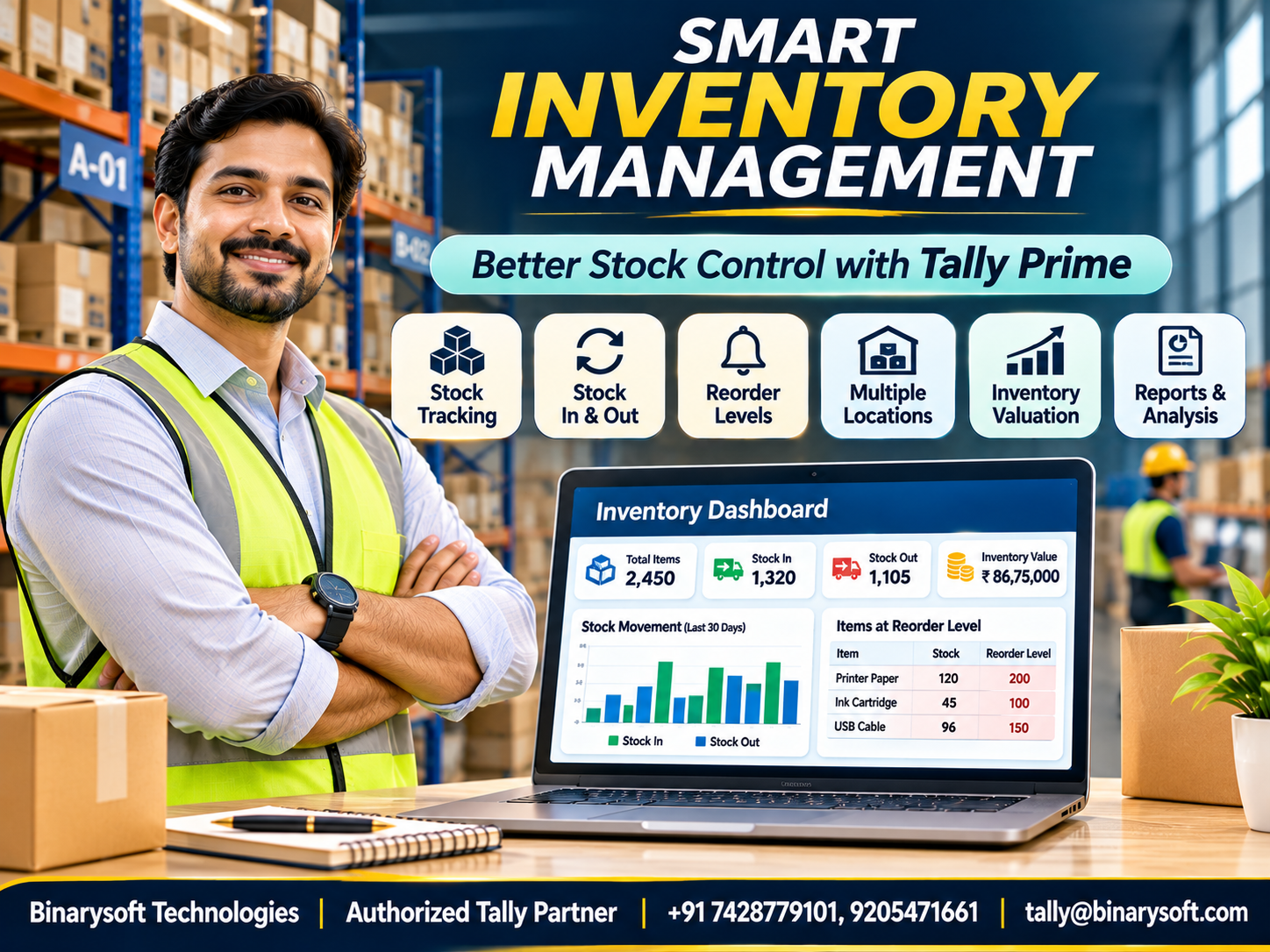
Accounting software such as Tally Prime can support these activities through stock masters, inventory vouchers, godown management, batch tracking and inventory reports.
Understanding inventory management is therefore essential for businesses seeking sustainable growth.
1. What Is Inventory Management?
Inventory management involves monitoring goods from procurement or production until their eventual sale or consumption.
Its primary objective is to maintain appropriate stock levels while minimizing unnecessary costs.
Inventory may include raw materials, work-in-progress items, finished goods and merchandise purchased for resale.
For example, a furniture manufacturer must manage timber, hardware, partially completed furniture and finished products.
A retail business primarily manages products available for sale.
Effective inventory management answers several important questions.
What products are currently available?
Which items are selling quickly?
When should additional stock be ordered?
Which products are moving slowly?
How much money is invested in inventory?
Where is each item stored?
Reliable answers help management make informed purchasing and operational decisions.
2. Why Inventory Management Is Important
Inventory affects nearly every department within a product-based business.
Prevents Stock Shortages
Regular monitoring helps businesses identify items approaching critical stock levels.
Reduces Excess Inventory
Purchasing decisions can be based on actual requirements rather than assumptions.
Improves Cash Flow
Avoiding unnecessary stock purchases helps preserve working capital.
Supports Customer Satisfaction
Reliable product availability improves the likelihood of fulfilling customer orders.
Reduces Storage Costs
Better stock planning can limit unnecessary warehouse requirements.
Improves Financial Reporting
Accurate inventory information supports meaningful stock valuation and profitability analysis.
Supports Business Growth
Organized inventory processes become increasingly important as product ranges and transaction volumes expand.
Inventory management is therefore both an operational and financial responsibility.
3. Main Types of Inventory
Different businesses maintain different categories of stock.
Raw Materials
Materials used in manufacturing finished products.
Examples include steel, fabric, timber and packaging materials.
Work-in-Progress
Goods that have entered production but are not yet complete.
Finished Goods
Completed products available for sale.
Merchandise Inventory
Products purchased by retailers or traders for resale.
Maintenance and Operating Supplies
Items used to support business operations, such as cleaning materials or selected maintenance supplies.
Businesses should classify inventory according to their operational and accounting requirements.
Clear classifications improve reporting and purchasing decisions.
4. How the Inventory Management Process Works
A typical inventory cycle includes several connected activities.
Demand Planning: Estimating future product requirements.
Purchasing: Ordering goods or materials from suppliers.
Receiving: Checking delivered quantities and quality.
Storage: Placing items in suitable locations.
Stock Tracking: Recording receipts, issues and transfers.
Order Fulfilment: Selecting and dispatching customer orders.
Reconciliation: Comparing physical stock with recorded quantities.
Reporting: Reviewing stock movement, valuation and availability.
Every stage affects the accuracy of inventory records.
For example, goods received without proper documentation may create discrepancies even when the purchasing decision was correct.
Businesses should establish clear responsibilities throughout the inventory cycle.
5. Common Inventory Management Challenges
Overstocking
Excess purchases increase storage costs and tie up working capital.
Stockouts
Insufficient inventory can result in missed sales and dissatisfied customers.
Inaccurate Records
Differences between physical stock and accounting records create operational confusion.
Slow-Moving Products
Unsold items occupy space and may lose commercial value.
Supplier Delays
Late deliveries can interrupt sales or production.
Multiple Storage Locations
Managing goods across warehouses becomes difficult without organized records.
Damaged or Expired Goods
Poor monitoring can lead to avoidable losses.
Unpredictable Demand
Seasonal changes and customer preferences complicate purchasing decisions.
Businesses should address these challenges through reliable data and disciplined processes.
6. An Emotional Story: The Shopkeeper Who Learned to Trust His Stock Records
Mahesh operated a small electrical goods shop in Karol Bagh, Delhi.
His father had started the business with limited savings and a strong commitment to customer service.
For years, Mahesh managed inventory using notebooks and personal experience.
He knew many product prices and could remember where most items were stored.
As the business expanded, however, the number of products increased.
One afternoon, a long-standing customer requested electrical fittings for an urgent project.
Mahesh confidently promised immediate delivery.
When his employees checked the warehouse, several required items were missing.
The customer had to purchase them elsewhere.
Mahesh felt deeply disappointed.
He remembered how his father had taught him that keeping a promise was more important than making a quick sale.
That evening, he reviewed the warehouse and discovered another problem.
Several boxes of slow-moving products had been lying untouched for months.
Money that could have supported new purchases was locked in unwanted stock.
Mahesh decided to change the way the business operated.
He introduced systematic stock records, reviewed product classifications and began monitoring inventory movements more regularly.
His team learned to verify available quantities before confirming large orders.
Over time, purchasing decisions became more disciplined.
One evening, Mahesh's daughter asked why he was returning home earlier.
He smiled and explained that he no longer needed to spend every evening searching for missing stock information.
For Mahesh, inventory management was not simply about counting products. It was about protecting customer trust, family savings and peace of mind.
This fictional story illustrates the human impact of better stock control.
7. Essential Inventory Management Techniques
Businesses can use several techniques to improve stock planning.
ABC Analysis
ABC analysis classifies inventory according to relative business importance, commonly using annual consumption value.
A-items typically require closer monitoring because they account for a significant share of inventory value.
B-items receive moderate attention.
C-items generally represent lower-value inventory.
First-In, First-Out
FIFO is an inventory valuation and stock-flow concept that assumes earlier inventory costs are assigned before later costs.
Physical stock rotation should be managed separately according to product requirements.
Just-in-Time
Just-in-Time aims to reduce inventory by arranging materials closer to the time they are needed.
It requires dependable suppliers and careful coordination.
Economic Order Quantity
EOQ estimates an order quantity that balances ordering costs and inventory holding costs under specific assumptions.
Safety Stock
Safety stock provides additional inventory to help manage uncertainty in demand or supply.
Reorder Levels
A reorder level identifies when replenishment should be considered.
No single technique suits every business.
Organizations should choose methods based on demand patterns, product characteristics and supplier reliability.
8. Understanding Reorder Levels
A reorder level helps businesses decide when to purchase additional inventory.
A common simplified formula is:
Reorder Point = Average Daily Demand × Lead Time + Safety Stock
Suppose a business sells approximately 20 units of a product daily.
Its supplier normally requires five days for delivery.
The company maintains 30 units as safety stock.
The reorder point would be:
20 × 5 + 30 = 130 units.
When available stock approaches this level, the business should consider replenishment.
Actual purchasing decisions should also account for outstanding purchase orders, demand changes and supplier conditions.
Reorder levels should be reviewed periodically rather than treated as permanent values.
9. What Is Inventory Turnover?
Inventory turnover indicates how frequently inventory is sold or consumed during a period.
A commonly used formula is:
Inventory Turnover Ratio = Cost of Goods Sold ÷ Average Inventory
Average inventory is often calculated using opening and closing inventory values.
A higher turnover ratio may indicate faster stock movement.
However, excessively high turnover can also suggest insufficient inventory.
A lower ratio may indicate slow-moving products or excess stock.
Interpretation depends on the industry and product category.
For example, grocery products and expensive industrial equipment naturally have different inventory movement patterns.
Businesses should compare turnover against their own operating requirements and relevant industry characteristics.
10. How Tally Prime Helps with Inventory Management
Tally Prime provides inventory features that help businesses maintain stock records alongside accounting information.
Stock Item Management
Businesses can create stock items with relevant descriptions and units.
Stock Groups
Related products can be organized into suitable categories.
Stock Categories
Where applicable, additional classification can support inventory analysis.
Units of Measurement
Businesses can maintain appropriate units for different products.
Godown Management
Stock can be tracked across configured storage locations.
Batch-Wise Details
Supported batch features help businesses maintain information for suitable inventory items.
Inventory Vouchers
Businesses can record relevant stock movements through supported voucher types.
Stock Reports
Reports provide information about available quantities, movements and inventory values.
Available functionality depends on the application release, configuration and enabled features.
11. How to Set Up Inventory in Tally Prime
Businesses should begin with accurate inventory master data.
Step 1: Create Stock Groups
Organize products into meaningful classifications.
Step 2: Configure Units
Define suitable units of measurement.
Step 3: Create Stock Items
Enter clear item names and relevant details.
Step 4: Configure Storage Locations
Enable and create godowns where multiple-location tracking is required.
Step 5: Review Batch Requirements
Use batch tracking where appropriate for the business.
Step 6: Record Opening Stock
Enter verified opening quantities and values.
Step 7: Record Transactions
Use appropriate purchase, sales and inventory vouchers.
Step 8: Review Stock Reports
Examine quantities, movements and valuation regularly.
Businesses should test configurations carefully before using them in live accounting operations.
12. Managing Multiple Warehouses with Tally Prime
Businesses operating from multiple locations need visibility into where goods are stored.
For example, a distributor may maintain a central warehouse and several branch storage locations.
Tally Prime's godown-related features can help maintain location-wise stock information when appropriately configured.
Businesses can use supported inventory vouchers to record stock transfers.
Location-wise reports can help employees review available quantities.
However, accurate warehouse records depend on timely transaction entry.
Physical movements that are not recorded correctly can still create discrepancies.
Regular reconciliation remains essential.
13. Case Study One: Inventory Control for an Electronics Distributor
Illustrative Case Study
Business Background
A Delhi-based electronics distributor supplies accessories to retailers.
The company maintains numerous stock items across multiple storage locations.
The Challenge
Employees occasionally struggle to identify available quantities.
Slow-moving accessories occupy valuable warehouse space.
The Approach
Management standardizes stock item names and classifications.
Tally Prime is configured to maintain suitable inventory records and godown information.
The team reviews stock summaries and purchasing requirements regularly.
Expected Outcome
The distributor can improve visibility into inventory movement and make more informed purchasing decisions.
Business Lesson
Accurate stock records and regular reviews are essential for reducing avoidable inventory problems.
14. Case Study Two: Raw Material Management in Manufacturing
Illustrative Case Study
Business Background
A small furniture manufacturer purchases timber, hardware and finishing materials.
The Challenge
Unexpected raw material shortages occasionally delay production.
At the same time, certain materials remain unused for extended periods.
The Approach
The company organizes raw materials into appropriate stock groups.
Tally Prime is used to maintain relevant purchase, consumption and inventory records.
Management establishes reorder guidelines for frequently used materials.
Expected Outcome
The manufacturer can improve material visibility and coordinate purchasing more effectively.
Business Lesson
Reliable raw material planning supports production continuity and working capital management.
Both case studies are illustrative rather than verified customer results.
15. Inventory Valuation and Financial Accuracy
Inventory valuation affects financial statements and profitability analysis.
Businesses should apply appropriate accounting policies and relevant standards.
Common inventory cost-flow assumptions include FIFO and weighted-average costing.
The suitability of a method depends on the nature of inventory and applicable accounting requirements.
Tally Prime provides supported inventory valuation options that should be configured carefully.
Management should review whether reported inventory values reflect the company's accounting policies.
Stock quantities and values should also be reconciled with relevant records.
Incorrect inventory valuation can distort reported profitability.
Businesses should seek professional accounting guidance where necessary.
16. How Inventory Management Improves Cash Flow
Inventory represents money invested in goods and materials.
When stock remains unsold, that investment cannot immediately support other business needs.
Excess inventory may also create additional expenses through storage, insurance and deterioration.
Effective inventory planning helps businesses avoid unnecessary purchases.
Management can use stock reports to identify slow-moving products and review replenishment requirements.
Tally Prime's accounting and inventory reports can support this analysis.
However, stock reduction should be balanced against customer demand.
Maintaining too little inventory can cause missed sales and operational interruptions.
The objective is to use working capital efficiently while maintaining dependable product availability.
17. Inventory Management Best Practices
Businesses can improve stock control through consistent operational practices.
Maintain Accurate Masters: Use clear stock item names and classifications.
Record Transactions Promptly: Update purchases, sales and stock movements without unnecessary delays.
Review Reorder Levels: Adjust replenishment guidelines as demand changes.
Monitor Slow-Moving Stock: Identify products requiring management attention.
Conduct Physical Verification: Compare recorded quantities with actual stock.
Review Supplier Performance: Consider delivery reliability and lead times.
Train Employees: Explain stock handling and documentation procedures.
Use Inventory Reports: Review quantities, movement and valuation regularly.
These practices help businesses maintain dependable inventory information.
18. The Future of Inventory Management
Inventory management is becoming increasingly data-driven.
Businesses are exploring barcode-based workflows, integrated applications, demand forecasting and automated reporting.
Suitable technologies can improve visibility and reduce repetitive work.
However, automation depends on accurate product information and reliable transaction processes.
Advanced forecasting tools may help estimate future demand, but predictions remain uncertain.
For Tally Prime users, supported inventory features provide a foundation for organized stock accounting.
Additional integrations may be considered where technically appropriate.
The most effective inventory strategy combines accurate records, thoughtful planning and practical technology.
Conclusion
Inventory management is essential for maintaining product availability, controlling costs and protecting working capital.
Businesses must balance the risks of stock shortages against the costs of excess inventory.
Techniques such as ABC analysis, reorder levels, safety stock and inventory turnover analysis help improve decision-making.
Tally Prime supports inventory operations through stock masters, godown management, inventory vouchers, batch-related features and stock reporting.
However, successful inventory control also requires accurate data entry, physical verification and disciplined purchasing practices.
Businesses that combine reliable accounting software with effective inventory processes are better positioned to serve customers and manage growth.
Good inventory management is not about keeping the largest quantity of stock. It is about having the right products, in the right quantities, at the right time and at a sustainable cost.
Powered by Binarysoft Technologies
Authorized Tally Partner
Binarysoft Technologies helps businesses improve accounting and inventory management through Tally Prime implementation, configuration, customization, technical support and cloud-based accounting solutions.
Our services support retailers, wholesalers, manufacturers and distributors seeking reliable stock records and more efficient operations.
Location:
1626/33, 1st Floor, Naiwalan, Karol Bagh, New Delhi – 110005, INDIA
Contact Us:
+91 7428779101, 9205471661
Email:
tally@binarysoft.com
Business Hours:
10:00 AM – 6:00 PM, Monday to Friday
Frequently Asked Questions
How does inventory management improve cash flow?
It can reduce unnecessary stock purchases and help prevent excessive working capital from remaining tied up in unsold goods.
Can Tally Prime track stock across warehouses?
Yes. Supported godown features can help businesses maintain location-wise stock information when properly configured.
What is the best way to improve inventory accuracy?
Maintain consistent stock masters, record transactions promptly, conduct physical verification and review inventory reports regularly.
What are the main types of inventory?
Common types include raw materials, work-in-progress, finished goods and merchandise purchased for resale.
CA. Mayankh Singhaal is a Chartered Accountant experienced in accounting systems, statutory audits, and compliance advisory. He has worked with businesses across different sectors to improve reporting accuracy and inventory tracking. His writing focuses on structured growth and compliance-ready operations.