Call CA Tally HelpDesk
+91 9205471661,
7428779101
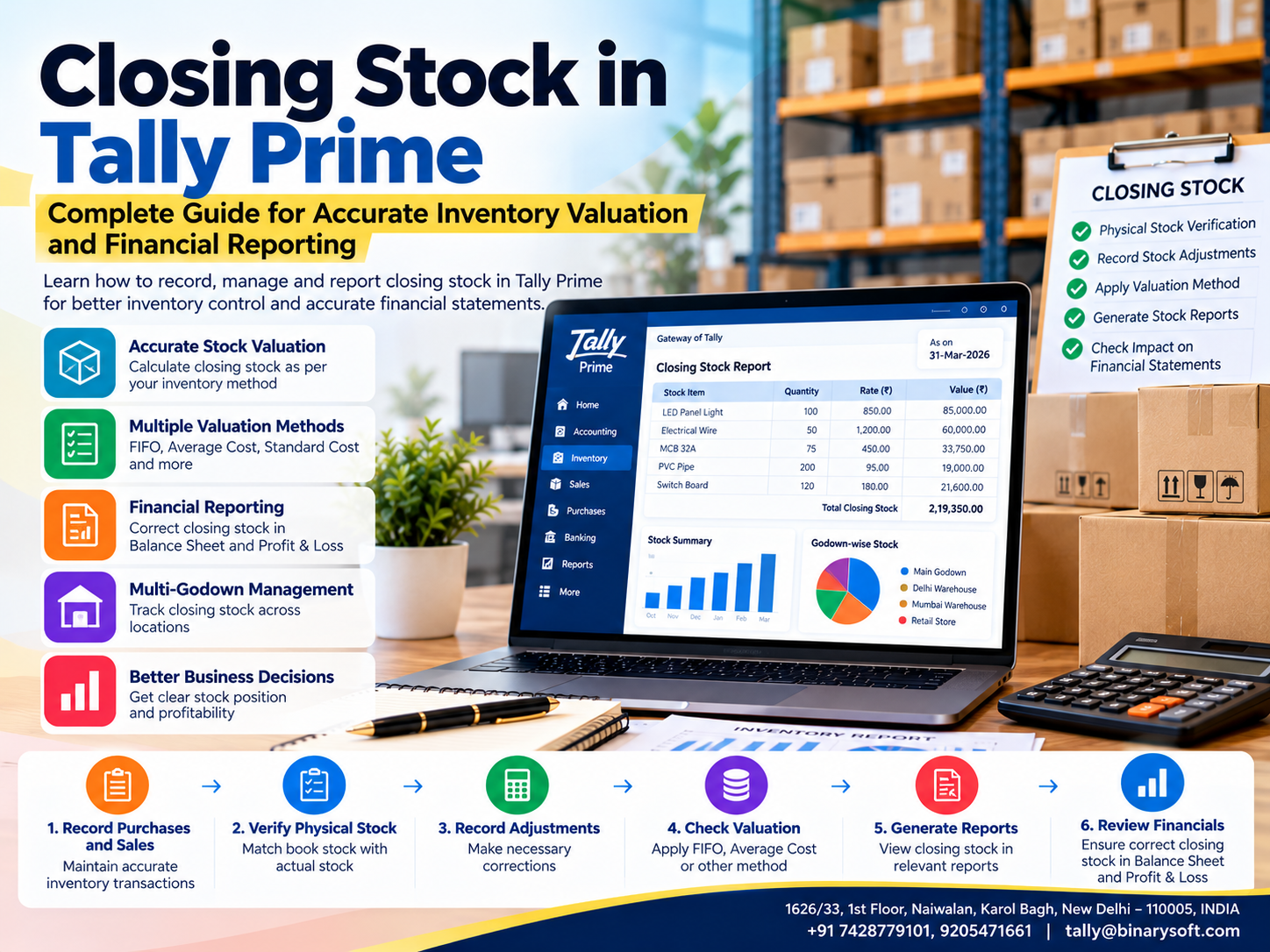
Introduction: Why Closing Stock Accuracy Matters More Than Ever in 2026
A business may achieve excellent sales, maintain strong customer relationships and expand its operations, yet still struggle to understand its actual profitability. One of the most overlooked reasons is inaccurate closing stock valuation.
In 2026, Indian retailers, wholesalers, manufacturers and distributors are managing increasingly complex inventory operations. Products move between warehouses, suppliers revise prices, customer demand changes and businesses must maintain accurate financial information for taxation, reporting and decision-making.
Closing stock represents the value of inventory remaining unsold or unused at the end of an accounting period. It affects the cost of goods sold, reported profits and the value of current assets.
Even a small stock-recording error can create significant differences when businesses handle thousands of products.
For example, an electrical distributor may record strong monthly sales but discover that physical stock does not match accounting records. Without proper reconciliation, management may make incorrect purchasing decisions or prepare unreliable financial statements.
Understanding closing stock is therefore essential for maintaining financial accuracy.
This guide explains closing stock calculation, inventory valuation methods, accounting treatment, practical examples and how Tally Prime helps businesses maintain better inventory control.
1. What Is Closing Stock?
Closing stock refers to the inventory remaining with a business at the end of a particular accounting period.
It generally includes goods purchased or manufactured for sale, along with relevant raw materials, work-in-progress and finished goods where applicable.
For a retail business, closing stock may consist of unsold products available in the shop or warehouse.
For a manufacturing business, it may include raw materials, partially completed goods and finished products.
For a wholesale distributor, closing stock represents goods remaining after purchases, sales, returns and other inventory movements have been considered.
Simple example
Suppose a stationery distributor begins April with inventory worth ₹2,00,000.
During the month, the business purchases additional goods costing ₹5,00,000.
The cost of goods sold during April is ₹4,50,000.
Closing stock will be:
₹2,00,000 + ₹5,00,000 − ₹4,50,000 = ₹2,50,000
Therefore, the business has closing inventory worth ₹2,50,000, assuming there are no other adjustments.
This amount represents inventory cost under the example's assumptions, not necessarily its selling value.
2. An Emotional Business Story: When Missing Inventory Threatened a Family Business
Ramesh operated a wholesale electrical goods business in Delhi's Bhagirath Palace market.
His father had established the shop decades earlier, and Ramesh had worked hard to maintain the family's reputation.
Over time, the business expanded from a small trading counter into a distribution operation supplying retailers and contractors.
Orders increased, and the warehouse became crowded with cables, switches, lighting products and electrical accessories.
Despite growing sales, Ramesh noticed that available cash was becoming increasingly tight.
His accountant reported reasonable profits, but the business frequently struggled to arrange funds for supplier payments.
One evening, while reviewing the warehouse, Ramesh discovered several cartons of products that had remained unsold for months.
Other products appeared in accounting records but could not be located physically.
The realization was painful.
Years of hard work had created a successful business, yet poor inventory visibility was affecting financial decisions.
Ramesh decided to introduce systematic stock verification.
His team reorganized product records, introduced godown-wise tracking and began reviewing stock movement regularly through Tally Prime.
Gradually, he developed a clearer understanding of inventory values, slow-moving products and purchasing requirements.
The biggest improvement was not simply producing a more accurate closing stock report.
It was regaining confidence in the financial position of the business his family had built.
This is an illustrative story demonstrating the importance of accurate inventory records.
3. Why Closing Stock Is Important for Businesses
Closing stock plays an important role in financial accounting and operational management.
Accurate profit calculation
Closing stock affects the cost of goods sold.
If closing stock is overstated, the cost of goods sold may be understated, resulting in higher reported profit.
If closing stock is understated, the cost of goods sold may be overstated, reducing reported profit.
Correct Balance Sheet presentation
Closing inventory is generally presented as a current asset in the Balance Sheet.
Its valuation affects the reported financial position of the business.
Better purchasing decisions
Accurate stock information helps businesses determine which products need replenishment and which items are already available.
Improved working capital management
Excess inventory can block funds that might otherwise support daily operations.
Reliable financial reporting
Closing stock information is essential for preparing consistent accounting reports and evaluating business performance.
Inventory loss identification
Physical stock verification can reveal shortages, damaged products and other differences requiring investigation.
4. Closing Stock Formula with Practical Examples
The basic closing stock formula is:
\[ \text{Closing Stock}=\text{Opening Stock}+\text{Net Purchases}-\text{Cost of Goods Sold} \]
This formula is commonly used for a trading business under simplified assumptions.
Net purchases account for relevant purchase returns and adjustments. Freight-inward and other directly attributable costs may also affect inventory cost.
For manufacturing businesses, the calculation may require additional information about production costs, raw materials and work-in-progress.
Example: Wholesale trading business
|
Particulars
|
Amount
|
|---|
|
Opening stock
|
₹3,00,000
|
|
Net purchases
|
₹8,00,000
|
|
Cost of goods sold
|
₹7,25,000
|
|
Closing stock
|
₹3,75,000
|
Calculation:
₹3,00,000 + ₹8,00,000 − ₹7,25,000 = ₹3,75,000
Example: Retail electronics business
Suppose a retailer has opening inventory of ₹4,50,000, net purchases of ₹9,00,000 and cost of goods sold of ₹10,25,000.
Closing stock:
₹4,50,000 + ₹9,00,000 − ₹10,25,000 = ₹3,25,000
These calculations assume the cost of goods sold is already known.
When it is not known, businesses generally determine inventory quantities and apply appropriate valuation methods to calculate closing stock.
5. Different Methods of Closing Stock Valuation
Inventory valuation determines the monetary value assigned to stock remaining at the end of an accounting period.
Different valuation methods can produce different results, particularly when purchase prices change.
FIFO: First In, First Out
Under FIFO, the earliest purchased inventory costs are assumed to relate to goods sold first.
Closing stock is therefore valued using the costs of more recent purchases.
Consider the following transactions:
|
Purchase
|
Quantity
|
Rate
|
Value
|
|---|
|
First purchase
|
100 units
|
₹100
|
₹10,000
|
|
Second purchase
|
100 units
|
₹120
|
₹12,000
|
|
Total
|
200 units
|
—
|
₹22,000
|
If 150 units are sold, closing stock is 50 units.
Under FIFO, those 50 units are valued at ₹120 each.
Closing stock = 50 × ₹120 = ₹6,000.
Weighted Average Cost
Under the weighted average method, the average cost per unit is calculated using the total relevant inventory cost and quantity.
Using the same example:
Average cost = ₹22,000 ÷ 200 = ₹110 per unit.
Closing stock = 50 × ₹110 = ₹5,500.
The example uses a periodic weighted average for simplicity.
Specific Identification
Specific identification assigns the actual cost of an identifiable item to that item.
It is generally suitable for distinct, high-value products that are not ordinarily interchangeable.
Standard Cost
Standard costing uses predetermined costs and requires appropriate review and adjustment.
Where permitted, standard costs should approximate actual inventory cost.
Important accounting principle
Under applicable Indian accounting requirements, inventory is generally valued at the lower of cost and net realizable value, subject to the relevant accounting framework and exceptions.
A business should not select a valuation method solely because it produces the highest reported profit.
6. Understanding Net Realizable Value
Net Realizable Value, commonly called NRV, represents the estimated selling price of inventory in the ordinary course of business less estimated costs of completion and costs necessary to make the sale.
NRV becomes particularly important when products are damaged, obsolete or difficult to sell.
Example
A business holds an item with an inventory cost of ₹1,000.
Its estimated selling price has fallen to ₹900, and the business expects to incur ₹50 in selling costs.
NRV = ₹900 − ₹50 = ₹850.
Under the lower-of-cost-and-NRV principle, the item would generally be valued at ₹850.
This prevents inventory from being reported above the amount expected to be recovered through sale.
Businesses should document the basis of material NRV adjustments and apply the relevant accounting standards consistently.
7. Closing Stock Accounting Treatment
Closing stock affects both the calculation of profit and the Balance Sheet.
In a traditional periodic inventory accounting approach, closing stock is reflected in the trading calculation and recognized as an asset.
Under an integrated inventory accounting system, inventory movements and valuation may be reflected through the configured accounting process.
Effect on profit
Higher closing stock generally reduces the calculated cost of goods sold, assuming other figures remain unchanged.
Lower closing stock generally increases the calculated cost of goods sold.
This relationship makes accurate inventory valuation particularly important.
Effect on the Balance Sheet
Closing inventory is ordinarily reported under current assets.
The value should be supported by reliable stock records and an appropriate valuation method.
Opening stock in the next period
The closing inventory of one accounting period normally becomes the opening inventory of the following period, subject to applicable adjustments.
Maintaining consistency between periods is essential for reliable financial reporting.
8. How to View Closing Stock in Tally Prime
Tally Prime provides inventory reports that help businesses examine stock quantities and values.
Step 1: Enable inventory-related features
Ensure that stock items and relevant inventory functionality are configured for the company.
Step 2: Record inventory transactions
Enter purchases, sales, returns, stock transfers and other relevant transactions accurately.
Step 3: Open Stock Summary
Use Alt+G (Go To) and select Stock Summary.
Step 4: Select the reporting period
Choose the appropriate date or period for reviewing inventory.
Step 5: Examine closing balances
Review the quantities, rates and values shown for relevant stock items.
Step 6: Drill down into details
Open stock groups or individual items to examine stock information more closely.
Step 7: Review financial statements
Compare relevant inventory information with the Balance Sheet and Profit and Loss Account.
Report appearance and available options may differ according to the software release and company configuration.
9. How to Adjust Closing Stock in Tally Prime
Physical inventory may differ from the quantity shown in accounting records.
Such differences can occur because of damaged products, missing entries, incorrect quantities, stock losses or recording mistakes.
Tally Prime provides Physical Stock vouchers to record verified quantities.
Steps for physical stock adjustment
-
Open Tally Prime and select the relevant company.
-
Press Alt+G (Go To) and select Create Voucher.
-
Open the Physical Stock voucher using the available inventory voucher options.
-
Select the relevant stock item and godown, where applicable.
-
Enter the actual quantity identified during physical verification.
-
Verify the stock details and save the voucher.
-
Review the updated Stock Summary.
Before making adjustments, businesses should investigate discrepancies and obtain appropriate authorization.
A Physical Stock voucher changes recorded stock quantities; it should not be used as a substitute for investigating valuation errors or unrecorded transactions.
10. Managing Closing Stock Across Multiple Godowns
Businesses operating from several warehouses need accurate location-wise stock information.
A distributor may store goods at its main warehouse, a secondary distribution centre and a retail outlet.
Without proper godown records, management may incorrectly assume that products are unavailable or available at the wrong location.
How Tally Prime helps
Tally Prime supports godown creation and location-wise inventory tracking.
Businesses can record stock movements between locations and examine relevant godown-wise reports.
For example:
|
Godown
|
Closing stock value
|
|---|
|
Main warehouse
|
₹4,50,000
|
|
Secondary warehouse
|
₹2,75,000
|
|
Retail outlet
|
₹1,25,000
|
|
Total
|
₹8,50,000
|
These illustrative values help demonstrate how location-wise reporting can support purchasing and distribution decisions.
Accurate warehouse records are particularly valuable for businesses with high inventory volumes.
11. Case Study One: An Electrical Distributor Improves Closing Stock Accuracy
Illustrative case study
An electrical goods distributor in Delhi handled cables, switches, lighting products and industrial accessories.
The business maintained inventory across two warehouses and frequently transferred goods between locations.
The challenge
At financial year-end, physical inventory quantities differed from accounting records.
Several products had been transferred without timely documentation.
Management also found slow-moving products occupying valuable warehouse space.
The solution
The distributor introduced a systematic stock-verification procedure using Tally Prime.
Employees organized stock masters, maintained separate godown records and recorded inventory transfers more consistently.
The accounts team reviewed Stock Summary reports and investigated discrepancies before finalizing stock adjustments.
The outcome
Management developed a clearer view of available inventory and stock movement.
The company also improved its ability to identify products requiring replenishment and items that were moving slowly.
The case illustrates how disciplined stock procedures can support more reliable closing stock information.
12. Case Study Two: A Garment Manufacturer Strengthens Inventory Valuation
Illustrative case study
A garment manufacturing company in Noida purchased fabrics, accessories and packaging materials from several suppliers.
The business maintained raw materials, work-in-progress and finished goods.
The challenge
Raw-material prices changed frequently, making inventory valuation difficult.
The company also struggled to distinguish unused materials from finished products.
These problems affected production planning and financial reporting.
The solution
The manufacturer introduced more structured inventory classification and transaction recording.
Tally Prime was used to maintain relevant stock items, purchase records and inventory reports.
Management reviewed the applicable valuation method and established procedures for identifying damaged and obsolete materials.
The outcome
The business improved inventory visibility and developed a more consistent process for reviewing closing stock.
Production and accounting teams could coordinate more effectively when preparing inventory information.
This example demonstrates the importance of combining appropriate accounting policies with practical inventory controls.
13. Common Closing Stock Mistakes Businesses Should Avoid
Closing stock errors can affect profitability, purchasing decisions and financial statements.
Common mistakes include recording purchases without corresponding inventory entries, failing to account for sales returns, using inconsistent units of measurement and overlooking damaged stock.
Other problems arise when businesses fail to record stock transfers, duplicate purchase entries or apply incorrect valuation rates.
Practical prevention measures
-
Verify physical stock periodically.
-
Maintain accurate stock-item masters.
-
Record transactions promptly.
-
Review negative stock quantities.
-
Investigate unusual inventory values.
-
Apply valuation methods consistently.
-
Maintain supporting purchase and stock documents.
-
Review damaged and obsolete inventory.
-
Reconcile relevant inventory and accounting reports.
Businesses should establish clear responsibilities for stock verification and adjustment approvals.
14. How Closing Stock Affects Gross Profit
Closing stock directly influences the cost of goods sold and, consequently, gross profit.
Consider a business with the following figures:
|
Particulars
|
Amount
|
|---|
|
Net sales
|
₹15,00,000
|
|
Opening stock
|
₹3,00,000
|
|
Net purchases
|
₹10,00,000
|
|
Closing stock
|
₹4,00,000
|
|
Cost of goods sold
|
₹9,00,000
|
|
Gross profit
|
₹6,00,000
|
Gross profit is calculated as:
\[ \text{Gross Profit}=\text{Net Sales}-\text{Cost of Goods Sold} \]
Therefore:
₹15,00,000 − ₹9,00,000 = ₹6,00,000.
Suppose closing stock is incorrectly recorded as ₹4,50,000 instead of ₹4,00,000.
Under the simplified calculation, the reported gross profit would increase by ₹50,000, even though no additional sale occurred.
This example demonstrates why inventory valuation must be based on accurate records and applicable accounting principles.
15. Closing Stock Management for Different Industries
Inventory requirements vary across industries.
Retail businesses should focus on product-wise stock quantities, returns and slow-moving inventory.
Wholesale distributors may require batch tracking, godown management and high-volume transaction recording.
Manufacturing businesses need appropriate treatment of raw materials, work-in-progress and finished goods.
Pharmaceutical distributors may need batch-wise records, expiry monitoring and appropriate treatment of unusable inventory.
Electronics businesses should monitor changing product values, obsolete models and damaged goods.
Tally Prime provides inventory-management capabilities that can be configured according to many of these requirements.
However, industry-specific controls and valuation policies must be established separately where necessary.
16. Closing Stock, GST and Business Compliance
Closing stock information is relevant to financial accounting and may also be important for specific GST compliance situations.
Businesses should maintain accurate records of purchases, sales, returns and inventory movement.
However, the value of closing stock is not automatically the amount on which GST becomes payable.
GST treatment depends on the nature of transactions and applicable statutory provisions.
For example, special circumstances involving business closure, registration cancellation or input tax credit adjustments may require separate consideration.
Businesses should consult qualified tax professionals when determining such obligations.
Tally Prime can help maintain relevant transaction and inventory records, but accurate compliance depends on proper classification, documentation and review.
17. How Tally on Cloud Supports Inventory Monitoring
Businesses with multiple locations may benefit from accessing accounting and inventory information through a centrally hosted environment.
Tally on Cloud can provide remote access to the configured Tally Prime application.
This may help authorized employees review stock information, record transactions and coordinate accounting activities.
Potential advantages include centralized access, reduced dependence on one office computer and improved coordination between teams.
However, cloud hosting does not automatically provide real-time physical inventory verification.
Businesses still need disciplined transaction recording, warehouse controls, reliable connectivity and appropriate backup arrangements.
18. Best Practices for Financial Year-End Closing Stock Verification
Year-end inventory verification should be planned carefully.
Businesses should establish a stock-counting date and define responsibilities for warehouse and accounting employees.
Relevant purchase, sales and stock-transfer transactions should be recorded up to the appropriate cut-off date.
Physical quantities should then be compared with accounting records.
Differences must be investigated, documented and approved before adjustments are entered.
The accounts team should also review inventory valuation, damaged goods, obsolete products and relevant financial reporting requirements.
Finally, management should verify that closing stock information is consistent with the applicable financial statements.
A documented year-end procedure can improve audit readiness and reduce last-minute accounting difficulties.
Conclusion
Closing stock is an essential component of inventory management and financial accounting.
It affects cost of goods sold, gross profit, working capital and the value of current assets.
For Indian retailers, wholesalers, manufacturers and distributors, accurate closing stock information supports better purchasing decisions, more reliable reporting and stronger operational control.
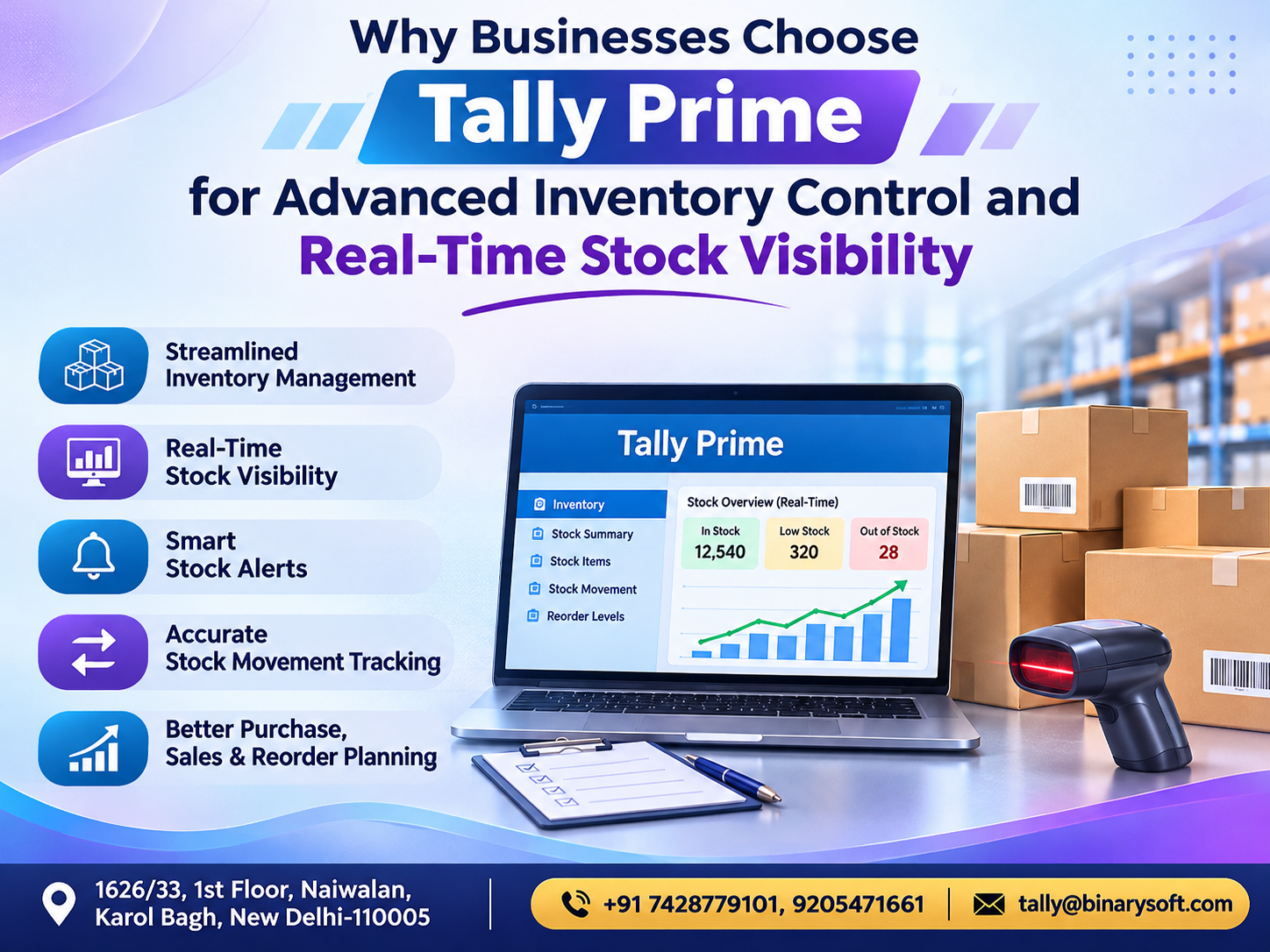
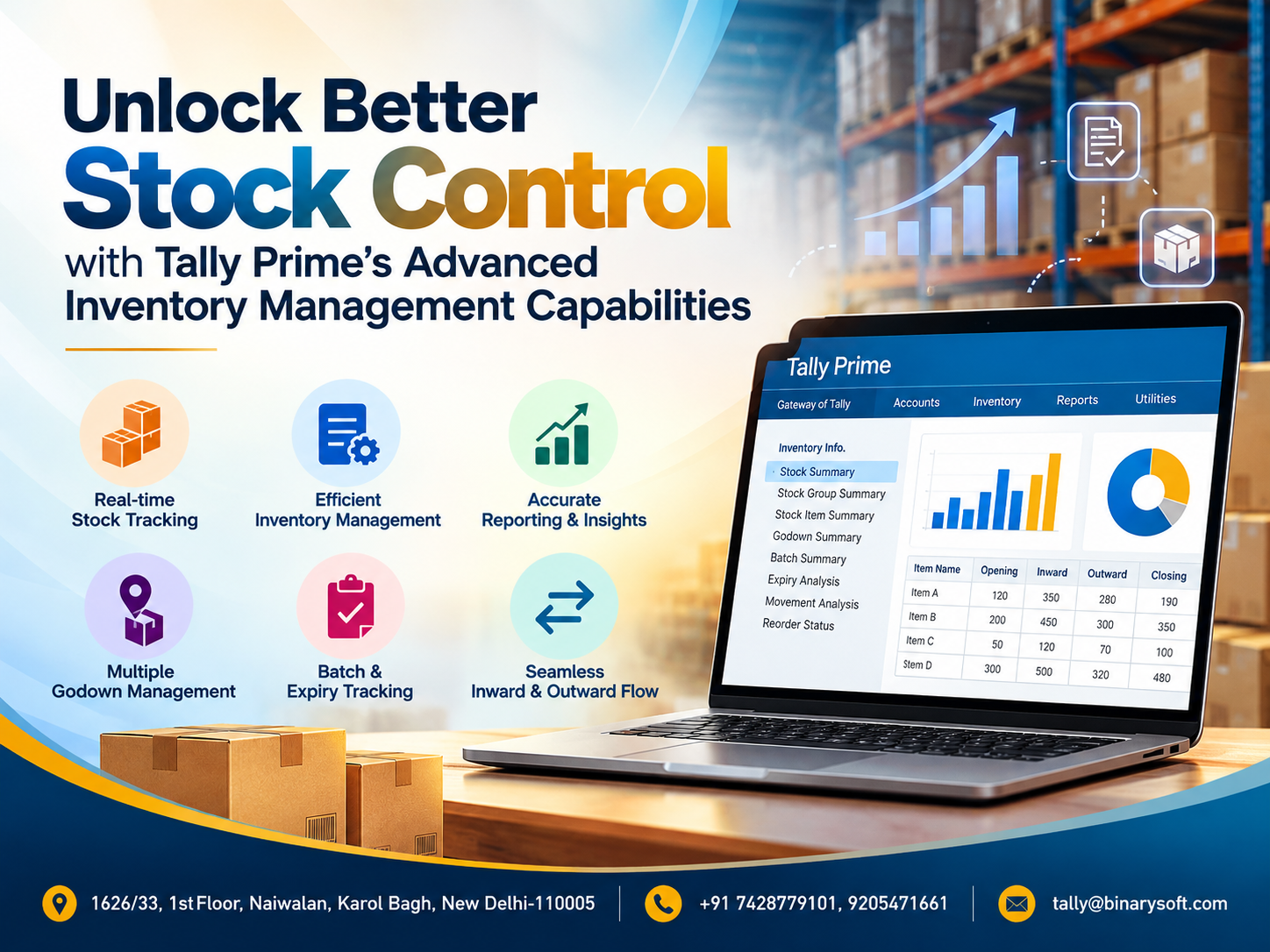
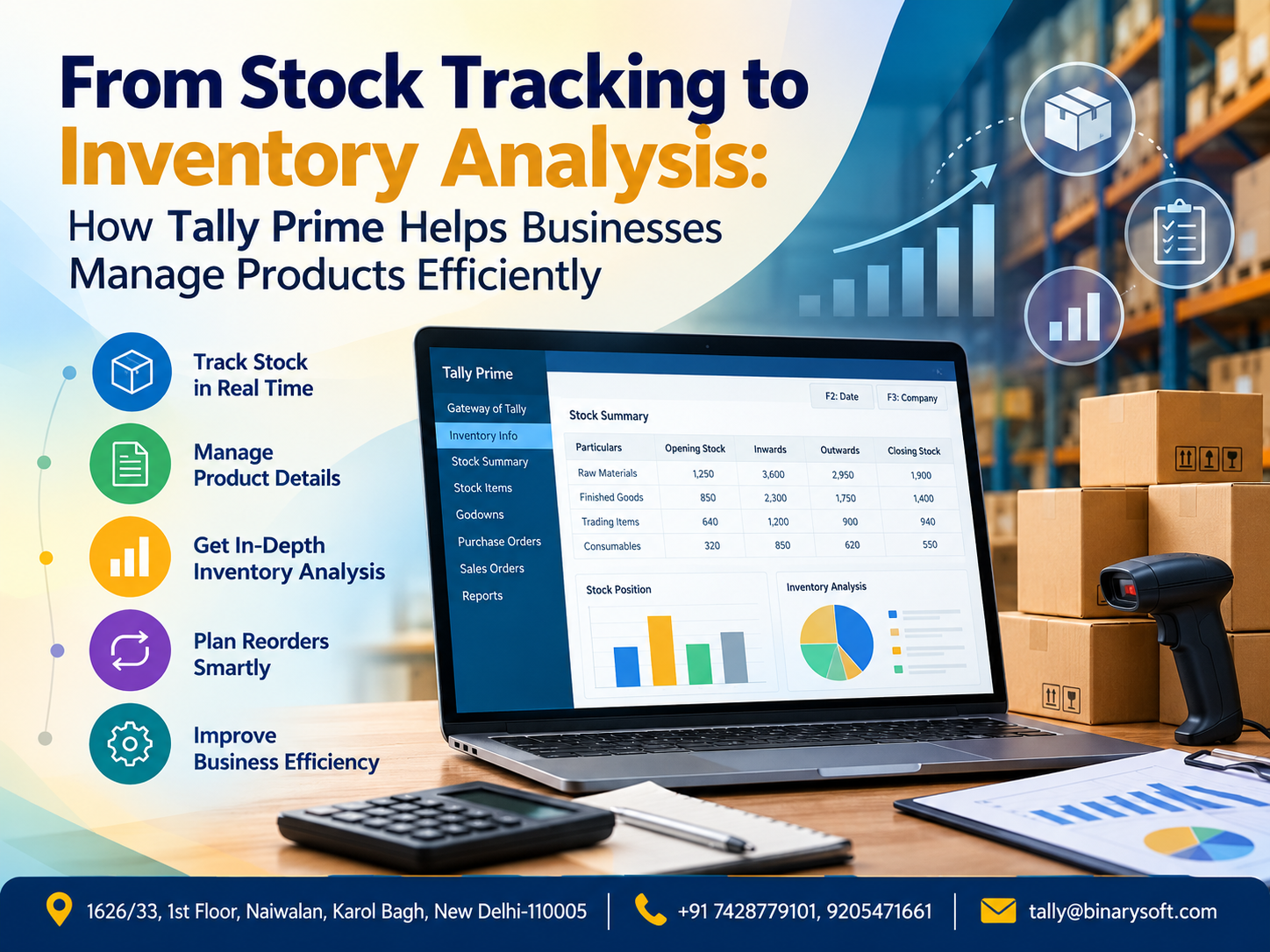
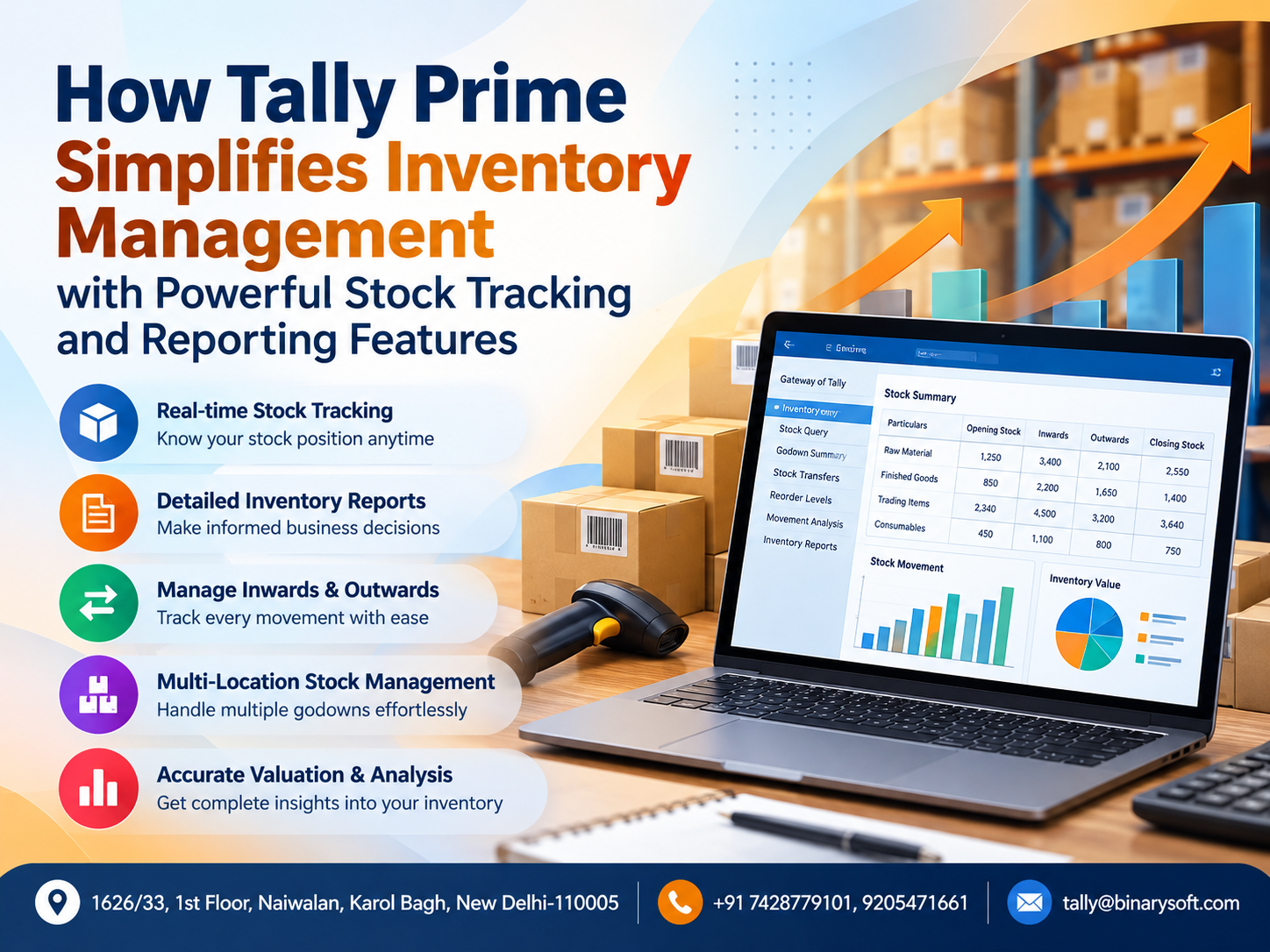
Tally Prime helps businesses maintain stock records, review inventory quantities, manage multiple godowns and examine closing stock through inventory reports.
Its Physical Stock voucher also supports recording verified quantity adjustments.
However, software alone cannot guarantee accurate inventory valuation. Businesses must maintain reliable transaction records, conduct physical verification and apply appropriate accounting principles.
By combining Tally Prime with disciplined inventory procedures, organizations can strengthen financial accuracy and make better-informed business decisions.
Powered by Binarysoft Technologies
Authorized Tally Partner
Location: 1626/33, 1st Floor, Naiwalan, Karol Bagh, New Delhi – 110005, INDIA
Contact Us: +91 7428779101, 9205471661
Email: tally@binarysoft.com
Business Hours: 10:00 AM – 6:00 PM, Monday to Friday
Frequently Asked Questions
What is closing stock in accounting?
Closing stock is the inventory remaining with a business at the end of an accounting period. It is generally reported as a current asset and affects the calculation of cost of goods sold.
How often should inventory classification be reviewed?
Businesses should review classifications periodically and whenever product ranges, storage arrangements or operational requirements change.
Why is inventory classification important for wholesalers?
It helps wholesalers organize large product ranges, identify available quantities and improve purchasing and dispatch processes.
Are fixed assets considered inventory?
Generally, no. Fixed assets are held for long-term business use, while inventory is held for sale or consumption in ordinary business activities. Classification depends on the purpose for which the item is held.
CA. Aarav Bhandari specializes in GST compliance, accounting systems, and business advisory services. He regularly writes about tax updates, accounting automation, and financial best practices to help businesses improve efficiency and maintain statutory compliance.