Call CA Tally HelpDesk
+91 9205471661,
7428779101
Introduction: Is Poor Inventory Management Silently Damaging Your Business?
Imagine running a wholesale business where sales are increasing, employees remain busy, and customer enquiries arrive throughout the day.
Everything appears successful.
However, your warehouse tells a different story.
Popular products frequently run out of stock, while unwanted goods occupy valuable storage space. Employees struggle to locate products, and inventory reports do not always match actual quantities.
Meanwhile, suppliers demand payments, customers complain about delayed deliveries, and working capital becomes increasingly difficult to manage.
These problems often indicate poor inventory management.
Inventory management involves purchasing, storing, tracking, moving and controlling goods throughout business operations.
When these activities are not properly coordinated, businesses may experience stock shortages, excess inventory, inaccurate records and financial losses.
For Indian retailers, wholesalers, manufacturers and distributors, identifying inventory problems early is essential.
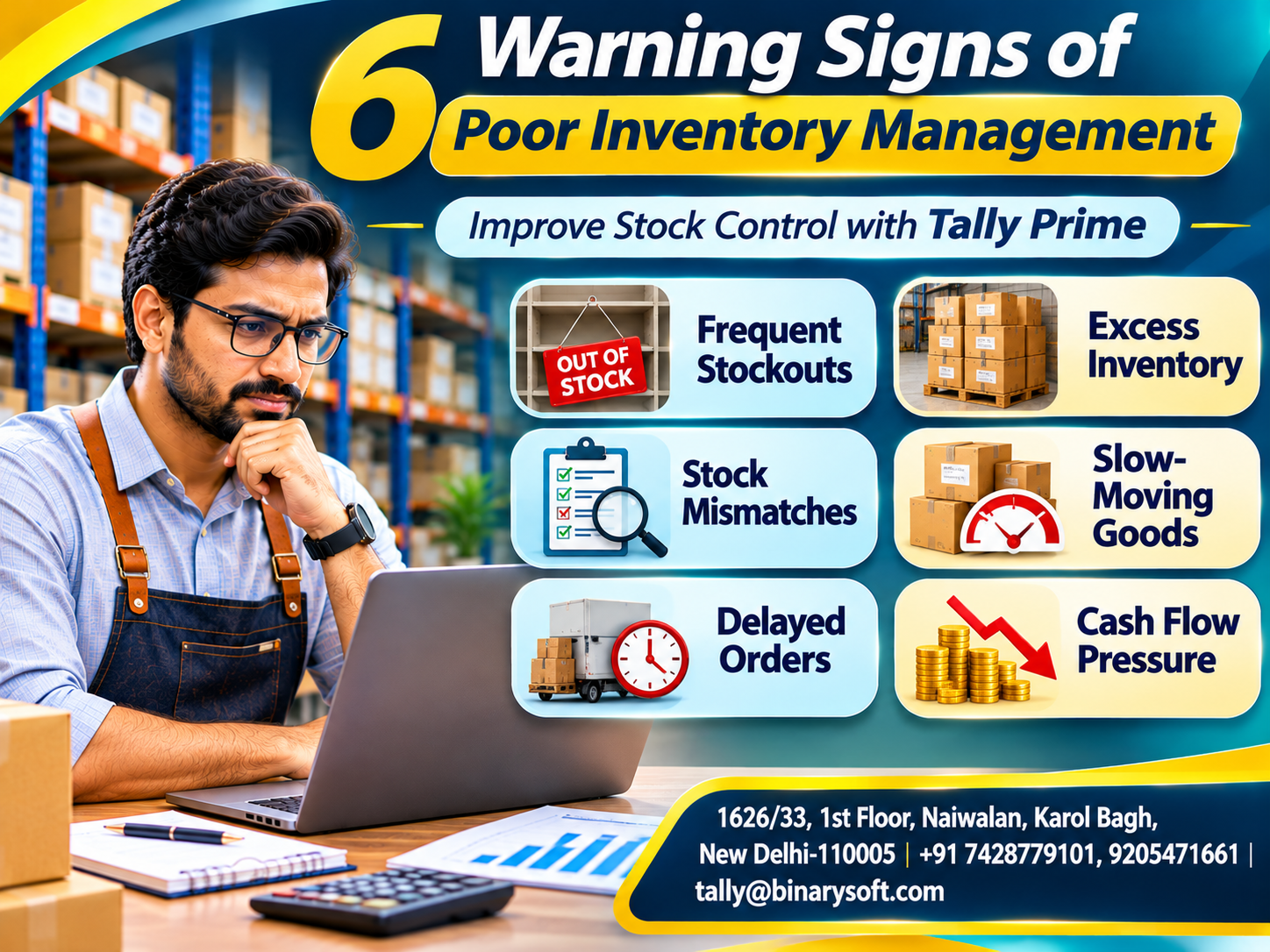
This guide explores six important warning signs, explains their causes and provides practical solutions using sound inventory practices and Tally Prime.
1. What Is Poor Inventory Management?
Poor inventory management occurs when a business cannot consistently maintain accurate stock information or balance inventory availability with customer demand.
It may involve purchasing too much stock, failing to replenish important products or recording inventory transactions incorrectly.
For example, an electronics distributor may have thousands of accessories in its warehouse but still be unable to fulfil orders for frequently purchased chargers.
Similarly, a garment retailer may invest heavily in seasonal products that remain unsold after the festive period.
Poor inventory management is not always caused by insufficient software.
It can also result from weak purchasing policies, inaccurate data entry, inadequate employee training and limited coordination between departments.
Recognizing the symptoms is the first step toward improvement.
2. Why Inventory Management Problems Are Dangerous
Inventory represents a significant investment for many businesses.
Poor stock control can affect several areas.
Lost Sales: Customers may purchase from competitors when products are unavailable.
Higher Operating Costs: Excess inventory increases storage and handling expenses.
Restricted Cash Flow: Money remains invested in products that are not selling.
Inaccurate Financial Reporting: Incorrect stock quantities or values can distort accounting information.
Customer Dissatisfaction: Delayed or incomplete orders may damage relationships.
Operational Inefficiency: Employees waste time searching for products or correcting errors.
These problems can become more serious as the business grows.
Businesses should therefore monitor inventory performance regularly rather than waiting for a financial crisis.
3. Warning Sign One: Frequent Stockouts
A stockout occurs when a business cannot fulfil demand because the required product is unavailable.
Occasional shortages may result from unexpected demand.
However, frequent stockouts indicate that replenishment planning requires attention.
Common Causes
Stockouts may result from inaccurate demand forecasts, delayed purchasing, unreliable suppliers or incorrect inventory records.
Businesses may also fail to consider supplier lead times.
Example
A hardware distributor sells approximately 20 units of a popular switch daily.
Its supplier requires seven days to deliver replenishment stock.
If the distributor waits until only 30 units remain before ordering, shortages are likely.
Practical Solutions
Review historical sales and identify frequently purchased products.
Maintain suitable reorder levels.
Consider supplier delivery times and demand variability.
Monitor outstanding purchase orders.
How Tally Prime Helps
Tally Prime provides stock reports, purchase order records and supported reorder-level features.
These capabilities help businesses review stock availability and plan replenishment more systematically.
4. Warning Sign Two: Excessive Inventory and Overstocking
Overstocking occurs when a business maintains more inventory than it reasonably requires.
A crowded warehouse may appear impressive, but excess stock can create significant financial pressure.
Common Causes
Businesses may purchase excessive quantities because of supplier discounts, unrealistic demand expectations or fear of shortages.
Poor coordination between purchasing and sales teams can also contribute.
Financial Impact
Excess inventory can increase storage expenses, insurance costs, handling requirements and the risk of product obsolescence.
It also restricts working capital.
Example
A retailer purchases ₹8 lakh worth of seasonal products.
Only ₹5 lakh worth of inventory cost is sold during the expected period.
The remaining goods may require additional storage or discounted selling.
Practical Solutions
Review demand before placing bulk orders.
Identify slow-moving products.
Evaluate supplier minimum order quantities.
Monitor inventory turnover.
How Tally Prime Helps
Stock Summary and inventory movement information can help management identify products with unusually high stock balances.
5. Warning Sign Three: Inventory Records Do Not Match Physical Stock
Inventory discrepancies occur when recorded stock quantities differ from actual inventory.
For example, an accounting report may show 150 units available while the warehouse contains only 125 units.
Such differences can create serious operational problems.
Common Causes
Discrepancies may result from unrecorded purchases, incorrect sales entries, duplicate transactions, damaged goods or missing stock adjustments.
Business Risks
Incorrect records can lead to false stock availability information, purchasing mistakes and inaccurate inventory valuation.
Practical Solutions
Conduct regular physical stock verification.
Investigate differences promptly.
Maintain clear transaction responsibilities.
Review stock adjustments and returns.
How Tally Prime Helps
Tally Prime provides inventory reports and physical stock adjustment workflows.
Businesses can use these features to support reconciliation between recorded and actual quantities.
However, software accuracy depends on complete and correct transaction recording.
6. Warning Sign Four: Increasing Slow-Moving and Dead Stock
Slow-moving inventory consists of products that sell or are consumed less frequently than expected.
Dead stock generally refers to products with little or no realistic movement under current business conditions.
These items can occupy storage space and restrict working capital.
Common Causes
Poor demand forecasting, changing customer preferences and excessive purchasing may contribute to slow-moving stock.
Example
A mobile accessories retailer purchases large quantities of products compatible with older phone models.
As customer preferences change, demand declines.
The remaining inventory becomes difficult to sell.
Practical Solutions
Review stock movement regularly.
Identify products with prolonged inactivity.
Reduce unnecessary replenishment.
Consider appropriate clearance strategies.
Assess whether inventory values require adjustment under applicable accounting requirements.
How Tally Prime Helps
Inventory reports can help businesses review stock quantities and movement patterns.
Management can use this information to identify products requiring additional attention.
7. Warning Sign Five: Delayed Orders and Customer Complaints
Repeated delivery delays are another important sign of ineffective inventory management.
A business may accept customer orders without confirming product availability.
Employees may also struggle to locate items within poorly organized warehouses.
Common Causes
Incorrect stock records, weak warehouse organization, supplier delays and poor coordination between departments can contribute.
Business Impact
Delayed deliveries may reduce customer confidence and encourage customers to seek alternative suppliers.
Practical Solutions
Verify stock availability before confirming orders.
Maintain organized storage locations.
Review pending customer orders.
Coordinate purchasing and dispatch activities.
How Tally Prime Helps
Tally Prime supports inventory records, sales orders and godown management where configured.
These features provide useful information for order processing and stock visibility.
Businesses requiring advanced warehouse picking or delivery automation may need additional systems.
8. Warning Sign Six: Cash-Flow Pressure Despite Strong Sales
One of the most concerning symptoms of poor inventory management is cash-flow pressure even when sales appear healthy.
A business may generate substantial revenue while keeping too much money invested in inventory.
Common Causes
Excess purchasing, slow-moving stock and poorly planned replenishment can restrict available cash.
Example
A distributor has monthly sales of ₹15 lakh but maintains unnecessarily high inventory balances.
Supplier payments become difficult because much of the available capital remains invested in unsold goods.
Practical Solutions
Monitor inventory turnover.
Review purchasing quantities.
Identify slow-moving products.
Coordinate stock planning with cash-flow forecasts.
How Tally Prime Helps
Tally Prime provides inventory valuation and accounting reports that can support working capital analysis.
Management should review inventory investment alongside receivables, payables and other financial obligations.
9. An Emotional Story: The Business Owner Who Almost Lost His Father's Legacy
Amit owned a family-run electrical distribution business in Delhi.
His father had started the company with a small shop and a reputation for dependable service.
Over the years, Amit expanded operations and rented a larger warehouse.
Sales increased, and the business began supplying contractors across the city.
However, inventory management remained largely dependent on experience and manual records.
One afternoon, a long-standing customer requested an urgent delivery of electrical fittings.
Amit confidently promised that the order would be ready the next morning.
But when his employees checked the warehouse, the required products were unavailable.
The inventory register showed sufficient quantities, yet the actual stock was much lower.
The customer was disappointed.
He explained that his construction project could not wait and placed the order with another supplier.
That evening, Amit sat alone in the warehouse.
He looked at shelves filled with products that rarely sold.
Despite having so much inventory, he had failed to serve one of his most loyal customers.
He remembered how his father had built the business through trust.
Amit worried that years of goodwill could disappear because of poor operational decisions.
The next morning, he called a meeting with his accountant and warehouse employees.
They reviewed stock records, physical quantities and purchasing procedures.
The team introduced regular inventory verification, clearer product classifications and reorder planning.
They also began reviewing stock reports before confirming large customer orders.
Gradually, operations became more organized.
Several months later, the same customer returned with another urgent requirement.
This time, Amit checked availability before making a commitment.
The order was delivered as promised.
When Amit told his father what had happened, the older man smiled.
He reminded Amit that customers remember reliability more than the size of a warehouse.
For Amit, improving inventory management was not simply about correcting stock records. It was about rebuilding trust and protecting the business his father had spent a lifetime creating.
This fictional story illustrates the human consequences of inventory problems.
10. How Tally Prime Helps Prevent Poor Inventory Management
Tally Prime provides inventory management capabilities that support accurate stock recording and operational visibility.
Stock Item Management
Businesses can maintain clear product records with appropriate classifications and units.
Stock Groups and Categories
Products can be organized for easier reporting and analysis.
Stock Summary
The Stock Summary helps users review quantities and inventory values.
Godown Management
Businesses can maintain stock information across configured storage locations.
Purchase Orders
Purchase order records help monitor planned procurement.
Sales Orders
Sales order information supports customer order tracking.
Reorder Levels
Supported reorder features help businesses review replenishment requirements.
Inventory Reports
Stock movement and related reports provide information useful for inventory analysis.
These features support better decisions, but they do not eliminate the need for sound operating procedures.
11. How to Improve Inventory Control Using Tally Prime
Businesses can follow a structured improvement process.
Step 1: Review Stock Masters
Check product names, units and classifications.
Step 2: Verify Opening Stock
Ensure opening quantities and values are accurate.
Step 3: Record Transactions Promptly
Enter purchases, sales, returns and stock movements correctly.
Step 4: Review Stock Summary
Identify unusual stock balances.
Step 5: Analyse Product Movement
Distinguish frequently purchased products from slow-moving items.
Step 6: Configure Reorder Information
Maintain appropriate reorder levels where supported.
Step 7: Review Outstanding Orders
Consider pending purchase and sales orders.
Step 8: Verify Physical Inventory
Conduct periodic stock counts.
Step 9: Investigate Differences
Correct errors through appropriate authorized procedures.
Step 10: Monitor Performance
Review stock availability, inventory turnover and working capital regularly.
The exact navigation and available options may vary by software release.
12. Case Study One: Improving Inventory Control for an Electronics Wholesaler
Illustrative Case Study
Business Background
An electronics wholesaler supplies chargers, cables and computer accessories.
The Challenge
Popular products frequently run out of stock, while older accessories accumulate in the warehouse.
The Approach
Management reviews sales history and stock movement reports in Tally Prime.
Products are classified according to demand.
Reorder levels are reviewed for important items.
Physical stock verification is introduced.
Expected Outcome
The company can improve stock visibility and reduce avoidable purchasing mistakes.
Business Lesson
Reliable inventory management requires accurate records and regular demand reviews.
13. Case Study Two: Reducing Stock Discrepancies for a Garment Distributor
Illustrative Case Study
Business Background
A garment distributor handles multiple clothing styles, sizes and colours.
The Challenge
Employees occasionally select incorrect product variants, creating stock discrepancies and dispatch errors.
The Approach
The business standardizes stock item names and classifications.
Relevant product variants are recorded separately.
Inventory transactions are maintained consistently in Tally Prime.
Regular physical verification and dispatch checks are introduced.
Expected Outcome
The company can improve product identification and reduce avoidable stock mismatches.
Business Lesson
Inventory accuracy depends on clear product identification, employee training and consistent transaction recording.
Both case studies are illustrative rather than verified customer results.
14. Important Inventory Management Formulas
Several calculations help businesses monitor inventory performance.
Inventory Turnover Ratio
Inventory Turnover = Cost of Goods Sold ÷ Average Inventory Value
A business with annual cost of goods sold of ₹24 lakh and average inventory of ₹6 lakh has an inventory turnover ratio of four.
Reorder Point
Reorder Point = Average Daily Demand × Supplier Lead Time + Safety Stock
If daily demand is 20 units, lead time is five days and safety stock is 30 units, the reorder point is 130 units.
Stock Accuracy Percentage
Stock Accuracy = Correctly Recorded Stock Items ÷ Total Stock Items Checked × 100
This simplified item-level measure helps assess record accuracy.
Businesses should use consistent measurement definitions when comparing performance over time.
15. Why Inventory Management Problems Affect Profitability
Inventory problems influence profitability in several ways.
Stockouts can reduce sales.
Excess inventory increases holding costs.
Damaged products may require write-downs.
Incorrect stock records can distort financial information.
Delayed orders may damage customer relationships.
However, reducing inventory indiscriminately is not always beneficial.
Businesses must maintain sufficient stock to serve customers and support production.
The objective is to balance product availability with inventory investment and operating costs.
16. Best Practices for Preventing Inventory Problems
Businesses can strengthen inventory control through practical procedures.
Maintain accurate stock masters.
Record transactions promptly.
Conduct regular physical verification.
Monitor fast-moving and slow-moving products.
Review supplier lead times.
Maintain suitable reorder levels.
Avoid unnecessary bulk purchasing.
Organize warehouse storage locations.
Train employees in stock handling.
Review outstanding customer orders.
Investigate inventory discrepancies.
Monitor working capital invested in stock.
These practices support more reliable inventory operations.
17. How to Identify Inventory Problems Early
Businesses should monitor warning indicators regularly.
A rising number of stockouts may indicate weak replenishment planning.
Increasing slow-moving stock may suggest excessive purchasing.
Frequent physical stock differences may indicate transaction errors.
Delayed customer orders may reveal warehouse or supplier problems.
Growing inventory balances without corresponding sales growth may indicate working capital pressure.
Management should review these indicators together rather than relying on a single report.
Early detection allows businesses to address problems before they become more expensive.
18. The Role of Technology in Inventory Management
Digital accounting and inventory systems can improve access to stock information.
Businesses are increasingly using inventory reports, barcode-based identification, warehouse systems and analytical tools.
These technologies can reduce repetitive work and improve operational visibility.
However, technology cannot compensate for incorrect data or weak purchasing policies.
For Tally Prime users, accurate transaction recording and regular report reviews provide a practical foundation.
Businesses with complex warehouse requirements may evaluate specialized tools or suitable integrations.
The most important objective is to maintain reliable information and support timely decisions.
Conclusion
Poor inventory management can damage a business through frequent stockouts, excessive inventory, inaccurate records, slow-moving products, delayed customer orders and cash-flow pressure.
These warning signs should not be ignored.
Businesses can improve inventory control through accurate records, regular stock verification, demand analysis, reorder planning and disciplined purchasing.
Tally Prime supports these activities through stock masters, inventory reports, order records, godown management and reorder information.
However, effective inventory management requires both appropriate software and consistent operating procedures.
A successful business is not measured by how much inventory it stores, but by how effectively it maintains the right products, serves customers and protects working capital.
Powered by Binarysoft Technologies
Authorized Tally Partner
Binarysoft Technologies helps businesses improve accounting, billing and inventory management through Tally Prime implementation, configuration, customization, technical support and cloud-based accounting solutions.
Our services support retailers, wholesalers, manufacturers and distributors seeking better stock control, reliable inventory records and improved operational efficiency.
Location:
1626/33, 1st Floor, Naiwalan, Karol Bagh, New Delhi – 110005, INDIA
Contact Us:
+91 7428779101, 9205471661
Email:
tally@binarysoft.com
Business Hours:
10:00 AM – 6:00 PM, Monday to Friday
Frequently Asked Questions
What should a business do when physical stock does not match accounting records?
It should investigate the discrepancy, verify relevant transactions and make appropriate authorized corrections.
How does inventory management affect cash flow?
Excess stock ties up working capital, while shortages can cause lost sales. Effective inventory planning helps balance these risks
How often should businesses review inventory records?
The appropriate frequency depends on transaction volume and inventory risk. Businesses may review critical products daily or weekly and conduct periodic physical verification.
How can businesses reduce excess inventory?
Businesses can review sales trends, identify slow-moving products, improve purchasing decisions and monitor inventory turnover.
CA. Atharv Nambiar provides advisory services in accounting, audit, and taxation. He shares practical guidance on financial reporting, business controls, and technology adoption for modern organizations.