Call CA Tally HelpDesk
+91 9205471661,
7428779101
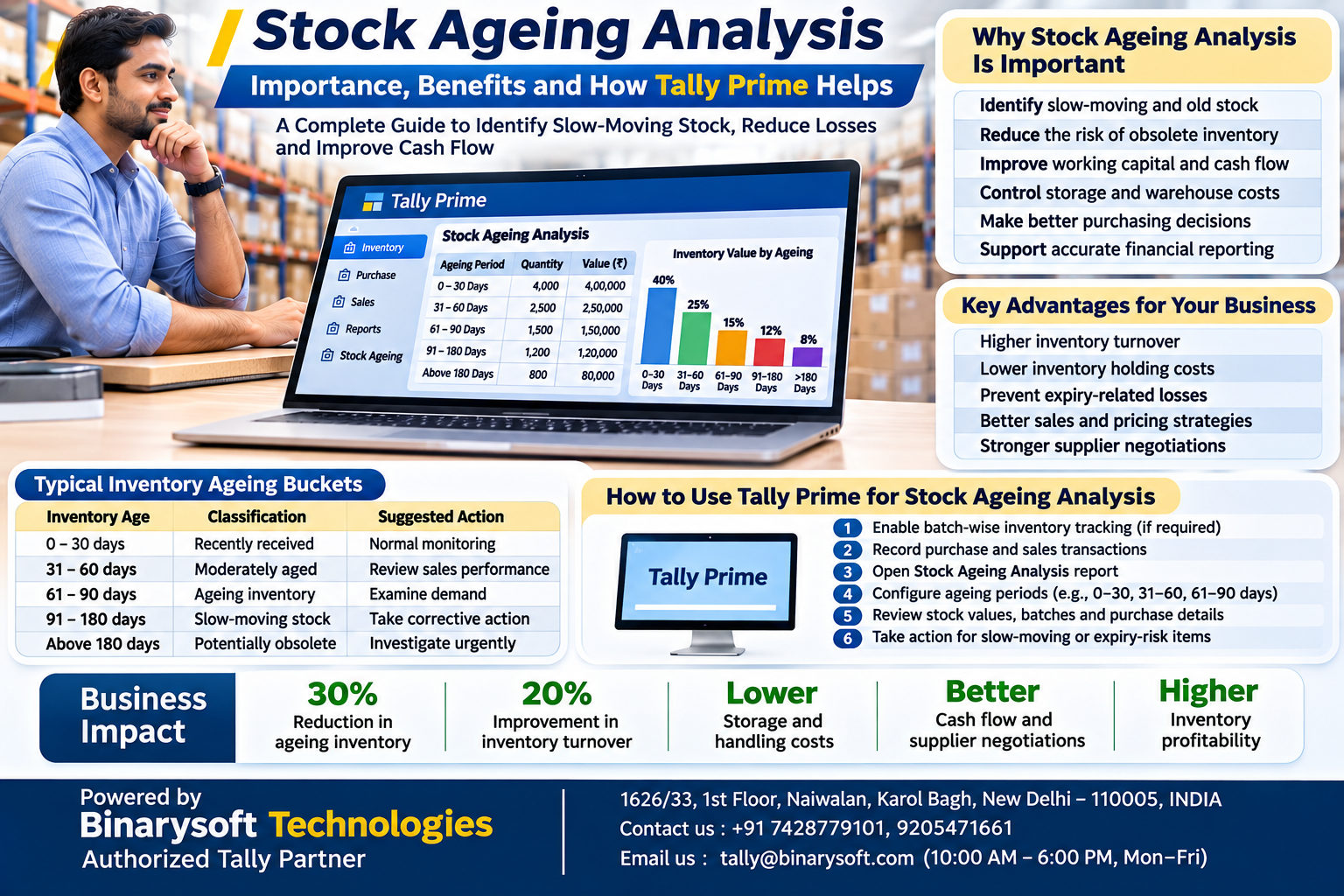
Introduction: Is Your Business Losing Money Through Unsold Inventory?
Every business owner wants a warehouse filled with products that customers are ready to purchase.
But what happens when those products remain unsold for months?
Imagine a wholesale distributor in Delhi who purchases inventory worth ₹25 lakh. Sales continue, employees remain busy and customers regularly visit the business.
Yet a significant portion of the inventory has remained untouched for more than six months.
The products occupy valuable warehouse space, block working capital and gradually lose market demand.
Some may become outdated. Others may require heavy discounts to attract buyers.
For businesses dealing with perishable goods, prolonged storage can even make products unsuitable for sale.
This is where stock ageing analysis becomes an essential business management technique.
Stock ageing analysis helps companies understand how long inventory has remained in storage, which products are moving slowly and where money is becoming trapped in unsold stock.
Instead of making purchasing decisions based on assumptions, business owners can use inventory ageing reports to identify problems before they become expensive.
With Tally Prime, businesses can review stock age, analyse inventory movement, monitor batch information and make more informed purchasing and sales decisions.
This comprehensive guide explains stock ageing analysis, its importance, advantages, calculation methods, practical applications and implementation strategies for Indian businesses.
What Is Stock Ageing Analysis?
Stock ageing analysis is the process of examining inventory according to how long products have remained in stock.
It helps businesses classify inventory into different time periods, commonly called ageing buckets or ageing slabs.
For example, a company may classify inventory into the following categories:
|
Inventory age
|
Classification
|
Suggested action
|
|---|
|
0–30 days
|
Recently received
|
Normal monitoring
|
|
31–60 days
|
Moderately aged
|
Review sales performance
|
|
61–90 days
|
Ageing inventory
|
Examine demand
|
|
91–180 days
|
Slow-moving stock
|
Consider corrective action
|
|
Above 180 days
|
Potentially obsolete
|
Investigate urgently
|
These classifications are illustrative. A grocery distributor may require much shorter ageing periods than a furniture manufacturer.
The objective is to identify products that remain unsold longer than expected and determine appropriate corrective measures.
Why Stock Ageing Analysis Is Important
Inventory is an investment, not merely a collection of products stored in a warehouse.
Every unsold item represents money that cannot immediately be used elsewhere.
Stock ageing analysis provides visibility into this investment.
1. Identifies Slow-Moving Products
Ageing reports highlight products that have remained in storage for extended periods.
Management can investigate whether the problem results from weak demand, incorrect pricing, excessive purchasing or changing customer preferences.
2. Reduces Obsolete Inventory
Products may become obsolete because of technological changes, new designs, seasonal trends or changing market requirements.
Early identification allows businesses to consider promotions, returns or alternative sales channels before products lose substantial value.
3. Improves Working Capital
Excess inventory blocks funds that could otherwise support supplier payments, salaries and business expansion.
By identifying ageing products, companies can reduce unnecessary purchases and improve inventory turnover.
4. Controls Warehouse Expenses
Unsold goods require storage space, handling, security and sometimes insurance or specialised environmental conditions.
Reducing ageing inventory can lower these expenses.
5. Improves Purchasing Decisions
Ageing analysis helps purchasing teams understand which products should not be reordered without further investigation.
It also supports better discussions with suppliers about delivery quantities and purchasing frequency.
How Stock Ageing Analysis Works
Stock ageing analysis begins with accurate inventory receipt dates and stock movement records.
Businesses then calculate how long remaining stock has been held.
A basic formula is:
\[ \text{Stock Age}=\text{Reporting Date}-\text{Receipt Date} \]
For example, if a product was received on 1 August and the reporting date is 30 September, its age is 60 days.
However, businesses must consider partial sales, multiple purchase batches, returns and stock transfers.
When identical products are purchased on different dates, the system must use a consistent approach to determine the age of remaining inventory.
For accurate results, businesses should maintain reliable purchase records and batch information where applicable.
Practical Example of a Stock Ageing Report
Consider a wholesale distributor maintaining inventory worth ₹10 lakh.
Its ageing analysis produces the following results:
Illustrative inventory ageing distribution
₹0₹150K₹300K₹450K0–30 days31–60 days61–90 days91–180 days>180 days
Illustrative inventory values, not actual business data.
|
Ageing period
|
Inventory value
|
Share
|
|---|
|
0–30 days
|
₹4,00,000
|
40%
|
|
31–60 days
|
₹2,50,000
|
25%
|
|
61–90 days
|
₹1,50,000
|
15%
|
|
91–180 days
|
₹1,20,000
|
12%
|
|
Above 180 days
|
₹80,000
|
8%
|
|
Total
|
₹10,00,000
|
100%
|
The report shows that ₹2 lakh, representing 20% of inventory value, has remained in stock for more than 90 days.
Management should investigate these products before placing additional orders.
This does not automatically mean that the entire ₹2 lakh is obsolete. Some items may be intentionally held for seasonal demand or long production cycles.
Ageing analysis identifies products requiring attention; it does not replace commercial judgement.
Major Advantages of Stock Ageing Analysis
Better Inventory Turnover
Inventory turnover measures how frequently stock is sold or consumed during a period.
The formula is:
\[ \text{Inventory Turnover}=\frac{\text{Cost of Goods Sold}}{\text{Average Inventory}} \]
For example, if annual cost of goods sold is ₹60 lakh and average inventory is ₹15 lakh, inventory turnover is four times annually.
Ageing analysis complements this ratio by identifying individual products that remain unsold despite acceptable overall turnover.
Reduced Product Expiry Losses
Food, pharmaceutical and cosmetic businesses must monitor products with limited shelf lives.
Ageing analysis can help identify batches approaching expiry so businesses can take appropriate action.
Products must never be sold after expiry where prohibited by applicable law or product safety requirements.
Improved Sales Planning
Sales teams can use ageing information to identify products suitable for targeted promotions, bundling or alternative distribution channels.
Stronger Supplier Negotiations
When ageing reports reveal repeated overstocking, businesses can negotiate smaller order quantities, more frequent deliveries or suitable return arrangements.
More Reliable Financial Reporting
Ageing information can help identify inventory that may require a net realisable value assessment or write-down.
Under applicable Indian accounting standards, inventory is generally measured at the lower of cost and net realisable value.
Age alone does not determine the write-down amount; expected selling prices and relevant completion or selling costs must also be considered.
Stock Ageing vs Inventory Turnover vs Stock Movement Analysis
These three techniques are related but serve different purposes.
|
Technique
|
Main purpose
|
|---|
|
Stock Ageing Analysis
|
Measures how long remaining stock has been held
|
|
Inventory Turnover
|
Measures how frequently inventory is sold or consumed
|
|
Stock Movement Analysis
|
Examines inward and outward stock transactions
|
A product can be old without being permanently unsaleable.
Similarly, a business may have strong overall inventory turnover while still holding certain obsolete products.
Using all three techniques provides a more complete picture of inventory performance.
How Tally Prime Helps Businesses Perform Stock Ageing Analysis
Tally Prime provides inventory reporting capabilities that help businesses identify old stock, examine inventory batches and analyse stock values.
Its Stock Ageing Analysis report displays age-wise inventory quantities and allows businesses to configure ageing periods according to their requirements.
Step 1: Enable Batch-Wise Inventory Tracking
Open the company features in Tally Prime and enable batch management where required.
Create stock items with appropriate batch information. For products requiring expiry monitoring, maintain manufacturing and expiry dates.
Step 2: Record Inventory Transactions
Enter purchase transactions with accurate dates, quantities and batch details.
Record sales and other inventory movements consistently to maintain reliable stock balances.
Step 3: Open Stock Ageing Analysis
Navigate to:
Alt+G (Go To) → Stock Ageing Analysis → Select Stock Group
Select Primary when you want to analyse all applicable stock groups.
Step 4: Configure Ageing Periods
Press F6 (Ageing Periods) to define suitable ageing ranges.
For example, a distributor may use 0–30, 31–60, 61–90 and above 90 days.
Different product categories may require different review periods.
Step 5: Review Stock Values
Use F7 (Show Value) to display inventory values and F8 (Valuation) to examine the report using available valuation methods.
This helps management identify products representing significant inventory investment.
Step 6: Analyse Purchase and Expiry Dates
Use F9 (Ageing Style) to select relevant ageing criteria, including purchase date, manufacturing date, expiry date or time remaining until expiry, where supported.
Step 7: Examine Item Inwards Details
Select an ageing column and drill down to view purchase dates, suppliers and related transaction vouchers.
These details can help identify purchasing decisions responsible for older inventory.
Case Study 1: Reducing Slow-Moving Stock in a Delhi Electronics Business
Illustrative business scenario; figures are hypothetical.
A Delhi-based electronics distributor maintained hundreds of products, including computer accessories, networking equipment and electrical components.
The company frequently purchased additional stock without reviewing existing inventory.
Over time, expensive accessories accumulated in storage.
Management introduced monthly stock ageing reviews and purchasing controls.
Using Tally Prime, the business examined product-wise inventory ages and identified items requiring promotional or purchasing action.
In this illustrative scenario, inventory held beyond 90 days decreased from ₹6 lakh to ₹3.8 lakh over six months.
The company also reduced repeat purchases of products with weak demand.
The key lesson was that identifying old inventory early helped management take corrective action before more working capital became blocked.
Case Study 2: Preventing Expiry Losses in a Food Distribution Business
Illustrative business scenario; results are not verified customer outcomes.
A packaged-food distributor in Noida supplied products to supermarkets and neighbourhood retailers.
The business maintained several product batches with different expiry dates.
Warehouse employees sometimes dispatched newer products while older batches remained unsold.
Management introduced batch-wise inventory records and regular expiry reviews.
Tally Prime helped the business examine batch information and identify products approaching expiry.
The distributor also introduced First-Expiry, First-Out procedures for warehouse dispatches.
In this hypothetical example, expiry-related inventory losses decreased by 30% over the following year.
The improvement resulted from combining accurate records with physical stock rotation and employee training.
An Emotional Story: The Warehouse Full of Products That Could Not Save a Family Business
The following fictional story illustrates the human impact of poor inventory management.
For twenty-two years, Suresh operated a wholesale business in Delhi.
He believed that maintaining large quantities of stock was the safest way to protect his customers from shortages.
Whenever suppliers offered discounts, he purchased additional products.
His warehouse gradually became crowded, but his bank balance continued shrinking.
One evening, his daughter noticed him reviewing unpaid supplier bills.
She asked why the business was facing financial pressure when the warehouse was full.
Suresh replied, "Everything we earned is sitting inside those boxes."
Together, they examined the inventory records.
They discovered products that had remained unsold for months, including items customers no longer preferred.
Instead of purchasing more stock, they began reviewing ageing reports, identifying slow-moving products and adjusting purchasing quantities.
They also contacted customers who might be interested in older but usable inventory.
Gradually, the business gained better control over purchasing and stock availability.
Suresh realised that a warehouse filled with products did not necessarily represent financial strength.
What mattered was whether those products could be sold profitably.
His experience illustrates an important business lesson: inventory should support business growth, not silently consume the money needed to sustain it.
Best Practices for Managing Ageing Inventory
Businesses should review ageing reports regularly and assign responsibility for corrective action.
Products with limited shelf lives may require daily or weekly monitoring, while durable goods may be reviewed monthly.
Purchasing teams should examine existing stock before placing repeat orders.
Sales teams can identify appropriate opportunities for promotions, while warehouse teams should follow suitable stock rotation procedures.
Management should also establish clear policies for obsolete inventory, supplier returns and damaged products.
Regular physical verification remains essential because inaccurate stock records can make ageing reports misleading.
Common Stock Ageing Analysis Mistakes
One common mistake is treating every old product as obsolete.
Some businesses intentionally hold slow-moving spare parts or seasonal inventory to meet specific customer requirements.
Another mistake is ignoring product value and focusing only on quantities.
A small number of expensive products may block more working capital than hundreds of inexpensive items.
Businesses should also avoid using the same ageing periods for all product categories.
Finally, stock ageing analysis should not be confused with receivables ageing. Inventory ageing measures the age of goods, while receivables ageing measures how long customer payments have remained outstanding.
Conclusion
Stock ageing analysis is an essential inventory management technique that helps businesses understand how long products remain in storage and where working capital may be unnecessarily blocked.
By identifying slow-moving, ageing and potentially obsolete products, companies can improve purchasing decisions, reduce storage costs and minimise avoidable inventory losses.
Tally Prime supports this process through configurable ageing reports, batch-wise tracking, inventory valuation options and detailed transaction information.
For Indian retailers, wholesalers, distributors and manufacturers, regular stock ageing reviews can strengthen inventory control and support more reliable financial decisions.
The objective is not simply to eliminate old inventory. It is to understand why products remain unsold and take appropriate action before their value deteriorates.
Better stock visibility leads to better purchasing decisions, healthier cash flow and stronger business control.
Powered by Binarysoft Technologies
Authorized Tally Partner
Location: 1626/33, 1st Floor, Naiwalan, Karol Bagh, New Delhi – 110005, INDIA
Contact us: +91 7428779101, 9205471661
Email us: tally@binarysoft.com
Business Hours: 10:00 AM – 6:00 PM, Monday–Friday
Frequently Asked Questions
Does ageing inventory always require an accounting write-down?
No. Ageing is a warning indicator. Write-downs depend on applicable accounting requirements and whether inventory's net realisable value has fallen below its carrying cost.
How can businesses reduce ageing inventory?
Businesses can improve demand forecasting, control purchasing quantities, review product movement and use appropriate promotions or supplier return arrangements.
What is the difference between slow-moving and dead stock?
Slow-moving stock sells or moves infrequently, while dead stock generally refers to products with little or no realistic prospect of sale or use.
Does Tally Prime provide stock ageing reports?
Yes. Tally Prime provides Stock Ageing Analysis with configurable ageing periods and inventory reporting options.
CA. Raghav Mundhra focuses on business accounting, GST reporting, and financial reconciliations. He works with organizations to strengthen accounting processes and maintain reliable financial information for compliance and decision-making.