Call CA Tally HelpDesk
+91 9205471661,
7428779101
Introduction: Why Choosing the Right Inventory Management Software Matters
Every growing business reaches a stage when managing inventory manually becomes difficult.
A retailer may struggle to identify fast-selling products. A wholesaler may purchase excessive stock without understanding actual customer demand. A manufacturer may experience production delays because essential raw materials are unavailable.
These problems may appear operational, but they directly affect profitability, customer relationships and working capital.
Imagine a business owner who invests ₹20 lakh in inventory but cannot accurately determine which products are selling, which items are becoming obsolete and how much money is blocked in warehouses.
Without reliable information, even a profitable business can experience serious cash flow difficulties.
This is where inventory management software becomes essential.
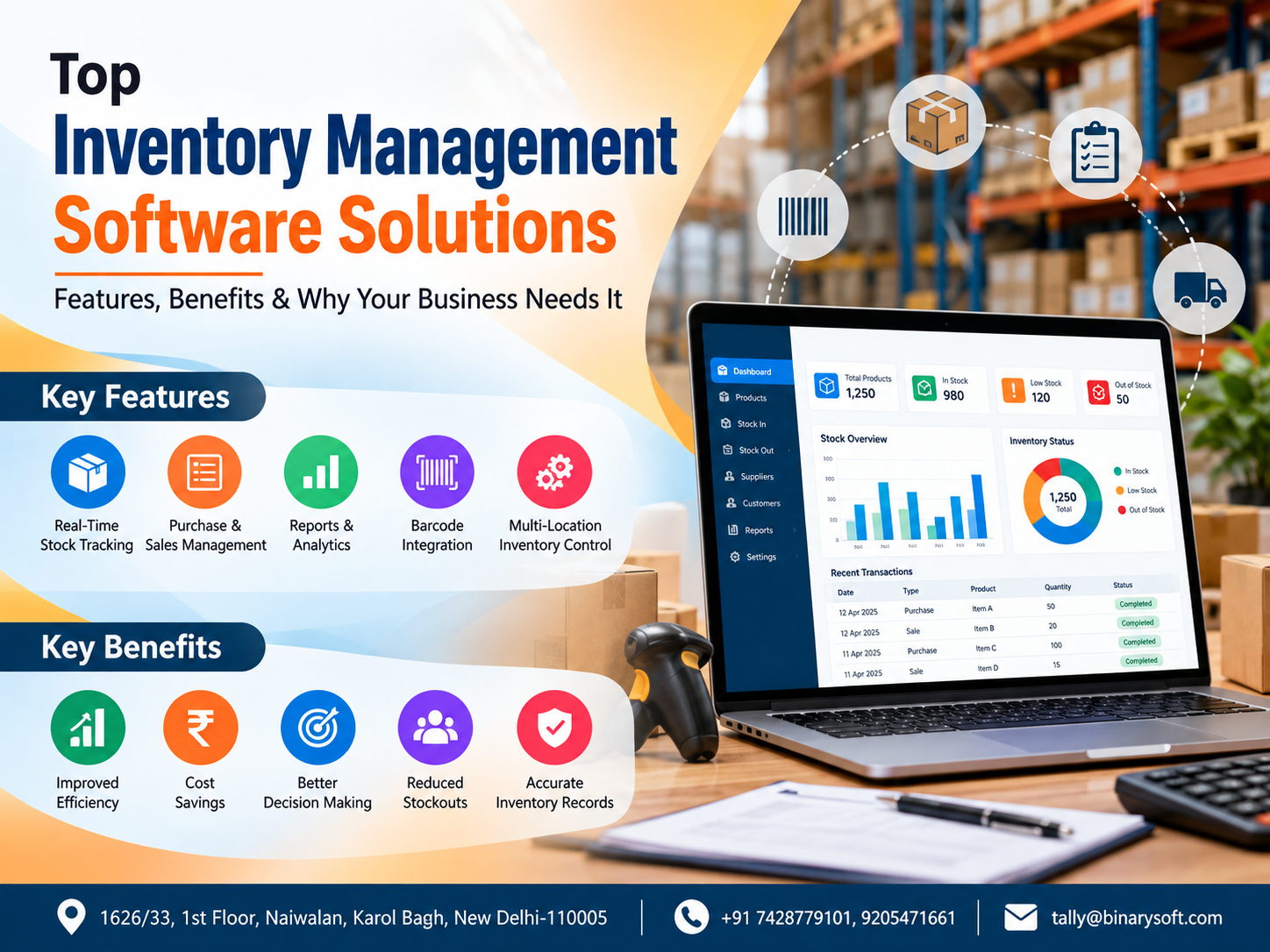
The right software helps businesses maintain accurate stock records, monitor product movement, manage purchasing, track warehouse inventory and make informed decisions.
However, purchasing software without evaluating business requirements can create additional complications.
Businesses must consider usability, reporting, integration, scalability, implementation costs and long-term support.
This comprehensive guide explains how to choose the best inventory management software for Indian businesses and how Tally Prime can support inventory control, financial management and operational efficiency.
What Is Inventory Management Software?
Inventory management software is a digital system that helps businesses monitor, organise and control stock throughout its lifecycle.
It records inventory received from suppliers, products stored in warehouses, goods transferred between locations and items sold to customers.
A comprehensive inventory system may also support purchase orders, sales orders, batch tracking, stock valuation and inventory reporting.
For example, when a retailer records the sale of ten units, an integrated inventory system updates the recorded stock quantity accordingly.
This allows management to review available inventory without manually updating separate registers.
Inventory software can be particularly valuable for businesses handling hundreds or thousands of products across multiple locations.
Why Indian Businesses Need Inventory Management Software
Indian businesses operate in increasingly competitive markets where customers expect accurate billing, timely delivery and consistent product availability.
Manual inventory processes can become unreliable as transaction volumes increase.
A well-implemented inventory system can provide several advantages.
Better Stock Accuracy
Businesses can maintain structured records of purchases, sales, returns and inventory adjustments.
Reduced Overstocking
Stock movement reports help identify products that are not selling as expected, allowing management to avoid unnecessary purchases.
Improved Cash Flow
Reducing excess inventory releases working capital for operational expenses and business expansion.
Faster Customer Order Fulfilment
Accurate stock availability helps sales teams make more reliable delivery commitments.
Improved Financial Visibility
Integrated inventory and accounting records allow businesses to evaluate inventory investment alongside revenue, expenses and profitability.
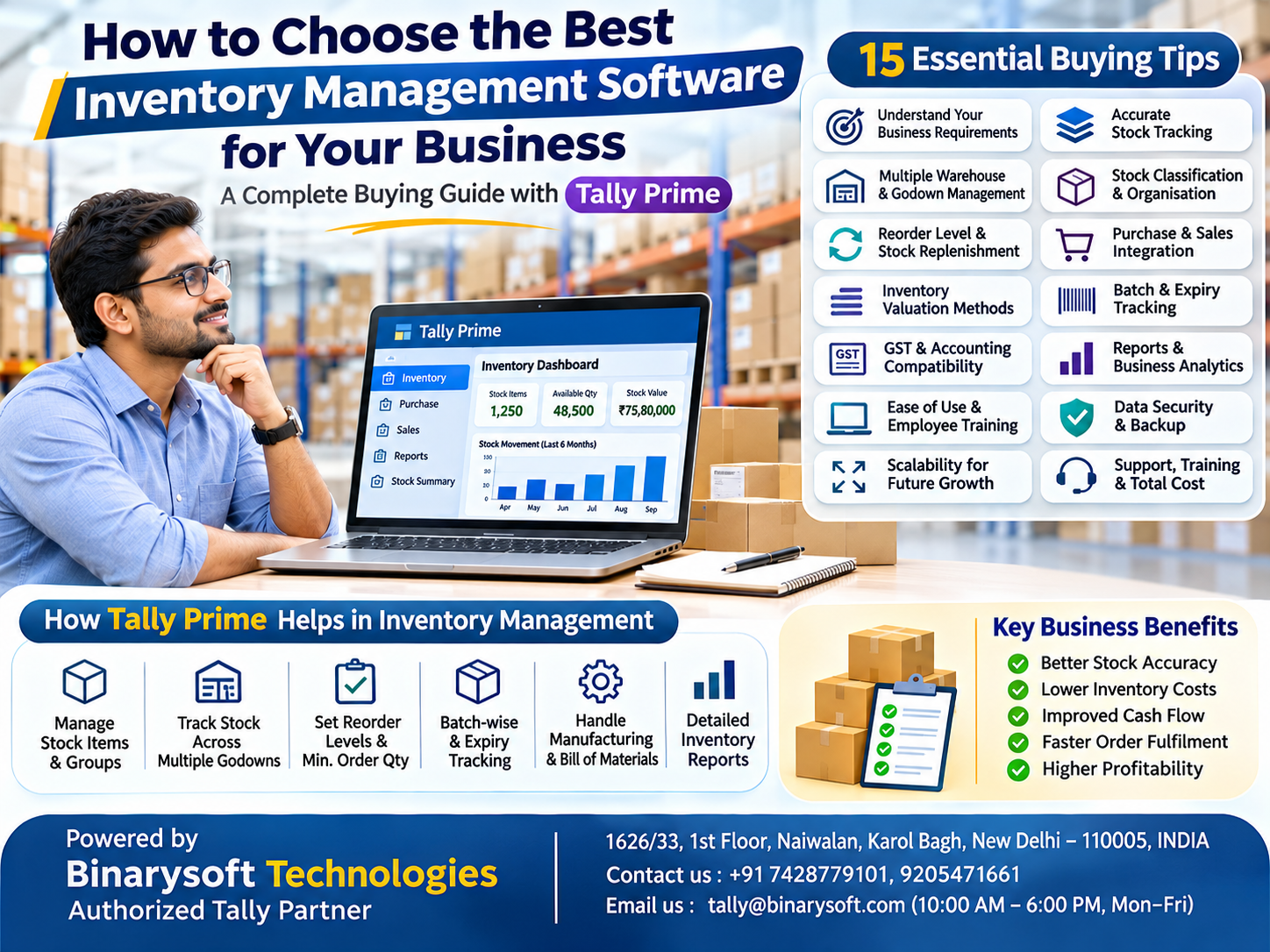
15 Essential Tips for Buying the Best Inventory Management Software
1. Understand Your Business Requirements Before Purchasing
The first step is identifying the problems your business needs to solve.
A retail shop, manufacturing company and wholesale distributor may have completely different inventory requirements.
Before evaluating software, determine the number of products you manage, the number of warehouses, daily transaction volumes and reporting requirements.
A small retailer may need basic stock tracking and billing, while a manufacturer may require raw material consumption, Bills of Materials and production costing.
Practical advice: Prepare a list of essential features and optional features before comparing software solutions.
This prevents unnecessary spending on capabilities that your business may never use.
2. Choose Software That Provides Accurate Stock Tracking
Accurate inventory information is the foundation of effective stock management.
Your software should update stock records as purchase, sales and inventory transactions are entered.
It should also provide visibility into opening stock, inward quantities, outward quantities and closing balances.
For businesses managing multiple products, this reduces dependence on handwritten registers and disconnected spreadsheets.
How Tally Prime helps: Stock Summary and related inventory reports provide updated information based on recorded transactions, helping businesses monitor quantities, rates and stock values.
3. Check Multiple Warehouse and Godown Management
Many businesses operate from more than one storage location.
A wholesaler may maintain a central warehouse, retail outlet and distribution godown.
Without location-wise inventory tracking, employees may struggle to identify where products are available.
Choose software that supports multiple locations, stock transfers and warehouse-wise reporting.
Tally Prime allows businesses to create multiple godowns and record stock transfers using Stock Journal vouchers.
Management can review location-wise inventory through Godown Summary reports.
4. Evaluate Stock Classification and Product Organisation
An effective inventory system should allow businesses to classify products logically.
Stock groups, categories and units of measurement help organise inventory and simplify reporting.
For example, an electrical distributor may classify products into wires, switches, lighting equipment and accessories.
Products can also be grouped by brand, size or other characteristics.
Tally Prime supports stock groups, stock categories and flexible units of measurement.
These capabilities help businesses maintain consistent product records and analyse inventory more effectively.
5. Look for Reorder Level and Stock Replenishment Features
Running out of popular products can result in lost sales and dissatisfied customers.
At the same time, purchasing excessive quantities increases storage expenses and blocks working capital.
Inventory software should help businesses identify when stock requires replenishment.
A simple reorder point calculation is:
\[ \text{Reorder Point}=(\text{Daily Demand}\times\text{Lead Time})+\text{Safety Stock} \]
For example, if daily demand is 15 units, supplier delivery takes eight days and safety stock is 40 units:
Reorder point = (15 × 8) + 40 = 160 units.
Tally Prime supports reorder levels and Inventory Reorder Status reporting to help businesses plan replenishment.
6. Prioritise Purchase and Sales Management Integration
Inventory management should work closely with purchasing and sales processes.
When these systems operate separately, employees may need to enter the same information multiple times.
This increases the risk of errors and delays.
Choose software that supports purchase orders, sales orders, delivery transactions and invoices.
Tally Prime integrates inventory records with purchase and sales workflows, helping businesses maintain coordinated transaction information.
7. Evaluate Inventory Valuation Methods
Inventory valuation affects the reported value of closing stock and business profitability.
Common valuation approaches include First-In, First-Out and weighted average costing.
Different businesses may require different methods depending on product characteristics and applicable accounting standards.
The selected software should provide appropriate valuation options and consistent reporting.
Tally Prime supports multiple stock valuation methods, allowing businesses to evaluate inventory values according to their accounting requirements.
8. Check Batch-Wise and Expiry Date Tracking
Businesses selling medicines, food products, cosmetics and other shelf-life-sensitive goods require additional inventory controls.
Batch tracking helps identify products by batch number, manufacturing date and expiry date.
It also supports traceability when products are returned or recalled.
Tally Prime supports batch-wise inventory management and expiry-date tracking.
Businesses can review batch-related information to identify products approaching expiry and plan suitable stock rotation.
9. Ensure Accounting and GST Compatibility
Inventory transactions often have a direct financial impact.
Purchase costs, sales revenue, taxes and inventory valuation should be recorded consistently.
For Indian businesses, GST-related billing and reporting requirements are particularly important.
Choosing inventory software that integrates with accounting can reduce duplicate data entry and simplify reconciliation.
Tally Prime combines accounting, inventory management and GST-related functionality in one business system.
However, businesses should verify that their specific GST, e-invoicing and e-way bill requirements are supported by the relevant configuration and software release.
10. Examine Inventory Reports and Business Analytics
A good inventory system should do more than display available quantities.
It should help management understand product performance and purchasing efficiency.
Important reports include:
-
Stock Summary and closing inventory valuation
-
Fast-moving and slow-moving stock analysis
-
Stock ageing and obsolete inventory
-
Warehouse-wise inventory balances
-
Purchase and sales movement
-
Item-wise profitability and stock replenishment requirements
Tally Prime provides inventory reports such as Stock Summary, Movement Analysis, Stock Ageing Analysis and Inventory Reorder Status.
These reports can support better operational decisions.
11. Evaluate Ease of Use and Employee Training
Complex software may increase operational difficulties instead of reducing them.
Employees responsible for purchasing, billing and warehouse management should be able to perform routine tasks confidently.
Before purchasing, request a demonstration covering actual business scenarios.
Check how easily employees can create stock items, record purchases, generate invoices and review inventory reports.
Also consider the availability of training materials and implementation support.
Software becomes valuable only when employees use it consistently and correctly.
12. Check Data Security, Backup and Access Controls
Inventory records contain commercially sensitive information, including product costs, purchasing quantities and customer transactions.
Businesses should evaluate user permissions, backup procedures and data recovery options.
Different employees may require different levels of access.
For example, warehouse staff may need inventory transaction access without permission to view confidential financial information.
Tally Prime provides user-level security and access controls, subject to configuration and edition.
Businesses should also establish reliable backup procedures and test data restoration periodically.
13. Consider Scalability and Future Business Expansion
Software suitable for a small shop today may become inadequate when the business expands.
Before purchasing, consider future requirements such as additional users, more warehouses, higher transaction volumes and manufacturing operations.
Businesses planning expansion should also evaluate remote access, hosting arrangements and deployment requirements.
Tally Prime supports a range of business sizes and operational requirements.
However, businesses should assess their expected workload, licensing needs and infrastructure before finalising a solution.
14. Evaluate Integration With Existing Business Systems
Some businesses use separate point-of-sale systems, barcode scanners, e-commerce platforms or warehouse applications.
Inventory software should fit into the existing workflow.
Before purchasing, verify whether required integrations are available and whether they involve additional development.
Tally Prime can support integration through its available data exchange and extensibility capabilities, but third-party connections may require compatible applications, customisation or additional services.
Never assume that every external system will connect automatically.
15. Compare Total Cost, Support and Long-Term Value
The cheapest inventory software is not necessarily the most economical choice.
Businesses should evaluate the total cost of ownership.
This may include software licensing, implementation, employee training, customisation, hardware, support and future upgrades.
Also consider the potential cost of operational errors, stock shortages and inefficient purchasing.
A slightly higher investment in suitable software may provide better long-term value if it improves accuracy and reduces avoidable work.
The best inventory management software is the solution that matches your operational requirements, budget and future growth plans.
How Tally Prime Helps Businesses Manage Inventory Efficiently
Tally Prime provides integrated inventory and accounting capabilities that help businesses manage stock movements, purchases, sales and financial records.
Practical Implementation Process
Step 1: Create Stock Items
Create individual stock records with suitable units of measurement, opening balances and relevant product information.
Step 2: Organise Stock Groups
Classify products according to their business categories, such as electronics, garments, hardware or raw materials.
Step 3: Configure Godowns
Create separate inventory locations for warehouses, branches or storage areas.
Step 4: Record Purchases and Sales
Enter purchase and sales transactions to maintain updated stock records.
Step 5: Enable Batch Tracking
Configure batch-wise details for products requiring manufacturing-date or expiry-date monitoring.
Step 6: Configure Reorder Levels
Set suitable reorder quantities based on sales demand and supplier delivery schedules.
Step 7: Review Inventory Reports
Regularly examine Stock Summary, Movement Analysis, Stock Ageing and Godown Summary reports.
Step 8: Verify Physical Inventory
Conduct periodic physical counts and record approved adjustments using Physical Stock vouchers.
With consistent procedures, these features can help businesses improve inventory accuracy and purchasing decisions.
Case Study 1: How a Delhi Wholesale Distributor Reduced Excess Inventory
Illustrative case study using hypothetical business figures.
A wholesale electronics distributor in Delhi managed more than 800 products, including computer accessories, networking equipment and electrical components.
The company maintained inventory records through spreadsheets, but stock information was frequently outdated.
Popular products became unavailable while slow-moving items occupied valuable warehouse space.
Management introduced structured stock classification, reorder planning and regular inventory reporting.
Using Tally Prime, the company organised products into stock groups, maintained warehouse-wise records and reviewed stock ageing information.
After six months, the hypothetical business achieved the following improvements:
|
Performance indicator
|
Before
|
After
|
|---|
|
Average inventory investment
|
₹30 lakh
|
₹24 lakh
|
|
Monthly stockout incidents
|
20
|
8
|
|
Inventory reporting time
|
5 hours
|
45 minutes
|
These illustrative results demonstrate how better stock visibility and purchasing discipline can reduce excess inventory and improve customer service. They are not verified customer outcomes.
Case Study 2: Improving Manufacturing Inventory in Faridabad
Illustrative case study using hypothetical business figures.
A furniture manufacturing company in Faridabad struggled to maintain accurate records of timber, fittings, hardware and finished products.
Production delays occurred because required components were sometimes unavailable.
The company introduced Bills of Materials, manufacturing inventory records and regular raw material reviews.
Tally Prime helped the business record component consumption, finished goods production and stock movements between storage locations.
In this illustrative scenario, raw material wastage decreased by 15%, and production planning became more predictable.
The important lesson was that inventory software delivered the greatest value when supported by accurate records and disciplined production processes.
An Emotional Story: The Business Owner Who Almost Lost His Dream
This fictional story illustrates the human challenges behind inventory management decisions.
For eighteen years, Mahesh operated a small wholesale business in Delhi.
He had started with limited savings, a rented shop and a determination to provide a better future for his family.
Over time, his business expanded. He hired employees, rented additional storage space and introduced new products.
But growth brought unexpected problems.
Customers complained about unavailable products, suppliers demanded overdue payments and expensive inventory remained unsold.
One evening, Mahesh sat quietly in his warehouse, surrounded by cartons he could not sell.
His daughter asked why he looked worried.
He replied, "I worked my whole life to build this business, but now I don't even know where my money is going."
She suggested replacing their disconnected inventory records with a systematic stock management process.
They reviewed product movement, identified excess inventory and began recording purchases and sales consistently.
Gradually, they gained better control over stock availability and purchasing requirements.
Mahesh no longer needed to depend entirely on memory when making business decisions.
For him, the greatest benefit was not simply saving money.
It was recovering the confidence to plan for his family's future.
Inventory management software cannot guarantee business success, but reliable information can help owners make decisions with greater clarity and confidence.
Common Mistakes to Avoid When Buying Inventory Software
Businesses sometimes purchase software based entirely on price or promotional claims.
Other common mistakes include ignoring employee training, overlooking data migration, failing to test essential reports and assuming all integrations are included.
A particularly costly mistake is implementing new software without first cleaning existing product records.
Duplicate stock names, incorrect opening balances and inconsistent units of measurement can undermine even a capable inventory system.
Before implementation, businesses should verify stock quantities, standardise product classifications and establish clear responsibilities for recording transactions.
Quick Checklist Before Finalising Inventory Software
Conclusion
Choosing the best inventory management software is an important investment for businesses seeking better stock accuracy, improved cash flow and sustainable growth.
The ideal solution should support everyday operations while providing reliable inventory reports, purchasing controls, financial integration and room for future expansion.
Tally Prime offers inventory management capabilities that can help Indian businesses organise products, track stock across locations, manage purchases and sales, monitor batches and analyse inventory performance.
However, businesses should evaluate their individual requirements, available integrations, implementation costs and employee training needs before making a purchase.
Ultimately, effective inventory management is not simply about installing software. It is about creating a reliable system that helps businesses maintain the right products, reduce unnecessary costs and serve customers consistently.
Powered by Binarysoft Technologies
Authorized Tally Partner
Location: 1626/33, 1st Floor, Naiwalan, Karol Bagh, New Delhi – 110005, INDIA
Contact us: +91 7428779101, 9205471661
Email us: tally@binarysoft.com
Business Hours: 10:00 AM – 6:00 PM, Monday–Friday
Frequently Asked Questions
Can inventory software help prevent stock shortages?
Inventory software can help identify replenishment requirements through stock reports and reorder planning, although reliable supplier coordination remains essential.
How much does inventory management software cost?
Costs vary according to licensing, features, user requirements, implementation, customisation and ongoing support. Businesses should request a quotation based on their actual requirements.
How can Binarysoft Technologies help businesses implement Tally Prime?
Binarysoft Technologies, an Authorized Tally Partner, can be contacted for assistance with evaluating Tally Prime requirements, inventory configuration, implementation and related support services.
Can inventory management software reduce business expenses?
Yes. Better stock planning can help reduce unnecessary purchases, storage expenses, wastage and administrative work.
CA. Aditya Khatod focuses on accounting automation, taxation, and financial reporting for MSMEs. He helps businesses organize transactions, improve reconciliation processes, and maintain structured records for compliance and management purposes.