Call CA Tally HelpDesk
+91 9205471661,
7428779101
Introduction: Why Inventory Classification Matters for Indian Businesses in 2026
Imagine running a growing business where sales are increasing every month, but employees cannot confidently answer a simple question: how much stock is actually available?
The warehouse may contain hundreds of products, yet identifying raw materials, finished goods, spare parts and slow-moving items becomes difficult when everything is recorded without proper classification.
In 2026, Indian retailers, wholesalers, manufacturers and distributors face increasing pressure to manage inventory accurately. Changing customer demand, procurement costs, delivery expectations and working capital requirements make stock management a critical business function.
Inventory classification provides a structured method for organizing products according to their nature, purpose, value and movement.
Proper classification helps businesses identify available stock, monitor consumption, improve purchasing decisions and maintain reliable financial records.
For organizations using Tally Prime, stock items, stock groups, stock categories and godowns provide practical ways to organize inventory information.
This guide explains inventory item classifications, real-world examples, valuation methods, common mistakes and how Tally Prime supports better inventory management.
A Business Owner's Story: The Day Missing Stock Almost Cost a Major Customer
Sandeep operated a wholesale electrical goods business in Delhi's Bhagirath Palace market.
His father had established the business years earlier, and Sandeep worked hard to expand its customer base.
The company supplied switches, cables, LED lights and electrical accessories to contractors and retailers.
One morning, a regular customer placed a large order for electrical cables required urgently at a construction site.
Sandeep checked his inventory spreadsheet, which showed sufficient stock.
He confidently promised next-day delivery.
But when the warehouse team began preparing the order, they discovered that the required cable specification was unavailable.
Different cable sizes had been recorded under similar product names, and several damaged rolls had not been separated from usable inventory.
The customer was disappointed and threatened to move future purchases to another supplier.
Sandeep felt frustrated. Years of building trust could be damaged by one preventable inventory mistake.
That evening, he decided to reorganize the company's stock records.
His team classified products by category, specification, unit of measurement and storage location. They introduced regular stock verification and began using structured inventory records in Tally Prime.
Gradually, the warehouse team could identify products more accurately, while the sales department gained greater confidence when confirming orders.
This fictional story highlights a common business challenge: inventory classification is not simply an accounting exercise. It can directly affect customer trust, profitability and business continuity.
1. What Are Inventory Items?
Inventory items are goods or materials held by a business for sale, consumption in production or use in delivering goods and services.
They may include products purchased for resale, raw materials used in manufacturing, partially completed goods and finished products awaiting delivery.
For example, a furniture manufacturer may maintain wood, screws, adhesive, unfinished tables and completed furniture.
A retail electronics store may maintain televisions, refrigerators, washing machines and accessories.
The nature of inventory depends on the business model.
Inventory should be distinguished from fixed assets, which are generally held for long-term business use rather than ordinary sale or consumption.
2. What Is Inventory Classification?
Inventory classification is the process of organizing inventory items into meaningful groups based on common characteristics.
Businesses may classify inventory according to its role in production, product category, value, movement frequency, storage requirements or demand.
For example, a garment manufacturer may organize stock into fabric, buttons, zippers, work-in-progress garments and finished clothing.
Classification improves reporting because management can analyze related products together instead of reviewing every item individually.
A well-designed classification structure also supports accurate purchasing, stock verification and inventory valuation.
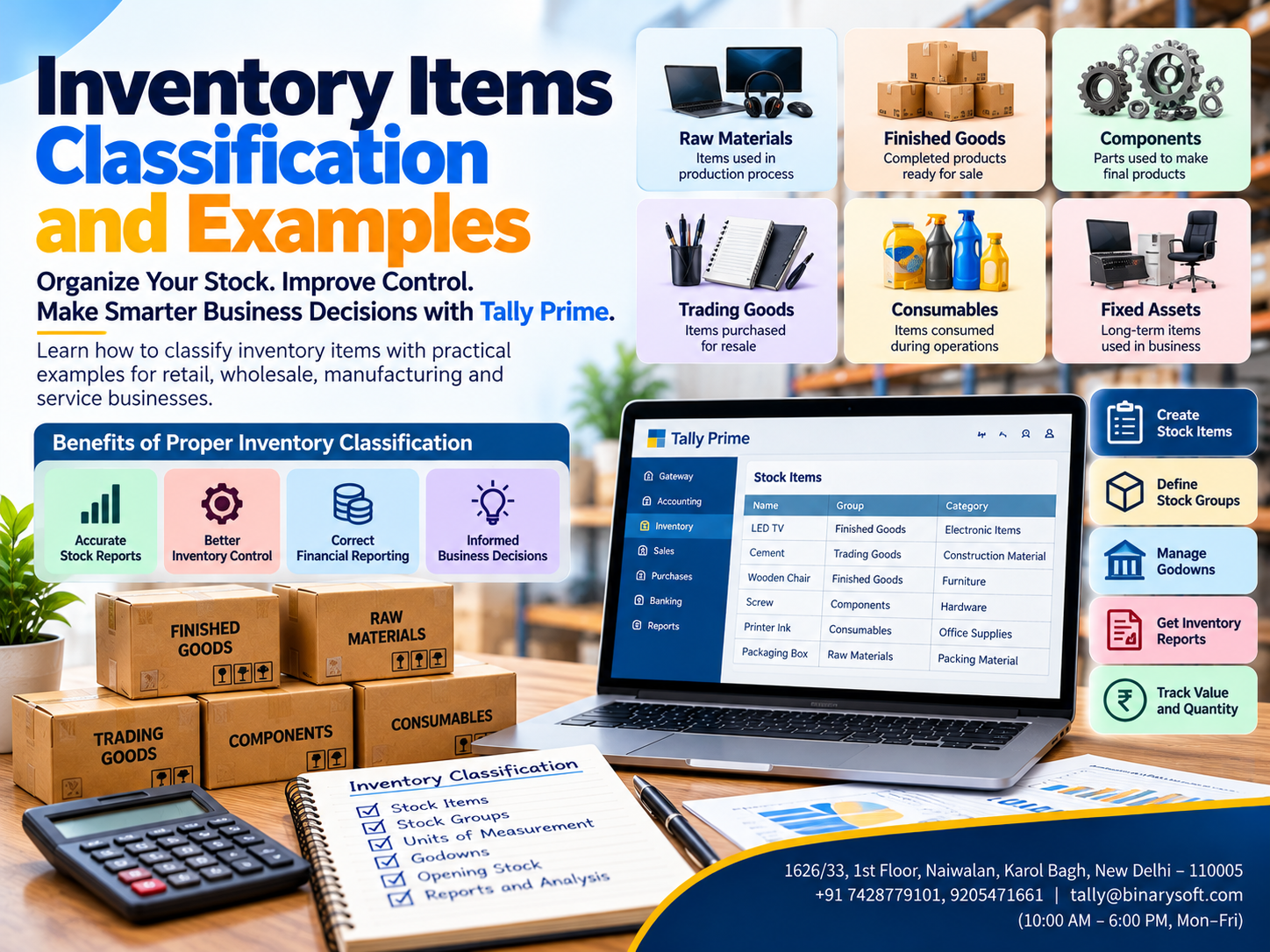
3. Main Types of Inventory Items
Raw Materials
Materials purchased for use in production, such as steel, timber, fabric, chemicals and electronic components.
Work-in-Progress (WIP)
Products that have entered production but are not yet complete, such as unfinished furniture or partially assembled machinery.
Finished Goods
Completed products ready for sale, such as packaged food, furniture, garments and manufactured equipment.
Trading Goods
Products purchased primarily for resale without substantial transformation, such as mobile phones, electrical appliances and packaged consumer products.
Consumables and Maintenance Supplies
Items such as lubricants, cleaning chemicals, packaging supplies and maintenance materials used during operations.
4. Inventory Classification Examples by Industry
Different industries require different stock structures.
|
Industry
|
Inventory categories
|
Examples
|
|---|
|
Retail
|
Trading goods
|
Clothing, footwear, electronics
|
|
Wholesale
|
Resale inventory
|
Cables, switches, hardware
|
|
Manufacturing
|
Raw materials
|
Steel, fabric, plastic granules
|
|
Manufacturing
|
Work-in-progress
|
Partially assembled products
|
|
Manufacturing
|
Finished goods
|
Machines, furniture, garments
|
|
Pharmaceuticals
|
Batch-controlled goods
|
Medicines and healthcare products
|
|
Food processing
|
Ingredients and finished goods
|
Flour, oil, packaged snacks
|
|
Automotive
|
Components and spare parts
|
Bearings, filters, brake components
|
A business may use multiple classification methods simultaneously.
For example, a pharmaceutical distributor may group medicines by product category while also tracking batches and expiry dates.
5. ABC Inventory Classification
ABC analysis categorizes inventory according to its relative value or business importance.
The method is commonly based on annual consumption value:
Annual Consumption Value = Annual Quantity Consumed × Unit Cost
A items generally represent a relatively small proportion of inventory items but account for a large share of annual consumption value.
B items have moderate importance, while C items usually account for a smaller share of total value.
An illustrative distribution might be:
|
Category
|
Share of items
|
Share of annual consumption value
|
|---|
|
A
|
20%
|
80%
|
|
B
|
30%
|
15%
|
|
C
|
50%
|
5%
|
These percentages are examples rather than universal rules.
How ABC Classification Helps
Businesses can apply tighter purchasing controls and more frequent stock reviews to high-value A items.
B items may require regular monitoring, while C items can often be managed using simpler replenishment procedures.
ABC analysis supports better allocation of management attention.
6. Fast-Moving, Slow-Moving and Non-Moving Inventory
Inventory can also be classified according to movement frequency.
Fast-moving inventory includes products with frequent sales or consumption.
Slow-moving inventory consists of items with limited movement over a defined period.
Non-moving inventory refers to products that have not moved during the selected review period.
For example, a mobile accessories distributor may sell charging cables daily while certain older phone covers remain unsold for months.
Monitoring stock movement helps businesses identify overstocking, obsolete products and opportunities to improve working capital.
How Tally Prime Helps
Tally Prime provides inventory reports and stock movement information that businesses can use to examine item-level activity.
Management can analyze transaction histories and identify products requiring closer review.
7. Perishable and Non-Perishable Inventory
Some businesses must classify inventory according to shelf life.
Perishable items include food products, medicines and other goods that may deteriorate or expire.
Non-perishable items generally have a longer usable life, although they may still become damaged or obsolete.
For perishable inventory, batch identification and expiry-date monitoring can be important.
How Tally Prime Helps
Tally Prime supports batch-wise inventory functionality where configured.
Businesses can maintain relevant batch details and use available reports to improve stock identification.
However, expiry monitoring should be supported by appropriate operational checks and handling procedures.
8. Inventory Classification by Value and Criticality
Not all inventory items are equally important.
Some inexpensive components may be essential for completing production.
For example, a manufacturing company may hold a low-cost electronic component without which an expensive machine cannot be completed.
Therefore, classification based only on monetary value may be insufficient.
Businesses can combine ABC analysis with criticality-based methods such as VED:
-
Vital items are essential for operations.
-
Essential items are important but may allow limited flexibility.
-
Desirable items have comparatively lower operational criticality.
This approach is particularly useful for manufacturing and maintenance inventories.
9. Inventory Classification by Storage Location
Businesses operating multiple warehouses or godowns need location-wise inventory visibility.
For example, an electrical distributor may store cables in one warehouse, lighting products in another and small accessories at its retail counter.
Location-based classification helps employees identify where stock is stored and reduces confusion during dispatch.
How Tally Prime Helps
Tally Prime supports multiple godowns and location-wise inventory reporting.
Businesses can record stock movements between locations using suitable inventory vouchers.
This helps maintain more organized warehouse records.
10. Understanding Stock Items, Stock Groups and Stock Categories in Tally Prime
Tally Prime provides different inventory masters for organizing stock.
Stock Items: Individual products or materials maintained in the inventory system.
Stock Groups: Hierarchical classifications used to organize similar items.
Stock Categories: An additional classification dimension that can group items across stock groups.
Units of Measurement: Define how quantities are recorded, such as pieces, kilograms, metres or litres.
Godowns: Represent storage locations used for inventory tracking.
For example, an electrical business may create a stock group called Electrical Products and maintain separate items for LED bulbs, switches and cables.
It may also use stock categories to organize items by brand or another useful attribute.
A carefully designed master structure makes inventory reports easier to understand.
11. How to Create Stock Items in Tally Prime
Businesses should begin by enabling inventory features appropriate to their requirements.
Next, they can create stock groups and units of measurement.
Individual stock items should be created with clear names and appropriate classifications.
A typical stock item setup may include:
|
Field
|
Example
|
|---|
|
Stock item name
|
LED Bulb 12W
|
|
Stock group
|
Lighting Products
|
|
Stock category
|
LED Lighting
|
|
Unit
|
Nos
|
|
Opening quantity
|
100
|
|
Opening rate
|
₹120
|
|
Opening value
|
₹12,000
|
After creating stock masters, businesses can record purchase, sales and stock adjustment transactions.
Accurate item names and units are particularly important for preventing duplicate or incorrect records.
12. Inventory Valuation and Financial Reporting
Inventory classification supports organization, while inventory valuation determines the monetary value of stock.
Common valuation methods include FIFO and weighted average cost.
Under FIFO, earlier acquired inventory costs are assigned to goods issued or sold first.
Under weighted average, the cost of inventory is calculated using an average cost per unit.
The selected method affects closing stock and Cost of Goods Sold.
Businesses should use valuation methods permitted by their applicable accounting framework and apply them consistently.
How Tally Prime Helps
Tally Prime supports inventory valuation settings and stock reports.
Businesses can review inventory values and related accounting information based on recorded transactions and configuration.
13. Case Study One: Electrical Distributor Improves Stock Accuracy
Illustrative case study
A wholesale electrical goods distributor in Delhi maintained more than 1,000 stock items.
Products included wires, cables, switches, lighting equipment and electrical accessories.
Initially, employees recorded products using inconsistent names.
For example, similar cable specifications appeared under multiple item descriptions.
This created difficulties during purchasing, stock verification and order dispatch.
The Solution
The distributor introduced standardized stock item names, product groups and units of measurement.
Employees reorganized inventory records and used Tally Prime to maintain purchase, sales and stock transactions.
Warehouse staff also performed regular physical verification.
The Outcome
The improved process made stock identification easier and reduced confusion between similar products.
Management gained clearer visibility into available quantities and stock movement.
Key lesson: Accurate inventory classification begins with consistent product identification.
14. Case Study Two: Garment Manufacturer Organizes Production Inventory
Illustrative case study
A garment manufacturer in Noida produced shirts, trousers and uniforms for wholesale customers.
The company purchased fabric, buttons, zippers and packaging materials.
Its accounting team initially maintained raw material and finished goods records in separate spreadsheets.
Management struggled to identify material consumption and unfinished production quantities.
The Solution
The company classified inventory into raw materials, work-in-progress and finished goods.
It introduced stock groups for fabric, accessories and completed garments.
The team also implemented structured production and inventory records using suitable Tally Prime workflows.
The Outcome
The company developed a clearer view of material availability, production movements and finished goods quantities.
This helped management coordinate purchasing and production planning more effectively.
Key lesson: Manufacturing businesses benefit from separating inventory according to its stage in the production process.
15. Common Inventory Classification Mistakes
Businesses often create unnecessary complications through inconsistent inventory records.
One common mistake is creating duplicate stock items with slightly different names.
Another is using incorrect units of measurement.
For example, recording cable quantities sometimes in metres and sometimes in rolls without a defined conversion can distort stock balances.
Businesses may also incorrectly classify fixed assets as inventory.
Damaged goods, obsolete products and returned stock should be handled through appropriate procedures.
Regular master-data reviews and physical verification can help prevent these errors.
16. Inventory Classification vs Inventory Categorization
The terms classification and categorization are often used interchangeably.
However, businesses may apply them at different levels.
Classification commonly refers to organizing inventory according to broader business characteristics, such as raw materials, finished goods or movement value.
Categorization may refer to more specific product attributes, such as brand, size, colour or model.
For example, a retailer may classify televisions as trading goods and categorize them by screen size or manufacturer.
Both approaches can work together to improve inventory analysis.
17. How Inventory Classification Improves Working Capital
Inventory represents money invested in goods and materials.
Excess inventory can tie up funds that might otherwise be used for business operations.
Insufficient inventory can result in missed sales and production delays.
Classification helps management identify high-value products, slow-moving items and critical materials.
By reviewing these categories regularly, businesses can make more informed purchasing decisions.
Better inventory visibility supports working capital management, although actual financial improvements depend on demand, supplier terms and operational decisions.
18. Using Inventory Reports for Better Decisions
Inventory reports help businesses understand stock availability, movement and value.
Useful information includes opening quantities, purchases, sales, transfers and closing balances.
Management can also compare product categories and review inventory across storage locations.
How Tally Prime Helps
Tally Prime provides Stock Summary and other inventory reports.
Users can drill down into relevant item details and examine recorded transactions.
These reports can support purchasing, stock verification and inventory analysis.
19. Best Practices for Inventory Item Classification
Businesses should establish a clear inventory naming convention.
Each item should have a consistent unit of measurement and appropriate classification.
Stock groups should reflect meaningful business categories rather than unnecessary complexity.
Where relevant, businesses should maintain batch and godown details.
Physical stock should be verified periodically, and differences should be investigated before adjustments are finalized.
Employees should receive training on stock item creation and transaction entry.
Businesses should also review inventory classifications as new products and operational requirements emerge.
20. The Future of Inventory Management
Inventory management is becoming increasingly data-driven.
Businesses are exploring barcode-based identification, connected inventory systems, automated reporting and more accurate demand planning.
These developments can improve stock visibility and reduce repetitive administrative work.
However, technology depends on reliable product masters and accurate transaction records.
A business with poorly classified inventory may continue experiencing problems even after introducing advanced software.
For this reason, inventory classification remains a fundamental requirement for effective stock management.
Conclusion
Inventory items classification is essential for businesses that purchase, manufacture, store or sell physical products.
By organizing inventory into raw materials, work-in-progress, finished goods, trading goods and other relevant categories, businesses can improve stock visibility and financial accuracy.
Additional methods such as ABC analysis, movement-based classification and criticality analysis provide further insights into inventory performance.
Tally Prime supports structured inventory management through stock items, stock groups, stock categories, units of measurement, godowns and inventory reports.
For retailers, wholesalers, distributors and manufacturers, accurate classification can reduce confusion, support better purchasing decisions and improve inventory control.
The most important step is establishing consistent inventory records and maintaining them through regular verification.
Powered by Binarysoft Technologies
Authorized Tally Partner
Location: 1626/33, 1st Floor, Naiwalan, Karol Bagh, New Delhi – 110005, INDIA
Contact: +91 7428779101, 9205471661
Email: tally@binarysoft.com
Business Hours: 10:00 AM – 6:00 PM, Monday–Friday
Frequently Asked Questions
What is ABC inventory classification?
ABC analysis categorizes inventory according to relative value or importance, allowing businesses to focus attention on the most significant items.
How does Tally Prime help with inventory classification?
Tally Prime supports stock items, stock groups, stock categories, units of measurement and godowns for structured inventory management.
Why is inventory classification important for wholesalers?
It helps wholesalers organize large product ranges, identify available quantities and improve purchasing and dispatch processes.
How often should inventory classification be reviewed?
Businesses should review classifications periodically and whenever product ranges, storage arrangements or operational requirements change.
CA. Priya Tanvi specializes in accounting compliance, GST advisory, and business reporting for small and growing enterprises. She works with business owners to improve record-keeping and financial clarity. Her articles focus on practical compliance solutions and operational discipline.