Call CA Tally HelpDesk
+91 9205471661,
7428779101
Introduction: Why Small Businesses Need Smarter Inventory Forecasting
Imagine a retailer preparing for the festive shopping season.
Customers are visiting the store, enquiries are increasing, and demand for popular products is growing.
However, just when sales reach their peak, the most popular items run out of stock.
Customers leave disappointed, and potential revenue is lost.
Now consider the opposite situation.
A business purchases excessive inventory expecting strong demand, but sales remain lower than anticipated.
Products occupy valuable storage space, and working capital becomes trapped in unsold stock.
Both situations highlight the importance of inventory forecasting.
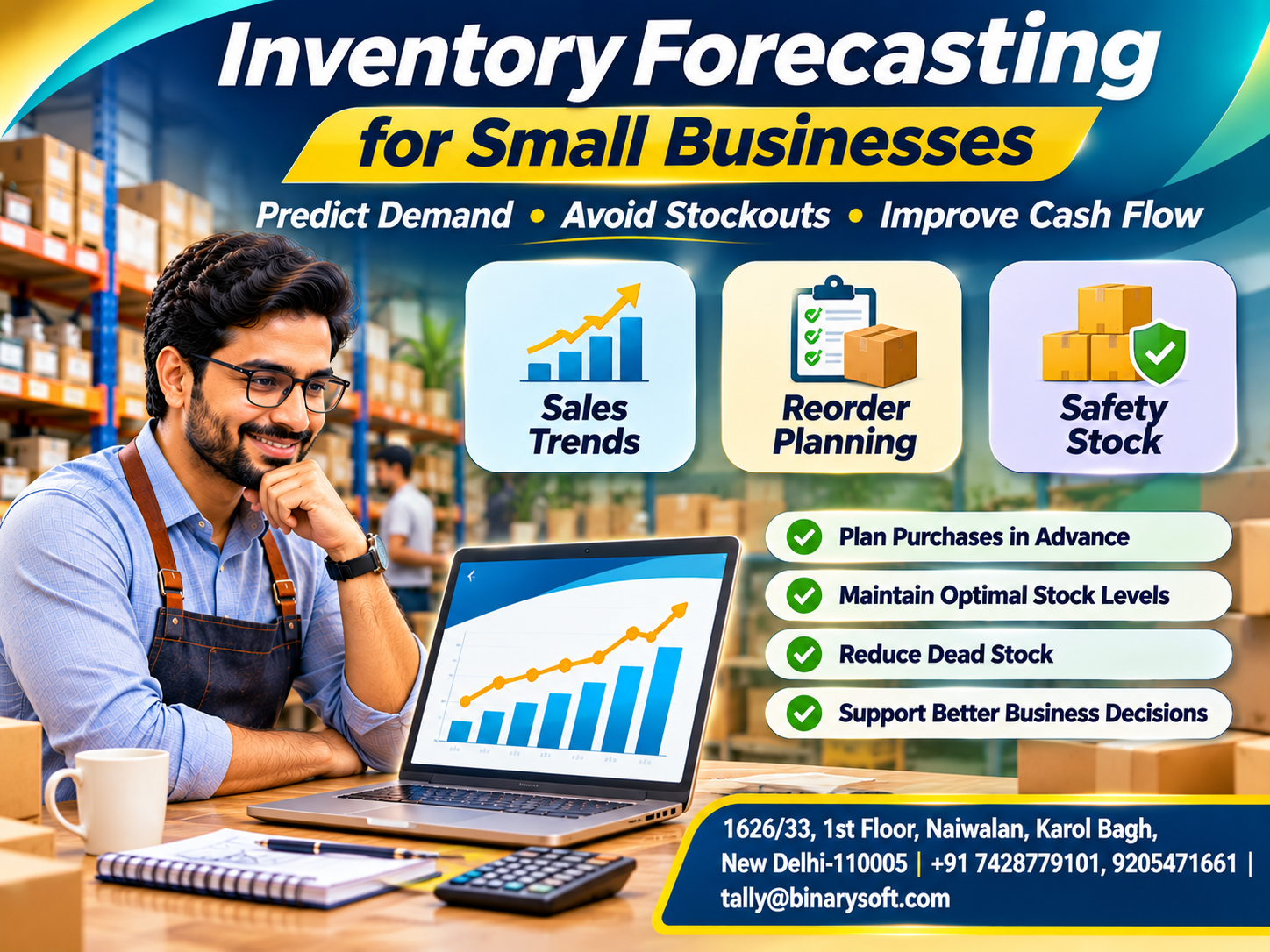
Inventory forecasting is the process of estimating future stock requirements using historical sales, demand patterns, supplier lead times and other relevant information.
For small businesses, accurate forecasting supports better purchasing decisions, reduces unnecessary inventory investment and improves customer service.
Tally Prime helps businesses maintain inventory records and analyse stock movements, providing useful information for forecasting and replenishment planning.
1. What Is Inventory Forecasting?
Inventory forecasting is a planning technique used to estimate how much inventory a business may need during a future period.
It involves analysing previous sales, expected customer demand, seasonal changes and supplier delivery schedules.
For example, a stationery retailer may experience increased notebook sales before the beginning of the academic session.
By reviewing previous sales and expected demand, the retailer can estimate future requirements.
Inventory forecasting helps answer three important questions:
How much stock will customers require?
When should additional inventory be purchased?
How much reserve stock should the business maintain?
Forecasting provides estimates rather than guaranteed outcomes.
Businesses should therefore review forecasts regularly and adjust them when conditions change.
2. Why Is Inventory Forecasting Important?
Small businesses often operate with limited working capital.
Purchasing too much inventory can restrict funds needed for salaries, rent and other expenses.
Purchasing too little can result in lost sales.
Inventory forecasting helps businesses balance these risks.
Prevents Stockouts
Forecasting helps identify likely demand before inventory becomes insufficient.
Reduces Excess Inventory
Businesses can avoid purchasing quantities that significantly exceed expected requirements.
Improves Cash Flow
Better purchasing decisions reduce unnecessary investment in stock.
Supports Customer Satisfaction
Maintaining suitable stock levels improves product availability.
Reduces Storage Costs
Lower excess inventory can reduce warehousing and handling expenses.
Improves Supplier Planning
Businesses can communicate anticipated requirements to suppliers earlier.
Supports Business Growth
Reliable inventory planning helps businesses manage increasing sales volumes more systematically.
3. How Inventory Forecasting Works
Inventory forecasting generally follows a structured process.
First, businesses collect historical sales information.
Next, they identify patterns such as increasing demand, seasonal fluctuations or declining product popularity.
They then review current inventory and outstanding purchase orders.
Supplier lead times are considered to determine when replenishment should begin.
Businesses may also include safety stock to protect against unexpected demand or delivery delays.
Finally, forecast estimates are compared with actual sales.
This comparison helps improve future planning.
A forecasting process should be practical enough for employees to maintain consistently.
4. Types of Inventory Forecasting Methods
Different methods suit different business requirements.
Qualitative Forecasting
This method relies on market knowledge, customer feedback and management experience.
It can be useful when historical data is limited.
Quantitative Forecasting
This method uses numerical information, such as previous sales quantities, to estimate future demand.
Trend-Based Forecasting
Businesses examine whether demand is increasing, decreasing or remaining stable.
Seasonal Forecasting
This method considers recurring demand patterns associated with festivals, weather or annual business cycles.
Moving Average Forecasting
A moving average uses recent sales observations to estimate future demand.
Demand-Driven Forecasting
Businesses incorporate available information about customer orders, promotions and market conditions.
Small businesses may combine several approaches rather than relying on one method.
5. Simple Moving Average Forecasting Formula
The moving average method is relatively easy to calculate.
Moving Average Forecast = Total Demand During Selected Periods ÷ Number of Periods
Suppose a retailer records the following monthly sales:
| Month | Units Sold |
|---|
| January |
120 |
| February |
150 |
| March |
180 |
| Total |
450 |
The three-month moving average is:
450 ÷ 3 = 150 units.
The business may use 150 units as an initial forecast for the next month.
However, this estimate assumes recent demand is reasonably representative.
If sales are increasing rapidly, a simple moving average may underestimate future demand.
Businesses should therefore consider trends and seasonal influences.
6. Understanding Reorder Levels
A reorder level indicates when a business should consider replenishing inventory.
A common simplified formula is:
Reorder Point = Average Daily Demand × Supplier Lead Time + Safety Stock
Suppose a business sells 20 units daily.
Its supplier requires five days to deliver new stock.
The business maintains 30 units as safety stock.
Reorder point:
(20 × 5) + 30 = 130 units.
When the relevant inventory position reaches approximately 130 units, the business should review replenishment.
For more accurate planning, inventory position should consider stock on hand, outstanding purchase orders and committed demand.
Reorder points should be updated when sales or supplier lead times change.
7. What Is Safety Stock?
Safety stock is additional inventory maintained to reduce the risk of shortages.
It provides a buffer against unexpected demand or supplier delays.
For example, a business expecting demand of 100 units during supplier lead time may maintain another 25 units as protection.
The safety stock requirement depends on demand variability, delivery reliability and the desired service level.
Maintaining excessive safety stock can increase inventory investment.
Maintaining too little may expose the business to stockouts.
Businesses should review safety stock periodically rather than treating it as a permanent fixed quantity.
8. An Emotional Story: The Shopkeeper Who Almost Lost His Biggest Customer
Rohit owned a small electrical accessories shop in Karol Bagh, Delhi.
His father had started the business with limited savings and a commitment to honest customer service.
Over the years, Rohit expanded the shop and began supplying electrical contractors.
One contractor had been purchasing materials from the family for nearly fifteen years.
During a busy construction season, the contractor placed an urgent order for several hundred electrical fittings.
Rohit confidently promised delivery.
However, when employees checked the warehouse, they discovered that the required stock was insufficient.
The supplier needed another week to deliver the remaining quantity.
The contractor was disappointed.
His project was already running behind schedule, and he could not wait.
He purchased the materials elsewhere.
That evening, Rohit sat quietly behind the shop counter.
He remembered how his father had built customer relationships through dependable service.
Losing an important order felt like losing part of that legacy.
His wife noticed his disappointment and asked what had happened.
Rohit explained that the business was growing, but purchasing decisions still depended largely on guesswork.
The next morning, he reviewed previous sales records with his accountant.
They identified fast-moving products, seasonal demand patterns and supplier delivery times.
Rohit introduced a weekly inventory review.
Popular items received reorder levels, and the team began monitoring expected demand before busy periods.
Over time, purchasing became more systematic.
Several months later, the same contractor placed another order.
This time, Rohit checked stock availability before confirming delivery.
The order was completed as promised.
When Rohit shared the news with his father, the older man smiled.
For Rohit, inventory forecasting was not merely about predicting product demand. It was about rebuilding customer trust and protecting the business his family had spent decades creating.
This fictional story illustrates why inventory planning matters beyond accounting figures.
9. How Tally Prime Helps with Inventory Forecasting
Tally Prime provides inventory management features that support demand analysis and purchasing decisions.
Stock Item Management
Businesses can maintain individual records for products and materials.
Sales History
Sales transactions provide historical information that can be analysed for demand patterns.
Stock Summary
The Stock Summary helps businesses review current quantities and values.
Reorder Levels
Supported inventory features allow businesses to maintain reorder information for suitable stock items.
Purchase Orders
Purchase order records help track planned procurement.
Godown Management
Businesses can review inventory across configured storage locations.
Inventory Reports
Stock movement and related reports provide information useful for replenishment planning.
These capabilities support inventory forecasting, although advanced statistical forecasting may require additional analysis or integrations.
10. How to Use Tally Prime for Inventory Planning
Small businesses can establish a practical workflow.
Step 1: Create Accurate Stock Masters
Maintain clear stock item names, units and classifications.
Step 2: Record Sales Consistently
Enter sales transactions accurately to build dependable historical data.
Step 3: Review Stock Reports
Examine current quantities and product movement.
Step 4: Identify Fast-Moving Products
Determine which items sell frequently and require regular replenishment.
Step 5: Analyse Historical Demand
Compare sales across weeks, months or seasonal periods.
Step 6: Review Supplier Lead Times
Estimate how long replenishment usually takes.
Step 7: Set Reorder Information
Configure appropriate reorder levels and quantities where supported.
Step 8: Review Purchase Requirements
Use inventory information to prepare purchasing decisions.
Step 9: Monitor Forecast Accuracy
Compare expected demand with actual sales and adjust assumptions.
The exact navigation and available settings may vary by software release.
11. Inventory Forecasting vs Inventory Management
Inventory forecasting and inventory management are closely related but different.
Inventory forecasting estimates future stock requirements.
Inventory management controls inventory purchasing, storage, movement and availability.
Forecasting helps businesses decide what they may need.
Inventory management helps businesses handle the stock they actually have.
For example, a retailer may forecast demand for 500 units next month.
Inventory management processes then help track purchases, receipts, sales and remaining quantities.
Both functions are important for maintaining suitable stock levels.
12. Seasonal Inventory Forecasting
Many Indian businesses experience seasonal demand.
Clothing retailers may see higher sales during festive periods.
Stationery businesses may experience increased demand before school sessions.
Air cooler distributors may see stronger demand during summer.
Seasonal forecasting involves comparing sales from relevant periods in previous years.
Businesses should also consider changes in customer preferences, pricing, promotions and local conditions.
For example, last year's festive sales may provide a useful reference, but they should not automatically determine this year's purchase quantity.
Seasonal forecasting is most effective when historical information is combined with current business knowledge.
13. Case Study One: Inventory Forecasting for a Retail Electronics Store
Illustrative Case Study
Business Background
A small electronics retailer sells mobile accessories, chargers and computer peripherals.
The Challenge
Popular products frequently run out of stock, while slow-moving accessories accumulate.
The Approach
The retailer reviews historical sales and current stock information in Tally Prime.
Products are classified according to sales movement.
Reorder levels are reviewed for frequently purchased items.
Supplier delivery times are included in purchasing decisions.
Expected Outcome
The business can improve stock availability and reduce unnecessary purchases.
Business Lesson
Forecasting becomes more useful when businesses combine sales history with stock visibility and supplier information.
14. Case Study Two: Inventory Forecasting for a Garment Wholesaler
Illustrative Case Study
Business Background
A garment wholesaler supplies clothing to several retailers.
The Challenge
Demand changes significantly across seasons and festivals.
The company sometimes purchases excessive quantities of products that become difficult to sell later.
The Approach
Management reviews historical sales by product category.
Seasonal demand patterns are documented.
Tally Prime is used to maintain stock and sales records.
Purchasing quantities are reviewed against expected demand and available inventory.
Expected Outcome
The wholesaler can make more informed seasonal purchasing decisions and improve working capital management.
Business Lesson
Seasonal forecasting requires both reliable historical information and awareness of changing customer preferences.
Both case studies are illustrative rather than verified customer results.
15. Common Inventory Forecasting Challenges
Small businesses may face several difficulties.
Limited Historical Data: New products may lack sufficient sales information.
Unexpected Demand Changes: Customer requirements can change suddenly.
Supplier Delays: Deliveries may take longer than expected.
Seasonal Variations: Demand may differ significantly throughout the year.
Inaccurate Stock Records: Incorrect inventory quantities undermine forecasts.
Changing Market Conditions: Competition, pricing and economic factors can influence demand.
Excessive Dependence on Guesswork: Informal purchasing decisions may create inconsistent stock levels.
Businesses should review forecasts regularly and avoid treating estimates as guaranteed outcomes.
16. How Inventory Forecasting Improves Cash Flow
Inventory represents money invested in goods that have not yet been sold or consumed.
Excess inventory can restrict funds needed for operating expenses.
For example, suppose a retailer purchases ₹5 lakh of additional stock but sells only a small portion during the expected period.
The remaining goods continue occupying working capital.
More disciplined forecasting can help the retailer purchase quantities that better reflect likely demand.
However, forecasting does not eliminate inventory risk.
Businesses must still consider minimum order quantities, supplier terms and uncertainty.
The objective is to balance product availability with responsible working capital management.
17. Understanding Inventory Turnover
Inventory turnover measures how frequently inventory is sold or used during a period.
A common formula is:
Inventory Turnover Ratio = Cost of Goods Sold ÷ Average Inventory Value
Suppose a business has annual cost of goods sold of ₹24 lakh.
Its average inventory value is ₹6 lakh.
Inventory turnover:
₹24 lakh ÷ ₹6 lakh = 4 times.
This indicates that the business turns over its average inventory approximately four times during the year.
Inventory turnover can support forecasting analysis, but it should not be used alone.
Different industries have different inventory requirements and operating cycles.
18. Best Practices for Small Business Inventory Forecasting
Businesses can improve forecasting through consistent procedures.
Maintain accurate stock and sales records.
Review demand at regular intervals.
Identify fast-moving and slow-moving products.
Consider supplier lead times before purchasing.
Maintain suitable safety stock.
Review reorder levels periodically.
Analyse seasonal demand patterns.
Monitor outstanding purchase orders.
Compare forecasts with actual sales.
Investigate significant differences.
Coordinate purchasing, sales and warehouse teams.
Avoid relying entirely on historical averages when market conditions change.
These practices help businesses make more informed inventory decisions.
19. How to Measure Forecast Accuracy
Forecast accuracy helps businesses understand whether their estimates are useful.
One simple measure is absolute forecast error.
Absolute Forecast Error = |Actual Demand − Forecast Demand|
Suppose a business forecasts demand of 200 units.
Actual demand is 180 units.
Absolute forecast error is 20 units.
The business can review why demand differed.
Possible reasons include pricing changes, competitor activity or seasonal variation.
Over several periods, businesses may use additional measures such as mean absolute error.
Forecast accuracy should be assessed across multiple periods rather than judging an entire process from one unusual month.
20. The Future of Inventory Forecasting for Small Businesses
Digital inventory systems are making historical stock and sales information easier to access.
Businesses are increasingly exploring automated reporting, forecasting models and analytical tools.
These technologies may help identify demand patterns and support purchasing decisions.
However, advanced forecasting tools still depend on accurate records and sensible assumptions.
For Tally Prime users, consistent inventory transactions, stock reports and reorder information provide a practical starting point.
Businesses requiring advanced forecasting may evaluate suitable analytical tools or integrations.
The most important principle remains unchanged: purchasing decisions should be informed by reliable data rather than guesswork alone.
Conclusion
Inventory forecasting helps small businesses estimate future stock requirements and make better purchasing decisions.
It can reduce stockouts, limit excess inventory, improve customer service and support working capital management.
Methods such as moving averages, seasonal analysis, reorder points and safety stock calculations provide practical forecasting tools.
Tally Prime supports inventory planning through stock records, sales history, purchase orders, reorder information and inventory reports.
However, accurate forecasting requires regular review and adjustment.
Businesses should combine software-generated information with supplier knowledge, market conditions and customer demand.
Successful inventory forecasting is not about predicting the future perfectly. It is about preparing the business to meet customer demand while using its resources wisely.
Powered by Binarysoft Technologies
Authorized Tally Partner
Binarysoft Technologies helps businesses improve accounting and inventory management through Tally Prime implementation, configuration, customization, technical support and cloud-based accounting solutions.
Our services support retailers, wholesalers, manufacturers and distributors seeking better stock visibility, purchasing discipline and inventory control.
Location:
1626/33, 1st Floor, Naiwalan, Karol Bagh, New Delhi – 110005, INDIA
Contact Us:
+91 7428779101, 9205471661
Email:
tally@binarysoft.com
Business Hours:
10:00 AM – 6:00 PM, Monday to Friday
Frequently Asked Questions
How does inventory forecasting improve cash flow?
It helps businesses avoid unnecessary stock purchases and reduce working capital tied up in excess inventory.
Is inventory forecasting useful for seasonal businesses?
Yes. Seasonal forecasting helps businesses prepare for predictable changes in demand during festivals, weather changes and other recurring periods.
Does Tally Prime automatically predict future demand?
Tally Prime provides inventory information and replenishment features. Advanced statistical demand forecasting may require additional analysis or suitable integrations.
How often should a small business review inventory forecasts?
The appropriate frequency depends on sales volume and demand variability. Fast-moving businesses may benefit from weekly reviews, while others may review forecasts monthly.
CA. Advait Chitale advises businesses on taxation, audit, and financial controls. He is passionate about helping organizations adopt technology-driven accounting solutions that enhance productivity and ensure regulatory compliance.