Call CA Tally HelpDesk
+91 9205471661,
7428779101
Introduction: Why Understanding Cost of Goods Sold Matters in 2026
A business may generate impressive sales and still struggle to earn a healthy profit. The reason is often hidden in the cost of purchasing, producing and delivering the goods it sells.
For retailers, wholesalers, distributors and manufacturers, understanding the Cost of Goods Sold (COGS) is essential for maintaining profitability. Without accurate cost calculations, business owners may set incorrect selling prices, underestimate inventory expenses or misunderstand their actual financial performance.
In 2026, Indian businesses face changing procurement costs, competitive pricing pressures, transportation expenses and increasingly complex inventory operations. These challenges make accurate cost accounting more important than ever.
COGS helps business owners identify the direct cost associated with products sold during an accounting period. It also plays an important role in calculating gross profit, inventory valuation and financial performance.
This guide explains COGS through simple formulas, practical examples and business scenarios. It also explores how Tally Prime supports inventory accounting, purchase management, cost monitoring and financial reporting.
A Business Owner's Story: Strong Sales but Disappointing Profits
Rohit owned a wholesale electrical accessories business in Delhi. Over several years, he developed relationships with retailers and contractors across the city.
His sales increased steadily, and customers appreciated his competitive pricing.
However, despite higher revenue, Rohit frequently struggled to maintain sufficient working capital.
He assumed that increasing sales would eventually solve the problem.
One evening, while reviewing his monthly accounts, he discovered that his purchasing costs had risen significantly. Freight charges were also increasing, but his selling prices had remained almost unchanged.
His accounting records showed sales revenue clearly, yet he had never carefully examined the direct cost of the products sold.
After reviewing opening inventory, purchases, direct costs and closing inventory, Rohit calculated his Cost of Goods Sold.
The results surprised him.
Several products that appeared profitable were generating much smaller margins than expected.
He began monitoring purchase costs, reviewing inventory valuation and adjusting pricing decisions using more accurate financial information.
He also introduced structured inventory accounting using Tally Prime.
Over time, Rohit gained greater confidence in understanding which products contributed to profitability.
This fictional story illustrates an important business lesson: higher sales do not automatically mean higher profits. Accurate cost information is essential for sustainable growth.
1. What Is Cost of Goods Sold (COGS)?
Cost of Goods Sold refers to the direct costs attributable to goods sold by a business during a particular accounting period.
For a trading business, COGS generally includes the purchase cost of goods sold and other directly attributable costs required to bring inventory to its present location and condition.
For a manufacturing business, it includes relevant production costs associated with finished goods sold.
COGS is recognized as an expense when the related inventory is sold.
For example, a retailer purchases a product for ₹800 and sells it for ₹1,200.
Ignoring other directly attributable costs, the COGS is ₹800 and the gross profit is ₹400.
COGS is important because it connects inventory costs with the revenue earned from selling those products.
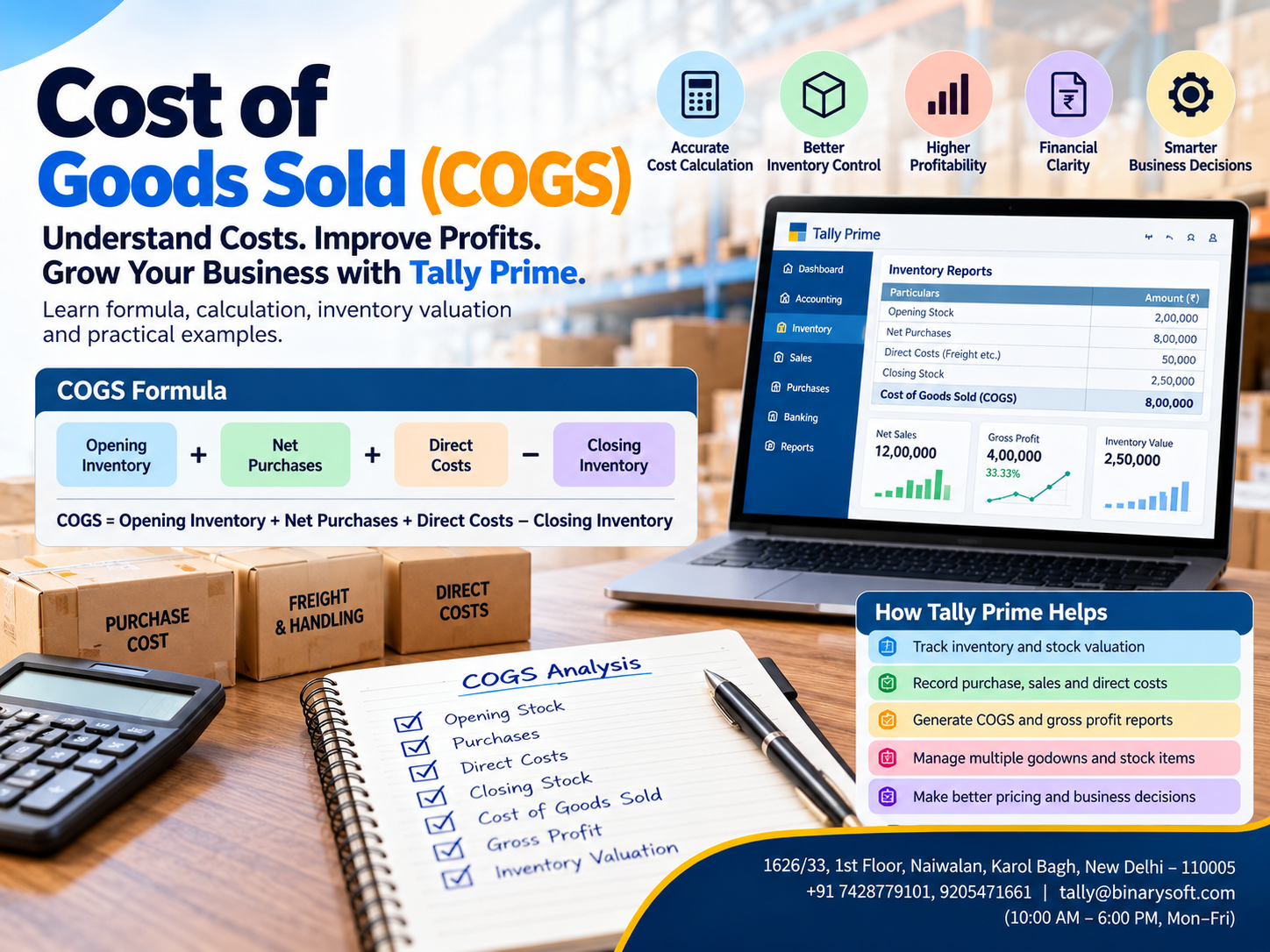
2. Cost of Goods Sold Formula
For a trading business, the basic formula is:
\[ \text{COGS}=\text{Opening Inventory}+\text{Net Purchases}+\text{Direct Costs}-\text{Closing Inventory} \]
Opening inventory represents the value of goods available at the beginning of the accounting period.
Net purchases represent inventory purchases after relevant purchase returns and discounts.
Direct costs include eligible expenses directly attributable to acquiring the inventory, such as inward freight.
Closing inventory represents the value of unsold goods remaining at the end of the accounting period.
The formula assumes that inventory quantities and values have been correctly recorded.
3. Practical Example of COGS Calculation
Consider a wholesale business with the following annual figures.
|
Particulars
|
Amount
|
|---|
|
Opening inventory
|
₹2,00,000
|
|
Net purchases
|
₹8,00,000
|
|
Direct inward expenses
|
₹50,000
|
|
Closing inventory
|
₹2,50,000
|
|
Cost of Goods Sold
|
₹8,00,000
|
Calculation:
COGS = ₹2,00,000 + ₹8,00,000 + ₹50,000 − ₹2,50,000
COGS = ₹8,00,000
If the business generates sales revenue of ₹12,00,000:
Gross Profit = ₹12,00,000 − ₹8,00,000
Gross Profit = ₹4,00,000
Gross Profit Margin = (₹4,00,000 ÷ ₹12,00,000) × 100
Gross Profit Margin = 33.33%
This means approximately ₹33.33 of gross profit is earned for every ₹100 of net sales before operating expenses.
4. What Costs Are Included in COGS?
The composition of COGS depends on the nature of the business.
For trading businesses, common components include the purchase cost of merchandise, non-recoverable purchase taxes and eligible inward transportation and handling costs.
For manufacturing businesses, relevant costs may include direct materials, direct production labour and allocated production overheads.
Examples include factory utilities, production-related depreciation and other costs incurred in converting raw materials into finished goods.
Recoverable GST is generally excluded from inventory cost when the business is entitled to claim the relevant input tax credit.
Correct cost classification is essential because overstating or understating COGS affects gross profit and inventory values.
5. Which Expenses Are Not Included in COGS?
Not every business expense should be included in Cost of Goods Sold.
General administrative salaries, office rent, marketing expenses, advertising and unrelated financing costs are normally treated separately.
Selling and distribution expenses generally do not form part of inventory cost.
For example, freight paid to bring purchased goods into a warehouse may qualify as an inventory cost, while delivery expenses incurred to distribute sold goods to customers are generally selling expenses.
The accounting treatment should follow the applicable accounting framework and the substance of the expense.
6. Difference Between COGS and Operating Expenses
COGS and operating expenses both reduce profitability, but they represent different types of business costs.
|
Cost of Goods Sold
|
Operating expenses
|
|---|
|
Directly related to goods sold
|
Related to general business operations
|
|
Includes eligible inventory acquisition costs
|
Includes office administration costs
|
|
Includes relevant production costs
|
Includes marketing and selling expenses
|
|
Used to calculate gross profit
|
Deducted after gross profit
|
|
Influenced by inventory valuation
|
Usually recorded as period expenses
|
Understanding this distinction helps business owners analyze product profitability separately from administrative efficiency.
7. COGS for Retail Businesses
Retailers purchase finished products and resell them to customers.
Their COGS primarily depends on the purchase cost of goods sold and relevant inventory acquisition expenses.
For example, a retailer purchases 100 units at ₹500 each and sells 70 units.
Assuming no other costs or valuation complications:
COGS = 70 × ₹500 = ₹35,000
Closing Inventory = 30 × ₹500 = ₹15,000
If the selling price is ₹750 per unit, revenue from 70 units is ₹52,500.
Gross Profit = ₹52,500 − ₹35,000 = ₹17,500.
How Tally Prime Helps
Tally Prime supports stock item management, purchase accounting, sales transactions and inventory reports.
Retailers can use these features to maintain product quantities, review stock values and analyze trading performance.
8. COGS for Manufacturing Businesses
Manufacturing companies calculate costs differently because they convert raw materials into finished products.
Their production costs may include direct materials, direct labour and manufacturing overheads.
A simplified cost of goods manufactured calculation is:
Cost of Goods Manufactured = Opening Work-in-Progress + Manufacturing Costs − Closing Work-in-Progress
The resulting production cost is then considered alongside opening and closing finished goods inventory to determine COGS.
For example, if opening finished goods are ₹1,00,000, cost of goods manufactured is ₹7,00,000 and closing finished goods are ₹1,50,000:
COGS = ₹1,00,000 + ₹7,00,000 − ₹1,50,000
COGS = ₹6,50,000
How Tally Prime Helps
Tally Prime supports inventory records, stock journals and manufacturing-related workflows, including bills of materials where configured.
Manufacturers can use these features to record material consumption, finished goods production and relevant inventory costs.
9. Inventory Valuation Methods and Their Impact on COGS
Inventory valuation determines how the cost of goods available for sale is allocated between COGS and closing inventory.
Two widely used methods are FIFO and Weighted Average Cost.
FIFO (First-In, First-Out)
FIFO assumes that the earliest purchased inventory is sold first for cost allocation purposes.
Consider these purchases:
|
Purchase
|
Quantity
|
Unit cost
|
|---|
|
First batch
|
100
|
₹100
|
|
Second batch
|
100
|
₹120
|
If 120 units are sold:
COGS = (100 × ₹100) + (20 × ₹120)
COGS = ₹12,400
Closing inventory consists of 80 units at ₹120, valued at ₹9,600.
Weighted Average Cost
Under the weighted average method:
Average Unit Cost = Total Inventory Cost ÷ Total Available Units
Average Cost = ₹22,000 ÷ 200 = ₹110
COGS for 120 units = 120 × ₹110
COGS = ₹13,200
Closing Inventory = 80 × ₹110 = ₹8,800
The selected valuation method affects reported COGS, closing stock and gross profit.
Businesses should use a method permitted by their applicable accounting framework and apply it consistently. Under Ind AS 2 and AS 2, FIFO and weighted average are generally accepted cost formulas for interchangeable inventories; LIFO is not permitted.
10. How COGS Affects Gross Profit and Pricing
COGS is directly related to gross profit.
\[ \text{Gross Profit}=\text{Net Sales}-\text{COGS} \]
Suppose a business generates net sales of ₹10,00,000.
If COGS is ₹7,00,000, gross profit is ₹3,00,000.
If purchasing costs increase and COGS rises to ₹8,00,000 without a corresponding increase in sales, gross profit falls to ₹2,00,000.
Interactive gross profit calculator
Gross profit
₹3,00,000
Gross profit margin
30.00%
COGS as a share of sales
70.0%
Illustrative calculation before operating expenses, interest and taxes.
Accurate COGS helps business owners establish selling prices, review product margins and identify opportunities for cost reduction.
11. How to Calculate and Monitor COGS in Tally Prime
Businesses can use Tally Prime to maintain inventory transactions and review cost-related information.
A practical workflow involves creating a company, enabling inventory features and setting up stock items with appropriate units of measurement.
Next, users record opening inventory, purchase invoices, inward expenses and sales transactions.
They should select suitable inventory valuation methods and ensure that purchase costs are correctly recorded.
Useful Tally Prime Reports
Stock Summary: Provides inventory quantities and values based on the configured valuation method.
Stock Item Vouchers: Helps examine inward and outward movements, consumption values and gross profit information.
Profit and Loss Account: Shows trading and financial results for the selected period.
Sales Reports: Help businesses review sales transactions and performance.
Accurate inventory valuation depends on correctly configured masters, complete transactions and regular stock verification.
12. Case Study One: Electrical Goods Distributor Reduces Costing Errors
Illustrative case study
A wholesale electrical goods distributor in Delhi purchased products from several manufacturers.
The company recorded sales accurately but did not consistently include inward transportation costs when evaluating product profitability.
As a result, management believed some products generated higher margins than they actually did.
The distributor introduced a monthly COGS review and standardized its inventory accounting procedures.
It began maintaining stock items, purchase entries and relevant direct expenses in Tally Prime.
Management also reviewed gross profit reports and compared purchasing costs across suppliers.
The improved process helped the company identify low-margin products and make more informed pricing decisions.
Key lesson: Accurate product profitability requires attention to both purchase prices and directly attributable inventory costs.
13. Case Study Two: Garment Manufacturer Improves Production Cost Visibility
Illustrative case study
A garment manufacturer in Noida produced shirts and uniforms for wholesale customers.
Its production team maintained material consumption records separately from financial accounting.
Management struggled to determine whether rising fabric costs were affecting product profitability.
The company introduced structured raw material records, production-related cost classification and periodic inventory reconciliation.
Using suitable Tally Prime inventory and manufacturing workflows, the business improved the organization of material consumption and finished goods information.
Management then reviewed production costs alongside selling prices to identify products requiring closer attention.
Key lesson: Manufacturing profitability depends on accurate material records, appropriate overhead allocation and consistent cost analysis.
14. Common Mistakes in COGS Calculation
Several mistakes can distort Cost of Goods Sold.
One common error is using an incorrect closing inventory value.
Another is failing to record purchase returns, inward expenses or inventory adjustments.
Businesses may also incorrectly include general administrative expenses in COGS or exclude relevant production costs.
Incorrect opening balances can affect the entire accounting period.
Inventory shrinkage, damage and obsolete stock require appropriate accounting treatment.
Regular physical verification and reconciliation help identify these problems.
15. How Businesses Can Reduce COGS
Reducing COGS does not necessarily mean choosing the cheapest supplier.
Businesses should evaluate product quality, supplier reliability, purchasing quantities and transportation costs.
Better demand forecasting can help reduce unnecessary stock accumulation.
Manufacturers may improve efficiency by monitoring material wastage, production processes and equipment utilization.
Retailers and wholesalers can analyze slow-moving inventory and negotiate purchasing terms.
The objective is to improve cost efficiency without compromising customer satisfaction or product quality.
16. COGS vs Cost of Sales
COGS and cost of sales are sometimes used interchangeably, but their meaning can differ depending on the business and accounting presentation.
COGS generally refers to the direct cost of inventory sold.
Cost of sales may be used more broadly to describe direct costs associated with generating revenue, including certain service-delivery costs.
For a professional services company, direct project labour may be part of the cost of delivering services even though the company does not sell physical inventory.
Businesses should maintain consistent accounting definitions when comparing financial results.
17. Why COGS Matters for Financial Planning
COGS affects gross profit, pricing decisions, inventory values and business forecasts.
A company that understands its cost structure can estimate the sales required to achieve target margins.
COGS analysis also supports supplier negotiations and purchasing budgets.
When combined with operating expense information, it helps management evaluate overall profitability.
However, COGS should not be analyzed in isolation.
Business owners must also consider cash flow, customer collections, inventory turnover and working capital requirements.
18. Inventory Turnover and COGS
Inventory turnover measures how efficiently a business sells and replaces inventory.
The formula is:
Inventory Turnover Ratio = COGS ÷ Average Inventory
Average Inventory = (Opening Inventory + Closing Inventory) ÷ 2
Suppose annual COGS is ₹12,00,000 and average inventory is ₹3,00,000.
Inventory Turnover = ₹12,00,000 ÷ ₹3,00,000
Inventory Turnover = 4 times
This means the business sells through an amount equivalent to its average inventory approximately four times during the year.
The appropriate turnover ratio depends on the industry, product characteristics and operating model.
19. How Tally Prime Supports Better Cost Control
Tally Prime provides a structured environment for recording purchases, sales, inventory movements and accounting transactions.
Businesses can review stock values, analyze gross profit and identify unusual inventory movements.
Inventory reporting also helps management examine product-level performance.
For manufacturers, relevant stock journal and material consumption processes support better production records.
When combined with periodic reconciliation and management review, these capabilities help organizations maintain more reliable cost information.
20. Best Practices for Accurate COGS Reporting
Businesses should maintain consistent inventory valuation policies and verify opening balances at the beginning of each accounting period.
Purchase invoices must be recorded accurately, including eligible directly attributable costs.
Physical stock should be checked periodically against accounting records.
Damaged, obsolete and missing inventory should be reviewed and adjusted according to applicable accounting policies.
Management should also compare gross profit margins across periods and investigate significant changes.
Most importantly, employees responsible for inventory and accounting should understand how their entries affect COGS and profitability.
Conclusion
Cost of Goods Sold is one of the most important financial measures for businesses that purchase, manufacture or sell products.
It helps determine the direct cost of goods sold, calculate gross profit and evaluate inventory performance.
Accurate COGS reporting depends on correct purchase records, appropriate cost classification, consistent inventory valuation and reliable closing stock information.
For Indian retailers, wholesalers, distributors and manufacturers, understanding COGS can improve pricing decisions and financial planning.
Tally Prime supports these activities through inventory accounting, purchase and sales records, stock valuation and financial reporting.
By combining accurate accounting practices with regular cost analysis, businesses can improve financial visibility and make more informed decisions about sustainable growth.
Powered by Binarysoft Technologies
Authorized Tally Partner
Location: 1626/33, 1st Floor, Naiwalan, Karol Bagh, New Delhi – 110005, INDIA
Contact: +91 7428779101, 9205471661
Email: tally@binarysoft.com
Business Hours: 10:00 AM – 6:00 PM, Monday–Friday
Frequently Asked Questions
Can manufacturers use the same COGS formula as retailers?
The overall principle is similar, but manufacturers must account for production costs, work-in-progress and finished goods inventory.
How often should businesses review COGS?
Businesses should review COGS regularly, ideally alongside monthly financial reporting, and investigate significant changes in product margins.
How does FIFO affect COGS?
FIFO allocates the cost of earlier purchased inventory to goods sold first. Its effect on COGS depends on changes in purchase costs.
Can Tally Prime help calculate COGS?
Yes. Its inventory valuation and reporting features help businesses determine consumption costs and analyze gross profit.
CA. Atharv Nambiar provides advisory services in accounting, audit, and taxation. He shares practical guidance on financial reporting, business controls, and technology adoption for modern organizations.









