Call CA Tally HelpDesk
+91 9205471661,
7428779101
Introduction: Why Every Growing Store Needs Better Management
Running a retail store is about much more than selling products.
Every day, business owners must manage customer purchases, supplier payments, inventory availability, employee responsibilities, billing and financial records.
When a store is small, these activities may appear manageable through notebooks, spreadsheets and manual calculations.
However, as sales increase and product ranges expand, manual processes become difficult to maintain.
Imagine a customer waiting at the billing counter while an employee searches for a product price.
Meanwhile, another customer asks whether an item is available, but nobody knows the exact stock quantity.
The owner is also worried about pending supplier payments and monthly expenses.
These situations highlight the importance of store management software.
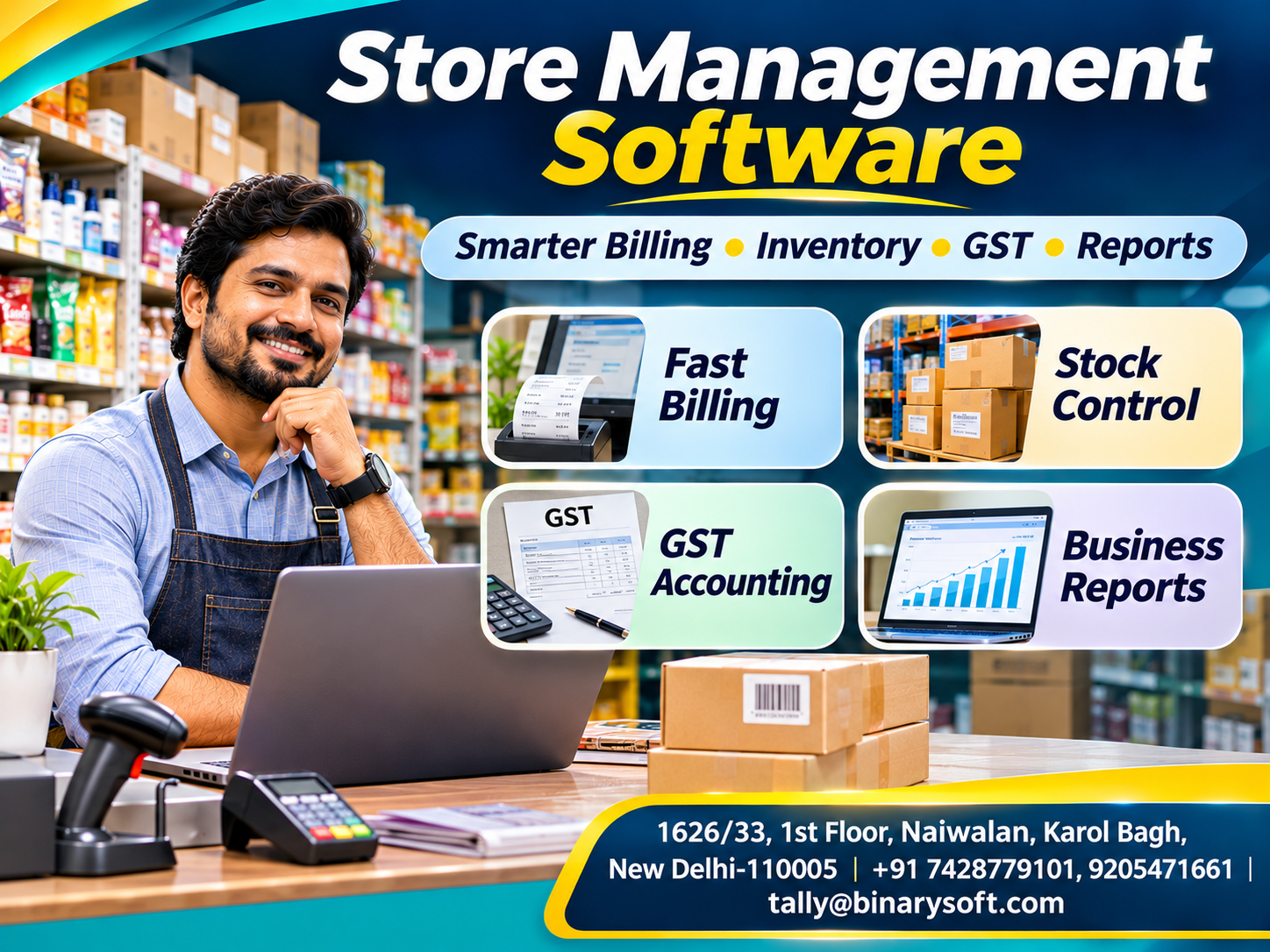
Store management software helps businesses organize daily operations through digital records and structured workflows.
For Indian retailers, wholesalers and distributors, Tally Prime provides accounting, billing, inventory and reporting features that support efficient store management.
1. What Is Store Management Software?
Store management software is a business application used to organize and monitor retail or wholesale operations.
Depending on the software, it may include sales billing, inventory tracking, purchase management, customer records, supplier accounts, tax calculations and financial reporting.
Its primary purpose is to reduce repetitive manual work and improve access to business information.
For example, a retail shop selling electrical accessories may maintain hundreds of products.
Instead of manually updating stock registers after every sale, employees can record transactions in a suitable inventory-enabled system.
The software then provides updated information based on the recorded transactions.
Store management software is useful for businesses that want better control over daily activities and financial performance.
2. Why Is Store Management Software Important?
Modern businesses must respond quickly to customer requirements.
Manual records can make it difficult to maintain accurate information as transaction volumes increase.
Store management software supports several important activities.
Faster Billing
Digital invoice preparation reduces repetitive calculations and manual paperwork.
Better Inventory Visibility
Business owners can review recorded stock quantities and values.
Organized Purchase Records
Supplier purchases and outstanding obligations can be monitored systematically.
Improved Customer Service
Employees can access relevant product and transaction information more efficiently.
Financial Transparency
Accounting reports provide information about sales, expenses, receivables and payables.
Better Business Decisions
Management can analyse business performance using reliable records.
These benefits depend on accurate data entry and appropriate software configuration.
3. Essential Features of Store Management Software
Different businesses require different capabilities.
However, several features are particularly useful.
Sales Billing: Preparing invoices and recording customer transactions.
Inventory Management: Maintaining stock quantities, product classifications and values.
Purchase Management: Recording supplier purchases and related transactions.
GST Accounting: Supporting tax calculations and compliance-related reporting.
Customer Management: Maintaining customer ledgers and outstanding balances.
Supplier Management: Monitoring purchase obligations and payment records.
Financial Reporting: Reviewing profitability and financial position.
User Access Control: Assigning suitable responsibilities and permissions.
Data Backup: Protecting important business information through appropriate backup procedures.
Businesses should evaluate these capabilities according to their actual operating requirements.
4. How Store Management Software Improves Billing
Billing is one of the most frequent activities in retail operations.
Manual billing can create problems when businesses handle numerous products or complex pricing arrangements.
A suitable billing system allows employees to select products, enter quantities and calculate invoice amounts.
Where configured, applicable taxes and discounts can also be recorded.
For example, a stationery retailer may sell notebooks, pens, folders and office accessories.
Digital billing helps maintain consistent transaction records.
Tally Prime supports sales invoices and POS-related billing workflows.
Businesses can configure appropriate stock items, customer details and tax information.
However, invoice accuracy still depends on correct product selection, pricing and tax configuration.
5. Inventory Management for Retail Stores
Inventory management is essential because stock represents money invested in goods.
Maintaining too much inventory can restrict working capital.
Maintaining too little can result in lost sales.
Store management software helps businesses review available stock and monitor inventory movement.
For example, an electronics shop may sell several models of chargers and headphones.
The owner needs to know which products are selling quickly and which remain unsold.
Tally Prime supports inventory accounting through stock items, stock groups, stock categories and stock reports.
These features help businesses organize inventory information and make more informed purchasing decisions.
6. Purchase and Supplier Management
Retail businesses depend on suppliers for product availability.
Poor purchase management can result in duplicate orders, delayed payments or unnecessary stock accumulation.
Store management software helps maintain purchase records and supplier information.
For example, a hardware retailer may purchase goods from ten different suppliers.
The owner needs to monitor purchase values, outstanding balances and expected deliveries.
Tally Prime supports purchase vouchers, supplier ledgers and purchase order workflows.
Businesses can use these records to improve procurement planning.
However, supplier performance and delivery reliability still require regular management review.
7. GST Billing and Accounting for Indian Stores
GST compliance is an important consideration for many Indian businesses.
Retailers and wholesalers must maintain appropriate tax records according to their registration status and applicable requirements.
Store management software can support tax-related invoice preparation and reporting.
Tally Prime provides GST accounting features, including relevant tax configurations and reports.
For example, a registered retailer may need to issue invoices containing applicable GST information.
Correct product classification, tax rates and party details remain essential.
Software can simplify recordkeeping, but businesses should verify their compliance obligations with qualified professionals.
8. An Emotional Story: The Shopkeeper Who Wanted to Save His Father's Business
Ramesh owned a small family-run grocery and household goods store in Delhi.
His father had opened the shop nearly thirty years earlier.
For many years, customers visited because they trusted the family.
Ramesh knew several customers by name and remembered their preferred products.
However, the business gradually became more complicated.
The number of products increased, suppliers changed, and daily transactions became difficult to manage.
Ramesh continued using notebooks for several activities.
One evening, a regular customer requested an urgent supply of household products.
Ramesh promised that everything would be available.
But when his employee checked the storeroom, several items were missing.
The stock register had not been updated correctly.
The customer was disappointed and purchased the products elsewhere.
That night, Ramesh sat behind the counter long after closing.
He remembered how his father had built the store through dependable service.
He worried that the business was losing the trust that had taken decades to establish.
His daughter, who had recently completed her studies, noticed his concern.
She suggested organizing billing, stock and accounting records through suitable software.
Initially, Ramesh hesitated.
He believed that digital systems would be difficult to learn.
However, he agreed to begin with a few essential processes.
The family reviewed product records, organized inventory and introduced digital billing.
Employees received training, and stock information was reviewed regularly.
Gradually, daily operations became more manageable.
Ramesh spent less time searching through notebooks and more time speaking with customers.
Several months later, the same customer returned.
This time, Ramesh checked the stock information before confirming the order.
The required products were available, and the transaction was completed smoothly.
That evening, Ramesh's daughter found him smiling behind the counter.
He told her that modernizing the business had helped him preserve the personal service his father valued.
For Ramesh, store management software was not simply a technological investment. It became a way to protect his family's livelihood and carry his father's legacy into the future.
This fictional story illustrates how organized business processes can support customer trust.
9. How Tally Prime Helps with Store Management
Tally Prime provides several features that support retail and wholesale operations.
Sales and Purchase Accounting
Businesses can record sales invoices, purchase transactions and related accounting entries.
Inventory Tracking
Stock item records and inventory reports help users review recorded stock quantities and values.
POS Billing
Supported POS workflows can assist businesses with retail billing requirements.
GST Accounting
Relevant tax configurations and reports support GST-related recordkeeping.
Customer and Supplier Ledgers
Businesses can monitor receivables, payables and transaction histories.
Financial Reports
Profit and Loss Account, Balance Sheet and other reports support financial analysis.
Godown Management
Businesses can maintain location-wise stock records where configured.
User Permissions
Appropriate security controls can help restrict access according to employee responsibilities.
These features make Tally Prime useful for many store accounting and inventory workflows.
10. How to Set Up Store Management in Tally Prime
Businesses can follow a structured implementation process.
Step 1: Create the Company
Enter the required company and financial information.
Step 2: Configure Accounting Features
Enable relevant accounting and inventory options.
Step 3: Create Stock Groups
Organize products into suitable classifications.
Step 4: Create Stock Items
Maintain clear product names, units and applicable details.
Step 5: Configure GST
Enter appropriate tax information where applicable.
Step 6: Create Customer and Supplier Ledgers
Maintain relevant party records.
Step 7: Record Opening Balances
Enter verified opening stock and accounting balances.
Step 8: Configure Billing
Set up appropriate sales invoice or POS workflows.
Step 9: Assign User Access
Provide employees with suitable permissions.
Step 10: Review Reports
Monitor sales, stock, receivables and payables regularly.
Exact navigation and available settings depend on the software release and enabled features.
11. Barcode-Based Billing for Retail Stores
Barcode scanning can simplify product identification during billing.
Businesses may associate barcode values with stock items and use compatible scanners in supported workflows.
For example, a supermarket employee may scan a packaged product instead of manually searching for its name.
This can reduce repetitive data entry.
However, barcode scanning should not be confused with complete warehouse automation.
Businesses requiring specialized label printing, mobile scanning or advanced warehouse processes may need additional tools or integrations.
Product identification and transaction accuracy remain important.
12. Customer and Supplier Account Management
Customer relationships are essential for long-term business success.
Stores offering credit sales need reliable information about outstanding customer balances.
Similarly, supplier payments must be monitored to avoid unnecessary delays.
Tally Prime supports customer and supplier ledgers, bill-wise details and relevant outstanding reports.
For example, a wholesale business may supply goods to several retailers on credit.
Management can review outstanding balances and follow up on overdue amounts.
Accurate ledger records help businesses manage cash flow and maintain professional relationships.
13. Case Study One: Store Management Software for an Electronics Retailer
Illustrative Case Study
Business Background
A Delhi-based electronics retailer sells chargers, cables, headphones and computer accessories.
The Challenge
Employees struggle to identify similar products during billing.
Stock records are inconsistent, and the owner has limited visibility into outstanding supplier balances.
The Approach
The business standardizes stock item records in Tally Prime.
Sales and purchase transactions are recorded consistently.
Inventory reports are reviewed regularly.
Customer and supplier ledgers are maintained systematically.
Expected Outcome
The retailer can improve transaction accuracy, stock visibility and financial recordkeeping.
Business Lesson
Store management becomes more effective when billing, inventory and accounting information are maintained consistently.
14. Case Study Two: Digital Store Management for a Garment Shop
Illustrative Case Study
Business Background
A garment retailer sells clothing in different sizes, colours and styles.
The Challenge
Similar product descriptions create billing confusion.
Seasonal inventory accumulates, and the owner struggles to understand product movement.
The Approach
The retailer creates appropriate stock item classifications.
Relevant size and colour variants are maintained consistently.
Sales records and inventory reports are reviewed in Tally Prime.
Purchasing decisions are compared with historical demand.
Expected Outcome
The business can improve product identification and make more informed inventory decisions.
Business Lesson
Accurate product classification and regular stock analysis are essential for retail store management.
Both case studies are illustrative rather than verified customer results.
15. How Store Management Software Improves Cash Flow
Cash flow is essential for paying suppliers, employees and operating expenses.
A business may generate strong sales but still experience financial pressure because of excessive inventory or delayed customer payments.
Store management software provides information that supports financial monitoring.
For example, a retailer may discover that substantial funds are invested in slow-moving products.
Management can review purchasing policies and inventory levels.
Tally Prime's accounting and inventory reports can support these decisions.
However, software does not automatically solve cash-flow problems.
Businesses must also manage credit policies, expenses and purchasing commitments.
16. Store Management Software vs Manual Recordkeeping
Manual systems may work for businesses with very few transactions.
However, their limitations become more noticeable as operations grow.
Digital systems can improve consistency and make information easier to retrieve.
For example, manually calculating daily sales totals may take considerable time.
A properly maintained accounting system can provide reports based on recorded transactions.
Digital systems also make it easier to review historical information.
However, businesses must maintain backups, appropriate access controls and reliable data-entry procedures.
The choice should reflect transaction volume, operational complexity and available resources.
17. How to Choose the Right Store Management Software
Businesses should evaluate several factors before selecting software.
Business Requirements: Identify essential billing, inventory and accounting needs.
Ease of Use: Consider employee training requirements.
Inventory Capabilities: Review stock tracking and reporting features.
GST Support: Confirm suitability for applicable compliance requirements.
Financial Reporting: Assess the available accounting information.
Security: Review user permissions and backup options.
Scalability: Consider future growth and additional users.
Support: Evaluate implementation and technical assistance.
Total Cost: Consider software, hardware, training and ongoing support expenses.
A structured evaluation helps businesses avoid unnecessary features or unsuitable systems.
18. Common Store Management Mistakes
Even with software, businesses may experience operational problems.
Common mistakes include incorrect stock item creation, missing purchase entries and inconsistent product classifications.
Employees may also use shared login credentials or fail to verify invoices.
Some businesses neglect regular inventory reconciliation.
Others assume that installing software automatically improves operations.
The effectiveness of store management software depends on how consistently employees use it.
Management should establish clear procedures and review reports regularly.
19. Best Practices for Efficient Store Operations
Businesses can improve store management through practical steps.
Maintain accurate product masters.
Record sales and purchases promptly.
Review stock availability regularly.
Monitor slow-moving products.
Reconcile physical stock with recorded quantities.
Maintain organized supplier and customer ledgers.
Review outstanding payments.
Use appropriate employee permissions.
Maintain regular data backups.
Train employees in billing and inventory procedures.
Review profitability and cash flow periodically.
These practices support reliable daily operations and informed management decisions.
20. The Future of Store Management Software
Retail operations are becoming increasingly digital.
Businesses are exploring integrated billing, inventory analytics, electronic payments and cloud-based access.
These technologies can improve access to business information and reduce repetitive work.
However, the value of any system depends on accurate records and suitable operating procedures.
Tally Prime provides accounting and inventory capabilities that support many retail business requirements.
Businesses with specialized needs, such as advanced loyalty programmes or e-commerce order synchronization, may evaluate additional applications or suitable integrations.
The objective is to create a reliable system that supports both customer service and financial control.
Conclusion
Store management software helps businesses organize billing, inventory, purchases, customer accounts, supplier records and financial reporting.
For retailers and wholesalers, digital systems can reduce repetitive manual work and improve operational visibility.
Tally Prime supports store management through sales and purchase accounting, inventory records, GST features, POS-related workflows and financial reports.
However, successful implementation requires accurate data entry, appropriate configuration, employee training and regular review.
Businesses should select software according to their actual needs and establish consistent operating procedures.
A successful store is not defined only by the number of products it sells. It is built on dependable customer service, accurate information and disciplined financial management.
Powered by Binarysoft Technologies
Authorized Tally Partner
Binarysoft Technologies helps businesses improve billing, accounting and inventory management through Tally Prime implementation, configuration, customization, technical support and cloud-based accounting solutions.
Our services support retailers, wholesalers, manufacturers and distributors seeking efficient store operations, better stock visibility and reliable financial records.
Location:
1626/33, 1st Floor, Naiwalan, Karol Bagh, New Delhi – 110005, INDIA
Contact Us:
+91 7428779101, 9205471661
Email:
tally@binarysoft.com
Business Hours:
10:00 AM – 6:00 PM, Monday to Friday
Frequently Asked Questions
Does Tally Prime support POS billing?
Tally Prime provides POS-related billing features for suitable retail workflows, subject to configuration and business requirements.
How does store management software help with GST?
It can support tax-related invoice preparation, accounting records and relevant reports when configured correctly.
Is store management software useful for small shops?
Yes. Small shops can benefit from organized billing, inventory records, customer balances and financial reporting.
How does store management software improve profitability?
It provides information that can help businesses identify costs, monitor inventory, manage receivables and make better operating decisions.
CA. Aarav Bhandari specializes in GST compliance, accounting systems, and business advisory services. He regularly writes about tax updates, accounting automation, and financial best practices to help businesses improve efficiency and maintain statutory compliance.