Call CA Tally HelpDesk
+91 9205471661,
7428779101
Introduction: Why Inventory Management Is Becoming More Important for Indian Businesses
Inventory management is no longer simply about counting products and recording purchases. For manufacturers, wholesalers, retailers and distributors, it directly influences profitability, customer satisfaction, working capital and business growth.
A business may generate impressive sales but still struggle financially because of excess inventory, misplaced products, delayed deliveries or inaccurate stock records.
As businesses manage more products, suppliers, warehouses and customer orders, traditional stock registers and disconnected spreadsheets become increasingly difficult to maintain.
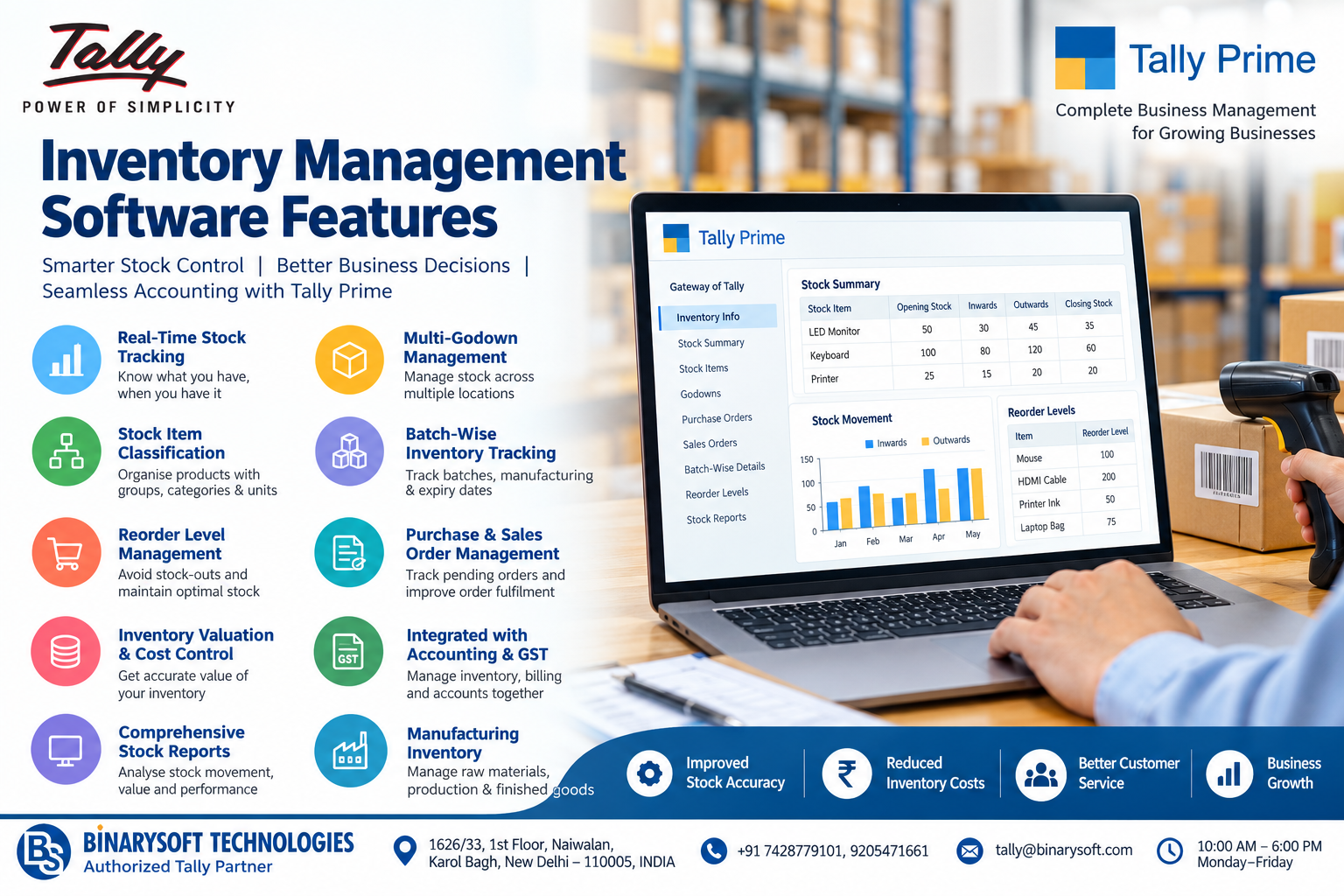
Modern inventory management software helps businesses monitor stock movements, calculate inventory values, identify shortages and connect inventory transactions with financial accounting.
For Indian businesses, Tally Prime provides practical inventory management capabilities alongside accounting, GST invoicing, purchase management and business reporting.
Understanding the most important inventory management software features helps business owners select appropriate systems, improve daily operations and make informed purchasing decisions.
A Story: How One Missing Stock Record Almost Cost a Business Its Biggest Customer
Rajesh operated a growing electrical goods distribution business in Delhi. His company supplied switches, cables, lighting equipment and electrical accessories to retailers and contractors.
For years, Rajesh relied on handwritten stock registers and spreadsheets.
Business was growing, but inventory management was becoming increasingly complicated.
One afternoon, a major customer placed an urgent order for electrical cables worth ₹4.5 lakh. The stock register showed sufficient inventory, so Rajesh confidently promised delivery the following morning.
However, when his warehouse staff began preparing the order, they discovered that a large quantity had already been dispatched against earlier invoices.
The stock register had not been updated.
Rajesh faced a difficult situation. His customer needed the materials urgently, and failing to deliver could damage a relationship built over several years.
He contacted multiple suppliers, arranged emergency transportation and purchased replacement stock at a higher price.
Although the order was eventually delivered, the business lost part of its expected profit.
More importantly, Rajesh realised that increasing sales without reliable inventory information could put his entire business at risk.
He decided to implement a structured inventory management system using Tally Prime.
Over time, his team began recording purchases, sales, stock transfers and warehouse movements through a connected accounting and inventory workflow.
The business gained better visibility into available stock, pending orders and product movement.
Rajesh learned an important lesson: successful inventory management is not only about knowing how much stock exists, but also knowing where it is, what it costs and when it needs replenishment.
This is an illustrative business story created to demonstrate common inventory management challenges.
1. What Is Inventory Management Software?
Inventory management software is a business application that helps organisations record, monitor, organise and analyse inventory across different stages of operations.
It maintains information about products, quantities, purchase costs, sales transactions, storage locations and stock movements.
Instead of depending entirely on manual stock registers, businesses can use inventory software to maintain a centralised record of their inventory activities.
An effective inventory management system generally supports:
-
Stock item creation and classification
-
Purchase and sales transaction recording
-
Warehouse and godown management
-
Batch-wise stock tracking
-
Inventory valuation and cost analysis
-
Reorder level monitoring
-
Stock movement and adjustment records
-
Inventory reports and financial integration
For growing businesses, these capabilities provide greater operational visibility and reduce the effort required to reconcile physical stock with accounting records.
2. Real-Time Stock Tracking and Inventory Visibility
One of the most valuable inventory management software features is the ability to monitor stock quantities as transactions are recorded.
Businesses frequently experience inventory differences because purchases, sales, returns and transfers are maintained separately.
An integrated inventory system updates stock balances when properly configured inventory vouchers are recorded.
How Tally Prime Helps
Tally Prime enables businesses to create stock items and record inventory movements through relevant vouchers.
For example, an electronics distributor can maintain:
|
Product
|
Opening Stock
|
Purchases
|
Sales
|
Closing Stock
|
|---|
|
LED Monitor
|
50
|
30
|
45
|
35
|
|
Keyboard
|
100
|
80
|
120
|
60
|
|
Printer
|
25
|
15
|
20
|
20
|
These quantities can be reviewed through stock reports.
This helps purchasing teams avoid unnecessary orders and allows sales teams to make better commitments to customers.
Stock information is updated as transactions are entered and synchronised within the relevant deployment; it should not be confused with automatic visibility into unrecorded physical movements.
3. Stock Item Classification and Organisation
Businesses often manage hundreds or thousands of inventory items.
Without proper classification, identifying products and analysing inventory becomes difficult.
Inventory management software should allow products to be organised using meaningful categories.
Important Classification Features
Stock Groups: Products can be grouped according to their categories, such as electronics, electrical accessories, hardware or stationery.
Stock Categories: Products can be classified across groups according to additional characteristics.
Units of Measurement: Businesses can maintain quantities in pieces, kilograms, litres, boxes, metres or other suitable units.
Stock Item Details: Each item can have a unique name, unit and applicable accounting or tax-related information.
Benefits in Tally Prime
Tally Prime supports stock groups, categories and units of measurement, helping businesses organise inventory systematically.
A hardware distributor can classify inventory into pipes, fittings, tools and electrical products while maintaining individual stock items for reporting.
This makes stock analysis more practical as the business expands.
4. Multi-Godown and Warehouse Management
Businesses operating from multiple warehouses require visibility into inventory at each location.
Without location-wise tracking, companies may purchase additional products even when sufficient stock exists in another warehouse.
Tally Prime Warehouse Features
Tally Prime supports godown or location-wise inventory management.
Businesses can maintain separate stock records for locations such as:
-
Main Warehouse – Delhi
-
Distribution Centre – Noida
-
Retail Outlet – Karol Bagh
-
Storage Facility – Gurugram
Stock transfers can be recorded using appropriate inventory vouchers.
This allows businesses to monitor available quantities by location and improve stock allocation.
For wholesalers and distributors, location-wise stock visibility helps reduce unnecessary transportation and purchasing.
5. Batch-Wise Inventory Tracking
Batch tracking is particularly important for pharmaceutical distributors, food businesses, cosmetics suppliers and other organisations handling batch-controlled products.
Different batches may have different purchase costs, manufacturing dates or expiry dates.
An inventory management system should help businesses distinguish between these batches.
How Tally Prime Supports Batch Management
Tally Prime provides batch-wise inventory capabilities, including manufacturing and expiry date tracking where configured.
For example:
|
Batch
|
Quantity
|
Expiry Date
|
|---|
|
MED-101
|
500
|
March 2027
|
|
MED-102
|
700
|
August 2027
|
|
MED-103
|
400
|
January 2028
|
A pharmaceutical distributor can use this information to review products approaching expiry.
Batch-wise tracking improves traceability and helps businesses reduce avoidable inventory losses.
However, businesses must establish suitable operational procedures to ensure that the correct batches are selected during dispatch.
6. Reorder Level Management and Stock Replenishment
Stock shortages can result in lost sales, delayed deliveries and dissatisfied customers.
Excess stock creates another problem by blocking working capital.
Reorder level management helps businesses maintain a practical balance between these situations.
Understanding Reorder Levels
A reorder level indicates the stock quantity at which a business should consider placing a new purchase order.
A commonly used calculation is:
Reorder Point = Average Daily Demand × Supplier Lead Time + Safety Stock
For example:
Average daily sales: 20 units
Supplier delivery time: 5 days
Safety stock: 40 units
Reorder point = (20 × 5) + 40 = 140 units.
When available inventory approaches 140 units, the purchasing team should review replenishment requirements.
Tally Prime Benefits
Tally Prime supports reorder level information and related stock analysis.
Businesses can use these reports to identify products requiring attention.
The calculation of reorder quantities should also consider supplier reliability, seasonal demand and storage capacity.
7. Purchase Order and Sales Order Management
Purchase orders and sales orders help businesses plan inventory movements before transactions are completed.
A purchase order records products requested from a supplier.
A sales order records products ordered by a customer.
Why Order Management Matters
Without structured order tracking, businesses may encounter duplicate purchases, missed customer orders or delivery delays.
Tally Prime supports purchase order and sales order processing.
Businesses can monitor pending orders and link relevant order details with subsequent inventory transactions.
For example, a furniture distributor receiving a customer order for 100 office chairs can review stock availability and pending supplier purchases before confirming delivery arrangements.
This improves coordination between sales, procurement and warehouse teams.
8. Inventory Valuation and Cost Control
Inventory valuation determines the monetary value of stock held by a business.
Accurate valuation is important for financial statements, profitability analysis and business decisions.
Common inventory valuation methods include FIFO, weighted average and other methods permitted by applicable accounting requirements.
Example of FIFO Valuation
A trader purchases:
100 units at ₹200 each.
100 units at ₹220 each.
The trader then sells 120 units.
Under FIFO, the assumed cost of goods sold is:
100 × ₹200 = ₹20,000
20 × ₹220 = ₹4,400
Total cost of goods sold = ₹24,400.
The remaining 80 units are valued at ₹220 each, giving a closing inventory value of ₹17,600.
How Tally Prime Helps
Tally Prime provides inventory valuation options and stock valuation reports.
Businesses can review inventory values and analyse product-related costs.
The selected valuation method should be appropriate for the business and applied consistently with relevant accounting standards.
9. Inventory Integration with Accounting and GST
Inventory and accounting should work together rather than operate as separate systems.
When businesses maintain stock records independently from financial accounts, reconciliation becomes time-consuming.
An integrated system connects inventory-related transactions with financial records.
Tally Prime Integration
Tally Prime combines inventory management with accounting and GST invoicing.
Businesses can record purchases and sales while maintaining relevant stock and accounting information.
This helps organisations analyse:
GST classifications, tax rates and HSN information must be configured accurately according to applicable requirements.
Integrated accounting reduces duplicate entry and makes financial reporting more efficient.
10. Stock Reports and Inventory Analysis
Inventory reports help businesses understand which products are selling, which products remain unsold and where working capital is invested.
Important reports include stock summaries, stock item movement reports, godown summaries, batch reports and inventory valuation statements.
Tally Prime Reporting Capabilities
Tally Prime provides stock summary and related inventory reports.
Business owners can analyse quantities, values and movements for selected stock items or categories.
For example, a retailer may discover that a particular product category generates strong sales while another category occupies valuable storage space without sufficient demand.
Such information helps businesses improve purchasing decisions and reduce slow-moving stock.
Inventory analysis becomes more useful when reports are reviewed regularly rather than only at financial year-end.
11. Manufacturing Inventory and Material Consumption
Manufacturers require inventory management beyond simple purchases and sales.
They must monitor raw materials, production consumption, finished goods and sometimes intermediate products.
A manufacturing business may use different materials to produce a single finished product.
Tally Prime for Manufacturers
Tally Prime supports manufacturing-related inventory records, including bills of materials and manufacturing journal workflows.
A furniture manufacturer can define the materials required to produce a table, such as wood, screws and fittings.
When production is recorded correctly, the relevant material consumption and finished goods quantities can be reflected in inventory records.
This helps manufacturers understand material requirements and maintain better control over production-related stock movements.
12. Inventory Adjustment and Physical Stock Verification
Differences between recorded stock and physical stock can occur because of damage, theft, incorrect entries, wastage or unrecorded movements.
Regular physical stock verification helps identify such discrepancies.
Inventory management software should support recording and investigating adjustments.
Tally Prime provides physical stock voucher functionality that can be used to record verified stock quantities and adjust inventory records where appropriate.
Businesses should establish an approval process before posting adjustments.
Maintaining supporting documentation also helps improve accountability and internal controls.
13. Barcode-Based Inventory Operations
Barcode systems can improve the speed and accuracy of product identification.
Retailers and warehouse operators frequently use barcode scanners to identify products during billing and stock handling.
Tally Prime can participate in barcode-based workflows through compatible hardware, item coding practices and suitable integrations or customisation.
However, advanced barcode generation, automated scanning workflows and specialised warehouse functions may require additional software or integration.
Businesses should evaluate their specific barcode requirements before selecting a solution.
14. Inventory Management with Tally on Cloud
Businesses with multiple offices or remote accounting teams may benefit from centrally hosted Tally Prime environments.
A properly configured Tally on Cloud deployment can allow authorised users to access the same business data from different locations through secure remote connections.
Important Advantages
Remote Access: Authorised staff can work with centrally hosted inventory and accounting data.
Multi-User Collaboration: Teams can perform different permitted activities using appropriate licensing and access controls.
Centralised Information: Businesses can maintain a common data environment rather than exchanging separate accounting files.
Backup Planning: Cloud deployments can support managed backup arrangements, depending on the provider and selected plan.
Security Controls: Access permissions, secure connectivity and suitable operational policies help protect business information.
Businesses should verify hosting performance, backup restoration arrangements, licensing and security requirements before deployment.
Case Study 1: Wholesale Distributor Improves Inventory Visibility
Illustrative case study
A wholesale electrical distributor in Delhi maintained approximately 2,500 stock items across two storage locations.
The business experienced frequent stock discrepancies and delays in preparing customer orders.
Employees maintained separate spreadsheets for purchases, sales and warehouse stock.
Management decided to introduce Tally Prime inventory management with structured stock groups and godown records.
Implementation
The business created stock items, defined units of measurement, enabled location-wise inventory records and introduced regular stock reconciliation.
Purchase and sales transactions were recorded through standardised workflows.
Results
The business gained clearer visibility into location-wise stock and could review stock movement reports more efficiently.
Purchasing decisions became better informed, and warehouse staff spent less time searching through disconnected records.
The case demonstrates how systematic inventory recording can improve operational control without requiring a highly complex warehouse system.
Case Study 2: Pharmaceutical Distributor Strengthens Batch Control
Illustrative case study
A pharmaceutical distributor supplied medicines and healthcare products to clinics and retail pharmacies.
The company handled products with different batches and expiry dates.
Previously, staff relied on manual batch registers, making it difficult to identify stock approaching expiry.
Implementation
The distributor introduced batch-wise stock tracking in Tally Prime.
Products were configured with appropriate batch information, and warehouse personnel were trained to record the correct batch during inward and outward transactions.
Management reviewed batch reports and introduced periodic physical verification.
Results
The business improved batch visibility and gained a more structured process for monitoring expiry-sensitive stock.
Warehouse and accounting teams could work with more consistent inventory records.
The experience highlights the importance of combining inventory software with disciplined warehouse procedures.
15. How to Set Up Inventory Management in Tally Prime
Businesses can begin with a structured implementation process.
Step 1: Create the Company
Create or open the company in Tally Prime and configure the applicable accounting and inventory features.
Step 2: Define Stock Groups
Organise products into meaningful categories such as electrical items, machinery, accessories or raw materials.
Step 3: Create Stock Items
Enter product names, units of measurement and relevant inventory information.
Step 4: Configure Godowns
Enable and create godowns or locations when warehouse-wise stock tracking is required.
Step 5: Configure Batches
Enable batch tracking for products requiring batch identification or expiry monitoring.
Step 6: Record Opening Stock
Enter verified opening quantities and values using appropriate stock item details.
Step 7: Record Daily Transactions
Maintain purchases, sales, returns, transfers and adjustments through relevant vouchers.
Step 8: Review Inventory Reports
Check stock summaries, pending orders, valuation reports and location-wise quantities regularly.
Step 9: Perform Stock Verification
Compare system records with physical quantities and investigate differences.
Step 10: Train Employees
Ensure that purchasing, billing, warehouse and accounting staff follow consistent inventory recording procedures.
The exact screens and options may vary depending on the installed Tally Prime release and enabled features.
16. How to Choose the Right Inventory Management Software
Businesses should evaluate software according to their operational requirements rather than selecting a solution solely because it offers many features.
Important considerations include the number of products, warehouse locations, transaction volume, batch tracking requirements, accounting integration, reporting capabilities and expected growth.
Retail businesses may prioritise fast billing and stock availability.
Wholesalers may require pending order tracking and multiple godowns.
Manufacturers may need material consumption records and production-related stock control.
Pharmaceutical distributors may prioritise batch and expiry management.
Tally Prime can be suitable for businesses seeking integrated accounting and inventory functionality.
Organisations requiring advanced warehouse automation, handheld scanning, complex picking routes or specialised manufacturing execution may need compatible extensions or dedicated systems.
17. Common Inventory Management Mistakes to Avoid
Even good software cannot produce accurate reports when transactions are recorded incorrectly.
Businesses should avoid entering purchases late, using inconsistent product names, overlooking stock transfers and failing to verify physical inventory.
Another common mistake is allowing unrestricted stock adjustments without proper review.
Businesses should also avoid maintaining multiple independent versions of the same inventory records.
A reliable inventory process depends on accurate master data, timely transaction recording, appropriate user permissions and regular reconciliation.
18. Future of Inventory Management for Growing Businesses
Inventory management is becoming increasingly connected with digital accounting, analytics and automated business processes.
Businesses are looking for better demand visibility, faster stock reporting and stronger coordination between procurement, sales and finance.
Technologies such as barcode scanning, cloud hosting, automated alerts and predictive analytics can improve inventory operations when implemented appropriately.
For small and medium businesses, the immediate priority should be establishing accurate stock records and reliable reporting.
Once these foundations are in place, additional automation can be introduced according to operational requirements.
Conclusion
Inventory management software plays an important role in improving stock accuracy, reducing unnecessary purchasing, strengthening customer service and protecting working capital.
Features such as stock classification, batch tracking, multi-godown management, reorder levels, inventory valuation and accounting integration help businesses maintain better control over daily operations.
Tally Prime provides a practical combination of inventory management, accounting, order processing, GST invoicing and reporting features for many Indian businesses.
However, successful implementation depends on accurate product records, employee training, regular stock verification and suitable operational controls.
For manufacturers, wholesalers, retailers and distributors, adopting a structured inventory management process can create a stronger foundation for sustainable business growth.
Powered by Binarysoft Technologies Authorized Tally Partner
Location: 1626/33, 1st Floor, Naiwalan, Karol Bagh, New Delhi – 110005, INDIA
Contact: +91 7428779101, 9205471661
Email: tally@binarysoft.com
Business Hours: 10:00 AM – 6:00 PM, Monday–Friday
Frequently Asked Questions
Why is Tally Prime useful for small and medium businesses?
Tally Prime combines inventory records with accounting, billing, GST-related transactions and business reports, helping organisations manage important operations without maintaining multiple disconnected systems.
How often should businesses verify physical stock?
Verification frequency depends on inventory value, product movement and operational risk. High-value or fast-moving products may require more frequent checks.
Which businesses benefit most from inventory management software?
Manufacturers, retailers, wholesalers, distributors, pharmaceutical suppliers, electronics businesses and other organisations handling physical stock can benefit from inventory management software.
Can Tally Prime inventory data be accessed through the cloud?
Yes. With an appropriately configured hosting environment, authorised users can remotely access centrally hosted Tally Prime data, subject to licensing and security arrangements.
CA. Aviraj Kothari focuses on business accounting, GST compliance, and management reporting. He helps businesses organize financial data and establish practical accounting processes for better visibility and smoother compliance.