Call CA Tally HelpDesk
+91 9205471661,
7428779101

Introduction: Why Learning Modern Accounting Skills Matters in 2026
A few years ago, knowing how to record purchases, sales and payments was often enough to begin a career in business accounting. Today, employers and entrepreneurs expect much more. Accountants must understand GST, digital invoicing, inventory control, banking transactions, financial reporting and the practical use of accounting software.
For small business owners, these skills are equally important. A single incorrect ledger entry can affect financial statements, while an unnoticed outstanding invoice can create unnecessary cash flow pressure.
In 2026, learning accounting software is no longer limited to students preparing for their first jobs. Retailers, wholesalers, manufacturers, service providers and experienced finance professionals are also developing digital accounting skills to improve efficiency.
A structured Tally Prime Learning Hub can help learners progress from basic accounting concepts to practical business operations.
This guide explains the essential subjects, recommended learning sequence, real-world applications and ways Tally Prime can support accounting education and business growth.
A Story of Determination: From Accounting Confusion to Professional Confidence
When Neha completed her commerce degree, she believed finding an accounting job would be straightforward.
She understood journal entries, ledgers and financial statements. However, during her first job interview at a distribution company in Delhi, the interviewer asked her to create a GST invoice, record a supplier payment and check customer outstanding balances using accounting software.
Neha knew the theory but struggled to perform the tasks.
She returned home disappointed, questioning whether her education had prepared her for practical accounting work.
Instead of abandoning her goal, she began following a structured learning plan. She practiced company creation, ledger management, voucher entries, GST configuration and inventory transactions using sample business data.
Every day, she completed a few practical exercises and checked the resulting reports.
Gradually, accounting concepts that once seemed complicated became easier to understand.
During a later interview, she confidently demonstrated sales entries, purchase accounting and outstanding reports.
Neha's experience is an illustrative story, but it reflects an important lesson: professional confidence develops when theoretical knowledge is combined with consistent practical learning.
1. What Is a Tally Prime Learning Hub?
A Tally Prime Learning Hub is a structured collection of educational resources designed to help individuals understand accounting concepts and perform business transactions using Tally Prime.
It may include beginner tutorials, practical exercises, topic-based lessons, accounting examples, business scenarios and troubleshooting guidance.
A well-organized learning program should cover fundamental concepts before introducing advanced accounting and compliance activities.
Important learning areas include:
-
Accounting fundamentals and bookkeeping
-
Company creation and configuration
-
Ledger and group management
-
Sales and purchase voucher entries
-
GST accounting and reporting
-
Inventory and stock management
-
Banking and reconciliation
-
Credit control and outstanding payments
-
Payroll and employee accounting
-
Financial statements and business reports
The purpose is not simply to memorize software menus. Learners should understand how every transaction affects the financial position of a business.
2. Understanding Basic Accounting Before Learning Software
Accounting software becomes easier to use when learners understand the underlying principles.
The first step is learning the meaning of assets, liabilities, capital, income and expenses.
Assets represent resources controlled by a business. Liabilities represent obligations, while capital reflects the owner's interest.
Income arises from business activities, and expenses are costs incurred in generating revenue.
Learners should also understand the accounting equation:
Assets = Liabilities + Equity
For example, when a business purchases furniture for cash, one asset increases while another decreases.
When goods are purchased on credit, inventory or purchases increase and a liability to the supplier is recorded.
Understanding these relationships helps learners identify incorrect entries and interpret financial reports.
How Tally Prime Helps
Tally Prime organizes transactions through ledgers, groups and vouchers.
Learners can record sample entries and immediately examine how those transactions affect accounting reports.
This connects classroom concepts with practical bookkeeping.
3. Getting Started with Tally Prime: Company Creation
Creating a company is one of the first practical exercises for beginners.
A company in Tally Prime represents the business entity whose accounting records will be maintained.
During setup, users enter relevant business information and establish the accounting period.
They may also configure financial year details, currency, taxation settings and other business features.
Practical Exercise
Imagine a business named Sunrise Electronics operating in Delhi.
The learner creates a practice company with an opening date, then configures the required accounting and inventory features.
Next, the learner creates ledgers for cash, bank accounts, sales, purchases, customers and suppliers.
This provides a foundation for recording transactions.
Learning Outcome
After completing this module, learners should understand company creation, basic configuration, accounting periods and the relationship between business masters and transactions.
4. Ledger Creation and Accounting Groups
Ledgers are essential components of accounting records.
A ledger stores transactions associated with a particular account, such as cash, bank, sales, purchases, rent or a customer.
Accounting groups determine how ledgers are classified in financial reports.
For example:
|
Ledger
|
Common group
|
|---|
|
Cash
|
Cash-in-Hand
|
|
Bank Account
|
Bank Accounts
|
|
Customer
|
Sundry Debtors
|
|
Supplier
|
Sundry Creditors
|
|
Office Rent
|
Indirect Expenses
|
|
Sales
|
Sales Accounts
|
|
Purchases
|
Purchase Accounts
|
Correct ledger classification is important because it affects the balance sheet and profit and loss statement.
How Tally Prime Helps
Tally Prime provides predefined accounting groups and allows users to create additional ledgers.
Learners can practice ledger creation, opening balances and account classification before entering business transactions.
5. Voucher Entry Training for Everyday Accounting
Voucher entries are central to practical accounting.
Different voucher types are used for different business activities.
Common examples include sales, purchases, payments, receipts, contra entries and journals.
Consider the following transactions:
|
Transaction
|
Amount
|
Common voucher
|
|---|
|
Cash sales
|
₹15,000
|
Sales
|
|
Credit purchases
|
₹40,000
|
Purchase
|
|
Office rent paid
|
₹12,000
|
Payment
|
|
Customer payment received
|
₹25,000
|
Receipt
|
|
Cash deposited into bank
|
₹20,000
|
Contra
|
Journal vouchers may be used for suitable adjustment entries, subject to the nature of the transaction.
How Tally Prime Helps
Learners can record these transactions and inspect the day book, ledgers and trial balance.
The software helps demonstrate how individual transactions flow into the overall accounting system.
6. Learning GST Accounting with Practical Examples
GST is an important subject for accountants working with Indian businesses.
Learners should understand GST registration, GSTIN, taxable value, input tax credit, HSN/SAC classification and the difference between intra-state and inter-state supplies.
For example, consider a taxable sale of ₹1,00,000 at an applicable GST rate of 18%.
For a qualifying intra-state transaction:
|
Particulars
|
Amount
|
|---|
|
Taxable value
|
₹1,00,000
|
|
CGST at 9%
|
₹9,000
|
|
SGST at 9%
|
₹9,000
|
|
Invoice total
|
₹1,18,000
|
For an inter-state transaction, IGST may apply instead.
Learners must understand that actual tax treatment depends on the supply, classification and current GST requirements.
How Tally Prime Helps
Tally Prime supports GST-related configuration, tax invoices and accounting reports.
Practical exercises can include GST sales invoices, purchase transactions, tax classifications and review of GST-related reports.
The objective is to develop the ability to recognize and correct mistakes rather than simply accept calculated tax values.
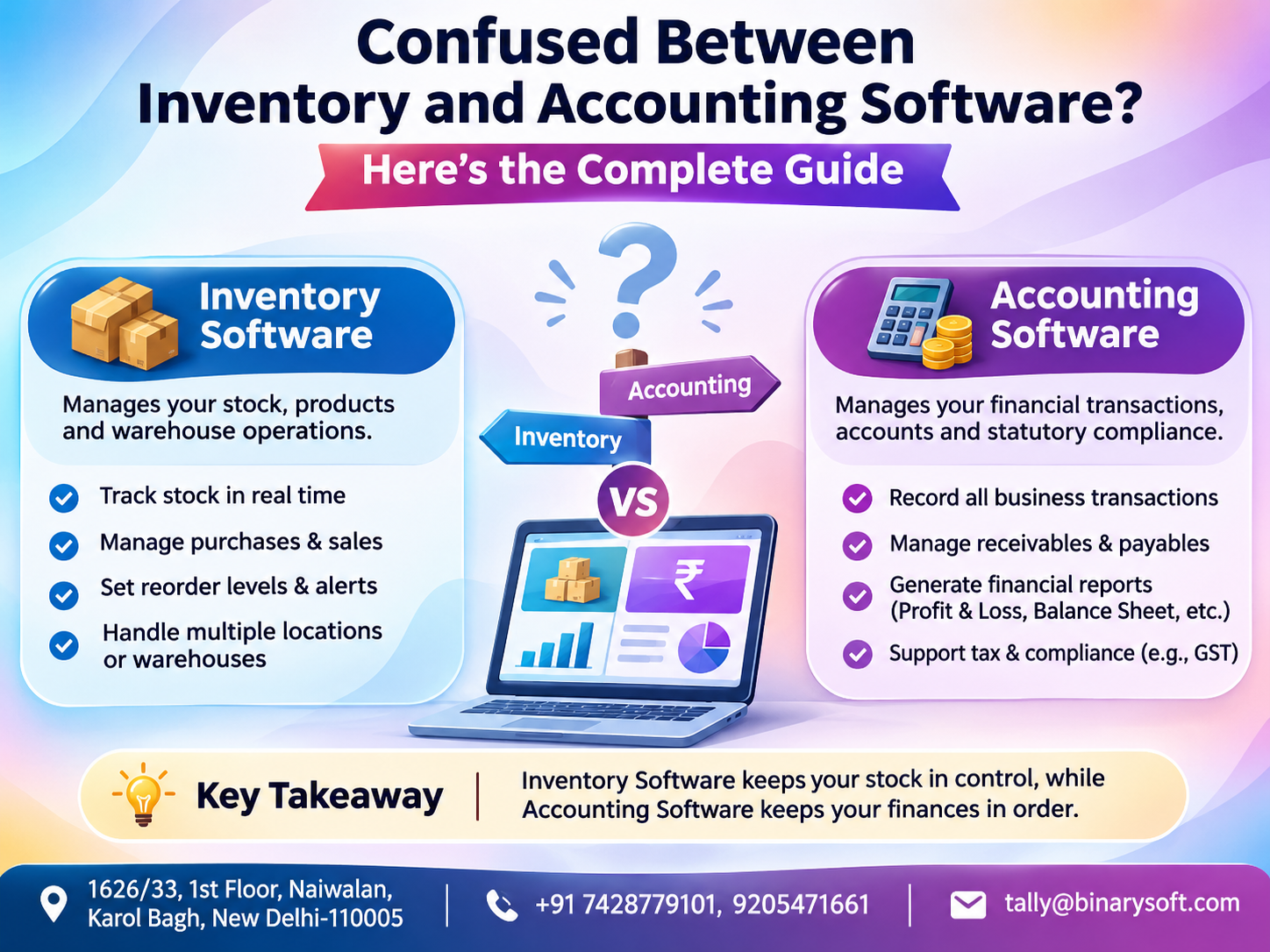
7. Inventory Management Training
Inventory accounting is particularly important for retailers, wholesalers, distributors and manufacturers.
Learners should understand stock items, units of measurement, stock groups, godowns and inventory valuation.
A basic inventory exercise may include:
|
Item
|
Opening
|
Purchases
|
Sales
|
Closing
|
|---|
|
LED Bulbs
|
100
|
80
|
120
|
60
|
|
Ceiling Fans
|
50
|
30
|
45
|
35
|
|
Switches
|
200
|
150
|
250
|
100
|
The basic stock calculation is:
Closing Quantity = Opening Quantity + Receipts − Issues
Returns, damages and transfers may require additional adjustments.
How Tally Prime Helps
Tally Prime supports stock masters and inventory vouchers, allowing learners to understand how purchase and sales transactions affect stock quantities.
Advanced learning can include batch management, godown-wise stock reports and inventory valuation methods.
8. Banking and Bank Reconciliation Training
Banking is a critical part of business accounting. Accountants regularly record deposits, withdrawals, supplier payments, customer receipts and bank charges.
Bank reconciliation helps identify differences between a company's accounting records and its bank statement.
For example, a business may issue a cheque that has not yet been presented to the bank. The transaction appears in the books but may not yet appear in the bank statement.
Learners should practice identifying such timing differences and recording missing transactions correctly.
How Tally Prime Helps
Tally Prime supports banking transactions and bank reconciliation processes. Depending on the version and supported banking services, users may also have access to additional bank-related capabilities.
Practical training should cover bank ledger creation, payment and receipt vouchers, reconciliation and the investigation of unmatched transactions.
9. Accounts Receivable and Payable Management
Customer collections and supplier payments are essential for maintaining healthy cash flow.
Accounts receivable represents money owed by customers, while accounts payable represents amounts owed to suppliers.
Learners should understand credit periods, due dates, invoice references and outstanding balances.
For example, a customer purchases goods worth ₹75,000 on 30-day credit. If the customer pays only ₹50,000, the remaining outstanding balance is ₹25,000.
How Tally Prime Helps
Tally Prime supports bill-wise accounting, customer outstanding reports and supplier payable tracking.
Learners can practice allocating receipts against invoices, reviewing ageing reports and identifying overdue payments.
These skills are valuable for accountants working in trading, distribution and service businesses.
10. Financial Reporting: Profit and Loss, Balance Sheet and Trial Balance
Financial reporting helps business owners understand performance and financial position.
The three essential reports beginners should learn are the trial balance, profit and loss statement and balance sheet.
The trial balance summarizes ledger balances and helps verify the equality of total debits and credits. However, a balanced trial balance does not guarantee that every transaction is correct.
The profit and loss statement measures income and expenses over a period.
The balance sheet presents assets, liabilities and equity at a particular date.
How Tally Prime Helps
Tally Prime generates financial reports from recorded accounting transactions.
Learners can examine ledger details, compare reporting periods and understand how corrections affect financial statements.
This builds analytical ability alongside software knowledge.
11. Payroll and Employee Accounting
Payroll management involves calculating employee earnings, deductions and net salary.
Important concepts include basic salary, allowances, overtime, statutory deductions and employer contributions.
Payroll training should also explain the importance of employee records, attendance information and applicable employment regulations.
How Tally Prime Helps
Where payroll functionality is enabled and configured, Tally Prime can support employee records, payroll vouchers and related reports.
Learners should practice payroll calculations using fictional employee data and verify statutory treatment against applicable requirements.
12. Learning Advanced Tally Prime Features
After mastering basic accounting, learners can progress to advanced business functions.
These may include cost centres, budgets, multiple godowns, batch-wise inventory, order processing, security controls, data backup and management reporting.
Advanced users should also learn how to identify incorrect ledger classifications, investigate reconciliation differences and verify opening balances.
For businesses using connected services, training may cover supported digital accounting and GST workflows.
The availability of particular capabilities depends on the installed release, configuration and relevant service requirements.
13. Case Study One: A Commerce Graduate Builds Practical Accounting Skills
Illustrative case study
A commerce graduate from Delhi had strong theoretical knowledge but limited experience with accounting software.
During interviews, the candidate struggled with practical tasks such as recording GST purchases, checking outstanding invoices and preparing financial reports.
The candidate followed a structured eight-week training program.
The first two weeks focused on company creation, ledgers and basic voucher entries. Subsequent lessons introduced GST, inventory, banking and financial statements.
By the end of the program, the learner had completed a fictional company's monthly accounting cycle.
The training improved the candidate's ability to explain accounting decisions and demonstrate software workflows during interviews.
Key lesson: Practical exercises and consistent revision help turn theoretical knowledge into workplace-ready skills.
14. Case Study Two: A Retail Business Improves Staff Accounting Knowledge
Illustrative case study
A retail business in Karol Bagh employed staff members who understood billing but had limited accounting knowledge.
Employees occasionally selected incorrect ledgers and failed to allocate customer receipts against outstanding invoices.
Management introduced a structured internal training program covering sales invoices, inventory entries, customer ledgers and daily reporting.
Employees practiced transactions in a separate training company before working with actual business records.
The business also introduced a daily checklist for transaction verification.
Over time, employees became more confident in reviewing their work and identifying discrepancies.
Key lesson: Accounting software delivers greater value when employees understand both the system and the financial principles behind their entries.
15. Recommended 30-Day Tally Prime Learning Plan
A structured learning schedule helps beginners avoid jumping between unrelated topics.
Accounting Fundamentals
Accounting principles, company creation, ledgers and voucher entries
GST and Inventory
GST configuration, tax invoices, stock items and purchase/sales entries
Banking and Reporting
Bank reconciliation, outstanding balances, trial balance and financial statements
Practical Business Project
Record a complete month of transactions, review reports and correct errors
Learners should allocate approximately 60–90 minutes daily to studying concepts and completing practical exercises.
16. Practical Assessment for Tally Prime Learners
A practical assessment is more useful than memorizing definitions alone.
A beginner-level exercise can involve creating a fictional company and completing the following activities:
-
Create five customer and supplier ledgers.
-
Record ten sales and purchase transactions.
-
Prepare GST invoices using sample taxable values.
-
Record payments, receipts and bank deposits.
-
Review closing inventory and outstanding balances.
-
Generate a trial balance, profit and loss statement and balance sheet.
Learners should compare their results against expected balances and investigate differences.
Completing a full accounting cycle provides a stronger understanding of how business transactions are connected.
17. Benefits of Learning Tally Prime for Different Users
For students, practical accounting training can improve familiarity with workplace processes and strengthen preparation for accounting-related interviews.
For accountants, it can support faster transaction processing, improved reporting and better reconciliation practices.
For business owners, understanding accounting software helps with reviewing cash flow, inventory, profitability and outstanding payments.
For entrepreneurs, these skills support more informed financial decisions and improved communication with accounting professionals.
Learning should remain continuous because accounting requirements, software releases and business processes change over time.
18. How to Make Accounting Training More Effective
Successful learning requires a combination of concepts, demonstrations, practice and review.
Beginners should use a fictional company so that mistakes do not affect actual business data.
Each lesson should explain the accounting principle, demonstrate the relevant transaction and provide a practical exercise.
Learners should also understand why an entry is correct instead of relying entirely on software calculations.
Regular assessments, error analysis and revision are essential.
Where possible, learners can practice realistic monthly accounting activities, including invoices, supplier payments, expenses, bank reconciliation and financial reporting.
19. Why Businesses Should Invest in Employee Training
Accounting errors can create operational delays and unreliable management information.
Employees who understand accounting principles and software procedures are better equipped to identify unusual balances and maintain accurate records.
Training can also support consistent billing practices, better customer service and more effective coordination between sales, inventory and accounts departments.
Businesses should combine training with documented procedures, appropriate user permissions and regular supervisory reviews.
Technology improves efficiency, but employee knowledge remains an important part of financial control.
20. The Future of Digital Accounting Education
Accounting education is increasingly focused on practical software skills, digital workflows and financial analysis.
Businesses need professionals who can do more than record transactions. They also need people who can interpret reports, investigate discrepancies and communicate financial information.
Structured learning resources make these skills more accessible to students, employees and entrepreneurs.
As accounting technology develops, continuous learning will help professionals adapt to new workflows and business requirements.
The strongest learners will combine accounting knowledge, software proficiency, compliance awareness and analytical thinking.
Conclusion
A structured Tally Prime Learning Hub can help beginners and experienced professionals develop practical accounting and business management skills.
From company creation and voucher entries to GST, inventory, banking, payroll and financial reporting, every learning module contributes to a broader understanding of business operations.
Students can use these skills to prepare for accounting roles, while business owners and employees can apply them to improve daily financial processes.
The most effective approach is to begin with accounting fundamentals, practice regularly and gradually progress toward advanced business scenarios.
With consistent training and practical experience, learners can develop greater confidence in managing accounting transactions and understanding business reports.
Powered by Binarysoft Technologies
Authorized Tally Partner
Location: 1626/33, 1st Floor, Naiwalan, Karol Bagh, New Delhi – 110005, INDIA
Contact: +91 7428779101, 9205471661
Email: tally@binarysoft.com
Business Hours: 10:00 AM – 6:00 PM, Monday–Friday
Frequently Asked Questions
What is the best way to become proficient in Tally Prime?
Follow a structured learning plan, complete regular practical exercises, review accounting reports and develop the ability to troubleshoot incorrect entries independently.
Can business owners benefit from learning Tally Prime?
Yes. Understanding the software can help business owners review financial reports, customer balances, inventory and business performance.
Is practical training important for accounting jobs?
Yes. Practical training helps learners apply accounting concepts, recognize errors and perform common workplace activities.
Does Tally Prime support inventory management training?
Yes. It provides practical opportunities to learn stock items, units, godowns, inventory vouchers and stock reporting.
CA. Vishal Mehta is a Chartered Accountant specializing in accounting compliance, GST advisory, and business process optimization. He has assisted businesses in transitioning to structured accounting and inventory systems. His articles focus on accuracy, compliance, and sustainable business growth.