Call CA Tally HelpDesk
+91 9205471661,
7428779101
Introduction: Why the Right Business Tools Matter More Than Ever
Running a business in India has become more demanding as customers expect faster invoices, accurate payments, transparent pricing and timely delivery. Business owners must simultaneously manage GST compliance, inventory, employee expenses, supplier payments and financial planning. Even a small error in a spreadsheet can create confusion, delay collections or affect business decisions.
In 2026, many growing businesses are reconsidering how they manage everyday financial activities. Instead of maintaining disconnected notebooks and spreadsheets, they are adopting structured business templates and integrated accounting systems.
Business tools and templates provide an affordable starting point. A properly designed invoice format, expense tracker or cash flow statement can make daily work more organized and reduce avoidable mistakes.
However, as transactions increase, manual templates can become difficult to maintain. This is where accounting software such as Tally Prime becomes valuable.
This guide explains essential business templates, their practical applications, common mistakes and how businesses can combine them with digital accounting to improve efficiency and financial control.
A Small Business Owner's Story: When One Spreadsheet Was No Longer Enough
Rajesh operated a wholesale electrical goods business in Delhi. During the early years, he maintained customer invoices in Excel, tracked stock in a notebook and recorded supplier payments in a separate register.
The arrangement worked while the business handled only a few orders each day.
As demand increased, problems began appearing. One customer received an invoice containing an incorrect quantity. Another payment was recorded twice. Meanwhile, Rajesh discovered that several fast-selling products were unavailable even though his spreadsheet showed sufficient stock.
The most difficult moment came when an important supplier requested payment for several overdue invoices. Rajesh believed the payments had already been cleared, but he could not immediately verify the records.
His business was growing, yet he was spending more time correcting records than serving customers.
He started by standardizing invoice templates, stock registers, purchase orders and payment trackers. This helped create discipline in daily operations. Later, he moved his accounting and inventory records into Tally Prime.
Instead of checking multiple files, he could review transactions and outstanding balances through connected reports.
Rajesh's story is an illustrative example, but the challenge is common: business growth creates a need for better information management.
1. What Are Business Tools and Templates?
Business tools are systems, applications or structured resources that help organizations perform everyday activities efficiently.
Business templates are predefined formats used to record, calculate, organize and present business information.
Templates may be created using Excel, Word, Google Sheets, PDF documents or accounting applications.
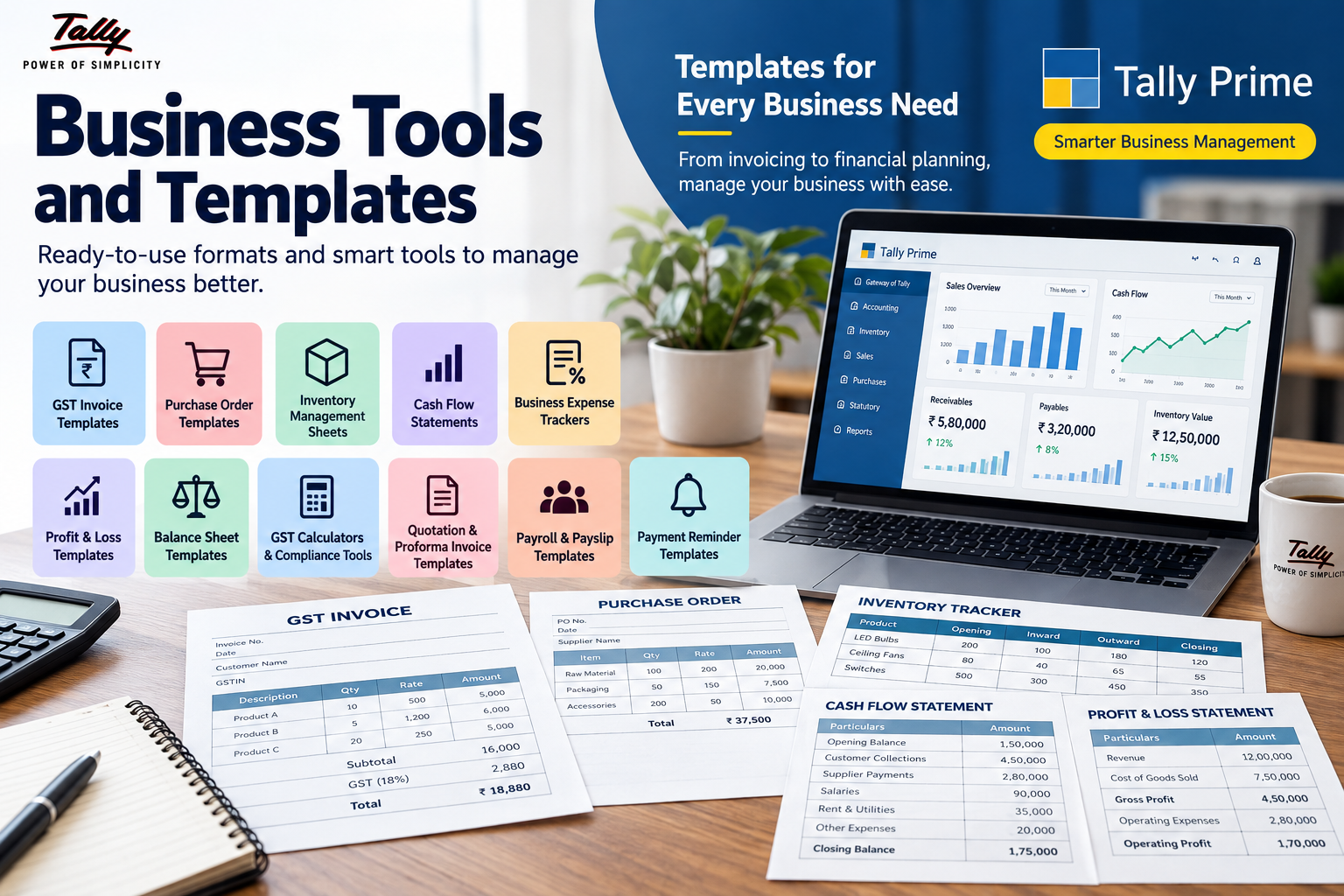
Common examples include:
-
Sales invoice templates
-
GST tax invoice formats
-
Purchase order templates
-
Inventory tracking sheets
-
Cash flow statements
-
Profit and loss statement formats
-
Business expense trackers
-
Payment reminder formats
-
Customer and supplier registers
-
Budget planning worksheets
A template provides a consistent structure, while accounting software can connect multiple activities within a common database.
For a newly established business, templates can be a practical starting point. For a growing organization, integrated systems usually offer better control over increasing transaction volumes.
2. GST Invoice Templates for Accurate Billing
A GST invoice is one of the most important documents for a registered business supplying taxable goods or services.
A well-designed invoice template should include relevant statutory and commercial details.
|
Invoice field
|
Purpose
|
|---|
|
Supplier name and GSTIN
|
Identifies the registered supplier
|
|
Invoice number and date
|
Supports transaction tracking
|
|
Customer name and details
|
Identifies the recipient
|
|
Customer GSTIN
|
Relevant for registered recipients
|
|
HSN or SAC
|
Classifies goods or services
|
|
Quantity and taxable value
|
Records the supply details
|
|
GST rate and tax amount
|
Calculates applicable tax
|
|
Invoice total
|
Shows the amount payable
|
The exact mandatory particulars depend on the applicable GST rules, invoice type and transaction.
How Tally Prime Helps
Tally Prime supports GST-oriented invoice preparation, tax calculations based on configured masters, and recording of sales transactions.
Businesses can use it to maintain customer ledgers, track receivables and generate accounting reports from recorded invoices.
This reduces the need to re-enter the same sales information into multiple spreadsheets.
3. Purchase Order Templates for Better Procurement
A purchase order is a formal document issued to a supplier describing the goods or services a business intends to purchase.
It commonly includes the supplier's details, item description, quantity, agreed price, delivery schedule and payment terms.
Purchase order templates help businesses avoid misunderstandings and maintain a documented purchasing process.
For example, a garment distributor ordering 500 shirts from a manufacturer can specify sizes, colours, delivery dates and unit prices.
How Tally Prime Helps
Businesses can use purchase order functionality in Tally Prime to record planned purchases and follow up on pending orders.
Where the relevant features are enabled, purchase orders can be linked with subsequent inventory and purchase transactions.
This improves visibility over procurement commitments and received quantities.
4. Inventory Management Templates for Stock Control
Inventory tracking is essential for wholesalers, retailers, manufacturers and distributors.
An inventory template generally records opening stock, inward quantity, outward quantity, closing stock and reorder levels.
Consider this example:
|
Product
|
Opening
|
Purchased
|
Sold
|
Closing
|
|---|
|
LED Bulbs
|
200
|
100
|
180
|
120
|
|
Ceiling Fans
|
80
|
40
|
65
|
55
|
|
Electrical Switches
|
500
|
300
|
450
|
350
|
The basic calculation is:
Closing Stock = Opening Stock + Stock Received − Stock Issued
Additional adjustments may be required for returns, damages, wastage and transfers.
How Tally Prime Helps
Tally Prime supports stock items, units of measurement, stock groups and inventory reports.
Depending on configuration, businesses can manage multiple godowns, batches and inventory valuation.
Sales and purchase transactions can update inventory records, reducing the need to manually revise separate stock spreadsheets.
5. Cash Flow Statement Templates for Financial Planning
Profitability and cash availability are not the same.
A business may record substantial sales while experiencing financial pressure because customers have not paid their invoices.
Cash flow templates help business owners understand cash receipts and payments over a selected period.
A simple monthly cash flow example is shown below.
|
Particulars
|
Amount
|
|---|
|
Opening cash balance
|
₹1,50,000
|
|
Customer collections
|
₹4,50,000
|
|
Supplier payments
|
₹2,80,000
|
|
Salaries
|
₹90,000
|
|
Rent and utilities
|
₹35,000
|
|
Other expenses
|
₹20,000
|
|
Closing cash balance
|
₹1,75,000
|
A cash flow template supports decisions about purchasing, expense control and upcoming financial commitments.
How Tally Prime Helps
Tally Prime provides financial reports, cash and bank balances, and receivables and payables information.
Businesses can use these reports to understand liquidity and identify payments that require attention.
6. Business Expense Tracking Templates
Small expenses can become significant when they are not monitored regularly.
An expense tracking template helps classify spending into categories such as rent, electricity, transport, salaries, advertising, repairs and office supplies.
Recording expenses consistently helps management understand where money is being spent.
It also supports budgeting and documentation for accounting and taxation.
How Tally Prime Helps
Expenses can be recorded under appropriate ledger groups in Tally Prime.
Business owners can review expense ledgers, compare spending across periods and examine the impact on profitability.
Instead of manually adding monthly totals, reports can be generated from the recorded transactions.
7. Profit and Loss Statement Templates
A profit and loss statement summarizes income and expenses over an accounting period.
It helps determine whether business operations have generated a profit or loss.
A simplified example:
|
Particulars
|
Amount
|
|---|
|
Revenue
|
₹12,00,000
|
|
Cost of goods sold
|
₹7,50,000
|
|
Gross profit
|
₹4,50,000
|
|
Operating expenses
|
₹2,80,000
|
|
Operating profit
|
₹1,70,000
|
The statement is useful for pricing decisions, cost control and performance analysis.
How Tally Prime Helps
Tally Prime can generate profit and loss reports from accounting entries.
Management can examine income and expense classifications, review periods and drill down into underlying transactions.
This makes financial analysis more practical than maintaining an independent profit calculation workbook.
8. Balance Sheet Templates for Financial Stability
A balance sheet presents the financial position of a business on a particular date.
It records assets, liabilities and owner's equity.
The basic accounting equation is:
Assets = Liabilities + Equity
A balance sheet template helps business owners review bank balances, outstanding loans, inventory, fixed assets and amounts payable.
For businesses applying for finance, accurate financial statements can also support discussions with banks and lenders.
How Tally Prime Helps
Tally Prime generates balance sheets using recorded accounting transactions. Businesses can examine individual ledger balances and compare financial positions across periods.
This provides a structured alternative to manually updating separate balance sheet worksheets.
9. GST Calculators and Tax Compliance Tools
GST calculations are important for businesses selling taxable goods and services.
A GST calculator helps estimate the tax amount, taxable value and invoice total.
For example, consider goods with a taxable value of ₹50,000 and an applicable GST rate of 18%.
|
Calculation
|
Amount
|
|---|
|
Taxable value
|
₹50,000
|
|
GST at 18%
|
₹9,000
|
|
Total invoice value
|
₹59,000
|
For an eligible intra-state supply, the tax may be split into CGST and SGST. An inter-state supply generally attracts IGST.
The correct tax treatment depends on the nature and place of supply, classification and applicable rules.
Useful supporting tools include GSTIN verification, HSN/SAC classification references, GST rate finders and return-related calculators.
How Tally Prime Helps
Tally Prime supports GST accounting and preparation of relevant GST reports. Supported connected services may assist with reconciliation and return-related activities, subject to software version, configuration and eligibility.
Businesses should verify current rates and statutory requirements before filing returns.
10. Quotation and Proforma Invoice Templates
Quotations and proforma invoices are important documents in the sales process.
A quotation communicates proposed prices and commercial conditions to a prospective customer.
A proforma invoice provides preliminary transaction details before the final tax invoice is issued.
These documents help customers understand expected costs and assist businesses in maintaining consistent pricing.
A professional quotation should contain product descriptions, quantities, prices, taxes where relevant, delivery terms, validity and payment conditions.
How Tally Prime Helps
Businesses can prepare quotations and proforma-style documents using appropriate features and configurations. Accepted transactions can subsequently be recorded through the regular sales and accounting process.
This helps maintain consistency between proposed commercial terms and final transactions.
11. Payroll and Payslip Templates
Employee payroll requires accurate records of earnings, deductions and net salary.
A payslip template commonly includes employee identification, pay period, basic salary, allowances, deductions and net pay.
A structured format improves transparency and reduces confusion about salary calculations.
How Tally Prime Helps
Tally Prime's payroll functionality, when enabled and configured, can help manage employee records, payroll calculations and related accounting entries.
Employers must separately ensure that statutory deductions and contributions are configured according to applicable requirements.
12. Revenue Forecasting and Business Liquidity Calculators
Revenue forecasting helps businesses estimate future sales using historical performance and reasonable assumptions.
A simple forecast may consider expected sales growth, seasonal demand, pricing changes and customer orders.
Business liquidity calculations help evaluate the ability to meet short-term financial obligations.
For example, the current ratio is calculated as:
Current Ratio = Current Assets ÷ Current Liabilities
A ratio of 1.5 indicates ₹1.50 in current assets for every ₹1 of current liabilities. However, the quality and liquidity of those assets also matter.
Forecasts and liquidity ratios are planning indicators, not guarantees of future performance.
How Tally Prime Helps
Tally Prime provides historical sales, financial and outstanding reports that can support forecasting.
Businesses can use exported data and management assumptions to develop more detailed financial projections.
13. Customer Payment Reminder Templates
Delayed customer payments can disrupt purchasing and daily operations.
A payment reminder template helps businesses communicate professionally about outstanding invoices.
It should include the customer's name, invoice reference, due date, outstanding amount and payment instructions.
A polite reminder can improve collection discipline without damaging customer relationships.
How Tally Prime Helps
Tally Prime supports bill-wise outstanding tracking and ageing analysis where properly configured.
Businesses can identify overdue invoices and use the information to prepare accurate customer communications.
14. Case Study One: Improving Wholesale Inventory and Billing
Illustrative case study
A wholesale electronics distributor in Delhi handled purchases from multiple suppliers and supplied products to retail outlets.
Initially, the company maintained separate spreadsheets for sales, purchases, inventory and outstanding payments.
This created several operational problems. Staff members occasionally used outdated product prices, and stock figures were not always updated after dispatches.
Management introduced standardized purchase order and invoice formats, then implemented integrated accounting and inventory processes using Tally Prime.
The company established item masters, customer ledgers, supplier accounts and a regular stock verification process.
As a result, employees could work with more consistent records, while management gained clearer visibility into stock availability and customer balances.
The important lesson is that templates establish a process, while connected accounting records can help maintain consistency as transaction volumes increase.
15. Case Study Two: Better Financial Planning for a Service Business
Illustrative case study
A small IT services company in Gurugram managed recurring customer invoices, employee salaries and operating expenses.
Although its sales were increasing, the business frequently experienced cash shortages.
The owner initially relied on a monthly expense spreadsheet and manually prepared revenue estimates.
A review revealed that several customers were paying significantly later than their agreed payment terms.
The company introduced formal quotation formats, payment tracking procedures, monthly cash flow forecasts and standardized expense categories.
It also began maintaining its accounting records in Tally Prime.
With improved visibility into outstanding receivables and operating costs, management could prioritize collections and plan expenditure more carefully.
The business learned that stronger financial management depends not only on sales growth but also on accurate records and timely cash collection.
16. How to Choose the Right Business Tools and Templates
Not every business requires the same tools.
A small retailer may prioritize invoices and stock registers, while a professional services firm may require quotations, timesheets and expense tracking.
Businesses should evaluate their requirements using five practical criteria.
Ease of use: Employees should understand how to complete and maintain the template.
Accuracy: Calculations and formulas must be tested to reduce errors.
Scalability: The process should remain manageable as transactions increase.
Compliance: Documents should support applicable legal and taxation requirements.
Integration: Information should be transferable or connected to accounting and management systems.
Businesses should also review data security, access controls, backup arrangements and ongoing maintenance.
17. Excel Templates vs Tally Prime: Which Is Better?
|
Feature
|
Excel templates
|
Tally Prime
|
|---|
|
Initial setup
|
Usually simple
|
Requires company and master setup
|
|
Invoice creation
|
Manual or formula-based
|
Integrated with accounting
|
|
Stock tracking
|
Requires regular updates
|
Transaction-linked inventory
|
|
GST calculation
|
Depends on formulas
|
Configurable tax calculations
|
|
Financial statements
|
Manual consolidation
|
Generated from entries
|
|
Outstanding tracking
|
Separate records
|
Bill-wise tracking
|
|
Error control
|
Depends on user checks
|
Structured entries and validations
|
|
Business reporting
|
Custom worksheets
|
Built-in reports
|
Excel remains useful for planning, custom analysis and small-volume tasks.
Tally Prime becomes especially valuable when businesses need connected records across billing, accounting, inventory and reporting.
The two approaches can also complement one another.
18. Practical Steps to Introduce Business Templates
Businesses should begin by identifying the activities that consume the most administrative time.
Common priorities include invoicing, purchase management, stock tracking, customer collections and expense recording.
The next step is to standardize essential documents and assign responsibility for maintaining them.
Employees should be trained to enter accurate information, verify calculations and follow consistent naming conventions.
Businesses can then review which activities would benefit from accounting software.
Before migrating data, it is important to clean customer and supplier records, reconcile opening balances, verify stock quantities and establish a backup procedure.
A phased implementation often reduces disruption and allows employees to adapt gradually.
19. Common Mistakes Businesses Should Avoid
Even well-designed templates can create problems when used incorrectly.
A common mistake is maintaining multiple versions of the same file. Employees may update different copies without realizing that the information has become inconsistent.
Another problem is relying on formulas without checking their accuracy.
Businesses should also avoid entering incorrect GST rates, overlooking customer payment terms and failing to reconcile stock records.
Sensitive business data should not be stored in publicly accessible documents without suitable controls.
Regular reviews, authorized access and dependable backups are essential to maintaining accurate business information.
20. The Future of Business Tools and Accounting Automation
Business management is moving toward more connected and data-driven operations.
Modern businesses increasingly expect their accounting systems to support faster invoicing, structured reporting, digital document handling and better financial visibility.
Automation can reduce repetitive data entry, but it does not eliminate the need for human verification.
Correct master data, accurate transactions and appropriate internal controls remain essential.
Businesses that combine disciplined processes with suitable technology are better positioned to respond to growth, changing customer expectations and evolving compliance requirements.
Conclusion
Business tools and templates play an important role in improving everyday operations.
From GST invoices and purchase orders to inventory registers, expense trackers and cash flow statements, structured formats help businesses organize information and make better decisions.
For startups and small enterprises, templates provide a practical foundation for financial discipline.
As businesses grow, integrated accounting software such as Tally Prime can help connect billing, inventory, financial records and reporting.
The goal is not simply to replace spreadsheets. It is to establish reliable processes that support accurate information, timely decisions and sustainable business growth.
With the right combination of templates, accounting systems and employee training, businesses can reduce administrative effort and concentrate more effectively on serving customers.
Powered by Binarysoft Technologies
Authorized Tally Partner
Location: 1626/33, 1st Floor, Naiwalan, Karol Bagh, New Delhi – 110005, INDIA
Contact: +91 7428779101, 9205471661
Email: tally@binarysoft.com
Business Hours: 10:00 AM – 6:00 PM, Monday–Friday
Frequently Asked Questions
When should a business move from spreadsheets to Tally Prime?
A business should consider integrated accounting software when manual records become difficult to reconcile, transaction volumes increase or management needs more timely and connected financial information.
Are business templates useful for service companies?
Yes. Service businesses can use quotations, proforma invoices, expense trackers, payment reminders, payroll formats and revenue forecasts.
Can business templates help reduce accounting mistakes?
Standardized templates can reduce inconsistent data entry and improve organization, provided users verify information and calculations regularly.
What is the benefit of a cash flow template?
A cash flow template helps businesses estimate available funds, plan upcoming payments and identify potential cash shortages.
CA. Tanishq Saraf works with traders and service businesses on GST compliance, ledger scrutiny, and accounting automation. His focus is on simplifying financial processes and improving the quality of business accounting records.