Call CA Tally HelpDesk
+91 9205471661,
7428779101
Introduction: Why Business Events and Professional Training Matter More Than Ever in 2026
A business can invest in modern accounting software, digital banking tools and advanced inventory systems, yet still struggle if employees do not understand how to use them effectively. In 2026, the increasing complexity of financial operations, GST compliance, customer expectations and business technology makes continuous learning an important part of sustainable growth.
For Indian entrepreneurs, accountants, retailers, distributors and manufacturers, professional workshops and training programs offer an opportunity to strengthen practical skills. Whether the subject is GST reconciliation, inventory valuation, cash flow management or Tally Prime, structured learning can help organizations reduce avoidable mistakes.
Business events also create opportunities to interact with experienced professionals, discuss operational challenges and understand emerging accounting practices.
However, the true value of an event is not simply attending a presentation. It comes from applying new knowledge to everyday business decisions.
This guide explains how to identify useful business events, organize employee training, develop accounting skills and make better use of Tally Prime to improve business operations.
1. Understanding Business Events and Professional Learning Programs
Business events are organized learning or networking activities designed to help professionals develop knowledge, exchange ideas and understand relevant industry practices.
These events may be conducted online, in person or through hybrid arrangements.
An accounting professional might attend a GST workshop to understand reconciliation procedures. A warehouse manager may participate in an inventory-management session, while a business owner may prefer training focused on profitability and working capital.
Common types of business learning events
Accounting workshops: Practical sessions covering bookkeeping, ledger management, financial statements and transaction recording.
GST training programs: Educational sessions on tax invoices, return preparation, reconciliation and applicable compliance requirements.
Software demonstrations: Guided introductions to accounting applications and business-management features.
Inventory workshops: Sessions covering stock tracking, valuation, warehouse management and inventory reporting.
Financial management webinars: Discussions about cash flow, customer outstanding balances, expenses and profitability.
Professional networking events: Opportunities for business owners, accountants and consultants to exchange practical experiences.
A well-planned learning calendar can combine several event formats to support employees with different responsibilities.
2. A Business Owner's Story: When One Training Session Changed Daily Operations
Amit managed a growing wholesale stationery business in Delhi. His company supplied products to schools, offices and local retailers.
Sales were improving, but accounting operations had become increasingly difficult.
His employees prepared invoices using familiar procedures, while inventory information was maintained through spreadsheets and handwritten notes.
At the end of every month, the accountant spent several days reviewing transaction differences.
Amit initially believed that hiring additional employees would solve the problem.
One day, he attended a practical business accounting workshop focused on integrated invoicing and inventory management.
During the session, he realized that several tasks performed separately in his office could be organized through a connected accounting process.
He also discovered the importance of configuring stock items correctly, reviewing customer outstanding reports and reconciling transactions regularly.
After returning to the office, Amit organized structured training for his employees.
Instead of changing everything immediately, the company improved one process at a time.
Within the following months, employees became more confident in recording transactions, reviewing inventory and preparing financial information.
For Amit, the most valuable lesson was simple: technology becomes more useful when people understand the processes behind it.
This is an illustrative story, not a documented customer experience.
3. Why Indian Businesses Should Maintain a Training Calendar
Many organizations conduct employee training only when problems occur.
An accountant may receive GST training after a reconciliation issue. A billing employee may learn new invoicing procedures only after making repeated mistakes.
A planned training calendar takes a more proactive approach.
It identifies important skills and provides opportunities to develop them before operational problems become serious.
Benefits of maintaining a training calendar
-
Better employee confidence and productivity
-
More consistent accounting procedures
-
Improved understanding of GST-related responsibilities
-
Reduced dependence on individual employees
-
Greater awareness of software capabilities
-
Better coordination between departments
-
More structured professional development
For example, a distributor may organize inventory training before expanding into another warehouse.
Similarly, a growing services company may conduct receivables-management training before introducing new customer credit arrangements.
Training becomes particularly valuable when it is connected to measurable business objectives.
4. GST Workshops: Building Stronger Compliance Knowledge
GST is an important area of professional learning for Indian businesses.
Accounting employees must understand how transactions are classified, how tax invoices are prepared and how relevant records support return filing.
Regulatory requirements can change, making periodic knowledge reviews essential.
Important GST workshop topics
GST invoice preparation: Understanding prescribed invoice particulars, taxable values, tax rates and relevant documentation.
GSTR-1 reporting: Reviewing outward supply details and the importance of accurate transaction records.
GSTR-3B preparation: Understanding summary reporting, tax liabilities and eligible input tax credit.
Input Tax Credit: Learning about statutory eligibility conditions, restrictions and reconciliation.
HSN and SAC classification: Understanding how correct classification supports appropriate tax treatment.
GST reconciliation: Comparing accounting information with relevant portal data and investigating differences.
How Tally Prime supports GST learning
Tally Prime provides GST-related accounting features that can be demonstrated during practical training sessions.
Participants can learn how to configure tax information, record transactions, review reports and identify discrepancies.
Actual workflows depend on the software release, company configuration and applicable compliance requirements.
Training should emphasize verification rather than assuming that software-generated reports are automatically correct.
5. Tally Prime Training for Beginners and Experienced Users
Tally Prime training can support employees at different levels of accounting experience.
Beginners may need to understand company creation, ledgers and vouchers.
Experienced users may benefit from learning advanced reporting, inventory configuration, cost centres or reconciliation procedures.
Beginner-level training
A foundational program may include:
-
Company creation and basic configuration
-
Accounting groups and ledgers
-
Contra, payment, receipt and journal vouchers
-
Sales and purchase transactions
-
Basic GST configuration
-
Trial Balance and financial statements
-
Data backup and restoration
Intermediate-level training
Employees with practical accounting experience can focus on bill-wise accounting, outstanding reports, bank reconciliation, inventory vouchers, stock groups and godown management.
Advanced-level training
Advanced learning may cover cost centres, budgeting, management reporting, transaction imports, relevant connected services and business-specific configurations.
A progressive training structure helps employees build skills without overwhelming them with unnecessary features.
6. Inventory Management Workshops for Retailers and Distributors
Inventory training is especially important for businesses that manage numerous products or multiple storage locations.
Inaccurate stock records can lead to unnecessary purchases, delayed deliveries and working capital problems.
Employees must understand both inventory principles and the procedures used to record stock movement.
Essential inventory learning areas
Stock master organization: Creating consistent product names, groups and units.
Purchase and sales recording: Understanding how inventory transactions affect stock balances.
Warehouse management: Tracking stock across godowns and locations.
Batch management: Recording relevant batch information where appropriate.
Stock verification: Comparing physical quantities with accounting records.
Inventory valuation: Understanding valuation methods and their effect on financial information.
Practical use of Tally Prime
During inventory training, employees can practice creating stock items, recording purchases, entering sales and reviewing stock summaries.
Organizations using multiple godowns can also demonstrate location-based stock reporting.
These exercises help connect theoretical inventory concepts with everyday operational responsibilities.
7. Business Events and Learning Opportunities in October 2026
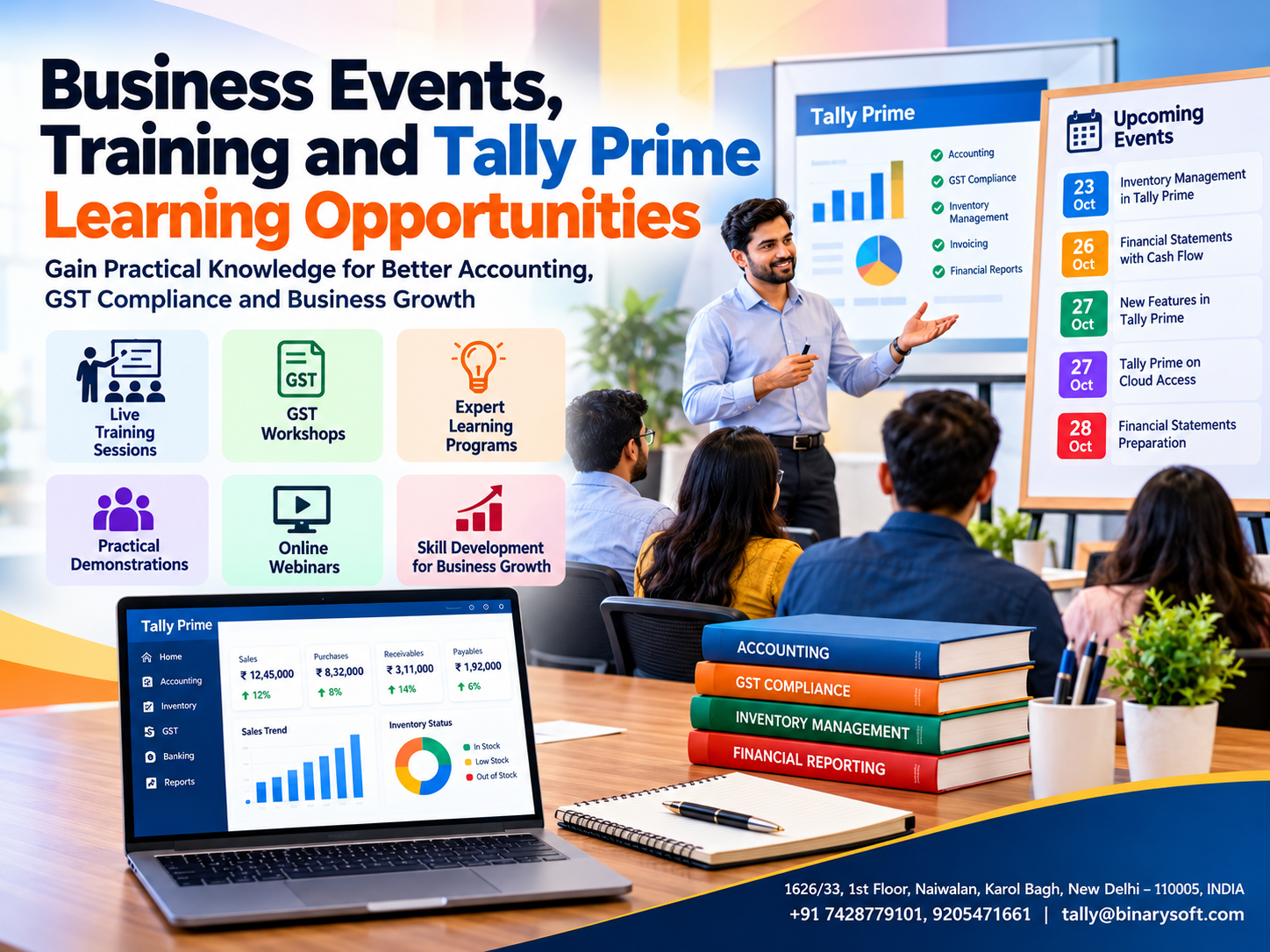
Professional learning events in October 2026 cover accounting, inventory management, financial statement preparation, software features and cloud access.
The following sessions illustrate the practical subjects available to business owners and accounting professionals.
|
Event topic
|
Date
|
Time
|
|---|
|
Basics of Inventory Management in Tally Prime (Hindi)
|
23 October
|
3:00–4:30 PM
|
|
Financial Statements with Cash Flow
|
26 October
|
3:00–4:30 PM
|
|
Exploring New Features in Tally Prime Release 7.2
|
27 October
|
11:30 AM–12:30 PM
|
|
Tally Prime on Cloud Access
|
27 October
|
3:00–4:30 PM
|
|
Tally Prime with WhatsApp and TDL Capabilities
|
27 October
|
3:30–4:30 PM
|
|
Financial Statements Preparation
|
28 October
|
3:00–4:30 PM
|
These are listed session dates and times, not confirmed registrations. Schedules and registration availability may change.
These topics demonstrate how learning events can support different business needs, from beginner-level stock management to advanced financial reporting and software integration.
8. How Tally Prime Can Be Used During Practical Training
The most effective software training programs include hands-on exercises.
Participants should have opportunities to work with sample business transactions, examine reports and understand how individual entries affect financial information.
Practical accounting exercises
Exercise 1: Record a sales transaction
Create a sample customer ledger, enter a sales invoice and review the accounting impact.
Exercise 2: Track customer outstanding payments
Record a credit sale, enter a partial receipt and examine the remaining customer balance.
Exercise 3: Manage inventory
Create stock items, record purchases and sales, and review available quantities.
Exercise 4: Review GST information
Configure relevant tax details, record sample transactions and inspect applicable GST reports.
Exercise 5: Reconcile bank transactions
Compare accounting records with a sample bank statement and investigate differences.
Exercise 6: Prepare financial reports
Review the Trial Balance, Profit and Loss Account and Balance Sheet.
These exercises help participants understand how daily transaction recording connects with overall business performance.
9. Training Opportunities for Different Business Sectors
Different industries require different accounting skills.
Retail businesses
Retailers benefit from training in invoicing, stock management, daily sales reporting and customer transactions.
Wholesale distributors
Distributors may prioritize credit control, inventory valuation, multiple godowns and customer outstanding reports.
Manufacturing businesses
Manufacturers may require training in raw-material tracking, stock movements, production-related transactions and cost monitoring.
Service businesses
Professional services organizations often focus on billing, expenses, customer receivables and profitability.
Accounting firms
Accounting professionals may benefit from advanced GST reconciliation, audit preparation, financial reporting and data-review techniques.
Organizations should select training programs based on their actual operational requirements.
10. Case Study One: A Retail Business Improves Employee Productivity Through Training
Illustrative case study
A retail electronics business operated three outlets with separate billing teams.
Employees used different procedures for recording sales, returns and inventory adjustments.
These differences created additional work for the central accounting department.
The challenge
Management found that software knowledge varied considerably between employees.
Some staff members understood advanced features, while others relied on manual procedures.
The training approach
The business introduced a structured Tally Prime learning program.
Employees attended sessions covering sales invoices, purchase entries, stock items, returns and reporting.
Practical exercises were developed using common transactions from the company's operations.
The outcome
Employees developed more consistent transaction-recording practices.
The accounts team could review information more systematically, while store managers gained greater confidence in using inventory reports.
The example demonstrates how targeted training can improve the value obtained from an existing accounting system.
11. Case Study Two: An Accounting Firm Strengthens GST Review Procedures
Illustrative case study
A small accounting firm handled bookkeeping and GST-related work for several business clients.
As its client base expanded, employees experienced increasing pressure during return preparation periods.
The challenge
The firm faced inconsistent transaction classification, incomplete supporting records and time-consuming reconciliation activities.
The training approach
Management organized practical workshops covering GST invoice verification, reconciliation, transaction review and relevant Tally Prime reporting features.
Employees practiced identifying differences between sample accounting records and corresponding tax information.
The outcome
The firm established a more consistent review process.
Employees gained a clearer understanding of common discrepancies and how to investigate them.
The case illustrates the importance of combining technical accounting knowledge with software-based review procedures.
12. How to Select the Right Business Workshop or Webinar
Not every business event provides the same value.
Organizations should evaluate training programs according to their objectives, employee experience and expected outcomes.
|
Selection factor
|
Questions to consider
|
|---|
|
Subject relevance
|
Does the topic address a current business challenge?
|
|
Participant level
|
Is it suitable for beginners or experienced users?
|
|
Practical content
|
Are demonstrations or exercises included?
|
|
Instructor experience
|
Does the trainer understand real business workflows?
|
|
Session format
|
Is the program online, classroom-based or hybrid?
|
|
Learning resources
|
Are supporting materials provided?
|
|
Follow-up support
|
Can participants clarify questions afterward?
|
|
Business value
|
Can the learning improve a measurable process?
|
Businesses should also distinguish between product demonstrations, conceptual webinars and comprehensive training programs.
Each serves a different purpose.
13. Creating a Year-Round Business Training Calendar
A structured annual training plan can help businesses maintain employee knowledge and respond to operational changes.
The following is a suggested learning framework, not a schedule of confirmed events.
|
Month
|
Suggested training focus
|
|---|
|
January
|
Accounting fundamentals and business reporting
|
|
February
|
GST invoicing and reconciliation
|
|
March
|
Financial year-end preparation
|
|
April
|
Opening balances and new financial-year setup
|
|
May
|
Inventory management and stock valuation
|
|
June
|
Customer outstanding and credit control
|
|
July
|
Banking and reconciliation
|
|
August
|
Advanced Tally Prime features
|
|
September
|
Financial reporting and profitability
|
|
October
|
Cloud access and connected business operations
|
|
November
|
Accounting automation and productivity
|
|
December
|
Internal controls and annual performance review
|
Businesses can adjust this calendar based on regulatory developments, employee requirements and industry-specific activities.
14. Measuring the Business Value of Training
Training should produce practical improvements rather than simply increase attendance.
Organizations can measure outcomes using operational indicators.
Accounting accuracy
Review the frequency of transaction corrections and reconciliation differences.
Employee productivity
Measure the time required to complete routine accounting activities.
Inventory reliability
Compare physical stock verification results with recorded quantities.
Payment management
Review outstanding balances and the timeliness of customer payment follow-ups.
Reporting efficiency
Measure how quickly employees can prepare accurate management reports.
Knowledge retention
Conduct short assessments or practical exercises after training.
These indicators can help management determine whether additional coaching or process improvements are required.
15. The Future of Business Learning and Accounting Technology
Professional learning is increasingly supported by online demonstrations, recorded sessions, interactive workshops and remote collaboration.
Businesses can use these formats to train employees across multiple locations.
Emerging technologies may also improve how accounting information is analyzed and presented.
However, organizations should avoid assuming that automation removes the need for professional judgment.
Accounting employees must still understand transaction accuracy, financial controls, taxation and business processes.
Continuous learning will remain important as business requirements and software capabilities evolve.
16. Why Expert Guidance Matters During Software Adoption
Businesses sometimes purchase accounting software without developing a structured implementation or training plan.
This can result in incomplete configurations, inconsistent transaction recording and underused features.
Experienced implementation and training professionals can help organizations assess requirements and establish appropriate procedures.
Support may include company setup, ledger configuration, inventory organization, employee training, reporting and troubleshooting.
Businesses should also maintain internal documentation so that knowledge does not depend entirely on one employee.
With appropriate guidance, organizations can develop more dependable accounting processes and improve long-term operational efficiency.
Conclusion
Business events, professional workshops and accounting training programs play an important role in helping Indian businesses adapt to changing operational requirements.
From GST compliance and inventory management to banking, financial reporting and cloud access, practical learning can strengthen employee capabilities and improve everyday business decisions.
Tally Prime offers integrated accounting and business-management capabilities that can be explored through structured demonstrations and hands-on training.
The greatest value comes when organizations apply what they learn, establish consistent procedures and regularly evaluate performance.
For businesses planning sustainable growth in 2026 and beyond, continuous learning should be treated as an ongoing investment in financial accuracy, employee productivity and operational confidence.
Powered by Binarysoft Technologies
Authorized Tally Partner
Location: 1626/33, 1st Floor, Naiwalan, Karol Bagh, New Delhi – 110005, INDIA
Contact: +91 7428779101, 9205471661
Email: tally@binarysoft.com
Business Hours: 10:00 AM – 6:00 PM, Monday to Friday
Frequently Asked Questions
How can Binarysoft Technologies help businesses with Tally Prime?
Binarysoft Technologies can assist businesses with Tally Prime-related product guidance, implementation, configuration, training and technical support according to their requirements.
What should employees learn before using Tally on Cloud?
Employees should understand authorized access procedures, data security, account permissions, backup responsibilities and the relevant hosted working environment.
How often should employees receive accounting software training?
Training frequency depends on employee experience, software changes and business requirements. Refresher sessions are useful when processes or relevant features change.
Can businesses arrange customized accounting training?
Yes. Businesses can arrange training focused on their accounting processes, employee responsibilities, software configuration and operational requirements.
CA. Kairav Dalmia focuses on GST reporting, bookkeeping controls, and accounting automation for trading and service businesses. He translates technical accounting requirements into practical processes that businesses can follow in their daily operations.