Call CA Tally HelpDesk
+91 9205471661,
7428779101
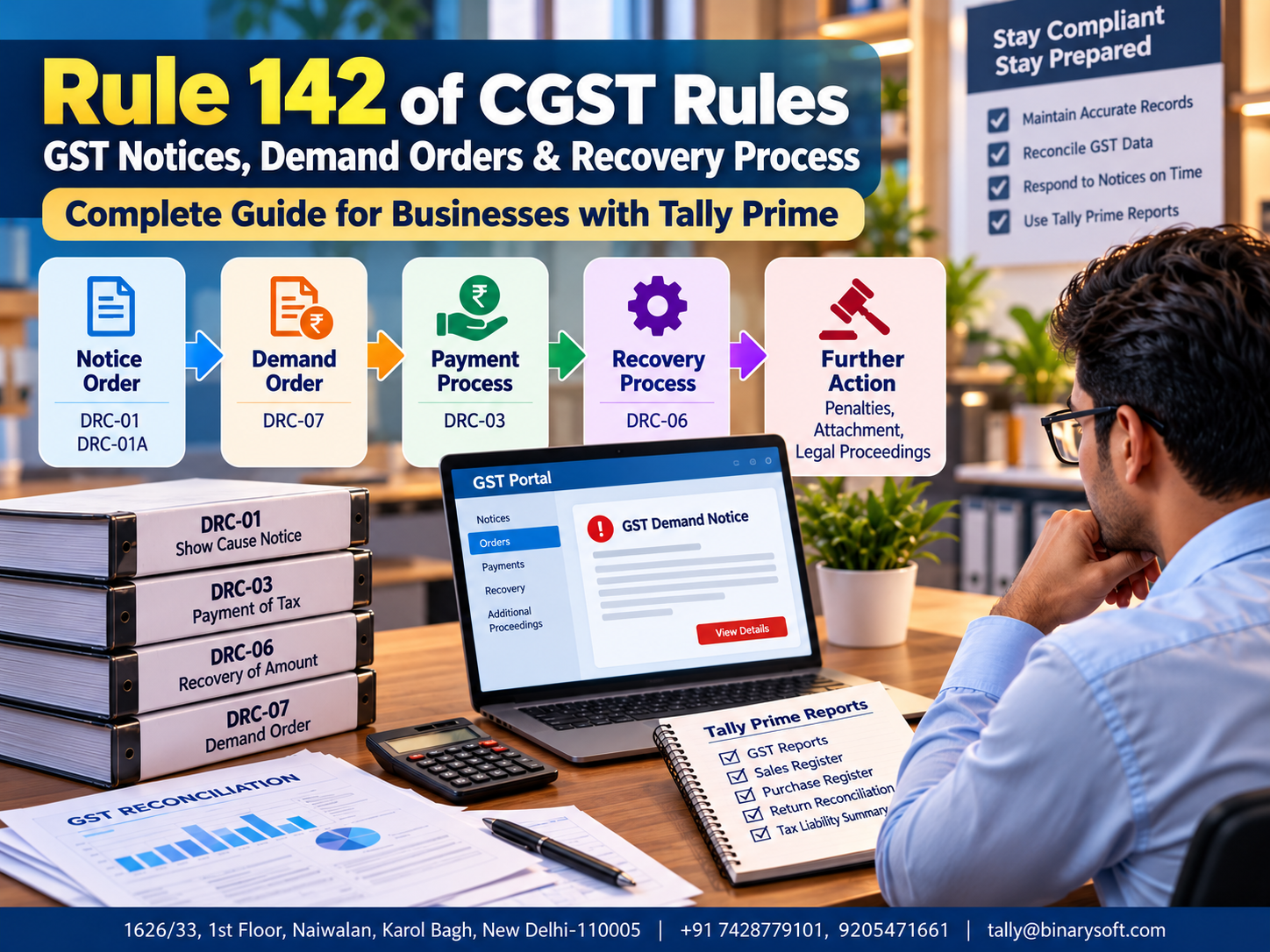
Introduction: Why Understanding Rule 142 Is Essential for Indian Businesses
Receiving a GST notice can be one of the most stressful experiences for a business owner. A company may have filed its GST returns regularly, maintained purchase and sales records, and paid taxes on time, yet still receive a communication demanding clarification about an alleged tax difference.
For retailers, wholesalers, manufacturers, distributors, and service providers, such notices can create uncertainty about financial liabilities, penalties, interest, and possible recovery proceedings.
Rule 142 of the Central Goods and Services Tax Rules, 2017 establishes important procedures for communicating GST demands, issuing notices, recording taxpayer responses, acknowledging payments, and uploading demand orders.
It provides a structured framework through which tax authorities and taxpayers can address disputed or unpaid GST liabilities.
The procedure involves prescribed forms such as GST DRC-01, DRC-01A, DRC-03, DRC-06, and DRC-07.
Understanding the purpose of these forms helps businesses respond appropriately, maintain supporting documentation, and avoid unnecessary escalation.
Accurate accounting records are equally important. Tally Prime can help businesses review sales, purchases, GST liabilities, input tax credit, and financial transactions when preparing responses to departmental communications.
This guide explains Rule 142, its practical application, taxpayer responsibilities, GST demand procedures, recovery provisions, and the role of accounting software in maintaining compliance.
A GST Notice That Almost Disrupted a Family Business
Amit owned a medium-sized electrical goods distribution business in Delhi. His father had started the company with a small rented shop, and Amit had spent years expanding it into a dependable wholesale operation.
The business supported more than twenty employees and supplied electrical products to retailers across northern India.
One morning, Amit received a message informing him that a GST notice was available on the portal.
The communication referred to a substantial difference between the tax department's calculations and the company's GST records.
The proposed liability was ₹4.8 lakh.
Amit immediately began worrying about employee salaries, supplier payments, and upcoming inventory purchases.
For a business operating on tight margins, an unexpected tax demand could create serious financial pressure.
His accountant carefully examined the notice and compared the disputed transactions with purchase registers, sales records, GST returns, and supplier documents.
The review revealed that some transactions had been incorrectly classified in the departmental comparison, while certain supporting documents had not been included in the initial reconciliation.
Using organized accounting records, the team prepared a detailed response explaining the differences.
The business submitted its supporting documents through the appropriate GST procedure and requested consideration of the evidence.
After reviewing the explanation, the authority accepted the supported adjustments and determined the remaining liability according to the applicable provisions.
Amit realized that receiving a GST notice did not necessarily mean that the entire proposed demand was correct.
The experience encouraged him to introduce regular GST reconciliation and improve his accounting documentation.
This is an illustrative story representing a common business compliance situation.
The lesson is that accurate records, timely responses, and an understanding of GST procedures can protect both financial stability and peace of mind.
1. What Is Rule 142 of the CGST Rules?
Rule 142 is titled Notice and order for demand of amounts payable under the Act.
It establishes the procedural requirements for communicating specified GST notices, taxpayer payments, representations, and demand orders through prescribed forms.
The rule supports transparency by creating an identifiable record of departmental communications and taxpayer responses.
Its principal objectives include ensuring that proposed liabilities are communicated, taxpayers receive opportunities to respond, payments are recorded, and demand orders are properly documented.
Rule 142 operates alongside substantive provisions of the CGST Act. It does not independently determine whether a taxpayer owes GST.
The actual liability depends on the relevant statutory section, transaction facts, evidence, and adjudication process.
2. When Does Rule 142 Apply?
Rule 142 may apply when GST authorities initiate specified proceedings involving unpaid or short-paid tax, erroneous refunds, wrongly availed or utilized input tax credit, or other liabilities covered by the relevant provisions.
Common situations include:
-
Differences between GST returns and accounting records.
-
Incorrect input tax credit claims.
-
Taxable supplies omitted from returns.
-
Tax collected but not deposited.
-
Incorrect tax classification or liability calculations.
-
Certain penalty proceedings.
-
Demand proceedings following departmental scrutiny or audit.
Not every GST portal notice is issued under Rule 142. Other provisions prescribe separate notices and response mechanisms.
Businesses should identify the exact statutory section and form mentioned in the communication before taking action.
3. Important CGST Act Sections Connected with Rule 142
|
Section
|
Main purpose
|
|---|
|
Section 73
|
Determination of specified tax liabilities for periods up to FY 2023–24 without fraud-related allegations
|
|
Section 74
|
Determination involving fraud, wilful misstatement, or suppression for periods up to FY 2023–24
|
|
Section 74A
|
Determination of specified tax liabilities for FY 2024–25 onward
|
|
Section 75
|
General provisions relating to determination of tax
|
|
Section 76
|
Tax collected but not paid to the government
|
|
Sections 122–125
|
Specified GST penalties
|
|
Section 127
|
Penalty proceedings in specified circumstances
|
|
Section 78
|
Initiation of recovery proceedings
|
|
Section 79
|
Recovery mechanisms for unpaid government dues
|
The introduction of Section 74A is particularly important because the demand framework for FY 2024–25 onward differs from the earlier separation under Sections 73 and 74.
Businesses should always identify the relevant financial year before evaluating notice deadlines, payment options, and penalty consequences.
4. Key GST DRC Forms Used Under Rule 142
The GST Demand and Recovery forms help identify the stage of a proceeding and the action expected from the taxpayer.
|
GST form
|
Purpose
|
|---|
|
DRC-01A
|
Pre-notice communication of proposed liability
|
|
DRC-01
|
Electronic summary of show cause notice
|
|
DRC-02
|
Summary of statement for applicable tax periods
|
|
DRC-03
|
Intimation of voluntary or other permitted payment
|
|
DRC-03A
|
Adjustment of eligible DRC-03 payments against demand
|
|
DRC-04
|
Acknowledgement of payment
|
|
DRC-05
|
Conclusion of proceedings in applicable circumstances
|
|
DRC-06
|
Taxpayer's reply to notice
|
|
DRC-07
|
Summary of demand order
|
|
DRC-08
|
Summary of rectification or withdrawal of order
|
These forms have distinct legal purposes. A pre-notice intimation is not the same as a final demand order, and an acknowledgement of payment does not always mean that every proceeding has concluded.
5. Step-by-Step GST Notice and Demand Process Under Rule 142
Typical GST demand procedure
DRC-01A
Optional pre-notice communication, where applicable
DRC-01 / DRC-02
Formal notice or applicable statement
DRC-03
Eligible payment route
DRC-06
Reply and supporting evidence
DRC-05 or DRC-07
Closure where permitted, or summary of adjudication order
Rectification, appeal or recovery
Further action depends on the order, payment status, and applicable law
This is a simplified illustration. Not every proceeding follows every stage, and statutory rights and deadlines depend on the relevant provision.
Stage 1: Pre-notice intimation through DRC-01A
The proper officer may communicate an ascertained liability before issuing a formal show cause notice.
The taxpayer can review the proposed calculation, make eligible payments, or submit an explanation through the prescribed mechanism.
This stage provides an opportunity to identify errors before formal adjudication.
Stage 2: Formal show cause notice through DRC-01
If the matter proceeds, the proper officer serves the substantive show cause notice along with its electronic summary in DRC-01.
The notice should identify the allegations, relevant period, proposed demand, and legal grounds.
The taxpayer should read the complete notice and annexures rather than relying only on the summary amount.
Stage 3: Taxpayer response through DRC-06
The taxpayer may submit a response explaining why the proposed demand is incorrect or requires modification.
Supporting documents may include tax invoices, ledgers, return reconciliations, payment records, and relevant correspondence.
A well-prepared response should address each disputed issue separately.
Stage 4: Payment through DRC-03
Where the taxpayer accepts an eligible liability, payment may be made through the applicable DRC-03 procedure.
The amount of tax, interest, and penalty depends on the relevant legal provision and stage of proceedings.
Payment should not be made merely because a proposed amount appears in a notice. The liability must first be verified.
Stage 5: Acknowledgement or conclusion
DRC-04 records acknowledgement of the relevant payment.
DRC-05 is used to conclude proceedings where the statutory conditions for closure have been satisfied.
Stage 6: Demand order through DRC-07
Following adjudication, the authority may issue an order determining the liability.
Its electronic summary is uploaded in DRC-07.
Under Rule 142, this summary serves as a notice for recovery. However, the actual commencement of recovery remains subject to the applicable statutory provisions, including Section 78.
6. How to Respond to a GST Notice Correctly
A business receiving a GST notice should follow a disciplined response process.
First, verify the notice. Access the GST portal and identify the reference number, issuing authority, tax period, applicable section, and response deadline.
Second, examine the allegation. Determine whether the issue relates to outward supplies, input tax credit, incorrect returns, tax payments, or another matter.
Third, reconcile accounting records. Compare the disputed transactions with invoices, ledgers, GST returns, and supporting documents.
Fourth, prepare a written explanation. Present the facts clearly and include calculations explaining any differences.
Fifth, submit the response within the prescribed period. Preserve the acknowledgement and copies of uploaded documents.
Finally, monitor subsequent communications. Attend hearings where required and review any order carefully.
If the amount is significant or the allegation involves fraud or suppression, professional legal and tax advice is particularly important.
7. GST Demand Recovery Under Sections 78 and 79
Once a valid demand becomes payable, failure to discharge the liability can lead to recovery proceedings.
Section 78 generally provides a three-month payment period from service of the order, although the proper officer may require earlier payment in specified circumstances with reasons recorded.
Section 79 provides mechanisms for recovering government dues.
These can include deduction from amounts payable by the government, recovery from third parties, attachment and sale of property, and other legally authorized methods.
Recovery must follow the applicable statutory conditions.
Taxpayers may also have rights to appeal, seek rectification, or obtain other relief.
A properly filed appeal and payment of the applicable pre-deposit can affect recovery of the disputed balance under the relevant provisions.
Businesses should therefore review available remedies promptly after receiving an adverse order.
8. How Tally Prime Helps Businesses Manage GST Notices
Tally Prime does not replace the GST portal's statutory notice-response process. However, it can provide important accounting information needed to examine disputed liabilities.
GST sales reconciliation
Businesses can review sales registers and GST reports to investigate differences between recorded sales and outward supplies reported in returns.
Purchase and input tax credit verification
Purchase vouchers and GST information help businesses identify supplier transactions, tax amounts, and records relevant to ITC claims.
Ledger-level investigation
When a notice refers to a particular transaction, accountants can examine the underlying voucher and related ledger information.
GST return preparation and reconciliation
Supported Tally Prime releases offer GST reports and connected capabilities that help users review return data and identify differences.
Tax liability tracking
Accounting reports can help businesses determine the amounts recorded as GST payable and compare them with payments and return information.
Financial reporting
Profit and Loss Statements, Balance Sheets, receivables reports, and other accounting information can help management evaluate the financial impact of potential liabilities.
Supporting document preparation
Businesses can export relevant reports and compile reconciliations for professional review and submission through the GST portal.
The effectiveness of these features depends on accurate bookkeeping, correct configuration, and the installed software release.
9. Practical GST Notice Reconciliation in Tally Prime
A business can use the following workflow to prepare reliable supporting information.
Step 1: Identify the disputed period. Record the financial year, return period, tax head, and transactions mentioned in the notice.
Step 2: Review sales records. Open the relevant sales register and verify taxable values, tax calculations, credit notes, and amendments.
Step 3: Examine purchase records. Check purchase vouchers, supplier GSTIN details, and supporting documents for disputed ITC.
Step 4: Compare filed returns. Reconcile the accounting figures with GSTR-1, GSTR-3B, and GSTR-2B, as relevant.
Step 5: Prepare a difference statement. Identify transactions already reported, incorrectly classified, omitted, or duplicated.
Step 6: Export supporting reports. Save the necessary ledger statements, invoices, and reconciliation schedules.
Step 7: Obtain professional review. Have the proposed response and liability calculations checked before submitting them through the GST portal.
A structured process helps distinguish genuine tax shortfalls from reporting differences that can be explained with evidence.
10. Case Study One: GST Demand Notice for a Wholesale Trader in Karol Bagh
Illustrative case study.
A wholesale electrical equipment dealer in Karol Bagh received a GST demand communication relating to differences between reported outward supplies and tax liability.
The proposed difference was ₹3,20,000.
The challenge
The company maintained thousands of sales transactions across multiple accounting periods.
Its accountant initially struggled to identify the invoices responsible for the difference.
Management was concerned that an incorrect response could result in additional financial exposure.
The solution
The accounting team used Tally Prime to review sales registers, customer ledgers, credit notes, and GST liability information.
The reconciliation revealed that certain adjustments had been reported in different periods and that some entries required correction.
The company prepared a transaction-wise explanation and submitted supporting documents through the applicable notice-response procedure.
The outcome
The reconciliation helped distinguish the supported adjustments from the actual liability requiring further consideration.
The company also introduced monthly GST reconciliation and management review procedures.
The important improvement was the ability to explain accounting differences with documented evidence rather than relying on estimates.
11. Case Study Two: Input Tax Credit Dispute for a Manufacturer in Bawana
Illustrative case study.
A manufacturing company in Bawana Industrial Area received a notice questioning input tax credit claimed on several purchase transactions.
The proposed disputed ITC amounted to ₹2,75,000.
The challenge
Some supplier invoices required further verification, and the accounting team needed to reconcile purchase records with GST portal information.
The company was concerned about the financial consequences of an adverse demand.
The solution
Using Tally Prime, the finance team reviewed purchase vouchers, supplier ledgers, tax amounts, and payment records.
It compared relevant transactions with GSTR-2B and collected additional supporting documentation.
The team identified the credits that could be supported and separately examined transactions requiring correction or further clarification.
A structured response was prepared for professional review.
The outcome
The company established a clearer reconciliation of the disputed transactions and improved its supplier verification process.
It also began reviewing ITC records regularly instead of waiting until a departmental notice arrived.
The case illustrates how organized purchase accounting can support effective GST dispute management.
12. Important Taxpayer Rights During GST Demand Proceedings
A GST notice does not automatically establish that the proposed demand is correct.
Taxpayers have important procedural rights, subject to applicable statutory provisions.
These include the opportunity to understand the allegations, submit supporting evidence, make representations, and obtain a personal hearing where required.
Adjudication orders must comply with applicable legal requirements.
Taxpayers may also seek rectification of qualifying errors or file an appeal within the prescribed period.
For many first appeals under Section 107, the general filing period is three months from communication of the order, with limited additional time available for condonation under the applicable conditions.
The relevant order, statutory provision, and current legal position should always be checked before calculating a deadline.
13. Common Mistakes Businesses Should Avoid
Several avoidable mistakes can make GST proceedings more difficult.
Ignoring portal notices is particularly risky because statutory response periods may continue running.
Another mistake is paying the entire proposed amount without verifying the underlying transactions.
Businesses should also avoid submitting explanations without supporting documents.
Failure to reconcile DRC-03 payments with demand records may create accounting or portal discrepancies.
Where applicable, DRC-03A can help link eligible payments to outstanding demand liabilities.
Finally, businesses should not assume that an email, verbal discussion, or informal correspondence replaces a prescribed statutory response.
14. Best Practices for Preventing GST Demand Disputes
Businesses should establish a regular compliance review system.
Monthly reconciliation of outward supplies, tax liabilities, and input tax credit can help identify differences before they develop into larger problems.
Accounting staff should verify GST rates, tax classifications, customer and supplier information, and credit note adjustments.
Businesses should preserve relevant invoices, payment records, reconciliations, and return acknowledgements for the legally required retention period.
Access to the GST portal should be monitored, and responsibility for responding to notices should be clearly assigned.
Tally Prime can support these controls through consistent accounting records and transaction-level reporting.
For growing businesses, preventive compliance is generally more efficient than investigating several years of transactions after receiving a notice.
Conclusion
Rule 142 of the CGST Rules provides an important procedural framework for GST notices, taxpayer responses, payments, demand orders, and related recovery matters.
Understanding forms such as DRC-01, DRC-01A, DRC-03, DRC-06, DRC-07, and DRC-08 helps businesses identify the stage of proceedings and take appropriate action.
A GST demand should be examined carefully using accounting records, relevant returns, and supporting evidence.
Tally Prime can help businesses maintain accurate transaction information, review GST liabilities, reconcile purchases and sales, and prepare financial reports needed for professional examination.
The most effective GST compliance strategy combines accurate accounting, regular reconciliation, timely responses, and informed professional advice.
For retailers, wholesalers, manufacturers, distributors, and service providers, this approach can reduce compliance uncertainty and support long-term financial stability.
Powered by Binarysoft Technologies Authorized Tally Partner
Location: 1626/33, 1st Floor, Naiwalan, Karol Bagh, New Delhi – 110005, INDIA
Contact us: +91 7428779101, 9205471661
Email us: tally@binarysoft.com
Business Hours: 10:00 AM – 6:00 PM, Monday to Friday
Frequently Asked Questions
What is Rule 142 of the CGST Rules?
Rule 142 prescribes procedures for communicating specified GST notices, recording payments, submitting taxpayer representations, and uploading demand orders.
Can a taxpayer reply to a GST demand notice?
Yes. A taxpayer may submit a response through DRC-06 where applicable, supported by relevant accounting records, legal explanations, and documents.
What happens if a taxpayer ignores a GST notice?
Failure to respond may result in adjudication based on available records and further proceedings. The exact consequences depend on the notice and applicable law.
Can Tally Prime directly cancel a GST demand notice?
No. A GST notice or demand must be addressed through the appropriate statutory process. Accounting software cannot independently cancel departmental proceedings.
CA. Aviraj Kothari focuses on business accounting, GST compliance, and management reporting. He helps businesses organize financial data and establish practical accounting processes for better visibility and smoother compliance.









