Introduction: One Small GST Difference Can Create a Big Business Problem
Imagine running a successful wholesale business, managing hundreds of invoices every month, receiving payments from customers, and ensuring timely GST filing. Everything appears normal until your accountant discovers that the outward tax liability reported in GSTR-1 does not match the liability declared in GSTR-3B.
Suddenly, questions arise. Was an invoice missed? Was a credit note recorded incorrectly? Has GST been underpaid? Will the business receive a notice?
For thousands of Indian businesses, GSTR-1 and GSTR-3B mismatches are a significant GST compliance challenge.
GSTR-1 reports outward supplies, while GSTR-3B is a summary return used to declare and discharge GST liabilities, along with reporting eligible input tax credit and other prescribed details. When corresponding figures differ without a valid explanation, businesses may face reconciliation difficulties, GST portal intimations, interest exposure, or further scrutiny.
The solution is not simply changing numbers until both returns match. Businesses must understand the cause of the difference, identify the correct reporting period, and make legally permitted corrections.
With systematic reconciliation and accounting software such as Tally Prime, businesses can improve GST data accuracy, detect reporting differences earlier, and maintain stronger financial control.
A Business Owner's Story: The GST Mismatch That Threatened a Festival Season
Rajesh operated a growing electrical goods distribution business in Delhi. His busiest period was approaching, and he had already committed substantial funds to new inventory.
One morning, his accountant informed him that the company's GSTR-1 tax liability exceeded the amount reported in GSTR-3B by ₹86,000.
Rajesh became concerned. The business needed working capital for supplier payments, employee salaries, and upcoming orders. An unexpected tax demand could disrupt everything.
The accounting team investigated and discovered that several invoices had been included in GSTR-1 but were missing from the GSTR-3B working calculation. A credit note had also been incorrectly classified.
Instead of making an unsupported adjustment, the team reconstructed the invoice records, compared GST portal data with accounting entries, and calculated the actual tax difference.
They then determined the appropriate correction and payment procedure based on the filing status.
The experience changed Rajesh's approach to accounting. He introduced monthly GST reconciliation, improved invoice verification, and began reviewing Tally Prime reports before return filing.
This is an illustrative story representing a common business situation.
The important lesson is that GST reconciliation is not merely a compliance activity. It protects business confidence, financial planning, and operational continuity.
1. Understanding GSTR-1 and GSTR-3B
Before correcting a mismatch, it is essential to understand the purpose of each GST return.
What is GSTR-1?
GSTR-1 is a statement containing details of outward supplies made by a registered taxpayer during a particular tax period.
It generally includes:
-
Business-to-business (B2B) sales invoices.
-
Business-to-consumer (B2C) supplies.
-
Export transactions.
-
Credit and debit notes.
-
Amendments to previously reported transactions.
-
Applicable taxable values and GST amounts.
The information reported in GSTR-1 also plays an important role in the recipient's input tax credit reconciliation.
What is GSTR-3B?
GSTR-3B is a summary GST return through which eligible taxpayers declare outward and reverse-charge liabilities, input tax credit, and tax payments.
It includes taxable outward supplies, applicable GST liabilities, eligible ITC, reversals, and tax settlement details.
Unlike GSTR-1, it does not provide a complete invoice-by-invoice outward supply statement.
Key differences between GSTR-1 and GSTR-3B
|
Particulars
|
GSTR-1
|
GSTR-3B
|
|---|
|
Primary purpose
|
Report outward supplies
|
Declare and discharge GST liabilities
|
|
Reporting level
|
Invoice-level and summary details
|
Consolidated summary
|
|
Sales information
|
Detailed outward supply reporting
|
Summarized taxable supplies
|
|
Input tax credit
|
Not claimed here
|
Reported and claimed subject to eligibility
|
|
Tax payment
|
Not made through GSTR-1
|
Liability discharged through GSTR-3B
|
|
Correction
|
Permitted amendment mechanisms
|
Filed return cannot be revised directly
|
Important: Matching the two returns does not mean comparing every field directly. Businesses must reconcile corresponding tax liability categories, tax heads, and reporting periods.
2. What Is a GSTR-1 and GSTR-3B Mismatch?
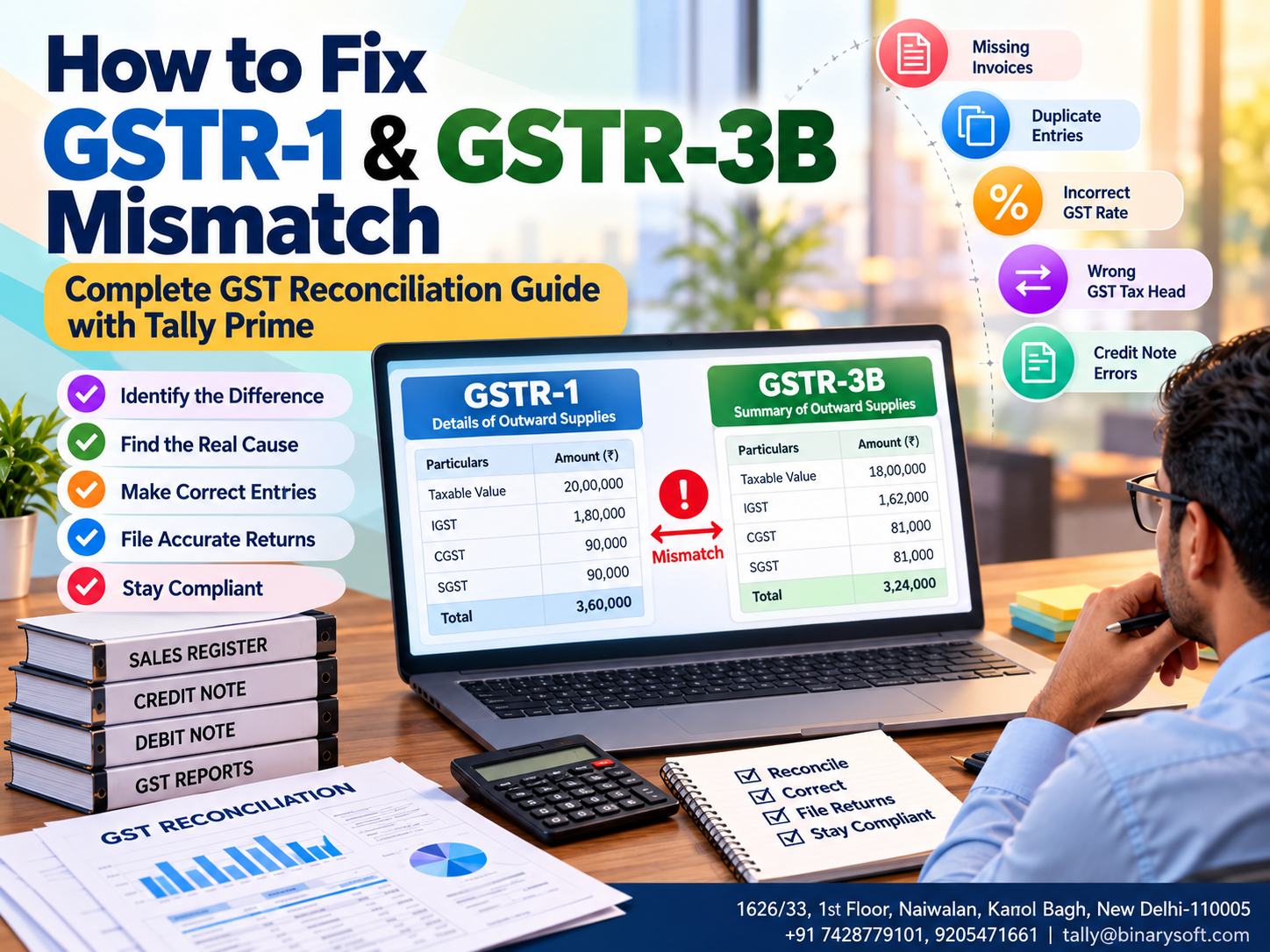
A mismatch occurs when corresponding outward supply or GST liability information reported in GSTR-1 and GSTR-3B does not agree.
For example, consider a trading company with the following monthly GST figures.
|
GST particulars
|
GSTR-1
|
GSTR-3B
|
|---|
|
Taxable outward supplies
|
₹20,00,000
|
₹18,00,000
|
|
Output GST liability
|
₹3,60,000
|
₹3,24,000
|
|
Difference
|
₹2,00,000
|
₹36,000
|
Illustrative example assuming all supplies are taxable at 18%, without adjustments.
The company has an output GST liability difference of ₹36,000.
However, this does not automatically establish that ₹36,000 remains unpaid. The accountant must investigate whether the difference arises from incorrect reporting, permitted adjustments, or an actual shortfall.
3. Common Reasons for GSTR-1 and GSTR-3B Mismatch
3.1 Missing sales invoices
One of the most common reasons is an invoice appearing in one return but not being correctly reflected in the corresponding return calculation.
This may happen when invoice records are maintained in separate spreadsheets or entered after the return preparation process.
3.2 Duplicate invoice reporting
When the same invoice is included twice in GSTR-1, the reported outward tax liability can become overstated.
Duplicate reporting may arise during bulk data imports, manual entry, or repeated invoice uploads.
3.3 Incorrect GST rate selection
Applying 18% GST instead of 12%, for example, can create incorrect tax liability.
Businesses should verify product classification, applicable notifications, and transaction dates before correcting tax rates.
3.4 Wrong GST tax head
An interstate transaction may be incorrectly classified as an intrastate supply.
This can create differences between IGST and CGST/SGST even when the total GST amount appears similar.
3.5 Credit note and debit note errors
Credit notes and debit notes affect reported taxable values and liabilities.
If a credit note is omitted, duplicated, or reported in the wrong period, the returns may not reconcile.
3.6 Transactions recorded in different periods
An invoice may be recorded in the accounting system during one month but reported in another GST period.
Timing differences should be documented and checked against the applicable time-of-supply and return-reporting requirements.
3.7 Manual data entry mistakes
Incorrect invoice values, GSTIN details, taxable amounts, and tax calculations can cause reconciliation problems.
3.8 Incorrect treatment of advances and adjustments
Advances, particularly for services, and their subsequent adjustments may affect GST liability according to applicable rules.
Incorrect treatment can produce differences between transaction records and return calculations.
3.9 Incorrect classification of exempt or zero-rated supplies
Exempt, nil-rated, non-GST, and zero-rated transactions have different reporting requirements.
Incorrect classification can distort taxable values and return comparisons.
3.10 Outdated accounting records
If sales records are updated after GST reports are generated, the return working papers may no longer reflect the final books.
This is why businesses should review the latest accounting information before filing.
4. How to Identify GSTR-1 and GSTR-3B Mismatch Step by Step
A structured reconciliation process makes error identification easier.
Step 1: Download GST return information
Obtain filed GSTR-1, GSTR-1A where applicable, GSTR-3B, and relevant comparison reports from the GST portal.
Step 2: Compare taxable values and tax liabilities
Review corresponding outward supply categories, including IGST, CGST, SGST/UTGST, and cess where applicable. Separate reverse-charge and other items requiring different treatment.
Step 3: Match transactions with accounting records
Compare sales registers, invoices, credit notes, debit notes, and previous-period adjustments with filed returns.
Step 4: Classify every difference
Identify whether each difference represents an omitted invoice, duplicate entry, tax classification error, timing difference, or actual short payment.
Step 5: Determine and document the correction
Select the appropriate amendment, payment, or explanation procedure. Preserve reconciliation statements and supporting documents.
The GST portal's tax liability comparison reports can help identify discrepancies, but accounting records remain essential for establishing the underlying cause.
5. How to Correct a GSTR-1 and GSTR-3B Mismatch
The appropriate correction depends on whether the returns have already been filed.
Situation A: GSTR-1 filed but GSTR-3B not filed
Where eligible, GSTR-1A allows taxpayers to amend or add outward supply details after filing GSTR-1 and before filing GSTR-3B for the same period.
The taxpayer should verify the error, make the permitted correction in GSTR-1A, and check the updated GSTR-3B liability.
This is particularly useful when an invoice or credit note was missed in GSTR-1.
Situation B: Both returns already filed
Once GSTR-3B has been filed, it cannot simply be reopened and revised.
Corrections generally require appropriate reporting in subsequent returns, subject to applicable legal conditions and amendment deadlines.
The business should:
-
Identify the original transaction and tax period.
-
Determine whether an amendment in a subsequent GSTR-1 is required.
-
Correct the relevant accounting entries.
-
Assess any additional tax liability and interest.
-
Use the applicable return or payment mechanism.
-
Retain documentation showing how the difference was resolved.
For GSTR-1 corrections relating to FY 2025–26, the general statutory cutoff is 30 November 2026 or the date of filing the relevant annual return, whichever is earlier, subject to applicable provisions.
Situation C: Additional GST is payable
If reconciliation establishes that tax was underpaid, the business must determine the correct payment mechanism and interest liability.
Form GST DRC-03 may be applicable in specified circumstances. Interest under Section 50 must be calculated according to the nature and timing of the liability, including the relevant statutory provisions.
Situation D: The difference is explainable
Not every mismatch requires additional payment.
For example, a business may identify a reporting error that overstated liability in GSTR-1 without creating an actual tax shortfall.
In such cases, it should maintain supporting documents and use the appropriate correction or response mechanism rather than paying an unverified amount.
6. Understanding Rule 88C and Form GST DRC-01B
Rule 88C provides a mechanism for addressing certain differences between outward tax liability reported through GSTR-1, including applicable amendments or IFF data, and liability declared through GSTR-3B.
When the difference exceeds the applicable system criteria, the GST portal may issue an intimation in Form GST DRC-01B.
The taxpayer is required to respond within seven days by paying the applicable differential amount with interest or explaining the difference.
A response is submitted through Part B of Form GST DRC-01B.
Failure to respond can restrict subsequent GSTR-1/IFF filing and may result in further action under applicable provisions.
Businesses should therefore monitor GST portal communications and registered email addresses regularly.
Important distinction: Form DRC-01B concerns outward tax liability differences. Form DRC-01C relates to specified input tax credit differences between GSTR-2B and GSTR-3B.
7. How Tally Prime Helps Identify and Prevent GST Mismatches
Tally Prime helps businesses maintain transaction-level accounting records and prepare GST reports from the same underlying data.
Rather than preparing invoices in one system, accounting summaries in another, and GST calculations in separate spreadsheets, businesses can use a more consistent accounting workflow.
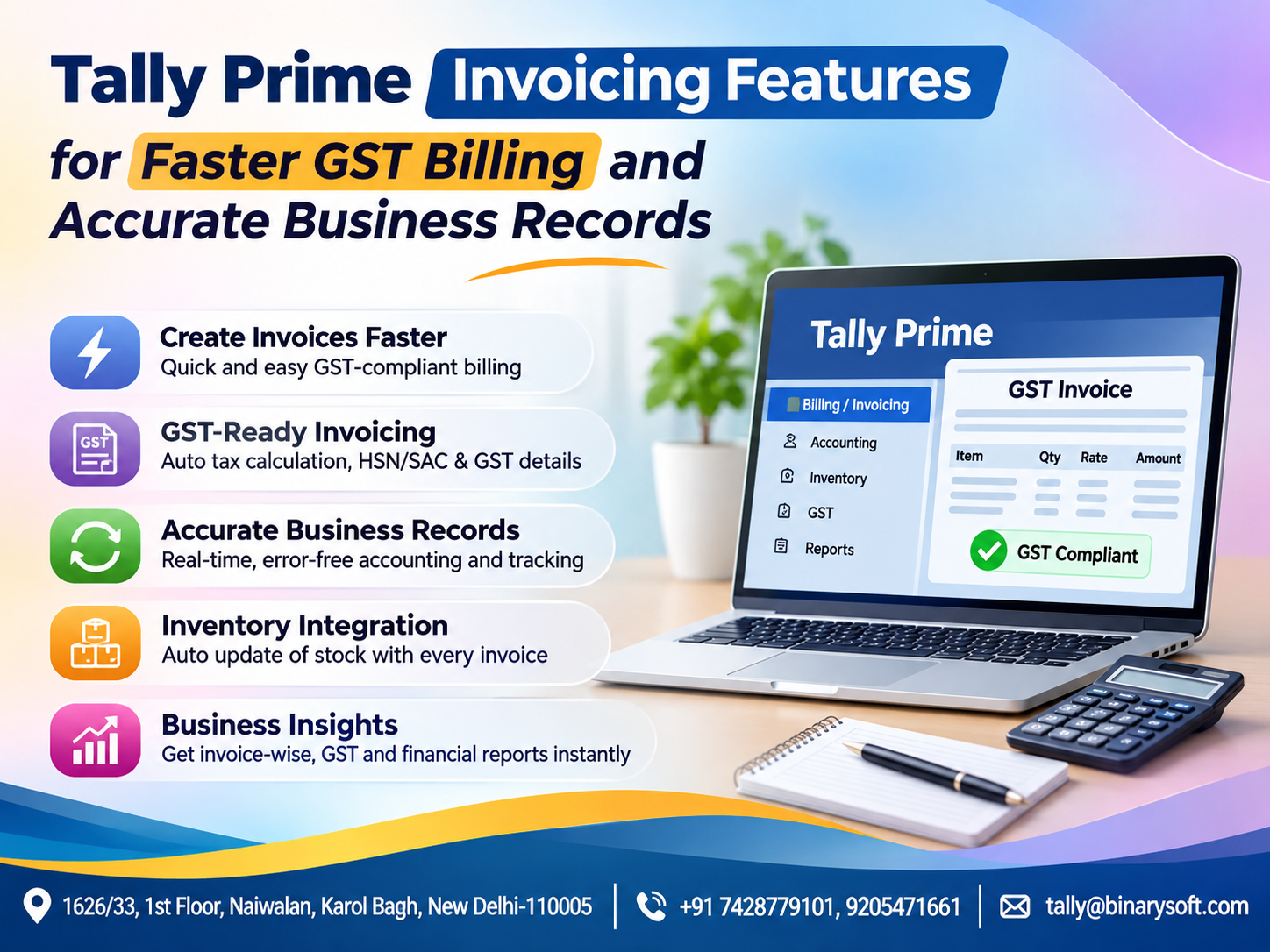
7.1 GST-ready sales invoicing
Businesses can configure relevant GST details for parties, stock items, ledgers, and transactions.
This supports consistent invoice preparation and GST calculations based on the configured tax treatment.
7.2 GST return reports
Tally Prime provides GST reports that help users review transactions contributing to return values.
Businesses can examine taxable supplies, tax amounts, and transactions requiring attention before return preparation.
7.3 Voucher-level verification
Where a difference is identified, users can investigate the underlying sales voucher instead of relying only on summarized figures.
This makes it easier to find incorrect tax ledgers, missing GST details, or other recording errors.
7.4 Exception and incomplete-information review
GST reports can highlight transactions with missing or inconsistent information, depending on the software release and configuration.
Correcting these exceptions before filing can reduce avoidable reporting problems.
7.5 Credit and debit note management
Proper recording of credit and debit notes helps businesses track adjustments to sales and tax liability.
Users should still verify the GST reporting period and legal eligibility of each adjustment.
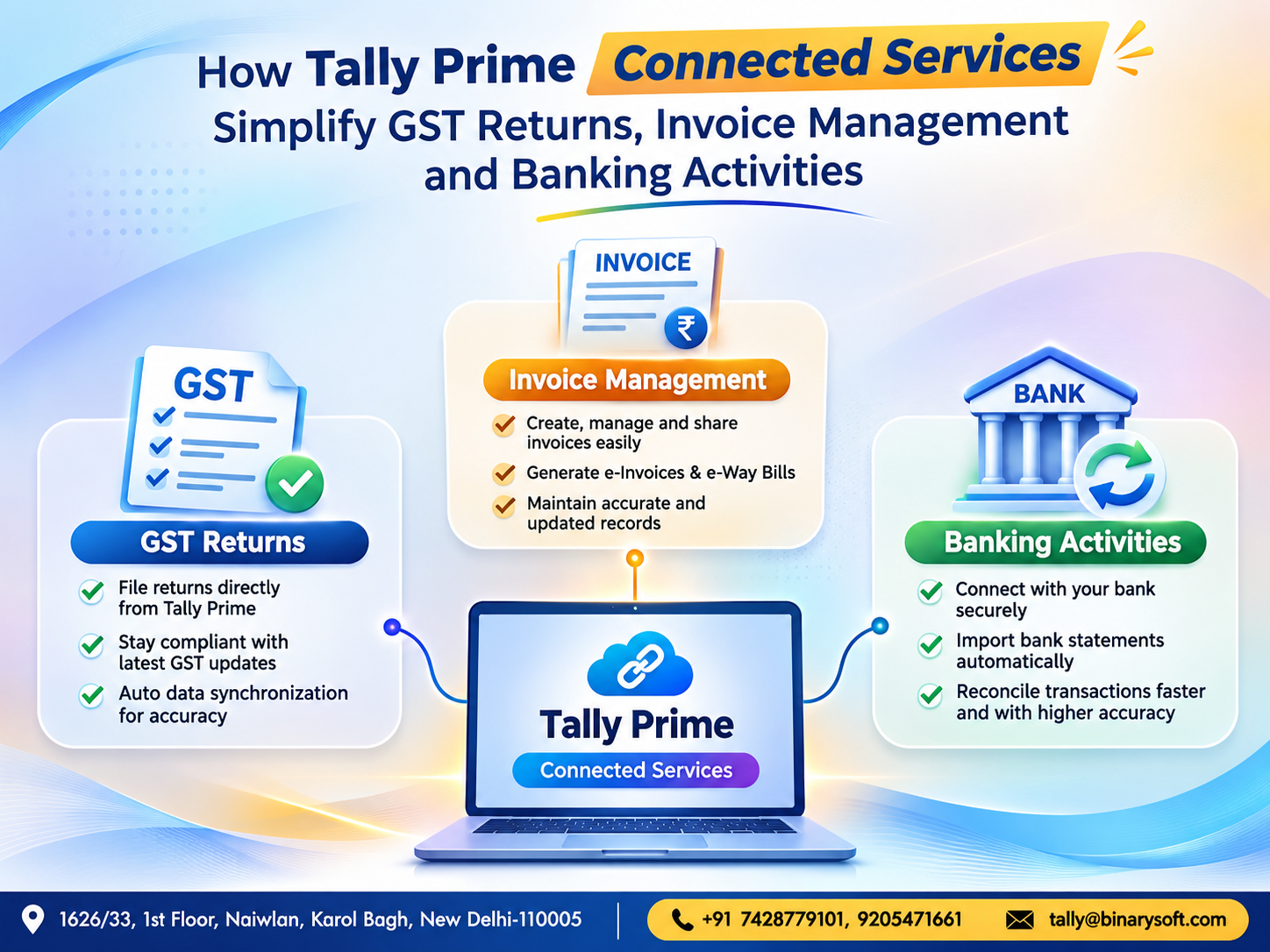
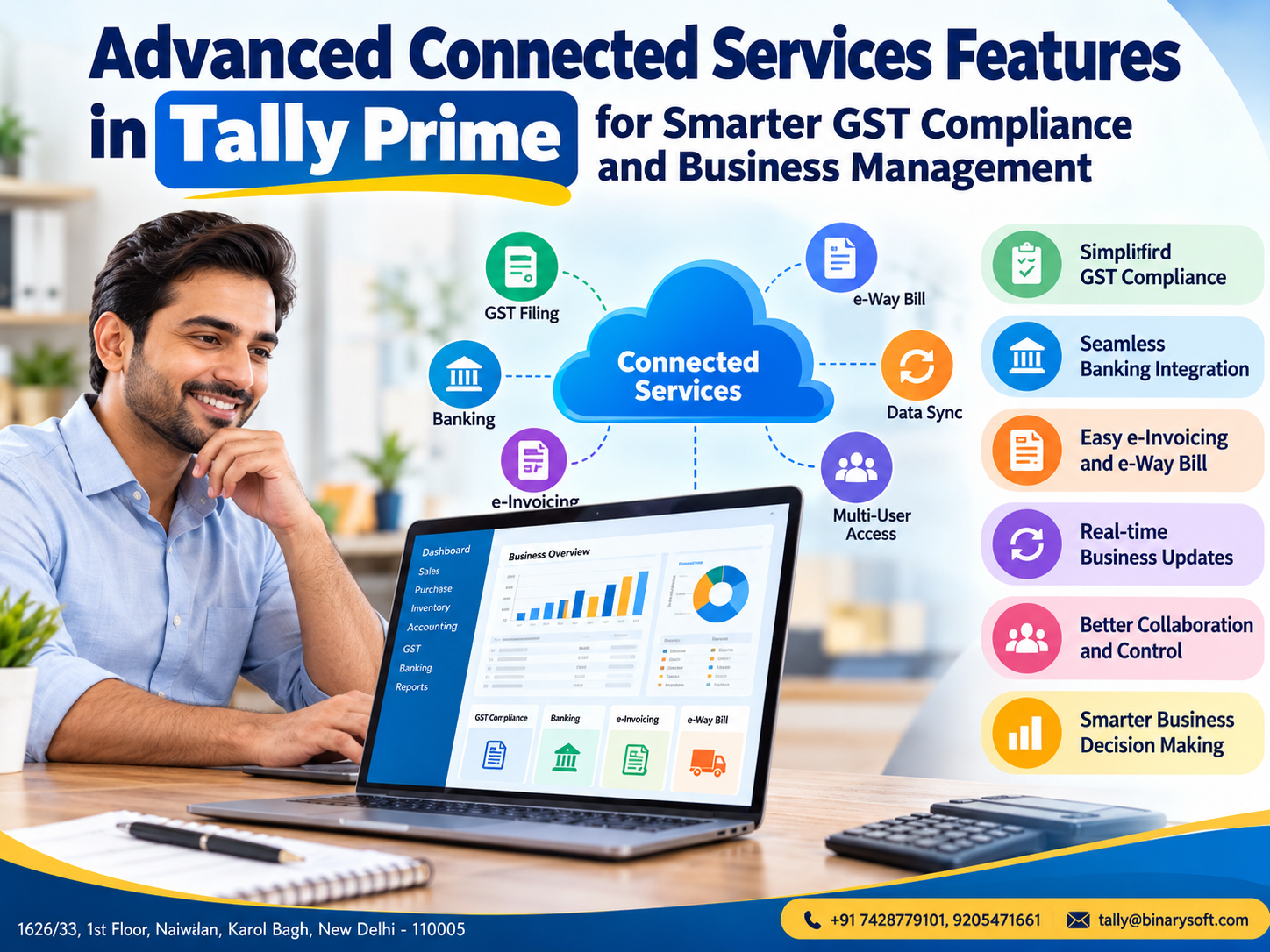
7.6 Connected GST capabilities
Supported Tally Prime releases provide connected GST functions for activities such as return-data exchange, reconciliation, and tracking.
Availability depends on the installed release, connected-service configuration, credentials, and supported return workflow.
7.7 Consistent accounting reports
Sales registers, ledger reports, and financial statements help businesses verify that reported GST values are supported by accounting transactions.
The main benefit is improved visibility and reduced dependence on repeated manual calculations.
8. Practical GST Reconciliation Workflow in Tally Prime
Businesses can establish a monthly process using the following workflow.
Step 1: Configure GST details
Open the relevant company in Tally Prime and verify GST registration information, state details, GSTIN, and applicable tax settings.
Step 2: Review sales vouchers
Check sales invoices, customer ledgers, GST classification, taxable values, and tax calculations.
Step 3: Verify adjustments
Review credit notes, debit notes, sales returns, and amendments to ensure that all applicable transactions are accounted for.
Step 4: Open GST reports
Access the GST reports through the relevant menu in your installed Tally Prime release. Review the GSTR-1 and GSTR-3B information and examine any exceptions.
Step 5: Compare with GST portal data
Download the relevant filed return information and compare it with the accounting reports.
Step 6: Investigate discrepancies
Drill down into vouchers to identify missing entries, incorrect tax treatment, and differences between the accounting and return periods.
Step 7: Make appropriate corrections
Correct the underlying books and use the legally permitted GST return amendment or payment process.
Step 8: Maintain reconciliation records
Save the final comparison statement, corrected voucher details, payment acknowledgements, and relevant supporting documents.
This workflow can be repeated monthly or quarterly, depending on the taxpayer's filing obligations.
9. Case Study One: Wholesale Electronics Distributor in Karol Bagh
Illustrative case study based on a typical wholesale trading scenario.
A wholesale electronics distributor in Karol Bagh managed approximately 600 invoices every month.
The company used separate spreadsheets for sales reporting and GST calculations. During monthly reconciliation, the accountant identified a ₹54,000 difference in output GST liability.
The problem
Investigation revealed that several invoices were duplicated during spreadsheet consolidation, while some credit notes had been recorded incorrectly.
The business was concerned about possible compliance notices and inaccurate tax reporting.
The solution
The company introduced a more structured accounting process using Tally Prime.
Sales vouchers were reviewed, customer ledger details were verified, and credit notes were matched with the original transactions.
The accountant then reconciled the accounting records against the filed GST data and identified the corrections required under the applicable GST procedures.
The outcome
The business obtained a clear explanation of the ₹54,000 difference and completed the appropriate reconciliation process.
It also introduced a monthly GST review checklist.
The most valuable improvement was not merely identifying one error. It was establishing a repeatable process for checking hundreds of invoices without depending entirely on manually consolidated spreadsheets.
10. Case Study Two: Manufacturing Business in Bawana Industrial Area
Illustrative case study showing the importance of correct tax classification.
A manufacturing company operating in Bawana Industrial Area supplied finished products to customers across several Indian states.
During a quarterly review, the finance team discovered that IGST reported in its outward supply records did not agree with the corresponding GSTR-3B figures.
The problem
Certain interstate transactions had been classified incorrectly under CGST and SGST.
Although the aggregate tax appeared close to the expected amount, the tax-head allocation was inaccurate.
The issue created reconciliation problems and uncertainty about the correct tax liability.
The solution
The company reviewed customer GSTIN details, place-of-supply information, sales vouchers, and applicable GST treatment.
Using Tally Prime reports, the team traced the affected transactions and corrected its accounting records.
The accountant assessed the appropriate GST return corrections and tax-head adjustments under the applicable rules.
The outcome
The company established more reliable interstate sales verification procedures and introduced a tax-head review before GST filing.
This reduced the risk of similar classification errors in subsequent periods.
The case demonstrates why comparing only the total GST amount is insufficient. Accurate IGST, CGST, and SGST classification is equally important.
11. Financial and Operational Benefits of Regular GST Reconciliation
Regular GST reconciliation provides benefits beyond statutory compliance.
Better financial accuracy
Accurate outward tax liability helps businesses understand their actual GST obligations and avoid unexpected adjustments.
Improved cash flow planning
Identifying additional tax liabilities early allows businesses to plan payments instead of facing sudden financial pressure.
Reduced compliance uncertainty
A documented reconciliation process makes it easier to explain reporting differences and respond to GST communications.
More reliable customer records
Correct outward supply reporting supports consistency between supplier and customer GST information.
Stronger management control
Business owners can review sales, tax liabilities, adjustments, and accounting records with greater confidence.
Improved audit readiness
Maintaining invoices, reconciliations, amendment records, and tax payment evidence supports internal reviews and statutory examinations.
12. Monthly GST Reconciliation Checklist
13. Best Practices to Prevent Future GST Mismatches
Businesses should adopt preventive controls rather than waiting for an error to appear after filing.
First, maintain consistent invoice numbering and avoid duplicate voucher entries.
Second, verify GST registration information, applicable rates, and place-of-supply details before finalizing transactions.
Third, establish a monthly cutoff procedure so that late entries and backdated changes are reviewed carefully.
Fourth, reconcile credit notes and debit notes with original transactions and applicable reporting periods.
Fifth, use GST reports in Tally Prime to review incomplete information and unusual transactions before filing.
Finally, assign responsibility for preparing, reviewing, and approving GST returns. A second-level review can help identify mistakes that the original preparer may overlook.
For growing businesses, these controls can become an important part of financial governance.
14. Why GST Reconciliation Matters for Growing Indian Businesses
As businesses expand, transaction volumes increase and accounting processes become more complex.
A small retailer may initially manage a limited number of invoices, while a growing distributor may process hundreds or thousands of transactions across multiple locations.
Without proper controls, the risk of incorrect reporting increases.
Tally Prime can support centralized accounting records, transaction verification, inventory-linked invoicing, and GST reporting. These capabilities help businesses create a more dependable foundation for compliance.
However, software does not replace professional judgment. GST liability must still be determined according to the law, and unusual transactions or complex amendments should be reviewed by a qualified GST professional.
The most effective approach combines accurate accounting software, trained staff, documented reconciliation procedures, and timely review.
Conclusion
A mismatch between GSTR-1 and GSTR-3B should never be ignored, but it should not automatically be treated as proof of unpaid tax.
The correct approach is to identify the underlying transaction, compare corresponding GST liabilities, investigate reporting differences, and determine the appropriate correction.
Missing invoices, duplicate entries, incorrect tax classifications, credit note errors, and timing differences are among the common causes of mismatches.
With regular reconciliation, reliable accounting records, and the reporting capabilities of Tally Prime, businesses can identify problems earlier and maintain stronger GST compliance.
For retailers, wholesalers, manufacturers, distributors, and service providers, accurate GST reconciliation is an investment in financial stability, business confidence, and long-term growth.
Powered by Binarysoft Technologies Authorized Tally Partner
Location: 1626/33, 1st Floor, Naiwalan, Karol Bagh, New Delhi – 110005, INDIA
Contact us: +91 7428779101, 9205471661
Email us: tally@binarysoft.com
Business Hours: 10:00 AM – 6:00 PM, Monday to Friday