Call CA Tally HelpDesk
+91 9205471661,
7428779101
When Managing Business Accounts Becomes More Difficult Than Running the Business
Every successful business begins with an ambition. For some entrepreneurs, it means opening a small retail shop. For others, it involves establishing a manufacturing unit, distribution network or professional service company.
However, as businesses grow, managing financial transactions becomes increasingly complicated.
GST invoices must be prepared accurately. Customer payments need continuous monitoring. Supplier bills require timely recording. Inventory movements must match accounting records, and financial reports must provide reliable information for decision-making.
Imagine completing an exhausting business day only to spend another three hours checking invoices, reconciling payments and preparing financial statements.
For thousands of Indian business owners, this situation is familiar.
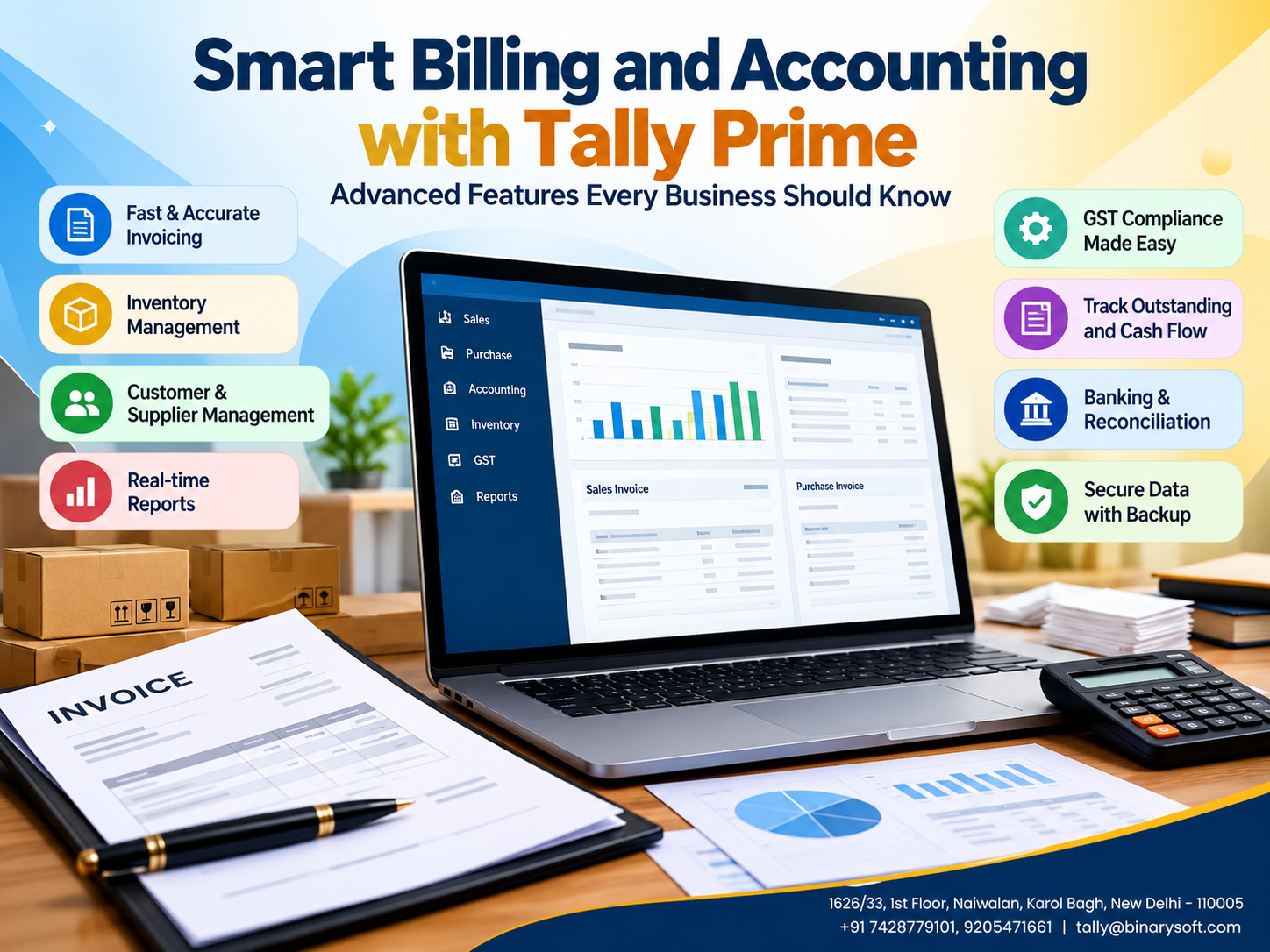
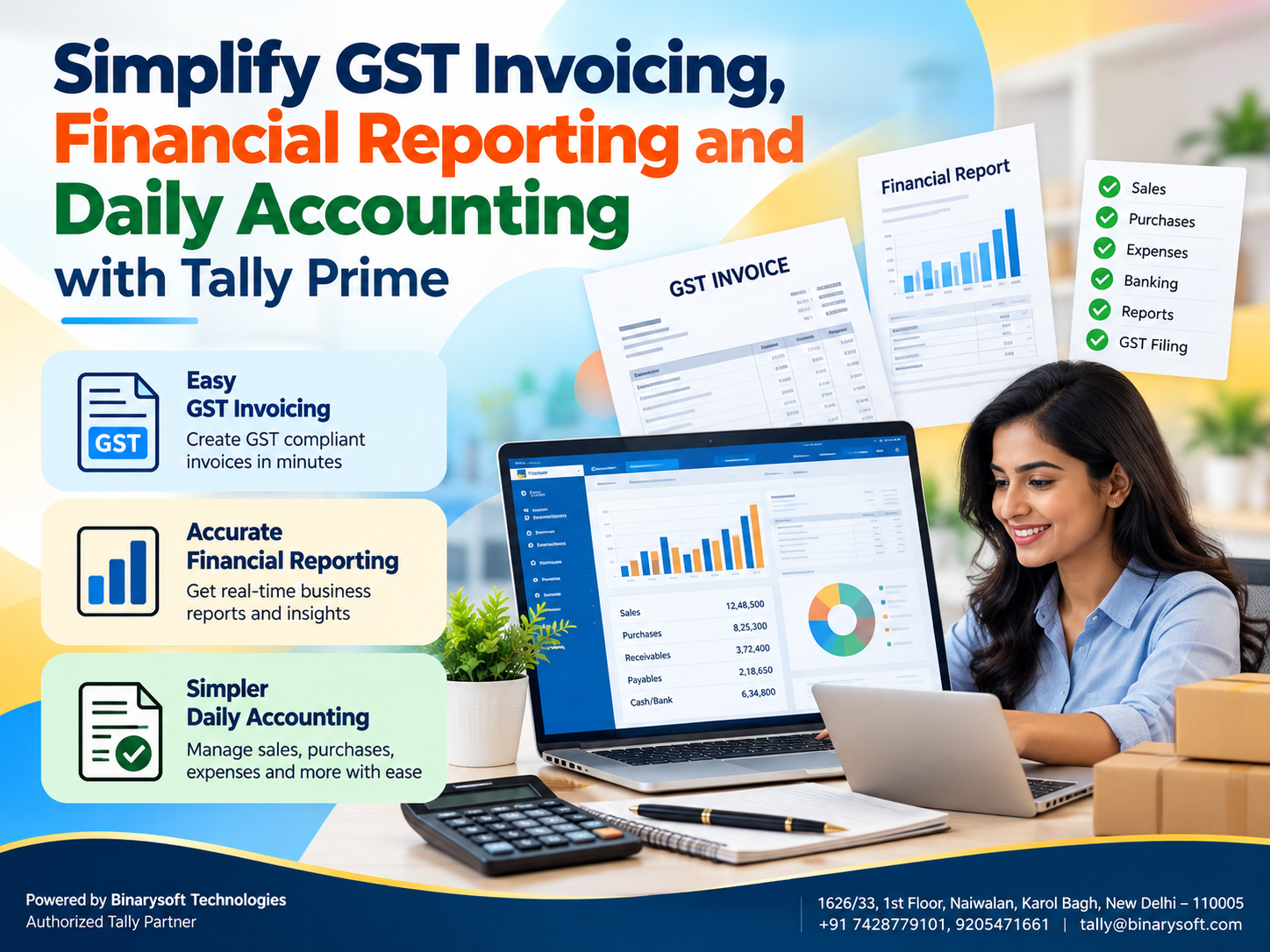
Tally Prime helps simplify these responsibilities by bringing GST invoicing, financial reporting, inventory tracking and everyday accounting into one integrated business management environment.
Instead of depending on disconnected spreadsheets and manual calculations, businesses can maintain organized financial records, generate reports and improve operational efficiency.
This guide explains how Tally Prime can transform daily accounting activities, reduce repetitive work and support sustainable business growth.
1. A Business Owner's Story: The Night an Accounting Mistake Almost Changed Everything
Rajesh operated a wholesale electrical goods business in Karol Bagh, New Delhi.
His father had established the business nearly twenty years earlier, and Rajesh was determined to expand it.
Customer orders were increasing, and his warehouse was becoming busier every month.
However, behind the growing sales figures was a serious problem.
His accounting system depended on spreadsheets, handwritten invoices and manually maintained customer payment records.
One evening, Rajesh received an unexpected call from an important customer.
The customer claimed that an invoice contained incorrect GST details and that the outstanding balance shown in Rajesh's records did not match the customer's statement.
Rajesh immediately opened his accounting files.
After nearly four hours of checking documents, he discovered several problems.
A customer payment had been recorded against the wrong invoice. One sales entry contained an incorrect tax classification, and a purchase invoice had not been entered into the accounts.
Rajesh felt overwhelmed.
He was not worried only about the accounting mistakes. He feared losing the trust of customers who had supported his family business for years.
That night, he realized something important.
Growing a business requires more than increasing sales. It requires reliable financial information.
Rajesh decided to organize his business accounting using Tally Prime.
Over the following weeks, his team established structured customer ledgers, configured GST details, recorded transactions consistently and began reviewing outstanding reports.
The improvement was gradual but meaningful.
Invoices became easier to prepare, customer balances were more transparent, and financial reports became available without manually combining multiple spreadsheets.
Most importantly, Rajesh could spend more time developing customer relationships instead of searching for accounting mistakes.
This illustrative story reflects a challenge faced by many growing businesses: accounting efficiency directly influences business confidence.
2. Why Modern Businesses Need Integrated GST Invoicing and Accounting
Traditional accounting methods may work when transaction volumes are small.
However, increasing sales, multiple customers, inventory movements and regulatory requirements make manual processes difficult to manage.
Common accounting challenges include:
-
Incorrect GST calculations and invoice classifications.
-
Duplicate or missing transaction entries.
-
Delayed preparation of financial statements.
-
Difficulty tracking outstanding customer payments.
-
Mismatches between physical inventory and accounting records.
-
Time-consuming bank reconciliation.
-
Limited visibility into daily profitability.
-
Dependence on multiple spreadsheets and applications.
An integrated accounting system addresses these challenges by connecting financial transactions with relevant business records.
For example, when a properly configured sales invoice is recorded in Tally Prime, the transaction can update the customer's ledger, sales accounts, applicable tax ledgers and inventory records.
This reduces the need to enter the same information repeatedly.
The result is a more organized accounting process and improved financial visibility.
3. Simplify GST Invoicing with Tally Prime
GST invoicing is one of the most important accounting responsibilities for businesses operating in India.
Incorrect tax rates, missing invoice information or inaccurate GSTIN details can create reconciliation difficulties and compliance risks.
Tally Prime provides GST-related accounting capabilities designed to simplify the preparation and management of tax invoices.
Create Professional GST Invoices
Businesses can prepare invoices containing essential transaction details such as:
-
Supplier and customer information.
-
GSTIN and billing addresses.
-
Invoice number and date.
-
Product or service descriptions.
-
HSN or SAC classifications.
-
Taxable value and applicable GST rates.
-
CGST, SGST or IGST amounts.
-
Discounts, additional charges and invoice totals.
Invoice formats can be configured according to business requirements and supported customization options.
Calculate GST During Invoice Preparation
Once the relevant tax classifications and configurations are established, Tally Prime can calculate applicable GST amounts during voucher entry.
This helps reduce manual calculation errors.
For example, consider a taxable sale worth ₹50,000 with an applicable GST rate of 18%.
The calculation would be:
Taxable Value: ₹50,000
GST at 18%: ₹9,000
Total Invoice Value: ₹59,000
For an eligible intra-state transaction, the tax may be divided into CGST and SGST. For an eligible inter-state transaction, IGST generally applies.
Actual treatment depends on the nature of supply, place-of-supply rules and applicable GST provisions.
Manage Different Types of GST Transactions
Businesses frequently handle transactions involving different tax treatments.
Tally Prime supports accounting for various GST transaction categories, subject to appropriate configuration, including local sales, inter-state sales, purchases, credit notes and debit notes.
Businesses can also maintain relevant records for exempt, nil-rated and other specially treated supplies.
Correct tax classification remains essential.
Support GST Return Preparation
Accurate transaction recording helps businesses prepare GST-related reports and review information required for returns such as GSTR-1 and GSTR-3B.
Depending on the software release, configuration and connected-service availability, additional return preparation, reconciliation and filing capabilities may be available.
Businesses should review return data and verify applicable compliance requirements before submission.
4. Improve Daily Accounting Efficiency with Tally Prime
Daily accounting involves recording business transactions consistently and accurately.
Even a small business may process dozens of sales, purchases, payments and receipts every day.
Managing these activities manually consumes valuable time.
Tally Prime simplifies routine accounting through structured voucher entry and integrated ledgers.
Sales Accounting
Businesses can record sales transactions and maintain customer-wise financial information.
Sales reports help identify transaction values, customer activity and outstanding balances.
Purchase Accounting
Purchase invoices can be recorded against relevant suppliers, expense accounts and inventory items.
This helps maintain accurate purchase records and supports supplier reconciliation.
Payment and Receipt Management
Cash and bank transactions can be recorded using appropriate payment and receipt vouchers.
Businesses can review transaction histories and maintain clearer cash and bank records.
Journal Entries
Journal vouchers support accounting adjustments, provisions and other entries that do not directly involve ordinary cash receipts or payments.
Contra Transactions
Transfers between cash and bank accounts can be recorded using contra vouchers.
Credit and Debit Notes
Businesses can record sales returns, purchase returns and eligible value adjustments using appropriate voucher types.
By organizing these transactions within a single accounting environment, businesses can reduce duplication and improve record consistency.
5. Generate Accurate Financial Reports for Better Decision-Making
Financial reporting is essential for understanding business performance.
Without reliable reports, business owners may struggle to identify profitability, expenses, liabilities and available working capital.
Tally Prime provides several important financial statements and accounting reports.
Profit and Loss Account
The Profit and Loss Account summarizes income and expenses for a selected accounting period.
It helps businesses evaluate profitability and identify major expense categories.
For example, a distributor may discover that transportation expenses have increased faster than sales revenue.
This information can support pricing reviews and operational improvements.
Balance Sheet
The Balance Sheet provides a financial snapshot of assets, liabilities and capital at a particular date.
Business owners can use it to understand their overall financial position.
Trial Balance
A Trial Balance summarizes ledger balances and helps accountants review accounting records.
Although a balanced trial balance does not guarantee that every transaction is correct, it remains an important verification tool.
Cash Flow Statement
Cash flow reporting helps businesses understand how cash is generated and used.
This is especially valuable for businesses that generate significant credit sales.
Outstanding Receivables and Payables
Receivables reports identify customer amounts awaiting collection.
Payables reports help businesses review outstanding supplier obligations.
These reports support better payment planning and working capital management.
The greatest advantage of integrated financial reporting is that reports can reflect recorded transactions without requiring separate manual compilation.
6. How Tally Prime Helps Businesses Improve GST Compliance
GST compliance requires more than generating invoices.
Businesses must maintain accurate transaction records, classify supplies correctly, review tax information and meet applicable filing obligations.
Tally Prime supports these activities through structured accounting records and GST-related reports.
Maintain Organized GST Records
Sales and purchase transactions can be maintained with relevant tax information.
This helps accountants review transaction details when preparing returns or responding to reconciliation queries.
Identify Potential Reporting Issues
GST reports and available exception or validation features can help users identify transactions requiring correction.
However, software checks cannot replace verification of legal eligibility, tax treatment or source documents.
Review Input Tax Credit Information
Businesses can maintain purchase records and use supported reconciliation facilities to assist with input tax credit reviews.
Actual ITC eligibility depends on applicable GST law, supplier compliance and other statutory conditions.
Support E-Invoicing and E-Way Bill Processes
Eligible businesses may use supported Tally Prime capabilities or connected services for e-invoicing and e-way bill activities.
Availability depends on the installed release, applicable thresholds, configuration and service connectivity.
Reduce Last-Minute Compliance Pressure
Regular transaction recording and periodic reconciliation make return preparation more manageable.
Instead of correcting several months of records at once, accountants can review discrepancies throughout the reporting period.
7. Manage Inventory and Accounting Together
Inventory management directly affects profitability, customer satisfaction and working capital.
Businesses dealing with physical goods must monitor stock quantities, purchases, sales and inventory valuation.
Tally Prime integrates inventory records with relevant accounting transactions.
Stock Item Management
Businesses can create stock items with appropriate units of measurement and classifications.
Stock Groups and Categories
Products can be organized into meaningful groups for easier reporting.
Godown Management
Businesses operating multiple warehouses can maintain location-wise stock records.
Batch-Wise Inventory
Where applicable, batch tracking can help businesses manage products according to batch numbers and relevant dates.
This is particularly useful for pharmaceutical distributors, food businesses and other industries requiring traceability.
Stock Summary Reports
Stock reports provide visibility into recorded inventory quantities and values.
Reorder Planning
Businesses can use inventory information and supported reorder-level features to assist purchase planning.
By integrating stock and financial records, businesses can make more informed purchasing decisions and reduce avoidable inventory discrepancies.
8. Case Study One: How an Electrical Goods Distributor Improved Billing Accuracy
Business Type: Electrical Goods Wholesale Distribution
Location: Bhagirath Palace, Delhi
Business Challenge: GST invoice errors and customer payment reconciliation
The following is an illustrative case study showing how a typical distributor could improve accounting processes.
The Challenge
An electrical goods distributor handled hundreds of product varieties and served retailers across Delhi NCR.
Its accounting staff maintained sales invoices in one application and customer outstanding records in spreadsheets.
As transaction volumes increased, the business experienced several difficulties.
Customer balances were not always updated promptly, GST invoice corrections required additional effort, and monthly reporting involved extensive manual work.
The owner wanted a system that could manage billing, accounting and stock records together.
The Tally Prime Implementation
The distributor introduced Tally Prime with a structured accounting setup.
The implementation included customer and supplier ledgers, GST classifications, inventory masters and standardized invoice formats.
Employees received training on sales vouchers, receipt entries and outstanding reports.
Management also introduced a daily review process to identify unrecorded transactions.
Illustrative Results
After the new workflow became established, the business experienced improvements in operational organization.
Billing information became more consistent, customer balances were easier to review, and inventory reports provided better visibility into recorded stock.
The owner could examine sales performance and outstanding collections without waiting for separate spreadsheet summaries.
Key Learning
Integrated accounting can improve operational control when supported by correct master data, trained employees and regular transaction verification.
9. Case Study Two: A Manufacturing Business Gains Better Financial Visibility
Business Type: Small Manufacturing Enterprise
Location: Faridabad, Haryana
Business Challenge: Delayed financial reporting and inconsistent inventory records
This illustrative case study demonstrates how Tally Prime can support a manufacturing business.
The Challenge
A small manufacturing company supplied fabricated components to industrial customers.
The business maintained raw material purchases, production-related records and financial transactions using disconnected systems.
Its accountant required several days after each month-end to prepare management reports.
The business owner frequently struggled to understand actual expenses and customer receivables.
The Tally Prime Implementation
The company organized its accounting and inventory records using Tally Prime.
Relevant raw material and finished goods masters were established.
Purchase and sales transactions were recorded systematically, and suitable inventory and manufacturing-related features were configured according to the company's requirements.
The accountant began reviewing the Profit and Loss Account, Balance Sheet and outstanding reports regularly.
Illustrative Results
The company gained more timely access to recorded financial information.
Management could identify expense movements, review customer dues and examine inventory values with greater consistency.
Regular reporting also helped the owner discuss financial performance more effectively with the accountant.
Key Learning
Manufacturing businesses benefit when accounting, inventory records and management reporting follow a consistent process.
10. Improve Cash Flow and Customer Payment Management
Profitability and cash availability are not the same.
A business may report strong sales while struggling to pay suppliers because customers have not cleared their invoices.
Tally Prime helps businesses monitor customer receivables and supplier payables.
Track Customer Outstanding Balances
Customer-wise reports help identify amounts awaiting collection.
Monitor Bill-Wise Details
When bill-wise tracking is enabled and used consistently, businesses can associate receipts with outstanding invoices.
Review Overdue Payments
Ageing and outstanding reports help identify invoices requiring follow-up.
Plan Supplier Payments
Payables information helps businesses understand upcoming payment obligations.
Strengthen Working Capital Decisions
By reviewing receivables, payables and cash information together, business owners can make more informed decisions about credit periods, purchases and expenses.
A disciplined collection process can reduce unnecessary financial pressure and improve business stability.
11. Simplify Bank Reconciliation and Transaction Monitoring
Bank reconciliation is an important part of accurate accounting.
Differences between bank statements and accounting records may arise from unrecorded charges, outstanding payments, delayed deposits or incorrect entries.
Tally Prime provides banking and reconciliation features that help businesses compare recorded transactions with bank information.
Depending on the release and supported banking facilities, users may be able to import bank statements or use additional connected banking capabilities.
Regular reconciliation helps identify missing entries, duplicate records and timing differences.
Businesses should also maintain appropriate approval controls and verify transactions against authentic bank records.
12. Use Tally Prime for Better Business Reporting
Different business owners require different management information.
A retailer may focus on daily sales and stock movement.
A wholesaler may prioritize customer outstanding balances.
A manufacturer may need expense, inventory and profitability reports.
Tally Prime supports multiple reporting views that can help businesses examine their financial and operational performance.
Useful reports include sales registers, purchase registers, ledger statements, stock summaries, cash and bank books, outstanding statements and financial statements.
Business owners can use these reports to answer important questions.
Which customers contribute the most sales?
Which invoices remain unpaid?
Are operating expenses increasing?
How much stock is recorded in each warehouse?
Is the business generating sufficient profit?
Accurate answers depend on timely transaction entry and appropriate accounting configuration.
13. How to Start Using Tally Prime for Daily Accounting
Businesses planning to introduce Tally Prime should follow a structured implementation process.
Step 1: Create the Company
Enter the business name, financial year, accounting details and relevant statutory information.
Step 2: Configure GST
Enable applicable GST features and enter the correct registration information.
Step 3: Create Accounting Ledgers
Establish customer, supplier, bank, expense, income and tax ledgers.
Step 4: Configure Inventory
Create stock groups, units, stock items and locations where required.
Step 5: Set Up Invoice Formats
Configure suitable invoice details, numbering and printing preferences.
Step 6: Record Opening Balances
Enter verified opening ledger and inventory balances.
Step 7: Begin Transaction Entry
Record sales, purchases, receipts, payments and other relevant vouchers.
Step 8: Review Reports
Examine accounting, GST, inventory and outstanding reports regularly.
Step 9: Establish Security and Backup Procedures
Assign appropriate user permissions and maintain verified data backups.
Step 10: Train Employees
Provide practical training so employees understand correct transaction entry, reconciliation and reporting procedures.
A phased implementation reduces disruption and supports more reliable accounting records.
14. Benefits of Using Tally Prime for Small and Medium Businesses
Tally Prime offers several practical advantages for businesses seeking organized accounting processes.
Time Savings: Integrated transaction recording reduces repetitive manual work.
Improved Accuracy: Configured calculations and standardized workflows help reduce avoidable errors.
Financial Visibility: Updated reports provide insight into recorded business performance.
GST Management: GST-related features assist invoice preparation, tax accounting and return-data review.
Inventory Control: Integrated stock records support inventory monitoring and purchasing decisions.
Payment Monitoring: Outstanding reports help businesses identify receivables and payables.
Scalability: Businesses can configure accounting and inventory processes according to changing operational requirements.
Better Decision-Making: Reliable financial information supports pricing, credit, purchasing and investment decisions.
These benefits depend on correct implementation, suitable configurations and disciplined accounting practices.
15. Advanced Tally Prime Features for Modern Business Accounting
Modern businesses need accounting software that supports both routine transactions and changing operational requirements.
Recent Tally Prime releases have introduced enhanced connected banking, GST reconciliation, transaction monitoring and data management capabilities.
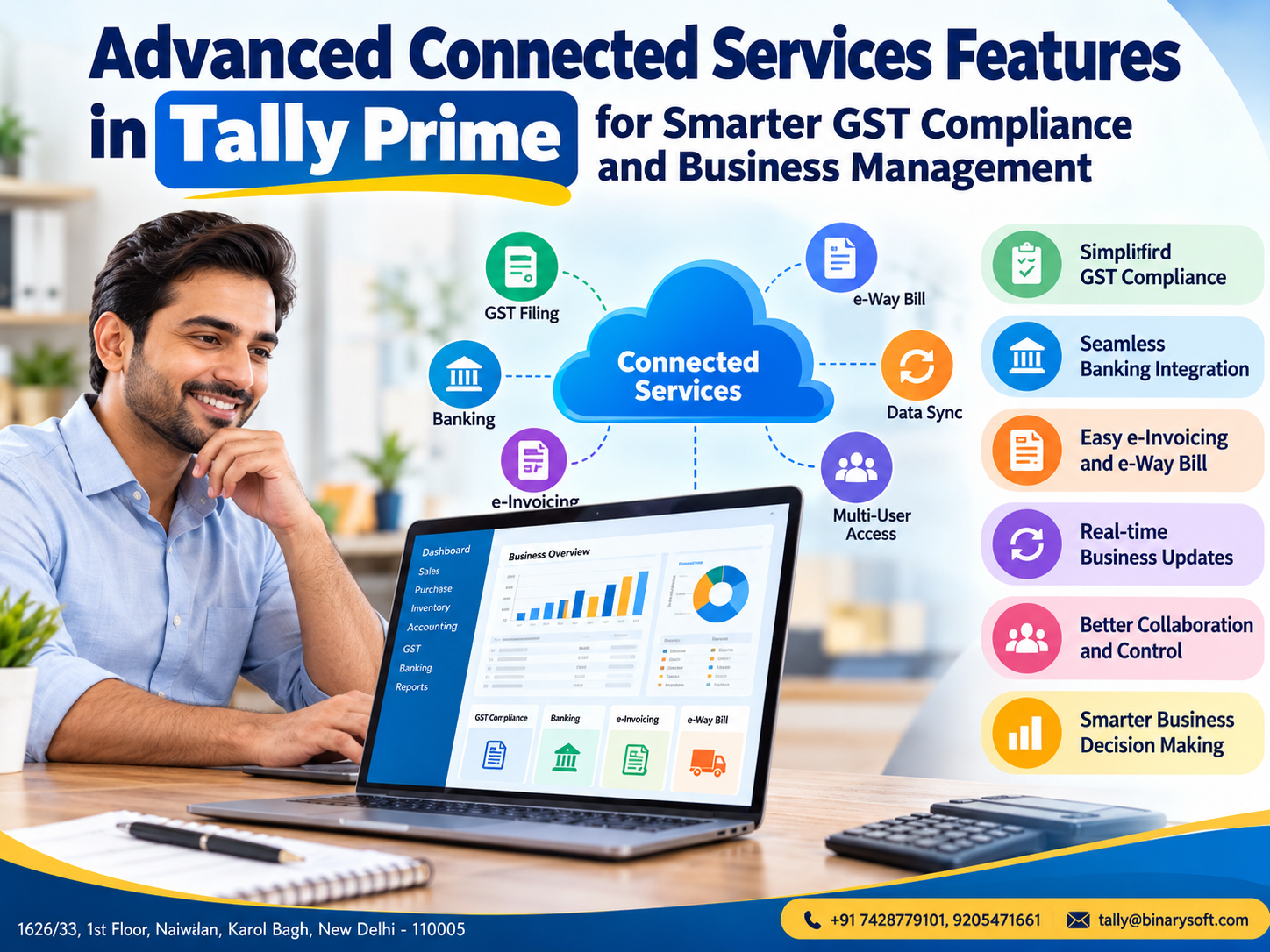
Connected GST Services
Supported releases allow businesses to perform selected GST-related activities directly from the accounting environment.
These capabilities can reduce repeated data transfers between accounting records and government portals.
Invoice Management System Reconciliation
Supported IMS functionality helps businesses review supplier invoice information and manage relevant input tax credit reconciliation activities.
This can improve visibility into purchase-related discrepancies.
Enhanced Banking Features
Connected banking and improved bank reconciliation facilities help reduce repetitive transaction matching.
Edit Log and Transaction Monitoring
Supported edit-log capabilities help businesses review changes made to accounting records.
This improves transparency and supports internal control procedures.
Data Backup and Business Continuity
Regular backups help protect important accounting information.
Businesses should maintain secure backup locations, restrict unauthorized access and periodically test restoration procedures.
Feature availability varies according to the installed release, license, configuration and connected services.
16. How Tally Prime on Cloud Can Improve Business Accessibility
Businesses increasingly require access to accounting information from different offices and locations.
Tally Prime can be deployed in suitable hosted environments, allowing authorized users to work with company data remotely.
A properly configured Tally Prime cloud environment may provide several advantages.
Remote Accessibility: Authorized employees can access accounting applications from supported locations and devices.
Centralized Data Management: Teams can work with a centrally maintained accounting database.
Multi-Location Collaboration: Branch offices can coordinate accounting activities more efficiently.
Backup Management: Hosting arrangements may include scheduled backup services, depending on the provider and selected plan.
Business Continuity: Appropriate hosting infrastructure can reduce dependence on a single office computer.
Scalable Infrastructure: Hosting resources may be adjusted as business requirements change.
Cloud deployment does not automatically guarantee uninterrupted service or complete data security. Businesses should evaluate hosting reliability, access controls, backup policies and recovery procedures.
For organizations with multiple employees or offices, professionally managed Tally Prime cloud hosting can provide a practical alternative to maintaining all accounting infrastructure locally.
17. Best Practices for Accurate GST Accounting and Financial Reporting
Even powerful accounting software requires disciplined business processes.
Organizations should adopt consistent accounting practices to improve reliability.
Record transactions promptly instead of postponing entries until month-end.
Verify GSTIN details, HSN or SAC classifications and applicable tax treatment before issuing invoices.
Reconcile bank transactions regularly and investigate unexplained differences.
Review customer outstanding reports to identify delayed collections.
Compare recorded inventory with physical stock at suitable intervals.
Maintain separate user permissions according to employee responsibilities.
Create regular backups and verify that data can be restored successfully.
Review financial statements periodically with qualified accounting professionals.
These practices help businesses use Tally Prime more effectively while reducing avoidable operational risks.
18. Why Choose Binarysoft Technologies for Tally Prime Implementation?
Selecting accounting software is only one part of improving business operations.
Correct configuration, employee training and ongoing technical support are equally important.
Binarysoft Technologies helps businesses adopt Tally Prime according to their accounting and operational requirements.
As an Authorized Tally Partner, Binarysoft Technologies assists businesses with Tally Prime-related solutions, including implementation guidance, GST accounting configuration, inventory setup, financial reporting and cloud deployment requirements.
Businesses can seek assistance with:
-
Tally Prime installation and configuration.
-
GST invoicing and accounting setup.
-
Customer and supplier ledger management.
-
Inventory and godown configuration.
-
Financial reporting and reconciliation workflows.
-
Tally Prime cloud hosting requirements.
-
Multi-user accounting environments.
-
Data backup and migration planning.
-
Employee training and technical support.
The objective is to help organizations establish reliable accounting workflows that support their everyday business activities.
Conclusion: Simplify Accounting Today and Build a Stronger Business Tomorrow
Managing GST invoicing, financial reporting and daily accounting should not become an obstacle to business growth.
When businesses depend on disconnected records and repetitive manual processes, accounting becomes time-consuming and difficult to control.
Tally Prime provides an integrated environment for recording financial transactions, preparing GST invoices, monitoring inventory, reviewing outstanding payments and generating financial reports.
For retailers, wholesalers, manufacturers, distributors and service providers, these capabilities can improve accounting consistency and support better business decisions.
The real value of accounting software is not simply faster invoice preparation.
It is the confidence that comes from having organized financial records, clearer payment information and timely management reports.
By combining Tally Prime with proper implementation, employee training and regular accounting reviews, businesses can establish stronger financial processes.
Simplify GST invoicing, improve financial visibility and make everyday accounting more efficient with Tally Prime.
Powered by Binarysoft Technologies
Authorized Tally Partner
Location: 1626/33, 1st Floor, Naiwalan, Karol Bagh, New Delhi – 110005, INDIA
Contact Us: +91 7428779101, 9205471661
Email: tally@binarysoft.com
Business Hours: 10:00 AM – 6:00 PM, Monday to Friday
Frequently Asked Questions
What is Tally Prime used for?
Tally Prime is business accounting software used for financial accounting, GST invoicing, inventory management, banking transactions, outstanding payment tracking and financial reporting.
Can Tally Prime generate GST invoices?
Yes. Tally Prime supports GST invoice preparation with relevant customer details, tax classifications, taxable values and applicable GST calculations.
Does Tally Prime calculate GST automatically?
Tally Prime can calculate GST during transaction entry when the relevant tax rates, classifications and accounting configurations are correctly established.
Can Tally Prime generate financial statements?
Yes. Tally Prime provides financial reports such as the Balance Sheet, Profit and Loss Account, Trial Balance and other accounting statements.
CA. Aarav Bhandari specializes in GST compliance, accounting systems, and business advisory services. He regularly writes about tax updates, accounting automation, and financial best practices to help businesses improve efficiency and maintain statutory compliance.