Call CA Tally HelpDesk
+91 9205471661,
7428779101
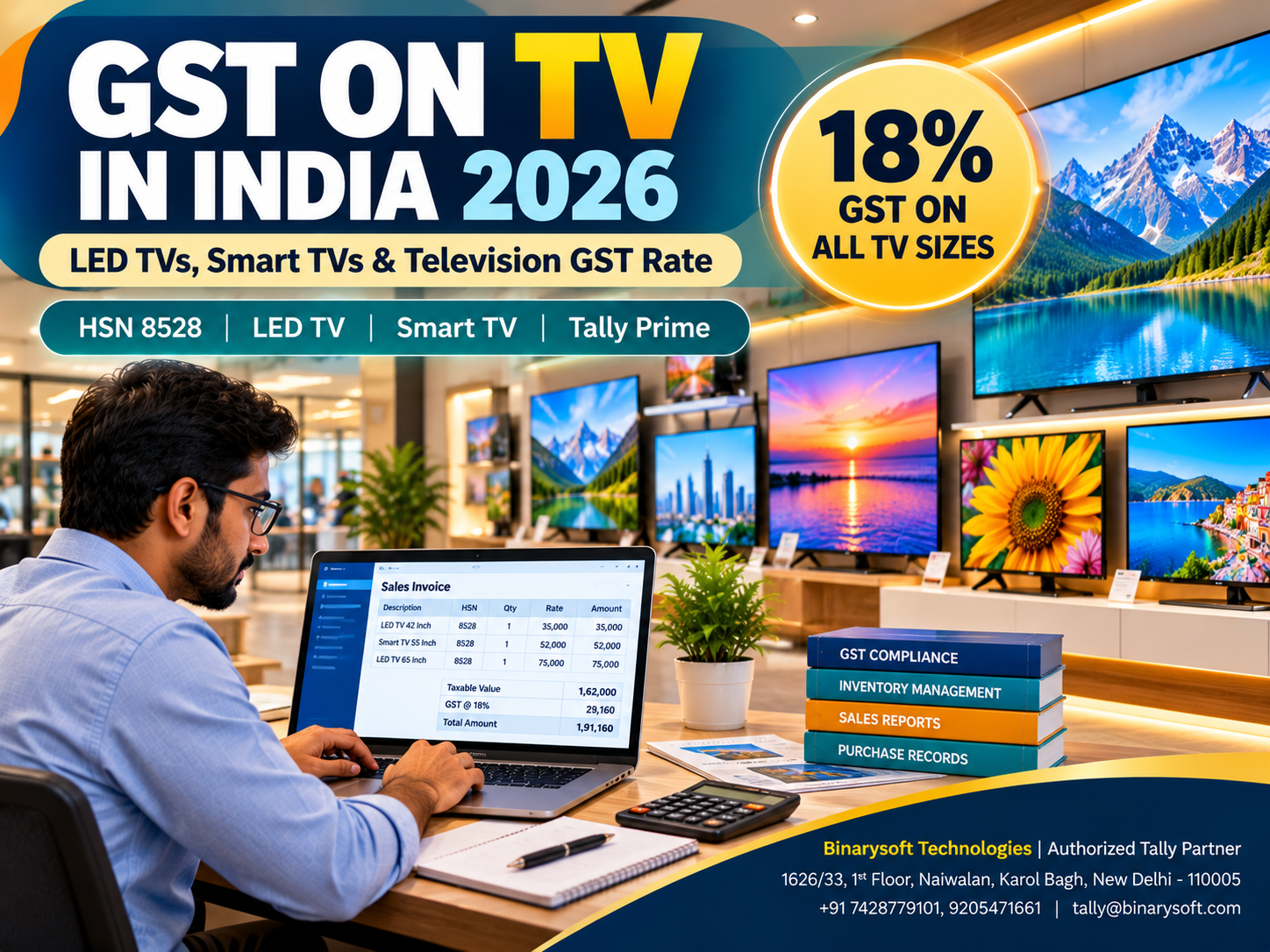
Introduction: Why the New GST Rate on Televisions Matters in 2026
A television is more than an electronic appliance in an Indian household. It brings families together for cricket matches, entertainment, education and memorable celebrations.
For many families, purchasing a large-screen Smart TV is an important investment that requires careful budgeting.
In 2026, understanding GST on televisions has become particularly relevant following the major tax changes introduced in September 2025.
Earlier, televisions above 32 inches generally attracted 28% GST, while smaller models attracted 18%. The revised structure brought television sets of all sizes under a uniform 18% GST rate.
This change matters not only to consumers but also to electronics retailers, wholesalers, distributors and manufacturers.
Businesses must update tax configurations, calculate selling prices accurately and maintain reliable GST records.
Incorrect classification or outdated billing settings can create customer disputes and tax reporting errors.
This comprehensive guide explains the latest GST rates, HSN codes, price examples, input tax credit rules and practical ways Tally Prime can simplify television sales accounting.
An Emotional Story: A Family's Dream of Buying Their First Smart TV
For several years, Ramesh and his family watched their favourite programmes on an ageing television.
Ramesh worked in a private company in Delhi, while his wife managed their household expenses carefully.
Their children often requested a larger Smart TV for educational videos, movies and cricket matches.
But every time Ramesh visited an electronics showroom, the price made him reconsider.
He had other responsibilities, including school fees, household expenses and savings for emergencies.
One Sunday, his daughter asked whether they could watch the next cricket tournament on a new television.
Ramesh promised that he would try.
A few months later, he visited a showroom again.
This time, the salesperson explained the revised GST rate on larger televisions and provided a clear price breakdown.
Ramesh compared different models and selected a television that suited his budget.
When the new Smart TV arrived, his children gathered excitedly around the screen.
His wife smiled as the family watched their first movie together.
For Ramesh, the purchase was not simply about better picture quality. It represented a promise fulfilled.
This fictional story illustrates the emotional and financial importance of household purchases.
The lesson is meaningful: transparent taxation and accurate pricing help families make confident purchasing decisions.
1. What Is GST on Television in India?
Goods and Services Tax is an indirect tax applicable to the taxable supply of television sets in India.
GST generally forms part of the final selling price paid by the customer.
The applicable rate depends on the product's classification under the GST tariff and relevant notifications.
Televisions are generally classified under HSN heading 8528.
From 22 September 2025, television sets across screen sizes generally attract 18% GST.
For dealers, correct classification and tax calculation are essential for preparing compliant invoices and maintaining accurate accounting records.
2. Latest GST Rate on TV in India in 2026
The GST rate on television sets is 18%, irrespective of screen size.
This includes conventional LED TVs, LCD TVs, Smart TVs and other television display technologies that qualify under the relevant television classification.
| Television category | GST rate |
|---|
| 24-inch television |
18% |
| 32-inch LED TV |
18% |
| 40-inch Smart TV |
18% |
| 43-inch LED or Smart TV |
18% |
| 50-inch television |
18% |
| 55-inch Smart TV |
18% |
| 65-inch television |
18% |
| Larger television sets |
18% |
The applicable rate is based on the product's legal classification, not merely its screen size or marketing description.
Businesses should verify classification for unusual products, specialized displays or bundled supplies.
3. What Changed in Television GST Rates After September 2025?
The revised GST structure became effective on 22 September 2025.
Before this change, televisions up to 32 inches generally attracted 18% GST.
Larger television sets generally attracted 28%.
Under the revised structure, televisions of all sizes moved to the 18% rate.
| Television size | Earlier GST | Revised GST |
|---|
| Up to 32 inches |
18% |
18% |
| Above 32 inches |
28% |
18% |
The rate reduction on larger televisions represents a difference of ten percentage points.
However, the actual reduction in retail price depends on the taxable value, manufacturer pricing, discounts and other commercial factors.
4. GST on LED TVs
LED televisions are among the most commonly purchased television types in India.
They use LED-based backlighting in their display systems and are available across a wide range of screen sizes.
Qualifying LED television sets attract 18% GST.
For example, a television with a taxable value of ₹25,000 attracts ₹4,500 GST.
The total invoice value becomes ₹29,500.
Retailers should ensure that the correct HSN code and tax rate are configured in their billing software.
5. GST on Smart TVs
Smart TVs provide internet connectivity and access to streaming applications and other digital services.
Their additional software features do not, by themselves, create a separate GST rate for the television.
A qualifying Smart TV generally attracts 18% GST.
For example, a Smart TV with a taxable value of ₹40,000 attracts ₹7,200 GST.
The total becomes ₹47,200.
Separate subscriptions, installation services or accessories may require their own tax treatment depending on the transaction.
6. GST on OLED, QLED and Premium Televisions
OLED and QLED televisions are popular among customers seeking enhanced picture quality.
These display technologies may increase the commercial price of a television, but they do not automatically change its GST rate.
Qualifying OLED and QLED television sets generally attract 18% GST.
For example, a premium television with a taxable value of ₹1,00,000 attracts ₹18,000 GST.
The total value becomes ₹1,18,000.
Dealers should distinguish the taxable value of the television from separately supplied accessories or services.
7. HSN Code for Television Sets
HSN stands for Harmonised System of Nomenclature.
It provides a standardized classification system for goods.
Television reception apparatus generally falls under HSN heading 8528.
The heading also covers certain monitors, projectors and related apparatus, with detailed subheadings distinguishing particular products.
| Product category | Common HSN heading |
|---|
| Television reception apparatus |
8528 |
| Certain monitors and projectors |
8528 |
| Parts suitable for specified television apparatus |
8529 |
A complete television and a replacement component should not automatically be assigned the same detailed HSN code.
Businesses should verify the appropriate tariff classification before invoicing.
8. How to Calculate GST on a Television
The basic calculation is straightforward.
GST Amount = Taxable Value × 18 ÷ 100
Total Invoice Value = Taxable Value + GST
Consider a television with a taxable value of ₹50,000.
GST at 18% equals ₹9,000.
The total invoice value becomes ₹59,000.
If the quoted price already includes GST, the tax component can be calculated using:
GST Included in Price = GST-Inclusive Price × 18 ÷ 118
This distinction is important because retailers should not add GST again to a price that already includes it.
9. GST Calculation for Different Television Prices
| Taxable value | GST at 18% | Total invoice value |
|---|
| ₹15,000 |
₹2,700 |
₹17,700 |
| ₹25,000 |
₹4,500 |
₹29,500 |
| ₹35,000 |
₹6,300 |
₹41,300 |
| ₹50,000 |
₹9,000 |
₹59,000 |
| ₹75,000 |
₹13,500 |
₹88,500 |
| ₹1,00,000 |
₹18,000 |
₹1,18,000 |
These are illustrative calculations.
Actual retail prices may include applicable discounts, delivery charges, installation arrangements or bundled items.
10. CGST, SGST and IGST on Television Sales
The total GST rate is generally 18%, but its components depend on the nature and place of supply.
For an intra-state taxable supply, the tax is ordinarily divided into 9% CGST and 9% SGST.
For an inter-state taxable supply, 18% IGST ordinarily applies.
Consider a television with a taxable value of ₹40,000.
| Particulars | Intra-state | Inter-state |
|---|
| Taxable value |
₹40,000 |
₹40,000 |
| CGST at 9% |
₹3,600 |
— |
| SGST at 9% |
₹3,600 |
— |
| IGST at 18% |
— |
₹7,200 |
| Total |
₹47,200 |
₹47,200 |
The correct place of supply must be determined under GST law rather than relying only on the customer's address.
11. How Much Can Buyers Save on Large TVs?
The reduction from 28% to 18% GST on larger televisions can lower the tax component significantly.
Consider a television with a constant taxable value of ₹60,000.
Earlier GST at 28% would have been ₹16,800, making the total ₹76,800.
Under 18% GST, the tax is ₹10,800, making the total ₹70,800.
The difference is ₹6,000.
This comparison assumes that the taxable value remains unchanged.
Actual savings depend on how manufacturers and retailers adjust their prices.
12. GST on Television Accessories and Spare Parts
Electronics dealers often sell televisions along with accessories.
These may include remote controls, wall-mount brackets, HDMI cables, speakers, set-top boxes and replacement components.
Such products may fall under separate HSN classifications.
Many commonly sold television accessories attract 18% GST, but the exact treatment must be verified for each product.
Dealers should not assign HSN 8528 automatically to every accessory.
Separate stock masters and accurate tax classifications help prevent invoicing mistakes.
13. Can Businesses Claim Input Tax Credit on Television Purchases?
Input Tax Credit allows eligible GST-registered businesses to claim qualifying input tax against output tax liabilities.
An electronics dealer purchasing televisions for resale can generally claim eligible ITC, subject to statutory conditions.
A business purchasing televisions for genuine taxable business activities may also qualify, depending on the facts.
However, personal consumption is not eligible for ITC.
Special restrictions may apply when goods are incorporated into immovable property or fall within another blocked-credit category.
A television used in an office is not automatically disqualified merely because employees may view it. Eligibility requires examining its actual business use and the relevant legal provisions.
Businesses should maintain proper invoices, verify supplier reporting and document the purpose of purchases.
14. How GST Changes Affect Electronics Retailers
A uniform 18% GST rate simplifies tax configuration for television sets of different sizes.
Retailers no longer need to distinguish between the earlier 18% and 28% television slabs solely on the basis of screen size.
However, businesses must still maintain correct product descriptions, HSN classifications and transaction records.
Dealers should also review discounts, sales returns, credit notes and old inventory.
Where transactions span a tax-rate change, the applicable rate must be determined using the relevant time-of-supply provisions.
Accurate accounting helps reduce disputes and reporting inconsistencies.
15. Case Study One: A Delhi Electronics Dealer Updates GST Billing
Illustrative case study — fictional business and figures.
A television retailer in Karol Bagh sold LED, Smart and premium televisions.
Before the revised GST structure, its accounting team maintained different tax rates for smaller and larger models.
When the new 18% rate became applicable, the business needed to update its billing configuration.
The retailer reviewed its stock masters and configured the appropriate GST rate in Tally Prime.
Employees checked sample invoices before using the updated settings for customer billing.
The company also introduced regular reviews of sales registers and GST reports.
As a result, invoice preparation became more consistent and employees spent less time selecting different television tax slabs.
Key lesson: Timely tax configuration updates help businesses maintain accurate invoices after regulatory changes.
16. Case Study Two: A Smart TV Distributor Improves Inventory Control
Illustrative case study — fictional business and figures.
A consumer electronics distributor in Noida supplied televisions to retailers across Delhi NCR.
The company maintained several television models, screen sizes and accessory categories.
Its employees previously relied on spreadsheets to monitor inventory and customer outstanding balances.
Management introduced Tally Prime for purchase accounting, stock management and GST-enabled invoicing.
Television models were organized into suitable stock groups, and accessories were maintained separately.
The accounts team reviewed GST classification and outstanding reports regularly.
Over time, the distributor improved visibility into stock availability and customer receivables.
Key lesson: Integrated accounting and inventory records help electronics distributors manage growing product ranges more effectively.
17. How Tally Prime Helps Electronics Dealers Manage GST
Tally Prime provides several capabilities relevant to television retailers, wholesalers and distributors.
GST invoicing: Prepare sales invoices with the appropriate taxable values, HSN details and GST rates.
Inventory management: Maintain stock items by brand, model, screen size and product category.
Purchase accounting: Record supplier invoices and related input tax information.
ITC review: Support reconciliation of eligible purchase-related GST with relevant records.
Sales reporting: Review television sales and business performance.
Outstanding management: Monitor customer receivables and supplier payables.
Financial reporting: Prepare accounting statements and evaluate profitability.
GST-related reporting: Review transactions before preparing applicable GST returns.
These capabilities help businesses maintain more organized accounting records and reduce repetitive manual work.
18. Step-by-Step GST Billing for TVs in Tally Prime
Step 1: Enable GST
Configure the company's GST registration and applicable statutory settings.
Step 2: Create Stock Groups
Organize television products into useful categories such as LED TVs, Smart TVs and premium models.
Step 3: Create Stock Items
Maintain separate records for each model, with suitable descriptions, units and pricing details.
Step 4: Configure HSN and GST Rates
Assign the appropriate HSN classification and applicable 18% GST rate to qualifying television sets.
Step 5: Record Purchases
Enter supplier invoices and verify purchase-related tax information.
Step 6: Prepare Sales Invoices
Select the customer, television model, quantity and taxable selling price.
Step 7: Verify GST Calculation
Confirm that the applicable CGST and SGST or IGST amounts have been calculated correctly.
Step 8: Review Reports
Check sales registers, inventory balances, customer outstanding amounts and GST-related reports.
Actual menu options and available features depend on the installed Tally Prime release and configuration.
19. Common GST Mistakes Television Dealers Should Avoid
One common mistake is continuing to charge 28% GST on qualifying larger television sets after the revised rate became effective.
Another is assigning the same detailed HSN classification to televisions, accessories and spare parts without verification.
Dealers may also calculate GST incorrectly when the selling price already includes tax.
Other errors include inaccurate credit notes, incorrect place-of-supply treatment and unsupported ITC claims.
Businesses should periodically review their accounting configurations and verify tax rates against applicable notifications.
20. Best Practices for TV GST Compliance
Electronics businesses should maintain accurate stock descriptions and product classifications.
Tax rates should be updated promptly when regulatory changes take effect.
Purchase invoices should be reconciled with accounting and GST records.
Sales returns, discounts and credit notes should be documented correctly.
Employees should receive practical training in GST invoicing and inventory procedures.
Management should review GST reports before return preparation.
Regular backups and appropriate access controls also help protect accounting data.
Conclusion: Understanding Television GST Supports Better Pricing and Compliance
The GST rate on qualifying television sets in India is 18%, irrespective of screen size.
The revised structure effective from 22 September 2025 reduced GST on larger televisions from 28% to 18%, while smaller televisions continued at 18%.
This change simplified television taxation and reduced the tax component on larger models, assuming unchanged taxable values.
For customers, understanding GST helps explain the final purchase price.
For electronics businesses, correct HSN classification, invoicing, inventory records and ITC review remain essential.
Tally Prime supports these activities through GST-enabled billing, stock management, accounting reports and reconciliation features.
With reliable accounting processes and timely compliance reviews, retailers and distributors can improve operational efficiency and customer confidence.
Powered by Binarysoft Technologies
Authorized Tally Partner
Location: 1626/33, 1st Floor, Naiwalan, Karol Bagh, New Delhi – 110005, INDIA
Contact Us: +91 7428779101, 9205471661
Email: tally@binarysoft.com
Business Hours: 10:00 AM – 6:00 PM, Monday to Friday
Frequently Asked Questions
What is the HSN code for televisions?
Television reception apparatus generally falls under HSN heading 8528. The detailed subheading depends on the product.
Is GST on OLED and QLED televisions different?
No. Qualifying OLED and QLED television sets generally attract the same 18% GST rate.
How can Binarysoft Technologies help electronics businesses?
Binarysoft Technologies provides assistance with Tally Prime setup, GST configuration, inventory management, financial reporting and Tally on Cloud solutions.
What is the GST rate on televisions in India in 2026?
The GST rate on qualifying television sets is 18%, regardless of screen size.
CA. Ronav Maheshwari works with small and mid-sized businesses on accounting processes, GST compliance, and financial reporting. His focus is on simplifying routine accounting workflows and helping business owners maintain accurate and audit-ready records.









