Call CA Tally HelpDesk
+91 9205471661,
7428779101
Introduction: Why Understanding Laptop GST Matters in 2026
Buying a laptop is no longer simply about selecting a processor, memory capacity or brand. For students, working professionals, startups and growing businesses, the final purchase price also includes Goods and Services Tax.
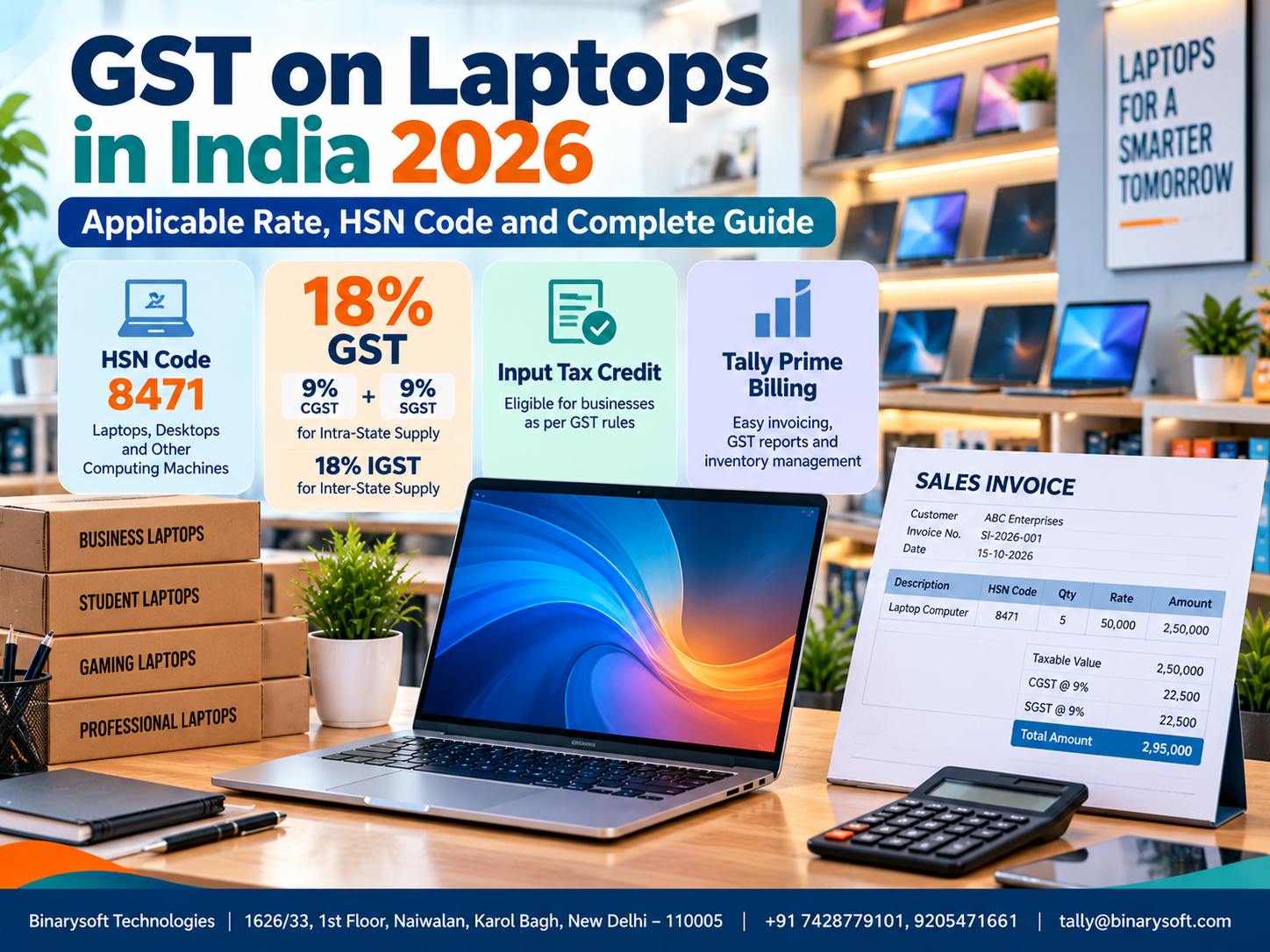
In India, laptops continue to attract 18% GST in 2026 under HSN heading 8471. Despite the GST rate rationalization introduced in September 2025, the applicable rate on laptops remained unchanged.
For an individual purchasing a laptop for personal use, GST forms part of the final purchase cost. However, a GST-registered business purchasing laptops for eligible business activities may be able to claim input tax credit.
This difference makes correct invoicing and accounting particularly important.
A laptop costing ₹60,000 before tax attracts ₹10,800 GST, taking the total invoice value to ₹70,800. For a business purchasing 20 laptops, the GST component alone becomes ₹2,16,000.
Computer dealers must also maintain accurate HSN classifications, inventory records, serial numbers, purchase invoices and GST returns.
Modern accounting software such as Tally Prime can help organize these activities, reduce repetitive calculations and improve financial reporting.
This guide explains laptop GST rates, HSN codes, invoice calculations, ITC eligibility and practical accounting methods for Indian businesses.
A Small Business Owner's Story: The Laptop Purchase That Changed Her Financial Planning
When Neha started her digital marketing agency in Delhi, she had only three employees and a limited budget.
After securing her first major client, she decided to expand her team and purchase eight laptops.
She had carefully planned the purchase based on the advertised prices.
However, when the supplier prepared the quotation, Neha noticed that the final amount was higher than expected.
The laptops had a combined taxable value of ₹4,80,000, with an additional ₹86,400 in GST.
For a new entrepreneur managing office rent, salaries and customer payments, the extra amount felt significant.
Neha wondered whether the GST paid on the laptops could be recovered through her business.
Her accountant explained that GST-registered businesses may claim input tax credit on eligible laptop purchases, provided the relevant legal conditions are satisfied.
The accountant also advised her to obtain a proper tax invoice containing the business GSTIN and maintain accurate purchase records.
Neha began using a structured accounting workflow in Tally Prime to record business assets, GST amounts and supplier payments.
The experience taught her an important lesson: understanding taxation before making a major purchase can improve financial planning.
She realized that accurate accounting was not merely a compliance requirement. It could also support smarter decisions during business expansion.
This is an illustrative story highlighting the financial challenges faced by growing businesses.
1. What Is the GST Rate on Laptops in India in 2026?
The applicable GST rate on laptops in India is 18%.
This rate applies to standard laptop and notebook computers classified under the relevant provisions of HSN heading 8471.
The rate generally remains the same whether a laptop is purchased from a physical computer store, an authorized distributor or an online marketplace.
However, the tax breakup depends on the nature and place of supply.
Applicable laptop GST
18%
Standard laptop supply
Primary HSN heading
8471
Automatic data processing machines
|
Type of supply
|
GST treatment
|
|---|
|
Intrastate supply
|
9% CGST + 9% SGST
|
|
Interstate supply
|
18% IGST
|
For example, a laptop sold by a Delhi dealer to a Delhi customer may attract CGST and SGST, while a qualifying interstate supply generally attracts IGST.
The rate does not change merely because the laptop belongs to a premium brand or has a higher price.
2. What Is the HSN Code for Laptops?
HSN stands for Harmonized System of Nomenclature.
It is an internationally recognized classification system used to identify goods for taxation and trade.
Under India's GST framework, laptops fall under Chapter 84, which covers machinery, mechanical appliances and related equipment.
HSN heading 8471 covers automatic data processing machines and certain associated units.
Portable computers such as laptops and notebooks are generally classified under subheading 847130.
For standard personal laptops, the commonly applicable detailed Indian tariff classification is 84713010.
Important HSN codes for laptops and computers
|
HSN code
|
Description
|
|---|
|
8471
|
Automatic data processing machines and units
|
|
847130
|
Portable automatic data processing machines
|
|
84713010
|
Personal computers, including qualifying laptops
|
|
84713090
|
Other portable data processing machines
|
|
847141
|
Certain integrated digital processing machines
|
|
84714900
|
Other digital processing systems
|
|
84715000
|
Specified processing units
|
|
847170
|
Certain storage units
|
The appropriate detailed code should be selected according to the product's technical characteristics and tariff description.
Computer accessories such as printers, monitors and networking equipment may fall under other headings even when they attract the same GST rate.
3. Did GST on Laptops Change After the 2025 GST Reforms?
India introduced significant GST rate rationalization measures effective from 22 September 2025.
Several product categories experienced changes in tax rates.
However, laptops and standard computers continued to attract 18% GST.
Therefore, businesses should not assume that laptop prices automatically became cheaper because other electronic products received rate reductions.
Retail prices may still change due to manufacturer pricing, exchange rates, promotions, import costs or dealer discounts.
For GST compliance, businesses should use the applicable notified rate rather than relying on promotional advertisements.
4. How to Calculate GST on a Laptop
GST is calculated on the applicable taxable value of the laptop.
The basic calculation is:
GST Amount = Taxable Value × 18%
Final Invoice Value = Taxable Value + GST Amount
Consider a laptop with a taxable price of ₹65,000.
|
Particulars
|
Amount
|
|---|
|
Laptop taxable value
|
₹65,000
|
|
GST at 18%
|
₹11,700
|
|
Total invoice value
|
₹76,700
|
For an intrastate supply, the ₹11,700 GST is generally divided into ₹5,850 CGST and ₹5,850 SGST.
For an interstate supply, the invoice generally shows ₹11,700 IGST.
The applicable taxable value must be determined according to GST valuation rules, including relevant discounts and additional charges.
5. Interactive Laptop GST Calculator
Use this calculator to estimate the GST and final invoice value for a laptop purchase.
| Taxable value |
₹65,000.00
|
| CGST (9%) |
₹5,850.00
|
| SGST (9%) |
₹5,850.00
|
|
Total GST
|
₹11,700.00
|
Total invoice value
₹76,700.00
Copy CalculationIllustrative calculation for a standard taxable laptop supply. Actual invoice treatment depends on the transaction and applicable GST rules.
6. GST on Laptop Accessories and Computer Hardware
Computer dealers often sell laptops together with accessories.
Although many computer accessories attract 18% GST, their HSN classifications may differ.
|
Product
|
Common HSN heading
|
Indicative GST
|
|---|
|
Laptop and notebook
|
8471
|
18%
|
|
Desktop computer
|
8471
|
18%
|
|
Computer monitor
|
8528
|
18%
|
|
Printer
|
8443
|
18%
|
|
Computer storage units
|
8471, where applicable
|
18%
|
|
Computer parts and accessories
|
8473, where applicable
|
18%
|
|
Laptop carrying bag
|
Classification depends on material and construction
|
Product-specific
|
For example, a laptop and printer sold on the same invoice may require different HSN codes.
Businesses should not classify every accessory under the laptop's HSN merely because the products are sold together.
7. Can Businesses Claim Input Tax Credit on Laptop Purchases?
Input tax credit is one of the most important GST considerations for registered businesses purchasing laptops.
A GST-registered business may claim ITC on eligible laptop purchases used in the course or furtherance of business.
The claim is subject to the conditions and restrictions prescribed under GST law.
Important requirements generally include:
-
A valid tax invoice containing the required particulars.
-
Receipt of the laptop.
-
Business use and satisfaction of applicable ITC eligibility conditions.
-
Relevant supplier reporting and GSTR-2B communication requirements.
-
Compliance with payment, return filing and other statutory conditions.
-
No prohibited double benefit through depreciation on the GST tax component.
Example of laptop ITC
Suppose a registered consulting company purchases five laptops.
|
Particulars
|
Amount
|
|---|
|
Taxable value of five laptops
|
₹3,00,000
|
|
GST at 18%
|
₹54,000
|
|
Total supplier invoice
|
₹3,54,000
|
|
Potential eligible ITC
|
₹54,000
|
If all applicable conditions are satisfied, the company may claim the eligible ₹54,000 as input tax credit.
However, ITC is not an automatic cash refund. It is generally utilized against eligible GST output tax liability according to the statutory credit-utilization rules.
Where laptops are used partly for personal or exempt activities, credit may need to be restricted or apportioned.
8. Can Students and Individuals Claim GST Refunds on Laptops?
Students and individuals purchasing laptops for personal use generally cannot claim input tax credit merely because GST was charged.
For personal purchases, GST forms part of the acquisition cost.
A college student purchasing a laptop for ₹59,000 inclusive of GST cannot ordinarily claim back the tax simply by submitting the purchase invoice.
Similarly, a salaried employee buying a laptop for personal use does not automatically become eligible for GST ITC.
The position may differ where a GST-registered business purchases laptops for eligible business activities.
Consumers should distinguish genuine GST benefits from misleading advertisements promising universal laptop GST refunds.
9. GST Invoicing Requirements for Laptop Dealers
Laptop dealers must issue invoices containing the prescribed GST information.
A proper tax invoice generally includes the supplier's name, address and GSTIN, invoice number, date, recipient details where required, product description, HSN code, quantity, taxable value and applicable tax amounts.
Computer dealers should also maintain laptop serial numbers and model details for inventory control and warranty management.
For example, a business selling five laptops may record each device's model and serial number alongside the invoice reference.
These details support stock verification, customer service and product returns.
Where the dealer is covered by mandatory e-invoicing requirements, applicable B2B invoices must also comply with the prescribed electronic invoicing process.
10. How Tally Prime Helps Laptop Dealers and Computer Businesses
Tally Prime provides accounting, inventory and GST reporting capabilities suitable for computer retailers, wholesalers and IT hardware distributors.
GST-compliant laptop billing
Businesses can configure laptop stock items with the appropriate HSN code and 18% GST rate.
Once configured correctly, the software can calculate applicable taxes when sales invoices are recorded.
Laptop inventory management
Computer dealers can maintain separate stock items for laptops, desktops, printers, storage devices and accessories.
Stock groups and godown records help monitor available quantities across different locations.
Serial number and warranty management
Tally Prime can maintain stock and batch-related information, while specialized serial-number and warranty workflows may require suitable customization or integration.
Purchase and supplier accounting
Laptop purchases from manufacturers, distributors and wholesalers can be recorded with supplier details and applicable GST.
GST reporting and reconciliation
Tally Prime provides GST reports that help businesses review outward supplies, purchase transactions and eligible input tax credit information.
Outstanding payment monitoring
Computer wholesalers supplying products on credit can monitor customer balances, bill-wise outstanding amounts and payment due dates.
Financial reporting
Profit and loss statements, balance sheets, stock summaries and receivables reports help business owners understand profitability and working capital requirements.
11. GST on Imported Laptops
Imported laptops are subject to applicable customs and GST requirements.
Import IGST is generally calculated using the prescribed customs valuation base, including applicable duties and other amounts required under law.
Therefore, the tax calculation for imported laptops may differ from a normal domestic purchase.
Businesses importing laptops for resale should maintain import documentation, customs records and relevant tax payment information.
Eligible registered importers may claim input tax credit of import IGST, subject to applicable GST conditions.
Import duties, valuation rules and product-specific requirements should be verified before completing a transaction.
12. GST on Refurbished and Second-Hand Laptops
The market for refurbished laptops has expanded as students, startups and small businesses look for affordable computing equipment.
Second-hand laptops generally remain classified under the relevant laptop HSN heading.
However, the taxable value may depend on the nature of the transaction.
Eligible second-hand goods dealers may qualify for the margin scheme under Rule 32(5) of the CGST Rules, subject to the prescribed conditions.
Under this arrangement, GST may be calculated on the eligible margin rather than the full selling price.
The margin scheme does not automatically apply to every refurbished laptop transaction.
Dealers should verify their eligibility and accounting treatment before using it.
13. Case Study One: Nehru Place Computer Dealer Improves GST Billing Accuracy
Illustrative case study
A computer dealer operating in Nehru Place, New Delhi, sold laptops, desktop computers, printers and accessories to corporate customers.
The business handled approximately 250 sales invoices every month.
Previously, the accounting team maintained separate spreadsheets for stock, customer billing and GST calculations.
This created problems involving inconsistent product descriptions, incorrect HSN classifications and delayed stock reconciliation.
The dealer introduced Tally Prime for centralized accounting and inventory management.
Separate stock items were created for laptops, printers, monitors and other hardware.
GST rates and HSN classifications were reviewed before being configured in the accounting system.
The business also introduced bill-wise customer tracking and regular inventory verification.
As a result, the accounting team could prepare invoices more consistently, review outstanding payments and generate GST reports without repeatedly combining spreadsheets.
Management gained better visibility into available stock and customer receivables.
14. Case Study Two: Growing IT Company Simplifies Laptop Purchases and ITC Tracking
Illustrative case study
A software development company in Gurugram expanded its workforce and purchased 40 laptops for employees.
The company needed to maintain accurate purchase records, asset information and GST documentation.
Initially, laptop invoices were stored across multiple email accounts and employee folders.
This made it difficult for the finance department to verify invoice details and track potential input tax credit.
The business introduced a centralized purchase-accounting process using Tally Prime.
Laptop purchases were recorded with supplier information, tax amounts and appropriate fixed-asset classifications.
The finance team reconciled relevant GST information and maintained supporting invoices.
It also introduced an internal asset register to track laptops issued to employees.
The improved process strengthened documentation, reduced administrative effort and supported more reliable ITC reviews.
15. Common GST Mistakes in Laptop Sales and Purchases
Computer dealers and business buyers should avoid several common errors.
Incorrect HSN classification is one frequent problem, particularly when accessories are billed using the laptop's HSN code.
Another mistake is issuing B2B invoices without the customer's correct GSTIN.
Businesses may also claim input tax credit without verifying eligibility or fail to distinguish personal use from business use.
Incorrect treatment of discounts, returns and warranty services can create additional reporting problems.
Computer dealers should regularly reconcile sales invoices with GSTR-1 and purchase records with relevant GSTR-2B information.
Accurate accounting records and timely verification reduce the risk of compliance disputes.
16. Best Practices for Laptop GST Compliance in 2026
Businesses should maintain verified product masters containing laptop model descriptions, HSN classifications and applicable GST rates.
Purchase invoices should be reviewed before recording eligible input tax credit.
Computer dealers should maintain organized stock records, document product returns and monitor outstanding customer balances.
Where applicable, e-invoicing requirements should be incorporated into the billing workflow.
For laptops used as business assets, the accounting team should maintain appropriate capitalization and depreciation records.
Tally Prime can support these activities through integrated accounting, inventory management and GST reporting.
Regular reviews of tax notifications and accounting configurations help businesses remain prepared for future changes.
Conclusion
Understanding GST on laptops is important for consumers, computer dealers, IT distributors and businesses purchasing computing equipment.
In 2026, standard laptops continue to attract 18% GST under HSN heading 8471.
The tax is generally divided into 9% CGST and 9% SGST for intrastate supplies, while interstate supplies generally attract 18% IGST.
GST-registered businesses may claim input tax credit on eligible laptop purchases, provided the statutory conditions are satisfied.
Correct invoicing, product classification and accounting records are essential for maintaining compliance.
Tally Prime helps businesses manage laptop billing, inventory, purchases, GST reports, customer receivables and financial statements.
By combining accurate tax treatment with reliable accounting software, computer businesses can reduce manual work, strengthen financial control and improve customer service.
Professional Tally Prime and Computer Business GST Accounting Assistance
Powered by Binarysoft Technologies
Authorized Tally Partner
Location: 1626/33, 1st Floor, Naiwalan, Karol Bagh, New Delhi – 110005, INDIA
Contact Us: +91 7428779101, 9205471661
Email: tally@binarysoft.com
Business Hours: 10:00 AM – 6:00 PM, Monday to Friday
Frequently Asked Questions
Can a GST-registered business claim ITC on laptops?
Yes, eligible registered businesses may claim ITC on laptops purchased for business use, subject to the prescribed GST conditions and restrictions.
Why is the correct HSN code important for laptop invoices?
Correct HSN classification supports accurate GST calculations, compliant invoices, consistent return reporting and reliable accounting records.
Is GST applicable to second-hand laptops?
Yes, taxable second-hand laptop sales generally attract GST. Eligible dealers may use the margin scheme when the prescribed conditions are satisfied.
Is GST different for gaming laptops and business laptops?
Standard gaming laptops and business laptops generally attract the same 18% GST rate when classified as laptops under the applicable HSN heading.
CA. Praneet Bansaal is a Chartered Accountant with experience in taxation, accounting controls, and financial process reviews. He has advised businesses on aligning inventory movement with accounting and GST requirements. His content focuses on compliance, accuracy, and long-term sustainability.









