Call CA Tally HelpDesk
+91 9205471661,
7428779101
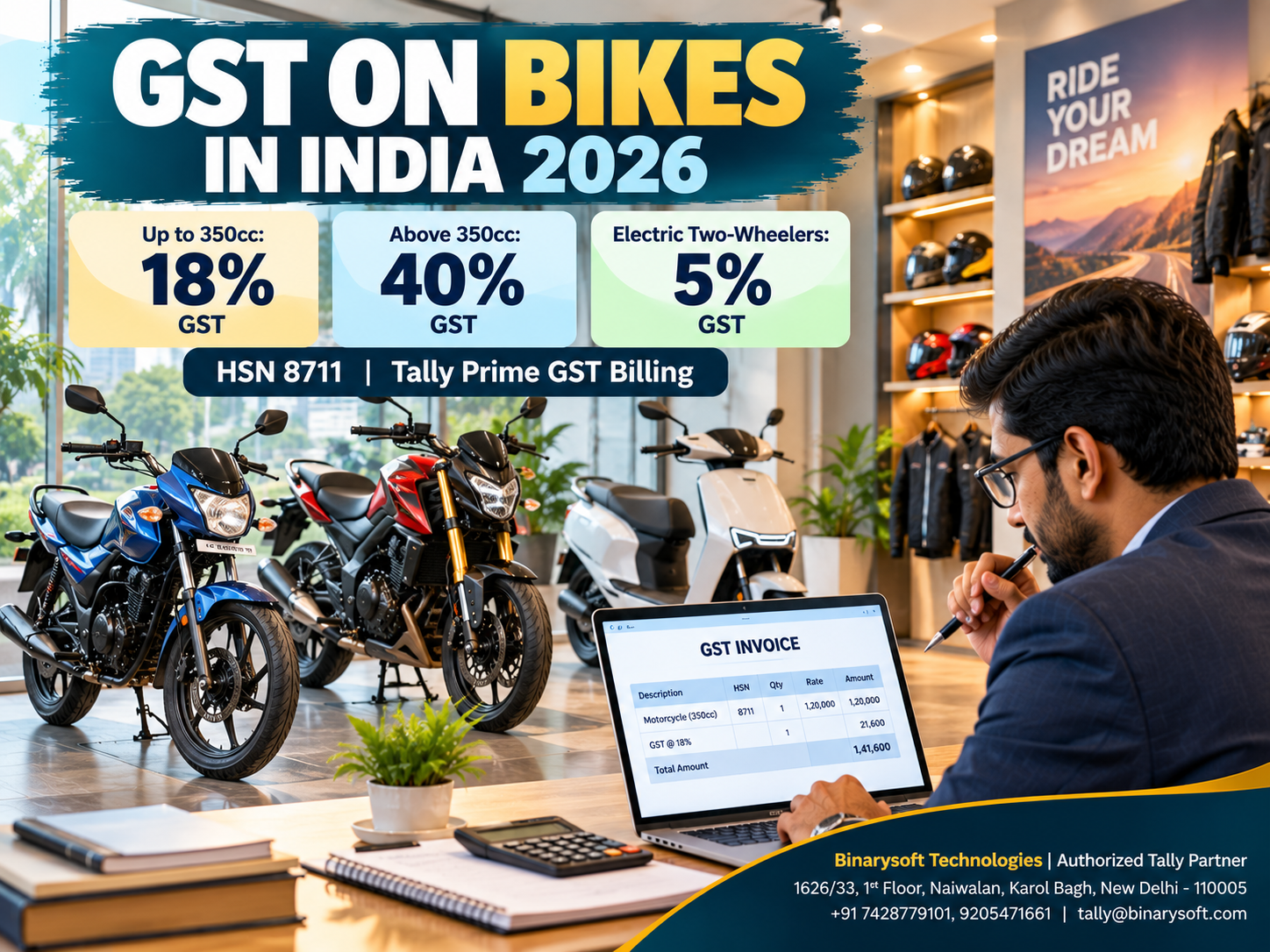
Introduction: Why Bike GST Rates Matter to Indian Buyers and Dealers in 2026
Buying a motorcycle is an important financial decision for millions of Indian families. For some, a two-wheeler provides an affordable daily commute. For others, it supports a delivery business, enables access to employment or represents a long-awaited personal achievement.
However, the price displayed in a showroom is influenced by more than the manufacturer's base price.
GST, registration charges, road tax, insurance and other applicable costs affect the final amount a customer pays.
India's revised GST structure, introduced in September 2025, significantly changed taxation for conventional motorcycles. The distinction between motorcycles up to 350cc and those above 350cc became particularly important.
For dealerships, correct classification is essential to avoid inaccurate invoices, pricing disputes and GST reporting errors.
Businesses also need to understand that GST on purchasing a motorcycle is not automatically available as input tax credit.
This guide explains the applicable rates, HSN classification, practical calculations and how Tally Prime can support accurate motorcycle sales accounting.
A Father's Promise: How a Motorcycle Became More Than a Purchase
For nearly seven years, Amit travelled from his home in Ghaziabad to his workplace in Delhi using crowded public transport.
Every morning, he left before sunrise. Every evening, he returned exhausted, often missing dinner with his young daughter.
He dreamed of purchasing a motorcycle that would shorten his commute and give him more time with his family.
After months of saving, Amit visited a showroom with his wife.
He had calculated the expected cost but was uncertain about taxes, insurance and registration charges.
When the salesperson explained the applicable GST rate and provided a detailed price breakdown, Amit could finally understand the difference between the motorcycle's taxable value and its on-road price.
He compared available models, reviewed his budget and selected a suitable commuter motorcycle.
A week later, he arrived home earlier than usual.
His daughter ran toward the gate and asked whether he could take her for a ride someday.
Amit smiled. The motorcycle represented something greater than convenience: it meant more time with his family.
This is a fictional story illustrating the financial and emotional importance of two-wheeler purchases.
For buyers, transparent taxation supports informed decisions. For dealers, accurate GST billing builds trust.
1. What Is GST on Bikes in India?
Goods and Services Tax is an indirect tax applicable to the supply of motorcycles, scooters and other taxable two-wheelers.
GST generally forms part of the vehicle's selling price.
For a registered dealer, the applicable rate depends on the product's classification and relevant tax notifications.
The revised structure introduced three important rates for major two-wheeler categories: 18%, 40% and 5%.
Businesses must distinguish the GST charged on the vehicle from registration fees, road tax, insurance and other charges that may have different tax treatments.
2. Latest GST Rates on Bikes in 2026
The following table summarizes the main rates under the revised GST framework effective from 22 September 2025.
|
Two-wheeler category
|
GST rate
|
|---|
|
Petrol motorcycles up to 350cc
|
18%
|
|
Petrol motorcycles exactly 350cc
|
18%
|
|
Motorcycles exceeding 350cc
|
40%
|
|
Conventional scooters and mopeds within the applicable lower-capacity category
|
18%
|
|
Qualifying electric motorcycles and scooters
|
5%
|
The 350cc threshold is inclusive for the 18% category. A motorcycle with an engine capacity of exactly 350cc does not fall into the above-350cc category.
Businesses should verify the correct classification for unusual vehicle types and confirm the latest applicable notification before invoicing.
3. Understanding HSN Code 8711 for Motorcycles
HSN stands for Harmonised System of Nomenclature.
It provides a standardized system for classifying goods for taxation and trade purposes.
Motorcycles, including mopeds and certain motor-assisted cycles, generally fall under HSN heading 8711.
Sub-classifications distinguish vehicles according to engine capacity and propulsion type.
Correct HSN classification is important because it influences GST rates, invoice reporting and tax compliance.
Dealers should maintain accurate product masters rather than assigning the same detailed HSN classification to every vehicle without verification.
4. GST on Bikes Up to 350cc
Motorcycles with engine capacity not exceeding 350cc generally attract 18% GST under the revised framework.
This category covers many commuter motorcycles and popular mid-capacity models.
For example, consider a motorcycle with a taxable value of ₹1,00,000.
|
Particulars
|
Amount
|
|---|
|
Taxable value
|
₹1,00,000
|
|
GST at 18%
|
₹18,000
|
|
Total including GST
|
₹1,18,000
|
This example excludes registration, insurance, road tax and other applicable charges.
The lower rate can reduce the GST component compared with the previous 28% rate, assuming the taxable value remains unchanged.
Actual showroom prices depend on commercial pricing decisions and other costs.
5. GST on Bikes Above 350cc
Motorcycles with engine capacities exceeding 350cc generally attract 40% GST.
The higher rate applies because these motorcycles fall into a separate category under the revised structure.
Consider a motorcycle with a taxable value of ₹2,50,000.
|
Particulars
|
Amount
|
|---|
|
Taxable value
|
₹2,50,000
|
|
GST at 40%
|
₹1,00,000
|
|
Total including GST
|
₹3,50,000
|
This is an illustrative calculation, not a dealer quotation.
The distinction between 350cc and 351cc or higher is therefore significant for classification purposes.
Dealers should verify engine capacity from reliable vehicle specifications and maintain supporting records.
6. GST on Electric Bikes and Scooters
Qualifying electric two-wheelers generally attract 5% GST.
This concessional rate makes electric vehicles a distinct category from conventional petrol-powered motorcycles.
For example, an electric scooter with a taxable value of ₹90,000 would attract ₹4,500 GST, resulting in a value of ₹94,500 before other applicable charges.
Dealers should confirm that the vehicle qualifies under the relevant electric vehicle classification.
The GST treatment of accessories, charging equipment, services and bundled supplies may differ from the treatment of the vehicle itself.
7. How Bike GST Rates Changed After September 2025
The revised GST rates took effect on 22 September 2025.
Before the changes, many conventional motorcycles attracted 28% GST, with additional compensation cess applicable to certain higher-capacity vehicles.
Under the revised structure, the rate for motorcycles not exceeding 350cc became 18%, while motorcycles above 350cc moved to 40%.
Electric two-wheelers continued to benefit from the concessional 5% rate.
|
Vehicle category
|
Earlier broad treatment
|
Revised treatment
|
|---|
|
Conventional motorcycle up to 350cc
|
28%
|
18%
|
|
Motorcycle above 350cc
|
28% plus applicable cess
|
40%
|
|
Qualifying electric two-wheeler
|
5%
|
5%
|
The revised structure makes accurate engine-capacity classification particularly important.
8. GST on Bike Spare Parts and Accessories
Motorcycle dealerships frequently sell spare parts, batteries, tyres, helmets, accessories and maintenance products.
These items do not necessarily attract the same GST rate as the motorcycle.
Classification depends on the nature of the product and its applicable HSN entry.
For example, parts classified under heading 8714 may have a different rate from the complete vehicle. Helmets, tyres, batteries and lubricants may fall under separate classifications.
Dealers should maintain distinct stock items, HSN codes and tax rates for each product category.
Applying a vehicle's GST rate automatically to every accessory can create incorrect tax calculations.
9. GST on Bike Insurance, Registration and Road Tax
Customers often confuse GST with the complete on-road price.
The final amount payable may include vehicle value, GST, registration charges, road tax, insurance and other applicable costs.
Insurance premiums generally have their own GST treatment.
Government registration fees and road taxes are not simply additional GST on the vehicle.
The treatment of dealer-handled charges depends on the underlying supply, invoice structure and applicable valuation rules.
Dealers should provide customers with a transparent price breakdown.
10. Can Businesses Claim Input Tax Credit on Bike Purchases?
Input Tax Credit allows eligible registered businesses to offset qualifying GST paid on purchases against their output tax liability.
However, Section 17(5) of the CGST Act restricts ITC on many motor vehicles designed to transport persons and having an approved seating capacity of not more than thirteen persons, including the driver.
There are important exceptions, including vehicles used for further supply, transportation of passengers or imparting training in driving such vehicles, subject to the statutory conditions.
A motorcycle dealership purchasing bikes for resale may therefore have a different ITC position from an office purchasing a motorcycle for employee commuting.
Businesses should evaluate eligibility carefully rather than assuming that GST paid on every business motorcycle purchase can be claimed.
11. How GST Affects Motorcycle Dealers
Motorcycle dealerships must maintain accurate tax classification, pricing and inventory records.
When GST rates change, dealers may need to update stock masters, invoice configurations and customer quotations.
Incorrect rates can lead to tax differences, customer complaints and reconciliation problems.
Dealers should also monitor credit notes, sales returns and manufacturer incentives.
The tax treatment of discounts and promotional schemes depends on their structure and applicable GST provisions.
A reliable accounting system helps dealerships maintain consistent records.
12. Step-by-Step GST Billing for Bikes in Tally Prime
Tally Prime can help motorcycle dealerships prepare GST-enabled sales invoices and maintain accounting records.
Step 1: Enable GST
Open the relevant company and configure GST details, including the registration information and applicable statutory settings.
Step 2: Create motorcycle stock items
Maintain separate stock items for each model or variant, with accurate descriptions and appropriate units.
Step 3: Assign HSN codes
Configure the correct HSN classification for each vehicle, verifying the applicable subheading where necessary.
Step 4: Configure GST rates
Set the applicable rate based on vehicle category and engine capacity.
For example, qualifying motorcycles up to 350cc should use 18%, while motorcycles exceeding 350cc should use 40%.
Step 5: Create the sales invoice
Record the customer, vehicle description, taxable value and applicable tax details.
Step 6: Verify tax calculations
Review whether CGST and SGST or IGST are calculated correctly according to the place-of-supply rules.
Step 7: Record payment
Maintain the corresponding receipt and customer settlement details.
Step 8: Review GST reports
Check sales registers, GST-related reports and transaction exceptions before preparing returns.
Actual menu paths and features can vary by software release and configuration.
13. GST Calculation: Intra-State and Inter-State Bike Sales
For a taxable motorcycle sale within the same state, GST is generally split between CGST and SGST.
For an applicable inter-state supply, IGST is generally charged instead.
Consider a motorcycle taxable at ₹1,50,000 with an 18% GST rate.
|
Particulars
|
Intra-state sale
|
Inter-state sale
|
|---|
|
Taxable value
|
₹1,50,000
|
₹1,50,000
|
|
CGST at 9%
|
₹13,500
|
—
|
|
SGST at 9%
|
₹13,500
|
—
|
|
IGST at 18%
|
—
|
₹27,000
|
|
Total
|
₹1,77,000
|
₹1,77,000
|
The place of supply must be determined under the applicable GST rules. A buyer's home address alone does not necessarily determine whether IGST applies.
14. Case Study One: A Delhi Motorcycle Dealership Updates Its GST Billing
Illustrative case study — fictional business and figures
A motorcycle dealership in Karol Bagh sold commuter bikes, scooters and mid-capacity motorcycles.
Following the revised GST structure, its accounting team needed to update tax rates for different vehicle categories.
Previously, employees had relied on manual calculations and spreadsheets.
The dealership introduced a standardized product master and configured GST rates in Tally Prime.
Each motorcycle model was assigned its relevant tax classification.
Sales staff received training on checking taxable values, invoice details and applicable rates.
The business also established a monthly review of sales and GST reports.
Business benefits
The dealership reduced manual rate selection, improved invoice consistency and gained better visibility into model-wise sales.
Key lesson: Accurate product classification and standardized billing processes are essential when GST rates differ by engine capacity.
15. Case Study Two: An Electric Scooter Dealer Improves Inventory and Tax Records
Illustrative case study — fictional business and figures
An electric scooter dealership in Noida expanded its operations as customer interest in electric mobility increased.
The business sold scooters, accessories and replacement parts.
Its main challenge was maintaining correct tax treatment for products with different classifications.
Management configured separate inventory categories and applicable GST rates in Tally Prime.
The dealership also introduced regular stock reconciliation and customer invoice reviews.
Over time, employees gained greater confidence in product classification and sales reporting.
Business benefits
The company improved inventory visibility, reduced incorrect rate selection and maintained more organized GST records.
Key lesson: Electric vehicle dealers should distinguish complete vehicles from accessories and services when configuring GST accounting.
16. How Tally Prime Helps Two-Wheeler Dealers Manage GST
Tally Prime provides several features relevant to motorcycle and scooter dealerships.
GST invoicing: Prepare invoices with applicable tax details and HSN information.
Inventory management: Maintain model-wise stock records and track vehicle purchases and sales.
Tax rate configuration: Assign appropriate GST rates to different product categories.
Purchase accounting: Record supplier invoices and related tax information.
Customer management: Maintain customer ledgers, receipts and outstanding balances.
Financial reporting: Review sales, purchases, profitability and other accounting information.
GST-related reports: Identify relevant transactions and review reporting information.
Bank reconciliation: Compare recorded payments with banking transactions.
These features can help dealerships reduce repetitive work and maintain more consistent accounting records.
However, Tally Prime does not independently determine the correct legal classification of every product. Dealers must verify applicable HSN codes and GST rates.
17. Common GST Mistakes Bike Dealers Should Avoid
One common mistake is applying the 18% rate to motorcycles exceeding 350cc.
Another is assuming that a motorcycle with exactly 350cc capacity attracts 40% GST.
Dealers may also incorrectly apply the complete vehicle's rate to accessories and spare parts.
Other mistakes include using outdated tax masters, recording incorrect taxable values and claiming ineligible ITC.
Businesses should verify rates before invoicing and periodically review GST configurations.
18. Practical GST Compliance Checklist for Motorcycle Dealerships
Dealers should establish procedures for maintaining accurate product classifications and tax records.
Important activities include checking vehicle specifications, verifying HSN codes, updating tax rates and reviewing purchase invoices.
Businesses should reconcile sales records with accounting and GST reports.
Stock movements, sales returns and credit notes should be recorded correctly.
Staff should receive training whenever tax rules or software configurations change.
Periodic review by a qualified tax professional can help identify classification or reporting errors.
19. How GST Changes Influence Bike Pricing and Business Planning
GST changes affect both customers and dealerships.
A lower tax rate can reduce the tax component of a motorcycle's selling price, assuming other pricing factors remain unchanged.
A higher rate can increase the amount customers must pay and influence demand for particular models.
Dealers should therefore review quotations, promotional pricing and inventory planning when tax rates change.
Businesses should also consider the working capital implications of purchasing and holding vehicle inventory.
Accurate accounting information helps management evaluate these decisions.
Conclusion: Understanding Bike GST Helps Buyers and Dealers Make Better Decisions
GST on motorcycles in India depends primarily on vehicle classification and engine capacity.
Under the revised structure effective from September 2025, conventional motorcycles up to and including 350cc generally attract 18% GST, while motorcycles exceeding 350cc attract 40%.
Qualifying electric two-wheelers attract 5%.
For buyers, understanding these rates helps clarify vehicle pricing.
For dealers, correct HSN classification, invoicing and accounting are essential for maintaining GST compliance.
Tally Prime supports these requirements through GST-enabled billing, inventory management, purchase accounting and financial reporting.
With accurate product information, suitable software configuration and periodic compliance reviews, two-wheeler businesses can improve billing accuracy and customer confidence.
Powered by Binarysoft Technologies
Authorized Tally Partner
Location: 1626/33, 1st Floor, Naiwalan, Karol Bagh, New Delhi – 110005, INDIA
Contact Us: +91 7428779101, 9205471661
Email: tally@binarysoft.com
Business Hours: 10:00 AM – 6:00 PM, Monday to Friday
Frequently Asked Questions
What is the GST rate on bikes in India in 2026?
Conventional motorcycles up to 350cc generally attract 18% GST, motorcycles above 350cc attract 40%, and qualifying electric two-wheelers attract 5%.
Is a 350cc motorcycle taxed at 18% or 40%?
A motorcycle with an engine capacity of exactly 350cc generally attracts 18% GST. The 40% rate applies to motorcycles exceeding 350cc.
What is the HSN code for motorcycles?
Motorcycles generally fall under HSN heading 8711. The applicable detailed classification depends on the vehicle's characteristics.
Can businesses claim ITC on motorcycle purchases?
ITC is generally restricted for many passenger-carrying motor vehicles, subject to statutory exceptions. Dealerships purchasing vehicles for resale may qualify where the applicable conditions are satisfied.
CA. Rishaan Lodha focuses on accounting controls, taxation, and financial reporting for trading and service organizations. He helps businesses improve transaction recording, reconciliations, and documentation for efficient financial management.









