Call CA Tally HelpDesk
+91 9205471661,
7428779101
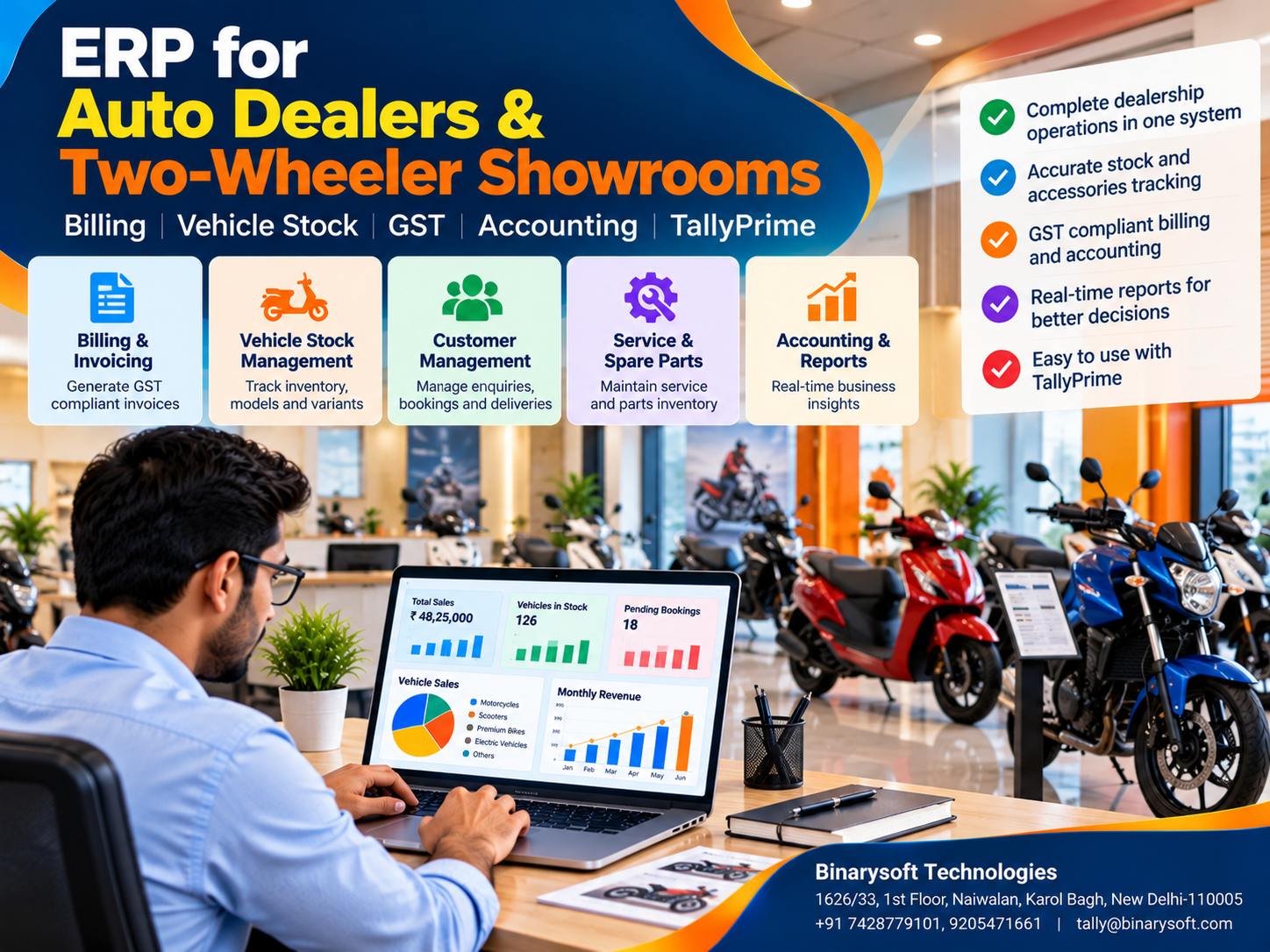
Introduction: Why Auto Dealers Need Smarter ERP and Accounting Software in 2026
Selling a motorcycle or scooter is an exciting moment for a customer. For a dealership owner, however, every successful delivery involves multiple financial and operational responsibilities.
A showroom must manage vehicle purchases, customer bookings, model-wise inventory, chassis numbers, GST invoices, insurance coordination, financing arrangements, accessories, spare parts and outstanding payments.
In 2026, Indian automobile dealerships face increasing pressure to provide faster customer service while maintaining accurate stock and accounting records.
Customers expect clear pricing, transparent documentation and timely vehicle delivery. Manufacturers and distributors expect accurate purchase records, stock visibility and financial settlements.
Meanwhile, dealership owners need to understand profitability across vehicles, accessories and service operations.
Managing these activities through disconnected spreadsheets and handwritten registers can create confusion.
A vehicle may appear available in the stock register even though it has already been reserved. An incorrect chassis number may delay documentation. Unrecorded discounts or additional expenses may reduce the profitability of a sale.
An integrated Enterprise Resource Planning (ERP) approach can help connect these activities.
TallyPrime provides accounting, inventory, invoicing, banking and financial reporting capabilities useful for automobile dealerships. Specialized dealership management systems may complement these functions when businesses require advanced vehicle booking, workshop or manufacturer integration.
This guide explains the essential ERP features for automobile dealers, practical dealership accounting procedures and how TallyPrime helps improve financial control.
1. What Is ERP Software for Automobile Dealerships?
ERP software integrates business information across departments.
For automobile dealers, it may connect vehicle purchasing, inventory, customer bookings, sales invoicing, spare parts, workshop operations and accounting.
A typical two-wheeler dealership handles several models, variants and colours.
Each vehicle also has unique identification details, including chassis and engine numbers.
These details must be accurately connected with purchase and sales records.
An appropriate dealership system helps employees identify available vehicles, review pending bookings and maintain financial information.
However, businesses should distinguish between general ERP accounting features and specialized Dealer Management System (DMS) capabilities.
A DMS may include vehicle allocation, test-drive scheduling, service job cards, warranty claims and manufacturer connectivity.
TallyPrime can serve as a strong accounting and inventory foundation, while specialized workflows may require customization or integration.
2. Common Challenges Faced by Two-Wheeler Showrooms
Vehicle Inventory Tracking
Dealers must monitor different models, variants, colours and individual vehicle identification numbers.
Incorrect records can create delivery delays and reconciliation problems.
Customer Booking Management
Advance bookings require accurate documentation, allocation and adjustment against final invoices.
Complex Billing
Vehicle sales may involve accessories, insurance, registration-related charges, discounts and financing arrangements.
These components may have different accounting and tax treatments.
Stock Financing
Many dealerships purchase inventory through financing arrangements, creating interest costs and repayment obligations.
Spare Parts Management
Service departments maintain numerous spare parts with different specifications and turnover rates.
Customer Outstanding Balances
Dealers may receive payments from customers, finance companies or other parties at different stages.
Profitability Analysis
Vehicle sales volumes alone do not reveal overall profitability.
Dealers also need to monitor discounts, financing costs, accessories and operating expenses.
3. Essential ERP Features for Auto Dealers and Two-Wheeler Showrooms
|
ERP feature
|
Business benefit
|
|---|
|
Vehicle purchase management
|
Records dealership inventory purchases
|
|
Model-wise inventory
|
Tracks motorcycles and scooters by variant
|
|
Chassis and engine number records
|
Supports vehicle-level identification
|
|
Customer booking management
|
Monitors booking advances and allocations
|
|
GST billing
|
Records taxable sales accurately
|
|
Accessories inventory
|
Tracks helmets and other accessories
|
|
Spare parts management
|
Monitors workshop-related stock
|
|
Customer receivables
|
Tracks outstanding payments
|
|
Banking and reconciliation
|
Supports financial verification
|
|
Financial reporting
|
Reviews dealership profitability
|
An ERP selection should also consider data security, reporting requirements, employee training and integration with manufacturer systems.
4. Vehicle Inventory Management: From Purchase to Delivery
Vehicle inventory management is one of the most important dealership activities.
Suppose a showroom purchases 25 motorcycles across three models.
The business must identify each vehicle accurately and maintain its purchase cost, stock status and sales details.
Important Inventory Information
A dealership may need to maintain the following:
-
Vehicle model and variant.
-
Colour and specifications.
-
Chassis and engine numbers.
-
Purchase invoice details.
-
Purchase cost and applicable taxes.
-
Stock location.
-
Booking or allocation status.
-
Customer delivery details.
TallyPrime supports stock items, stock groups, godowns and inventory transactions.
Vehicle identification details can be maintained using suitable stock item structures, batch-related features, additional fields or approved customization, depending on the business workflow.
Businesses should test whether their chosen configuration provides the required chassis-wise traceability before implementation.
5. Customer Booking and Advance Payment Management
Customers often book vehicles before delivery.
A showroom may receive an advance payment while the requested model is being arranged.
For example, a customer books a scooter worth ₹1,10,000 and pays ₹10,000 as an advance.
The dealership must record the receipt without incorrectly treating the entire booking as completed sales revenue.
When the vehicle is delivered and invoiced, the advance is adjusted against the customer's final amount payable.
The accounting and GST treatment of advances should be determined according to the applicable rules and transaction circumstances.
TallyPrime can record customer receipts, outstanding balances and invoice adjustments.
However, advanced booking allocation, waiting lists and automated customer notifications may require a specialized DMS or additional software.
6. GST Billing for Automobile Dealerships
Automobile dealers must prepare invoices according to applicable GST requirements.
The tax treatment depends on the vehicle category, classification and prevailing rules.
A dealership may also sell accessories, spare parts and services, which can have different GST classifications.
Example of a Vehicle Sale
Assume a vehicle has a taxable value of ₹80,000 and an illustrative GST rate of 18%.
GST = ₹14,400.
Invoice value = ₹94,400.
This example demonstrates the calculation only. It does not establish that 18% is the correct GST rate for any particular vehicle. Dealers must verify the current applicable rate, classification and any other statutory charges.
TallyPrime supports GST-related sales invoices, tax ledgers and accounting reports.
Businesses should also distinguish dealership revenue from amounts collected on behalf of insurers, registration authorities or other parties, according to the actual transaction structure.
7. An Emotional Story: A Showroom Owner and the Customer Who Waited for His First Motorcycle
For eighteen years, Manoj operated a two-wheeler dealership in West Delhi.
His father had opened the original showroom with a small investment and a simple ambition: to help families purchase reliable vehicles.
Manoj grew the business gradually.
He introduced more models, employed additional salespeople and opened a small accessories counter.
But as sales increased, inventory records became harder to manage.
Vehicle bookings were maintained in spreadsheets, purchase invoices were stored separately and accounting information was updated at the end of each day.
One afternoon, a young customer named Rohit arrived with his parents to collect his first motorcycle.
Rohit had saved money for nearly two years while working his first job.
He had already arranged financing and invited his family to celebrate the delivery.
Unfortunately, the showroom team discovered that the motorcycle allocated to Rohit had already been assigned to another customer.
The stock register had not been updated.
Rohit's excitement turned into disappointment.
Manoj watched the family leave without the motorcycle they had come to collect.
That evening, he sat alone in his office.
He remembered the day his own father had handed over the keys to their first customer.
He realized that inaccurate records were affecting more than inventory figures. They were damaging customers' trust.
Manoj decided to improve the dealership's systems.
He introduced structured vehicle records, more disciplined booking procedures and regular stock reconciliation.
TallyPrime was configured to manage accounting, inventory transactions and financial reporting.
A separate booking register was linked to the dealership's operational workflow, and employees received training on stock allocation and delivery verification.
Within a few weeks, the team had clearer visibility into available and reserved vehicles.
When Rohit returned to collect his motorcycle, Manoj personally checked the documentation and handed over the keys.
Rohit's father thanked him for making the occasion special.
For Manoj, that moment reinforced an important lesson.
A successful dealership does not simply sell vehicles. It delivers trust, reliability and memorable experiences.
This fictional story illustrates how accurate dealership records and organized operations can protect customer relationships.
8. How TallyPrime Helps Auto Dealers Manage Billing and Accounting
TallyPrime provides several useful capabilities for dealership financial management.
Sales and Purchase Accounting
Dealers can record vehicle purchases, customer invoices, purchase returns and other relevant transactions.
Inventory Management
Stock groups and items help organize vehicles, accessories and spare parts.
Customer and Supplier Ledgers
Separate ledgers help track customer receivables and supplier liabilities.
GST Accounting
TallyPrime supports GST invoicing and related reporting.
Banking
Bank reconciliation features help compare recorded transactions with bank statements.
Cost Centres
Cost centres can help businesses analyze relevant income and expenses across departments.
Financial Reporting
The Profit & Loss Account, Balance Sheet, stock reports and outstanding statements provide useful management information.
Access Control
Suitable user permissions and operational procedures can help protect sensitive accounting records.
TallyPrime does not automatically include every specialized dealership workflow. Advanced CRM, warranty processing, workshop scheduling and manufacturer integration may require additional systems.
9. Managing Accessories and Spare Parts Inventory
Accessories and spare parts can contribute significantly to dealership revenue.
Common inventory categories include helmets, seat covers, batteries, filters, brake components and lubricants.
Businesses should maintain separate stock groups and appropriate units of measurement.
Regular stock verification helps identify slow-moving items, shortages and discrepancies.
TallyPrime supports inventory summaries and stock movement records.
For businesses operating service workshops, additional systems may be needed to connect spare parts consumption with individual service job cards.
10. Understanding Dealership Profitability
A dealership's financial performance depends on more than the number of vehicles sold.
Management should consider vehicle margins, discounts, accessories revenue, financing costs, workshop profitability and operating expenses.
Illustrative Profit Calculation
Suppose a showroom sells 40 vehicles in one month.
Average vehicle contribution before allocated operating expenses: ₹5,000.
Total vehicle contribution = ₹2,00,000.
Accessories contribution = ₹50,000.
Other recognized operating contribution = ₹30,000.
Total contribution = ₹2,80,000.
Less allocated operating expenses = ₹1,80,000.
Illustrative operating profit = ₹1,00,000.
Actual profitability depends on complete cost recognition, the dealership's commercial arrangements and applicable accounting policies.
TallyPrime financial reports can support this analysis when transactions and cost allocations are recorded correctly.
11. Step-by-Step TallyPrime Setup for a Two-Wheeler Showroom
Step 1: Create the company. Enter business details, financial year and applicable tax configuration.
Step 2: Create vehicle stock groups. Organize motorcycles and scooters by brand, model or other useful classifications.
Step 3: Create stock items. Configure individual models and variants with appropriate identification methods.
Step 4: Set up accessories and spare parts. Maintain separate stock groups for these categories.
Step 5: Create customer and supplier ledgers. Establish accurate receivable and payable records.
Step 6: Configure GST. Set up the relevant tax classifications and invoicing requirements.
Step 7: Record purchases. Enter vehicle purchase invoices and verify inventory details.
Step 8: Record bookings and advances. Maintain suitable operational and accounting records for customer reservations.
Step 9: Generate sales invoices. Record vehicle sales and applicable charges correctly.
Step 10: Review reports. Monitor stock balances, customer outstanding amounts, banking and profitability.
Dealerships requiring chassis-wise allocation, registration workflows or service management should evaluate additional configuration or integration.
12. Case Study One: A Delhi Two-Wheeler Dealership Improves Inventory Accuracy
Illustrative case study based on common dealership challenges.
Business Background
A two-wheeler dealership in Karol Bagh, Delhi, sold motorcycles, scooters and accessories.
The showroom maintained multiple models and received regular stock deliveries.
Challenges
Vehicle purchase records and customer bookings were maintained separately.
Employees occasionally struggled to confirm the availability of specific models and colours.
Accounting staff also spent considerable time reconciling stock records with invoices.
Solution
The dealership introduced standardized vehicle inventory records and improved booking allocation procedures.
TallyPrime was configured with appropriate stock groups, customer ledgers and purchase and sales workflows.
The team also established a daily stock verification process.
Business Outcome
Management gained clearer visibility into recorded vehicle stock.
Accounting discrepancies became easier to identify, and communication between sales and accounts improved.
Customer deliveries were supported by more organized documentation.
Key lesson: Accurate vehicle inventory records are essential for reliable dealership operations.
13. Case Study Two: A Multi-Branch Auto Dealer Strengthens Financial Reporting
Illustrative case study demonstrating dealership accounting improvements.
Business Background
An automobile dealer operating across Delhi NCR maintained multiple showrooms and an accessories distribution operation.
Each location recorded transactions independently.
Challenges
Management struggled to consolidate financial information and monitor customer outstanding balances.
Expense reporting also varied between branches.
Solution
The business standardized its chart of accounts and established consistent transaction procedures.
TallyPrime was configured to support branch-related accounting and financial reporting, with appropriate controls and consolidation procedures.
Employees received training on ledger classification, bank reconciliation and inventory reporting.
Business Outcome
Management gained more consistent financial information.
Branch performance became easier to compare, and outstanding receivables could be reviewed more systematically.
The accounting department reduced dependence on disconnected spreadsheets.
Key lesson: Standardized accounting procedures support better multi-branch financial control.
14. Choosing Between TallyPrime and a Specialized Dealership Management System
The right software depends on the dealership's operational complexity.
|
Requirement
|
TallyPrime
|
Specialized DMS
|
|---|
|
Accounting and ledgers
|
Strong core capability
|
Varies by product
|
|
GST invoicing
|
Supported
|
Often supported
|
|
Inventory accounting
|
Supported
|
Usually supported
|
|
Customer receivables
|
Supported
|
Usually supported
|
|
Chassis-wise vehicle allocation
|
May require configuration
|
Often purpose-built
|
|
Test-drive scheduling
|
Requires separate workflow
|
May be included
|
|
Workshop job cards
|
May require integration
|
Often included
|
|
Warranty claims
|
Requires separate workflow
|
May be included
|
|
Manufacturer connectivity
|
Depends on integration
|
May be supported
|
|
Financial statements
|
Strong core capability
|
Varies by product
|
A small showroom may find TallyPrime sufficient for its primary accounting requirements.
A larger dealership with complex service operations may benefit from combining TallyPrime with a specialized DMS, subject to integration compatibility.
15. TallyPrime on Cloud for Multi-Location Dealerships
Cloud-hosted TallyPrime can help authorized employees access a centralized accounting environment remotely, subject to suitable licensing and hosting arrangements.
This can support collaboration between showroom managers, accountants and business owners.
Management may review financial reports without being physically present at the dealership.
Cloud hosting may also assist with backup planning and business continuity.
However, businesses should assess user permissions, data security, connectivity and recovery procedures before implementation.
16. How Binarysoft Technologies Supports Automobile Dealerships
Binarysoft Technologies, an Authorized Tally Partner based in New Delhi, assists businesses with TallyPrime licensing, implementation, accounting configuration and financial reporting.
Auto dealers and two-wheeler showrooms can seek support for inventory masters, sales and purchase workflows, GST accounting, customer outstanding reports and employee training.
Businesses may also explore cloud-hosting options and suitable customization requirements.
Specialized dealership processes should be evaluated separately to determine whether additional software or integrations are necessary.
Conclusion
Automobile dealerships require accurate billing, dependable inventory records and strong financial management.
As businesses grow, disconnected spreadsheets and manual registers can create operational delays and accounting errors.
An effective ERP approach connects vehicle purchasing, inventory, customer transactions, GST billing and financial reporting.
TallyPrime provides a strong foundation for accounting, inventory management, invoicing and business reporting.
For advanced dealership requirements, specialized DMS software may complement these capabilities.
The objective is to build a system that improves customer service while giving management clearer financial information.
When every vehicle is accounted for, every customer transaction is recorded correctly and every financial decision is supported by reliable information, a dealership can grow with greater confidence.
Powered by Binarysoft Technologies
Authorized Tally Partner
Location: 1626/33, 1st Floor, Naiwalan, Karol Bagh, New Delhi – 110005, INDIA
Contact Us: +91 7428779101, 9205471661
Email: tally@binarysoft.com
Business Hours: 10:00 AM – 6:00 PM, Monday to Friday
Frequently Asked Questions
Which ERP software is suitable for two-wheeler showrooms in India?
The best solution depends on dealership size and operational requirements. TallyPrime supports accounting, inventory and GST billing, while specialized DMS software may be needed for advanced dealership workflows.
Can TallyPrime manage vehicle sales invoices?
Yes. TallyPrime supports sales invoicing, customer ledgers and applicable GST accounting.
Can TallyPrime track vehicle inventory?
Yes. It supports stock items, stock groups, godowns and inventory transactions. Detailed chassis-wise tracking may require specific configuration or customization.
Is TallyPrime suitable for multi-branch dealerships?
It can support multi-location accounting requirements through suitable company structures, inventory locations and reporting procedures. The correct setup depends on business operations.
CA. Aaryan Kanodia focuses on GST reporting, bookkeeping systems, and financial process improvement. He works with businesses to simplify routine accounting activities and maintain records suitable for compliance and internal review.