Call CA Tally HelpDesk
+91 9205471661,
7428779101
Introduction: Why GST Software Has Become Essential for Indian Businesses
Running a business in India involves much more than selling products, generating invoices and collecting customer payments.
Every registered business must also manage applicable Goods and Services Tax (GST) requirements.
These responsibilities may include issuing compliant tax invoices, maintaining purchase and sales records, applying appropriate tax rates, reviewing Input Tax Credit, reconciling transactions and preparing GST returns.
For small businesses, managing these activities manually can become challenging.
A retailer may process hundreds of invoices every week. A wholesaler may purchase goods from numerous suppliers, while a manufacturer may need to track taxes associated with raw materials and finished products.
When GST records are maintained through disconnected spreadsheets and manual calculations, businesses may face reporting errors, reconciliation difficulties and unnecessary administrative work.
This is where GST accounting software becomes valuable.
A suitable GST software solution helps businesses organize taxable transactions, calculate taxes according to configured rules and prepare relevant information for compliance activities.
For Indian MSMEs, Tally Prime provides GST-related invoicing, accounting and reporting capabilities that can support day-to-day business requirements.
This article explains the role of GST software, its major benefits, essential features and how Tally Prime can help businesses manage GST-related accounting more efficiently.
A Business Owner's Story: The GST Mistake That Turned a Successful Month Into a Sleepless Night
For nearly fifteen years, Amit had operated a wholesale electrical accessories business in Bhagirath Palace, Delhi.
His company supplied switches, cables, lighting products and electrical fittings to retailers across Delhi NCR.
Business was growing steadily.
His employees processed numerous sales invoices every day, and the company maintained relationships with suppliers across several states.
However, Amit continued to rely heavily on spreadsheets for tax-related calculations and reconciliation.
One evening, his accountant informed him that some purchase invoices were not matching the available GST records.
Several supplier invoices required verification.
At the same time, the team discovered inconsistencies in certain sales invoice details.
Amit became worried.
He had always believed that maintaining invoices and paying taxes on time would be sufficient.
Now he realized that incomplete reconciliation could create difficulties when preparing returns and reviewing Input Tax Credit.
He spent the next several days contacting suppliers, checking invoice numbers and comparing purchase records.
The process was exhausting.
His employees worked late, regular accounting activities were delayed, and Amit worried about the financial consequences of incorrect records.
What troubled him most was the possibility that avoidable administrative mistakes could affect the business his family had spent years building.
Eventually, Amit decided to improve the company's accounting procedures.
He introduced more consistent GST invoice recording, organized supplier information and established regular reconciliation reviews.
Instead of waiting until return preparation, the accounting team began identifying discrepancies throughout the month.
Amit learned an important lesson:
GST compliance becomes easier when businesses maintain accurate transaction records every day rather than trying to correct everything at the end of the reporting period.
His experience reflects a challenge faced by many Indian businesses.
Reliable GST software cannot replace professional judgment, but it can provide a stronger foundation for organized tax-related accounting.
1. What Is GST Software?
GST software is a digital application designed to help businesses manage transactions and records related to Goods and Services Tax.
Depending on the product, GST software may support tax invoicing, GST calculations, transaction classification, reconciliation, reporting and return-related activities.
Some applications focus exclusively on GST compliance.
Others combine GST functionality with accounting, inventory and financial reporting.
Common Functions of GST Software
GST software may help businesses:
-
Generate GST-compliant invoices.
-
Maintain customer and supplier GST information.
-
Record taxable purchases and sales.
-
Apply configured GST rates.
-
Maintain HSN and SAC information.
-
Organize Input Tax Credit records.
-
Prepare relevant GST reports.
-
Support GST reconciliation.
-
Identify transaction inconsistencies.
-
Maintain financial accounting records.
The availability of specific features depends on the software and product version.
2. Why GST Software Is Important for Businesses
GST software plays an important role in organizing tax-related financial information.
Reducing Manual Calculations
Businesses processing numerous invoices may find manual tax calculations time-consuming.
Software can calculate applicable taxes using configured transaction details.
Improving Invoice Accuracy
Structured invoice preparation helps businesses maintain consistent tax-related information.
Supporting Recordkeeping
GST software helps organize sales, purchases and other relevant transactions.
Simplifying Reconciliation
Digital reports can help businesses compare accounting information with available GST records.
Supporting Return Preparation
Software can help prepare relevant information required for applicable GST returns.
Improving Financial Visibility
When GST records are integrated with accounting, businesses can review financial transactions more consistently.
Reducing Administrative Work
A structured system can reduce repeated data entry and manual consolidation.
However, businesses remain responsible for verifying tax rates, classifications, eligibility and statutory compliance.
3. Major Roles of GST Software in Business Management
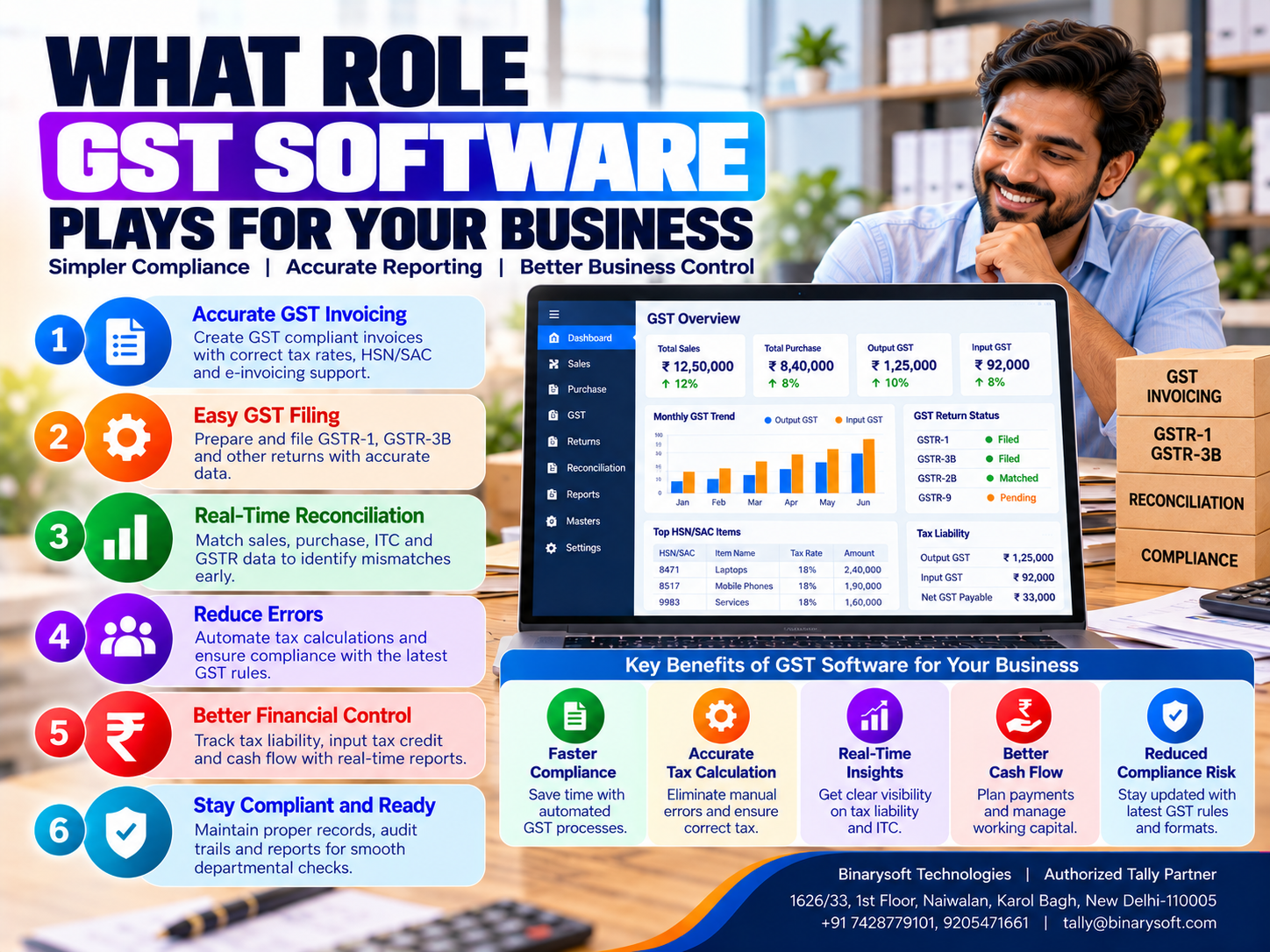
Role 1: GST-Compliant Invoice Preparation
Invoices are among the most important documents in GST accounting.
A tax invoice must contain the applicable information required under GST rules.
Depending on the transaction, this may include supplier details, GSTIN, invoice number, date, recipient information, HSN or SAC classification, taxable value and tax amounts.
GST software helps businesses maintain consistent invoice formats.
How Tally Prime Helps
Tally Prime supports GST-related invoicing with relevant tax information.
Businesses can configure applicable tax details and generate invoices using supported features.
Invoice accuracy depends on correct master data and transaction classification.
Role 2: GST Tax Calculation
GST calculations depend on several factors.
These may include the nature of the supply, place of supply, applicable tax rate and transaction value.
Incorrect tax calculations can create financial and compliance difficulties.
How GST Software Helps
Software can calculate GST according to configured tax settings and transaction information.
For example, a correctly configured taxable sale may involve CGST and SGST or IGST, depending on the applicable circumstances.
How Tally Prime Helps
Tally Prime supports GST calculations for relevant transactions.
Businesses should verify tax rates and classifications according to applicable requirements.
Role 3: Input Tax Credit Management
Input Tax Credit, commonly called ITC, is an important component of GST.
Eligible registered businesses may claim credit for applicable taxes paid on purchases, subject to statutory conditions and restrictions.
Incorrect ITC records can create reconciliation difficulties and compliance risks.
How GST Software Helps
Suitable software can help organize purchase transactions and relevant tax amounts.
Businesses can review purchase information and identify records requiring further verification.
How Tally Prime Helps
Tally Prime provides GST-related accounting and reconciliation capabilities that can support ITC review.
However, the presence of an amount in accounting software does not automatically establish ITC eligibility.
Businesses must verify applicable legal conditions and available GST portal information.
Role 4: GST Return Preparation
GST-registered businesses may need to furnish returns according to their registration category and applicable requirements.
Common GST returns include GSTR-1 and GSTR-3B.
GSTR-1 generally contains details of outward supplies.
GSTR-3B is a summary return involving relevant tax liabilities, ITC and other applicable information.
How GST Software Helps
Software can help organize transaction information required for return preparation.
It may also provide reports and validation tools.
How Tally Prime Helps
Tally Prime provides GST reports and supported return-related capabilities.
The exact filing and connected-service functionality depends on the installed version and available services.
Businesses should verify current filing requirements and reconcile information before submission.
Role 5: GST Reconciliation
GST reconciliation involves comparing information from different records to identify inconsistencies.
Businesses may need to compare purchase books with relevant GST portal information.
Sales records may also require reconciliation with return-related data.
Common Reconciliation Problems
Discrepancies may arise from:
-
Incorrect invoice numbers.
-
Missing supplier invoices.
-
Incorrect GSTIN details.
-
Differences in taxable values.
-
Incorrect tax classifications.
-
Transactions recorded in different periods.
-
Credit notes requiring adjustment.
How Tally Prime Helps
Supported GST reconciliation features can help businesses review relevant differences.
However, unresolved discrepancies require investigation and appropriate corrective action.
Role 6: E-Invoicing Support
E-invoicing requirements apply to specified taxpayers and transactions under applicable GST rules.
Where required, invoice information must be reported through the prescribed Invoice Registration Portal process.
How GST Software Helps
Compatible software may support relevant e-invoicing workflows.
How Tally Prime Helps
Tally Prime provides e-invoicing-related functionality for supported scenarios and versions.
Businesses should verify whether e-invoicing applies to them and confirm current procedural requirements.
Role 7: E-Way Bill Management
E-way bill requirements may apply to certain movements of goods.
Applicability depends on relevant legal provisions, transaction circumstances and exemptions.
How GST Software Helps
Suitable applications may assist with preparing information required for e-way bills.
How Tally Prime Helps
Supported e-way bill functionality can help businesses manage relevant transaction information.
Businesses should verify current thresholds, exemptions and requirements before generating or relying on e-way bills.
Role 8: Better Accounting and Financial Reporting
GST-related transactions affect business accounting.
Sales, purchases, tax liabilities and relevant credits must be recorded correctly.
When GST functionality is integrated with accounting, businesses can maintain more consistent records.
How Tally Prime Helps
Tally Prime supports accounting ledgers, GST-related entries and financial reporting.
Businesses can review relevant accounting statements and transaction reports.
This helps management understand financial information while maintaining tax-related records.
4. GST Software vs Manual GST Accounting
| Business Activity | Manual GST Accounting | GST Software |
|---|
| GST Invoices |
Manual preparation |
Structured invoice generation |
| Tax Calculations |
Manual calculations |
Calculations using configured rules |
| Purchase Records |
Registers and spreadsheets |
Digital transaction records |
| ITC Review |
Manual comparison |
Supported reports and reconciliation |
| GST Returns |
Manual compilation |
Return-related reports and tools |
| Invoice Validation |
Manual checking |
Supported validation features |
| Financial Accounting |
Separate bookkeeping |
Integrated accounting where available |
| Record Retrieval |
Searching multiple files |
Organized transaction access |
| Reporting |
Manual consolidation |
Reports from recorded transactions |
Software can reduce administrative work, but it does not guarantee compliance without accurate data and appropriate review.
5. How Tally Prime Supports GST Accounting
Tally Prime combines accounting and GST-related functionality in a business management environment.
GST Invoice Management
Businesses can record taxable sales and generate invoices using relevant GST details.
Purchase Accounting
Purchase transactions can be recorded with applicable tax information.
GST Ledgers
Relevant accounting ledgers help maintain tax-related transaction information.
HSN and SAC Classification
Businesses can configure applicable product and service classifications.
GST Reports
Supported reports help users review transaction information.
Reconciliation
Relevant features can support comparison and verification of GST-related records.
E-Invoicing and E-Way Bills
Supported versions provide capabilities for applicable connected GST workflows.
Financial Reporting
Accounting information can be reviewed through available financial statements.
Businesses should ensure that the installed version supports the specific features they require.
6. How to Set Up GST Accounting in Tally Prime
Step 1: Create the Business Company
Enter the relevant company information and accounting details.
Step 2: Configure GST Details
Enable and configure GST-related functionality according to the business's registration and requirements.
Step 3: Create Accounting Ledgers
Prepare relevant sales, purchase, customer, supplier and tax ledgers.
Step 4: Configure Stock Items or Services
Maintain applicable HSN or SAC information and tax classifications.
Step 5: Record Sales Transactions
Enter invoices using correct customer, item and tax information.
Step 6: Record Purchase Transactions
Maintain supplier invoices and relevant tax details.
Step 7: Review GST Reports
Examine applicable GST-related transaction information.
Step 8: Reconcile Records
Compare accounting information with relevant external GST records.
Step 9: Resolve Differences
Investigate missing invoices, incorrect classifications and other discrepancies.
Step 10: Prepare Applicable Returns
Use verified information for return preparation and filing through supported procedures.
7. Case Study One: GST Software for an Electrical Wholesale Distributor
Business: Illustrative electrical goods distributor, Bhagirath Palace, Delhi
Business Challenge
A wholesale distributor processed numerous purchase and sales invoices.
The accounting team maintained GST-related information in spreadsheets.
During return preparation, employees frequently encountered differences between purchase records and available GST information.
Solution
The company introduced structured GST accounting using Tally Prime.
Customer and supplier records were reviewed.
Relevant tax classifications were configured.
Employees received training on invoice recording and reconciliation procedures.
Business Benefits
The company established more consistent GST-related accounting records.
The accounting team could identify transaction differences earlier.
Management also gained better visibility into relevant tax-related information.
Key Learning
Regular GST reconciliation and accurate transaction recording are essential for businesses processing large numbers of invoices.
This is an illustrative case study.
8. Case Study Two: GST Accounting for a Manufacturing Company
Business: Illustrative packaging manufacturer, Bawana Industrial Area, Delhi
Business Challenge
A manufacturing company purchased raw materials from several suppliers and sold finished products to customers across different states.
The accounting team found it difficult to maintain consistent purchase tax records.
Some invoices required additional verification before return preparation.
Solution
The business introduced a more organized accounting process using Tally Prime.
Relevant purchase and sales ledgers were configured.
Stock items were reviewed for appropriate tax classifications.
The accounting team established regular GST reconciliation procedures.
Business Benefits
The company improved consistency in transaction recording.
Employees could review purchase and sales information more efficiently.
Management also established clearer responsibilities for resolving GST-related discrepancies.
Key Learning
Integrated accounting and GST-related records can help manufacturers improve financial visibility and compliance preparation.
This is an illustrative case study.
9. How GST Software Helps Small Businesses
Small businesses often operate with limited accounting resources.
Owners may personally handle billing, purchasing and financial management.
GST software can help organize routine tax-related activities.
Easier Invoice Preparation
Structured invoice formats reduce the need for repeated manual calculations.
Better Transaction Records
Digital records make it easier to review relevant sales and purchase information.
Reduced Administrative Work
Supported reports can simplify data compilation.
Improved Financial Visibility
Integrated accounting helps owners review financial information.
Better Preparation for Compliance Activities
Regular recordkeeping reduces dependence on last-minute transaction compilation.
Small businesses should choose software that matches their transaction volumes and compliance requirements.
10. GST Software for Retail Businesses
Retail businesses may process large numbers of daily transactions.
Maintaining correct invoice information and tax classifications is important.
GST accounting software can help organize sales transactions and relevant tax records.
Tally Prime supports accounting, invoicing and inventory management for suitable retail operations.
Retailers requiring advanced point-of-sale functionality should evaluate whether additional compatible applications are necessary.
11. GST Software for Wholesale Traders
Wholesale businesses often manage numerous suppliers and customers.
They may process interstate transactions, credit sales and purchase returns.
Accurate GST-related accounting is important for maintaining consistent records.
Tally Prime can help wholesalers organize sales, purchases, inventory and relevant tax information.
Regular reconciliation is particularly important for businesses with high transaction volumes.
12. GST Software for Manufacturing Businesses
Manufacturing businesses must manage raw material purchases, finished goods sales and relevant tax-related transactions.
Accurate accounting supports better financial reporting and GST recordkeeping.
Tally Prime provides accounting and inventory functionality that may support suitable manufacturing operations.
Businesses requiring advanced production management should evaluate specialized software separately.
13. How GST Software Can Reduce Compliance-Related Errors
GST software can help reduce certain administrative errors through structured processes.
Consistent Invoice Details
Configured invoice formats help maintain relevant information.
Tax Calculation Support
Software calculates taxes using applicable configured rules.
Transaction Validation
Supported validation features may identify missing or inconsistent information.
Reconciliation Reports
Comparison tools can help users identify differences.
Organized Records
Digital records support easier transaction review.
However, businesses should not assume that software automatically identifies every legal or accounting error.
Professional review remains important, particularly for complex transactions.
14. GST Software and Cash Flow Management
GST-related accounting can influence business cash flow.
Businesses must plan for applicable tax liabilities while managing customer collections and supplier payments.
Incorrect records may create uncertainty about financial obligations.
How Accounting Software Helps
Relevant reports can help businesses review sales, purchases, receivables, payables and tax-related balances.
Management can use this information to plan financial commitments.
However, GST liability and ITC eligibility must be determined according to applicable law.
Software reports should be reconciled before making significant compliance decisions.
15. How to Choose the Right GST Software
Businesses should evaluate several factors before selecting GST accounting software.
GST Functionality
Review the features required for the business's registration and transaction types.
Accounting Integration
Determine whether the software also supports financial accounting.
Invoice Management
Verify whether invoice formats meet business requirements.
Reconciliation Features
Evaluate the available tools for reviewing transaction differences.
Reporting Capabilities
Check whether relevant reports are available.
Ease of Use
Employees should be able to learn routine procedures.
Security
Review access controls and backup arrangements.
Technical Support
Reliable implementation and support services are important.
Total Cost
Consider licensing, training, implementation and maintenance expenses.
16. Common Mistakes Businesses Make While Using GST Software
Incorrect GST Configuration
Businesses should verify registration information and relevant settings.
Wrong HSN or SAC Classification
Incorrect classification may affect tax treatment and reporting.
Ignoring Purchase Reconciliation
Supplier invoice information should be reviewed regularly.
Delayed Transaction Recording
Late entries can complicate return preparation.
Incorrect Customer GSTIN Details
Businesses should verify relevant customer information.
Failing to Review Reports
Generated reports should be checked before use.
Ignoring Software Updates
Businesses should evaluate updates relevant to changing requirements.
Inadequate Employee Training
Users must understand the accounting and compliance procedures they perform.
17. Cloud-Hosted GST Accounting for Growing Businesses
Businesses operating from multiple locations may require remote access to accounting information.
Compatible Tally Prime cloud-hosting arrangements can support authorized remote access to the accounting environment.
Potential benefits include improved accessibility and reduced dependence on a single office workstation.
However, businesses should evaluate internet reliability, hosting costs, licensing, security and backup responsibilities.
Cloud hosting does not automatically guarantee GST compliance or provide every connected-service feature.
18. Best Practices for Managing GST Through Accounting Software
Businesses should establish consistent GST accounting procedures.
Record transactions promptly.
Verify customer and supplier details.
Maintain accurate product and service classifications.
Review tax calculations.
Reconcile relevant purchase information.
Investigate discrepancies before filing.
Retain supporting documentation.
Restrict access to sensitive financial information.
Create reliable backups.
Review current statutory requirements regularly.
These practices help businesses maintain more dependable accounting records.
19. Future of GST Software in India
GST accounting technology continues to evolve as businesses adopt digital invoicing, connected services and automated reconciliation tools.
Software providers are developing capabilities that can reduce repetitive administrative work and improve transaction visibility.
However, businesses should not rely solely on automation.
GST requirements can change, and complex transactions may require professional interpretation.
For Indian MSMEs, accurate records, regular reconciliation and reliable accounting processes remain essential.
Businesses that establish these foundations can benefit more effectively from advanced GST software capabilities.
Conclusion
GST software plays an important role in helping Indian businesses organize tax-related transactions and maintain reliable accounting records.
Its benefits include structured invoicing, supported tax calculations, purchase and sales reporting, reconciliation assistance and improved financial visibility.
For retailers, wholesalers, manufacturers and service providers, suitable GST software can reduce administrative complexity and support more consistent compliance preparation.
Tally Prime provides GST-related accounting, invoicing, inventory and financial reporting capabilities that can help many Indian businesses manage everyday operations.
However, software cannot replace accurate transaction entry, regular reconciliation or professional compliance review.
The greatest benefit of GST software is not simply calculating tax. It is helping businesses maintain organized financial information, identify discrepancies early and manage compliance responsibilities with greater confidence.
Featured Image and Short Description
Featured Image Title: Role of GST Software in Business 2026 – Benefits, Features and Tally Prime
Suggested Image Size: 800 × 600 pixels
Image Description: Professional GST accounting infographic featuring digital tax invoices, GST calculations, Input Tax Credit reconciliation, financial reporting and a business owner reviewing accounting information.
Image Alt Text: Role of GST software in business showing GST invoicing, tax calculations, Input Tax Credit, reconciliation and accounting reports.
Short Description
Discover how GST software helps Indian businesses manage tax invoicing, GST calculations, Input Tax Credit records, reconciliation and return preparation. Learn how Tally Prime supports integrated GST accounting, inventory management and financial reporting for retailers, wholesalers, manufacturers and MSMEs.
Powered by Binarysoft Technologies
Authorized Tally Partner
Location: 1626/33, 1st Floor, Naiwalan, Karol Bagh, New Delhi – 110005, INDIA
Contact Us: +91 7428779101, 9205471661
Email: tally@binarysoft.com
Business Hours: 10:00 AM – 6:00 PM, Monday to Friday
Frequently Asked Questions
Why is manual accounting risky for growing businesses?
As transaction volumes increase, manual accounting becomes more difficult to maintain accurately and consistently.
Can a small business operate without accounting software?
Yes. Some businesses with limited transactions can maintain manual records, but accounting software may provide greater efficiency and financial visibility.
How does accounting software reduce bookkeeping errors?
Accounting software supports structured transaction entry and automatic calculations for relevant processes, although accurate data entry and review remain essential.
Is accounting software expensive for small businesses?
Costs vary depending on licensing, implementation, training and support. Businesses should evaluate total ownership costs rather than only the purchase price.
CA. T.R Venkat is a Chartered Accountant with extensive experience in accounting systems, GST compliance, and MSME advisory. He has worked closely with Indian traders and businesses on inventory control and accounting process improvement. His writing draws from real operational challenges faced by growing enterprises.