Call CA Tally HelpDesk
+91 9205471661,
7428779101
Google Discover Introduction: Why Smart Businesses Are Rethinking ERP in 2026
A growing business can look successful from the outside while struggling internally with delayed payments, inaccurate stock records, rising expenses and disconnected accounting information.
In 2026, Indian businesses face increasing pressure to maintain accurate financial records, manage GST compliance, control working capital and respond quickly to changing customer demands.
Traditional methods involving multiple spreadsheets and manual processes often make these responsibilities more difficult.
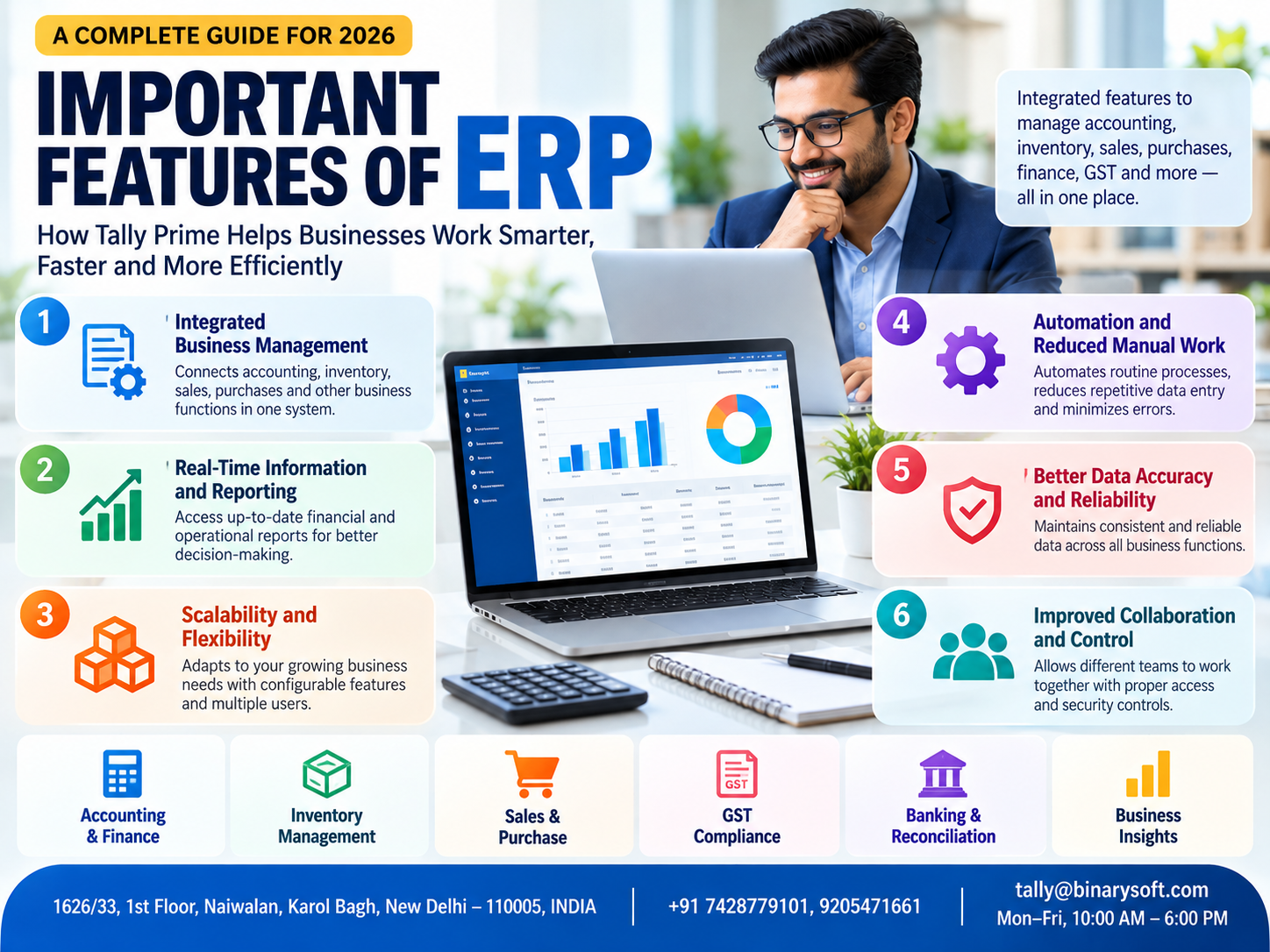
Enterprise Resource Planning (ERP) software helps businesses organize their operations through integrated information and connected workflows.
From accounting and inventory to purchasing, banking and financial reporting, ERP systems improve visibility and reduce repetitive work.
For small and medium-sized businesses, Tally Prime provides practical tools for managing several essential business activities within one application.
Understanding the important features of ERP software can help business owners reduce operational confusion, improve financial control and build a stronger foundation for sustainable growth.
A Business Owner's Story: The Day a Successful Business Almost Lost Its Biggest Customer
Rajiv owned a growing electrical equipment distribution company in Delhi.
For nearly twelve years, he had worked hard to build the business.
His company supplied electrical products to contractors, retailers and industrial customers across North India.
Sales were increasing, employees were busy and new customers were placing regular orders.
Everything appeared successful.
But behind the scenes, Rajiv was struggling.
His accountant maintained financial records separately from the warehouse team's inventory spreadsheets. Sales employees confirmed customer orders without always checking updated stock information.
One morning, Rajiv received an urgent call from his largest customer.
The customer needed 500 units of an electrical component for an important project.
Rajiv's sales team had already confirmed the order.
However, when warehouse employees checked the actual inventory, only 320 units were available.
The customer was furious.
The delivery delay threatened a relationship Rajiv had spent years building.
Later that afternoon, his accountant informed him that several supplier payments were overdue.
Despite increasing sales, the business was experiencing serious cash flow pressure.
That evening, Rajiv sat alone in his office, reviewing spreadsheets and unpaid invoices.
He realized that his business had grown faster than its management systems.
The problem was not a lack of hard work.
It was a lack of connected information.
Rajiv decided to reorganize his accounting, inventory and purchasing processes using Tally Prime.
His team established accurate stock records, maintained customer outstanding balances and began reviewing financial reports regularly.
Gradually, the business became easier to manage.
Rajiv could review recorded stock availability before confirming orders and monitor supplier obligations more effectively.
The most valuable improvement was peace of mind.
He no longer needed to depend entirely on disconnected reports to understand his business.
This fictional story illustrates how integrated business management can address common operational challenges.
What Is ERP Software?
Enterprise Resource Planning software is a business management system that connects different organizational functions through integrated processes and shared information.
ERP systems commonly support accounting, inventory, sales, purchasing, manufacturing, human resources, customer management and reporting.
Instead of maintaining separate information across multiple departments, businesses can coordinate relevant activities through a common system.
For example, a properly configured sales transaction may update the customer ledger, sales account, tax information and inventory records.
This reduces duplicate work and improves information consistency.
However, ERP capabilities vary significantly between software products.
Tally Prime offers integrated accounting, inventory, taxation, banking and business reporting features, making it useful for many Indian businesses.
It does not replace every specialized function available in large enterprise ERP platforms.
10 Important Features of ERP Software Every Business Should Know
1. Integrated Business Management
One of the most important ERP features is the integration of different business functions.
Traditional business processes often involve separate applications for accounting, inventory, purchasing and sales.
This creates information gaps and increases the risk of inconsistent records.
ERP software connects related activities so that information can be shared more efficiently.
How Tally Prime Helps
Tally Prime supports integrated accounting and inventory transactions.
For example, when an inventory-linked sales invoice is recorded, the relevant accounting and stock information can be updated according to the transaction configuration.
Business Benefits
Integrated business management can reduce duplicate data entry, improve coordination, simplify reporting and strengthen financial visibility.
It also helps employees work with more consistent information.
2. Real-Time Information and Financial Reporting
Business owners need timely information to make effective decisions.
Waiting several days for financial reports can delay important actions.
ERP software provides access to updated information based on recorded transactions.
Important Financial Reports
Businesses commonly require:
- Balance Sheet
- Profit and Loss Account
- Cash Flow Statement
- Sales and Purchase Reports
- Accounts Receivable
- Accounts Payable
- Inventory Valuation
- Expense Analysis
Financial Reporting with Tally Prime
Tally Prime provides financial statements and operational reports that reflect the accounting information entered into the system.
Management can review profitability, outstanding balances and inventory records for selected periods.
Practical Example
A wholesaler notices that sales have increased but profitability has declined.
By reviewing purchase costs, sales values and operating expenses, management can investigate the reasons.
Key benefit: Faster access to financial information supports more informed business decisions.
3. Automation and Reduced Manual Work
Repetitive manual activities consume valuable employee time.
These activities may include entering transactions multiple times, updating spreadsheets, preparing reports and reconciling financial information.
ERP systems can reduce repetitive work by connecting related transactions and automating supported processes.
How Tally Prime Helps
Tally Prime provides structured vouchers, automatic ledger posting from recorded transactions, inventory-linked accounting and GST calculation support.
Available banking features can also simplify selected reconciliation activities.
Example
A distributor processes hundreds of invoices every week.
Using integrated accounting and inventory records reduces the need to manually update separate stock and financial spreadsheets.
Business Benefits
Automation can improve productivity, reduce repetitive work, support consistency and allow employees to focus on more valuable activities.
However, automation does not eliminate the need for transaction verification and internal controls.
4. Better Data Accuracy and Reliability
Accurate business information is essential for financial planning and regulatory compliance.
Incorrect inventory quantities, duplicate invoices and inaccurate accounting entries can create significant problems.
ERP systems improve consistency by reducing disconnected records.
Tally Prime Features
Tally Prime supports structured accounting ledgers, voucher-based transactions, inventory records and financial reporting.
Businesses can also configure user access controls and maintain transaction records for review.
Practical Example
A company maintains purchase records in one spreadsheet and supplier outstanding balances in another.
Differences between these records create confusion during payment planning.
Integrated accounting helps maintain a more consistent record of purchasing and supplier obligations.
Important Consideration
Software cannot guarantee accuracy when incorrect information is entered.
Businesses must maintain reliable master data, proper authorization procedures and regular reconciliations.
5. Scalability and Flexibility
As businesses expand, transaction volumes, inventory requirements and reporting responsibilities increase.
A suitable ERP system should support changing operational needs.
How Tally Prime Supports Growing Businesses
Tally Prime offers accounting and inventory capabilities suitable for many small and medium-sized organizations.
Depending on the product edition and deployment configuration, businesses can support multi-user operations and additional accounting requirements.
Example
A small retailer initially manages one store.
After expanding into multiple locations, the business requires better inventory organization and financial reporting.
Suitable inventory and accounting configurations can help manage the increased complexity.
Business Benefits
Scalable software can reduce the need for frequent system replacements and support business growth.
However, organizations should assess software capacity, integrations and advanced functionality before expanding.
6. Inventory and Stock Management
Inventory management is an essential ERP feature for trading, manufacturing, retail and distribution businesses.
Poor inventory control can result in excessive purchases, stock shortages, delayed deliveries and blocked working capital.
An integrated ERP system helps businesses monitor inventory movements and maintain organized stock information.
Important Inventory Features
ERP inventory capabilities may include:
- Stock item management
- Stock groups and categories
- Warehouse management
- Inventory valuation
- Batch tracking
- Reorder level monitoring
- Stock movement reporting
- Purchase and sales integration
How Tally Prime Helps
Tally Prime provides stock groups, stock items, units of measurement, godown management, batch-related features and Stock Summary reports.
Businesses can link inventory transactions with relevant accounting entries.
Practical Example
A pharmaceutical distributor manages hundreds of medicines with different batches.
Using properly configured inventory records, the distributor can monitor available quantities and relevant batch details.
This helps employees make better purchasing and delivery decisions.
Business Benefits
Effective inventory management improves stock visibility, reduces unnecessary purchases and supports better working capital utilization.
7. Sales and Purchase Management
Sales and purchasing are closely connected with accounting, inventory and cash flow.
An ERP system helps businesses organize these activities through structured transactions.
Important Functions
Sales and purchasing capabilities commonly include quotations, sales orders, purchase orders, invoicing, purchase records, returns and outstanding balances.
Tally Prime Capabilities
Tally Prime supports sales and purchase vouchers, order processing, customer and supplier ledgers, and GST-related invoicing.
Businesses can monitor receivables and payables using accounting reports.
Example
A manufacturing company purchases raw materials from multiple suppliers.
Structured purchase records help management review pending orders, supplier balances and purchasing activity.
Business Benefits
Better sales and purchasing management improves transaction tracking, supplier coordination, customer billing and financial control.
8. Financial and Cash Flow Management
Cash flow is essential for business survival.
A company may generate strong sales but still experience financial difficulties when customer payments are delayed.
ERP software helps businesses monitor financial obligations and available resources.
Important Functions
Financial management capabilities include accounts receivable, accounts payable, cash and bank monitoring, expense analysis and financial reporting.
How Tally Prime Helps
Tally Prime provides bill-wise outstanding tracking, cash and bank ledgers, financial statements and cash flow reporting.
These features help management understand recorded financial movements.
Practical Example
A wholesale business generates monthly sales of ₹35 lakh.
However, customers frequently delay payments.
Using outstanding receivables reports, management can identify overdue invoices and prioritize collections.
Business Benefits
Better cash flow visibility supports timely supplier payments, improved credit management and more informed purchasing decisions.
9. GST Compliance and Tax Management
Tax management is an important requirement for Indian businesses.
Organizations must maintain accurate records and comply with applicable taxation requirements.
ERP software helps organize tax-related information and reduce repetitive compliance work.
GST Features in Tally Prime
Tally Prime supports GST configuration, GST invoicing, tax-related accounting entries and relevant statutory reports.
Depending on the software version and available connected services, additional GST workflows may also be supported.
Practical Example
A business supplies goods to customers across multiple states.
Correct GST configuration helps the accounting team record applicable tax details and prepare information for compliance activities.
Business Benefits
Integrated taxation features support more organized records, improved transaction consistency and reduced manual effort.
Businesses must still verify tax classifications, applicable rates and return information.
10. Security, Access Control and Collaboration
Financial and operational information is among a company's most valuable assets.
Unauthorized access, accidental modifications and data loss can create serious business problems.
Modern ERP systems therefore require appropriate security and access management.
Important Security Features
ERP security capabilities may include user authentication, role-based permissions, transaction controls, activity records and data protection mechanisms.
How Tally Prime Helps
Tally Prime provides configurable security features that help businesses manage user access.
Organizations can establish permissions appropriate to employee responsibilities.
Businesses should also maintain secure backups and appropriate device and network security.
Example
A company employs separate accounting, sales and inventory teams.
By configuring suitable permissions, management can restrict access to sensitive financial information.
Business Benefits
Effective security controls help protect business records, support accountability and reduce the risk of unauthorized changes.
Case Study 1: How a Delhi Trading Business Improved Efficiency with Tally Prime
Business Background
A medium-sized electrical equipment distributor in Delhi supplied products to retailers and contractors.
The company processed approximately 1,800 invoices every month.
Its accounting and inventory information was maintained through separate systems.
Business Challenges
The company experienced frequent inventory discrepancies, delayed customer collections and difficulty preparing financial reports.
Management also struggled to understand how much money was tied up in unsold inventory.
ERP-Based Solution
The company introduced integrated accounting and inventory processes using Tally Prime.
The implementation included stock item management, sales and purchase accounting, customer outstanding tracking, bank reconciliation and monthly financial reporting.
Illustrative Results
| Business Activity | Before | After |
|---|
| Inventory management |
Separate spreadsheets |
Integrated records |
| Financial reporting |
Manual consolidation |
Structured reports |
| Customer outstanding |
Manual follow-up |
Bill-wise tracking |
| Purchase management |
Disconnected records |
Organized transactions |
| Financial visibility |
Limited |
Improved |
Key Learning
Integrated accounting helped management identify overdue customer payments and inventory discrepancies more efficiently.
The business also established a more consistent monthly financial review process.
This fictional case study illustrates potential benefits rather than verified customer results.
Case Study 2: How a Manufacturing Company Improved Cost Control
Business Background
A manufacturing company in Faridabad produced industrial components for engineering businesses.
The organization purchased raw materials from several suppliers and maintained multiple finished product categories.
Major Challenges
Management faced difficulties monitoring raw material consumption, controlling purchasing expenses and analyzing product profitability.
Financial information was often available only after manual consolidation.
ERP Implementation
The company implemented structured accounting and inventory processes using Tally Prime.
The implementation focused on stock classification, Bills of Materials, manufacturing-related inventory transactions, supplier accounting and expense reporting.
Illustrative Results
The business gained better visibility into material consumption, inventory quantities, supplier obligations and operating expenses.
Management could investigate unexpected cost increases and review purchasing decisions more regularly.
Key Learning
Integrated financial and inventory records can help manufacturers identify inefficiencies and improve cost control.
This is an illustrative case study.
How to Use Tally Prime for Integrated Business Management
Businesses can follow a structured implementation process to take advantage of important ERP-like features.
Step 1: Create Your Company
Create the company in Tally Prime and configure the required accounting period, financial year and business details.
Step 2: Configure Accounting Ledgers
Create customer, supplier, bank, sales, purchase and expense ledgers.
Maintain accurate opening balances.
Step 3: Enable Inventory Management
Create stock groups, stock items, units of measurement and godowns where required.
Step 4: Configure GST
Enable applicable GST features and maintain relevant registration and tax information.
Step 5: Record Sales and Purchases
Use appropriate vouchers to record commercial transactions.
Ensure that relevant accounting and inventory information is maintained correctly.
Step 6: Monitor Outstanding Payments
Review customer receivables and supplier payables regularly.
Identify overdue invoices and upcoming payment obligations.
Step 7: Perform Bank Reconciliation
Compare accounting records with bank statements and investigate discrepancies.
Step 8: Review Financial Reports
Use the Balance Sheet, Profit and Loss Account, Cash Flow and other reports to evaluate business performance.
Step 9: Configure Security
Establish suitable user permissions and maintain secure backups.
Step 10: Conduct Monthly Business Reviews
Review profitability, inventory, expenses, cash flow and outstanding balances.
Use the findings to guide operational and financial decisions.
ERP Software vs Traditional Business Management
| Feature | Traditional Methods | ERP-Based Management |
|---|
| Accounting |
Separate records |
Integrated accounting |
| Inventory |
Manual spreadsheets |
Connected stock records |
| Reporting |
Manual consolidation |
Structured reports |
| Sales |
Disconnected information |
Linked transactions |
| Purchasing |
Manual tracking |
Organized purchase records |
| Cash Flow |
Limited visibility |
Financial reports |
| Data Accuracy |
Greater duplication risk |
More consistent information |
| Collaboration |
Departmental information gaps |
Improved coordination |
| Security |
Depends on individual files |
Configurable controls |
| Business Decisions |
Often delayed |
More timely information |
The actual benefits depend on the software selected and how effectively it is implemented.
Why ERP Features Are Important for Indian Businesses in 2026
Indian businesses operate in an environment where accurate financial information, digital transactions and tax compliance are increasingly important.
As transaction volumes grow, disconnected systems can create operational inefficiencies.
Integrated business management helps organizations maintain more consistent information and improve financial visibility.
For small and medium-sized businesses, Tally Prime offers practical capabilities across accounting, inventory, sales, purchasing, banking and GST-related workflows.
Businesses requiring advanced manufacturing planning, specialized customer relationship management or enterprise-wide automation should evaluate whether additional software is necessary.
The most effective solution is one that matches the company's actual operational requirements.
Common Mistakes to Avoid During ERP Implementation
Businesses sometimes assume that installing software will automatically solve every operational problem.
However, successful implementation requires accurate data, suitable configuration and employee training.
Common mistakes include incorrect opening balances, duplicate ledgers, inconsistent stock classifications and inadequate reconciliation procedures.
Another mistake is enabling unnecessary features without understanding their operational impact.
Businesses should identify their requirements before implementation and establish clear responsibilities for transaction recording and review.
Regular backups, user permissions and periodic financial checks are also essential.
Future of ERP Software: Automation, Integration and Business Intelligence
ERP software continues to evolve as businesses seek faster reporting, improved connectivity and reduced manual effort.
Important areas of development include digital invoicing, connected banking, automated reconciliation, cloud-based access and financial analytics.
Artificial intelligence is also influencing business software development through capabilities such as forecasting and anomaly detection.
However, not every ERP product provides these advanced features.
Businesses should evaluate the actual capabilities of their chosen software rather than assuming that all modern ERP systems offer the same functionality.
For growing Indian businesses, reliable accounting, accurate inventory records and secure financial information remain fundamental priorities.
Conclusion: Important ERP Features Create Stronger and More Efficient Businesses
ERP software helps businesses connect accounting, inventory, purchasing, sales, financial reporting and other operational activities.
Its most important features include integrated information, timely reporting, automation, scalability, accuracy, inventory control, financial management and security.
These capabilities can reduce repetitive work, improve coordination and strengthen management decisions.
Tally Prime provides several integrated business management features suitable for Indian small and medium-sized organizations.
However, technology alone cannot guarantee business success.
Accurate data, trained employees, appropriate internal controls and regular financial reviews are equally important.
The greatest advantage of ERP software is not simply automation. It is the ability to understand business performance, improve financial discipline and make confident decisions for sustainable growth.
Powered by Binarysoft Technologies
Authorized Tally Partner
Location: 1626/33, 1st Floor, Naiwalan, Karol Bagh, New Delhi – 110005, INDIA
Contact Us: +91 7428779101, 9205471661
Email: tally@binarysoft.com
Business Hours: Monday to Friday, 10:00 AM – 6:00 PM
Frequently Asked Questions
Why are ERP features important in 2026?
ERP features help businesses manage increasing transaction volumes, maintain accurate records, improve financial visibility and respond more effectively to operational challenges.
What should businesses consider before selecting ERP software?
Businesses should evaluate functionality, implementation costs, employee training, security, scalability, reporting requirements and integration capabilities.
Can ERP software improve inventory management?
Yes. ERP inventory features help businesses monitor stock quantities, inventory movements and purchasing requirements.
What should businesses consider before selecting ERP software?
Businesses should evaluate functionality, implementation costs, employee training, security, scalability, reporting requirements and integration capabilities.
CA. Yuvan Rajagopal specializes in accounting advisory, statutory compliance, and financial consulting. He writes extensively on business automation, inventory management, and accounting best practices.