Call CA Tally HelpDesk
+91 9205471661,
7428779101
Introduction: Why Construction Businesses Need Smarter Project Management
Managing a construction business involves much more than completing buildings on schedule.
Every construction project requires careful coordination between materials, labour, contractors, suppliers, equipment, budgets and financial records.
A builder may manage several residential projects simultaneously. A civil contractor may work on commercial buildings, roads and infrastructure developments. A construction company may operate across multiple sites with different project managers and subcontractors.
When these activities are managed through spreadsheets, handwritten registers and disconnected accounting systems, maintaining accurate information becomes difficult.
Material purchases may exceed planned budgets. Contractor payments may remain unreconciled. Project expenses may be recorded under incorrect classifications.
Most importantly, business owners may not know whether individual projects are generating the expected profit.
Construction management software helps organizations coordinate project-related activities, monitor expenses and maintain structured business records.
However, choosing the right solution requires careful evaluation.
Some applications specialize in project scheduling and site execution. Others focus on accounting, inventory, procurement and financial control.
For Indian construction businesses, Tally Prime can provide a strong accounting and inventory management foundation.
Its cost centres, financial reports, purchase accounting, inventory records and GST-related capabilities can support important construction business requirements.
However, specialized activities such as advanced project scheduling, measurement book management and automated running account billing may require additional software or customization.
This guide explains how builders, contractors and construction SMEs can select suitable software based on their actual operational needs.
A Construction Contractor's Story: When One Missing Report Threatened an Entire Project
Rajesh had spent almost twenty years building his construction contracting business in Delhi NCR.
He started with small residential renovation projects.
Through determination and consistent work, he gradually secured larger contracts.
Eventually, his company began handling residential and commercial construction projects in Noida, Gurugram and Faridabad.
Rajesh felt proud of his progress.
His employees depended on the business, and his family had supported him through difficult years.
However, managing multiple construction sites introduced unexpected challenges.
Each site supervisor maintained separate material registers.
Purchase invoices reached the accounts department several days late.
Contractor payments were tracked through spreadsheets.
Project budgets were prepared at the beginning of construction but rarely compared with actual expenses.
One evening, Rajesh received an urgent call from a project manager.
The construction team required additional steel to continue work.
The purchase department had already exceeded the project's estimated steel budget.
Rajesh was surprised.
He had approved several purchases but had never received a complete project-wise material consumption report.
When the accountant reviewed the records, it became clear that material expenses were not consistently allocated to individual projects.
Some contractor advances also remained unreconciled.
Rajesh realized that his business had expanded faster than its financial management processes.
He worried about completing the project without damaging the company's cash flow.
Instead of relying on verbal updates, he introduced structured project-wise accounting and inventory procedures.
Employees began recording expenses against relevant projects.
Material movements received greater attention.
The accounts team prepared regular cost summaries.
Rajesh could finally review project expenses more systematically.
He understood that successful construction management required more than experienced engineers and skilled workers.
It required dependable financial information.
A construction project may look successful from the outside, but its real success depends on what remains after every material bill, labour payment and operating expense is accounted for.
This is an illustrative story created to explain common construction business challenges.
What Is Construction Management Software?
Construction management software is a digital solution designed to help businesses plan, coordinate, monitor and control construction-related activities.
Depending on its features, the software may support project planning, cost estimation, procurement, inventory, subcontractor management, billing and financial reporting.
A comprehensive construction management environment may combine several specialized applications.
For example, project management software may handle schedules and milestones, while accounting software manages financial transactions.
The objective is to improve coordination and provide reliable information for decision-making.
Why Choosing the Right Software Matters
Construction projects involve significant financial commitments.
A small mistake in material estimation or payment tracking can affect profitability.
Selecting unsuitable software may create additional problems.
Employees may struggle with complicated workflows.
Important construction-specific requirements may remain unsupported.
Management may continue depending on spreadsheets despite investing in new technology.
The right software should address actual business challenges rather than simply offering an impressive list of features.
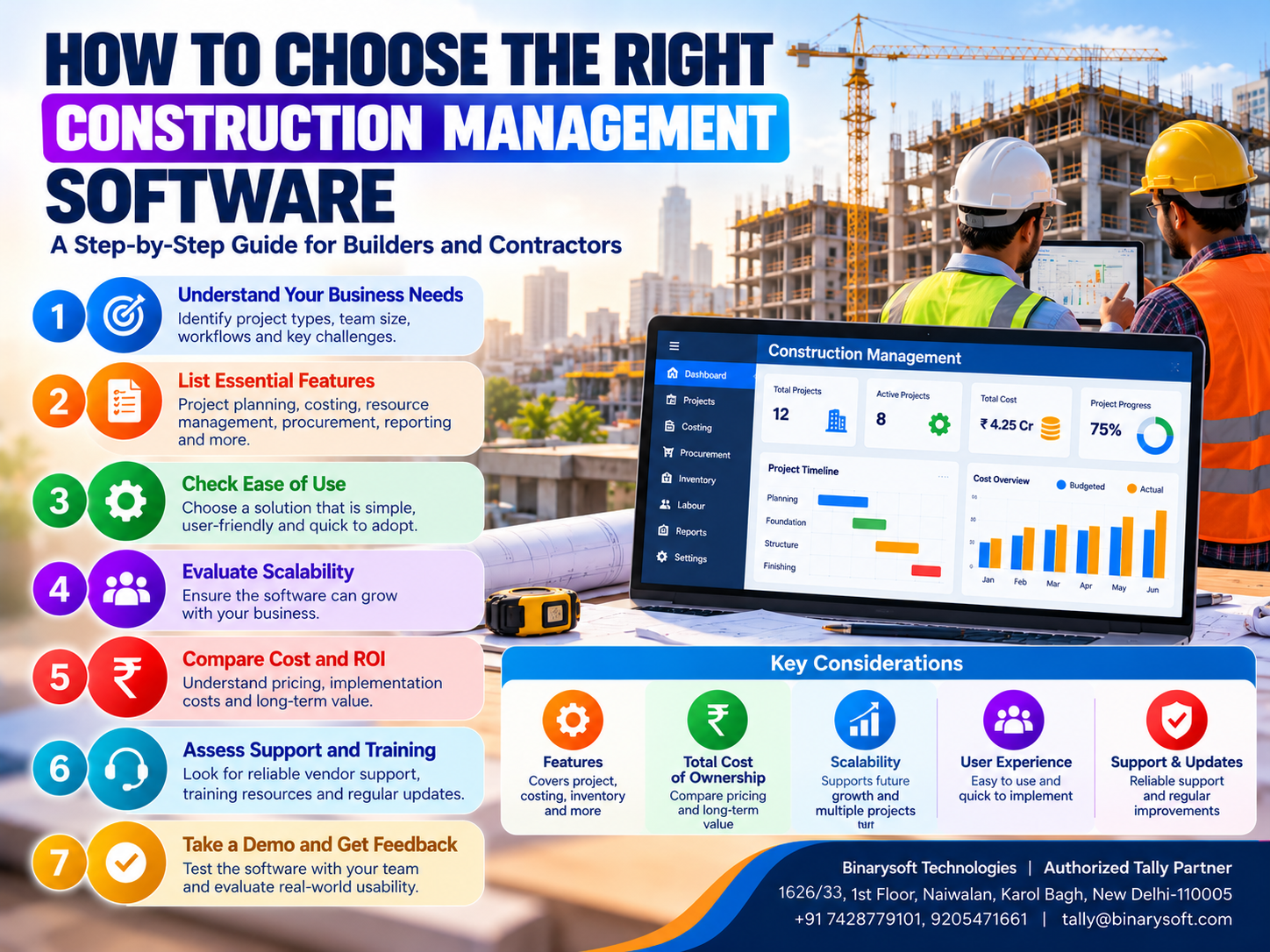
15 Important Factors to Consider When Choosing Construction Management Software
1. Understand Your Construction Business Requirements
Before evaluating software, identify the activities your organization needs to manage.
A residential builder may prioritize project budgets, customer collections and contractor payments.
A civil contractor may require detailed material tracking and project-wise expense analysis.
An infrastructure company may need advanced scheduling, equipment utilization and subcontractor coordination.
Prepare a list of essential requirements.
Separate critical functions from optional features.
This prevents unnecessary spending on software that does not match the business.
2. Look for Project-Wise Accounting
Project-wise accounting is one of the most important requirements for construction companies.
Businesses need to understand how much money is spent on individual projects.
Expenses may include cement, steel, bricks, labour, transportation, equipment rental and subcontractor charges.
Without project-wise records, management may struggle to determine profitability.
How Tally Prime Helps
Tally Prime supports cost centres that can be used to allocate relevant income and expenses to individual projects.
For example, a company may create cost centres for:
Residential Project – Noida
Commercial Project – Gurugram
Industrial Project – Faridabad
Properly classified transactions can support project-related financial analysis.
However, complete project profitability reporting requires consistent allocation of direct costs, indirect expenses and relevant revenue.
3. Evaluate Construction Material Management
Materials represent a major component of construction costs.
Businesses need accurate information about purchases, stock availability, transfers and consumption.
Important materials may include cement, steel, sand, electrical equipment, plumbing products and finishing materials.
Why Material Tracking Matters
Poor material control can result in over-purchasing, shortages, wastage and discrepancies.
Tally Prime Application
Tally Prime supports stock items, units of measurement, inventory transactions and godown management.
Businesses can use godowns to represent different storage locations or project sites.
Appropriate inventory vouchers can help record material movements.
Site-level consumption procedures must be configured carefully to ensure that recorded stock reflects actual usage.
4. Check Project Budgeting and Cost Control
Construction projects typically begin with estimated budgets.
Actual expenses may change due to material prices, labour requirements and unexpected site conditions.
The software should help management compare planned costs with actual expenditure.
Example
A project has an estimated material budget of ₹40 lakh.
Recorded material expenses reach ₹34 lakh while significant construction work remains incomplete.
This information may indicate a risk of exceeding the budget.
Management can investigate purchasing and consumption patterns.
Tally Prime can support financial cost tracking through suitable accounting classifications and cost centres.
Advanced automated project budget controls may require additional configuration or specialized tools.
5. Evaluate Subcontractor Management
Construction companies frequently engage subcontractors for electrical work, plumbing, painting, fabrication and other activities.
Managing subcontractor payments requires accurate records.
Businesses may need to track advances, certified bills, partial payments and retention amounts.
Important Features
The software should support contractor-wise accounting, payment history and outstanding balances.
Tally Prime Support
Tally Prime provides ledger accounting and voucher capabilities that can support subcontractor financial records.
Retention amounts and advances can be maintained through an appropriately designed ledger and reconciliation structure.
However, automated subcontractor certification, contract administration and specialized retention workflows should be verified separately.
6. Look for Running Account Billing Support
Running Account billing, commonly called RA billing, is widely used in construction projects.
Contractors may submit periodic bills based on completed work.
Payments may depend on measurements, certification and contractual conditions.
A suitable construction management system should help maintain these records.
Important Considerations
Businesses should evaluate whether the software supports measurement records, certified quantities, previous bill adjustments and retention deductions.
Tally Prime can record the resulting financial transactions.
However, a complete automated RA billing and measurement book workflow may require a specialized application or customization.
7. Verify GST and TDS Capabilities
Construction businesses must carefully manage applicable taxation requirements.
GST treatment can depend on the nature of the supply, contract terms and relevant statutory provisions.
TDS obligations may arise under applicable sections of the Income-tax Act.
Why Compliance Matters
Incorrect tax treatment can create reconciliation difficulties and potential compliance exposure.
Tally Prime Application
Tally Prime supports GST-related accounting and TDS functionality.
The correct configuration depends on the transaction and applicable law.
Businesses should consult qualified tax professionals for works contracts, contractor payments and other specialized transactions.
Software assistance does not replace statutory verification.
8. Check Multi-Site Inventory Management
Construction companies may operate several sites simultaneously.
Management needs to understand where materials are stored and how they move between locations.
For example, one project may require additional steel while another site has unused stock.
Location-wise inventory information can support better allocation decisions.
Using Tally Prime Godowns
Businesses can configure separate godowns for project sites.
Stock movements can be recorded through appropriate inventory procedures.
However, godown-wise stock tracking does not automatically provide complete project management or scheduling functionality.
9. Evaluate Financial Reporting
Construction businesses require reliable reports to monitor financial performance.
Important reports may include:
-
Project-related expenses
-
Customer outstanding balances
-
Supplier and subcontractor dues
-
Inventory summaries
-
Cash and bank balances
-
Profit and loss statements
-
Balance sheets
-
Cost centre reports
Tally Prime provides accounting and inventory reporting capabilities.
Specialized project dashboards may require additional reporting tools.
10. Check Ease of Use
Construction teams include employees with different technical backgrounds.
Accountants, project managers, site supervisors and procurement employees may use the software differently.
A complicated system can discourage adoption.
Businesses should request practical demonstrations.
Employees should test relevant workflows before the final purchase decision.
The objective is to choose software that supports everyday activities without creating unnecessary complexity.
11. Evaluate Mobile and Remote Access
Construction work takes place across different project sites.
Employees may need to communicate material requirements and transaction information while away from the head office.
Some construction management applications provide dedicated mobile interfaces.
Others require browser access or suitable remote infrastructure.
Tally Prime Considerations
Tally Prime can be accessed remotely through appropriate supported arrangements and hosting environments.
However, businesses should not assume that every desktop function is available through a dedicated mobile application.
Site-level mobile data collection may require compatible integrations or separate tools.
12. Consider Data Security and Backup
Construction businesses maintain sensitive financial and commercial information.
This may include contract values, supplier rates, employee payments and customer balances.
The selected software should support appropriate access controls and backup procedures.
Businesses should evaluate:
Data access permissions
Backup frequency
Recovery procedures
Infrastructure security
Employee authentication
Technical support arrangements
A cloud-hosted system should also be assessed for security and operational reliability.
13. Evaluate Software Scalability
A construction company may begin with two projects and later manage ten or more.
The software should support expected growth.
Businesses should consider additional users, locations, transactions and reporting requirements.
They should also evaluate whether the system can integrate with specialized applications when needed.
Selecting software based only on current transaction volume may create limitations later.
14. Compare Total Cost of Ownership
The purchase price is only one component of software cost.
Businesses should evaluate the total investment.
This may include software licensing, implementation, data migration, employee training, hosting, customization and ongoing support.
Example
Suppose a construction company estimates the following first-year expenses:
Software licensing: ₹45,000
Implementation: ₹35,000
Training: ₹20,000
Hosting and infrastructure: ₹30,000
Additional support: ₹15,000
Total estimated first-year cost: ₹1,45,000
These figures are illustrative and are not product quotations.
Businesses should compare actual proposals based on their requirements.
15. Choose Reliable Implementation and Support
Construction businesses cannot afford prolonged software disruptions during critical project activities.
Reliable implementation support is therefore important.
Businesses should evaluate the provider's experience, training approach and availability.
They should also ask how technical problems will be handled.
A suitable implementation partner can help configure accounting structures, inventory records and reporting procedures.
How Tally Prime Can Help Construction Companies
Tally Prime provides several capabilities that can support construction business accounting and financial management.
Project-Wise Expense Tracking
Cost centres can help allocate relevant expenses to individual construction projects.
Material Inventory Management
Stock items and godowns support structured inventory records.
Purchase Accounting
Businesses can record supplier transactions and maintain payable information.
Subcontractor Financial Records
Ledger accounting supports advances, payments and outstanding balances.
GST and TDS-Related Accounting
Applicable tax features can support statutory recordkeeping when configured correctly.
Financial Statements
Profit and loss statements, balance sheets and other reports help management review financial performance.
Outstanding Management
Businesses can monitor relevant customer and supplier balances.
Remote Access
Suitable hosting arrangements may support authorized access from different locations.
Important Limitation
Tally Prime should not automatically be treated as a complete replacement for specialized construction project management software.
Advanced scheduling, equipment tracking, measurement book management, automated RA billing and field workforce coordination may require additional applications.
Businesses should verify each required capability before implementation.
Case Study 1: Construction Accounting for a Residential Builder in Noida
Business Type: Residential construction
Location: Noida, Uttar Pradesh
Projects: Three residential developments
Primary Challenges: Unorganized project expenses, material discrepancies and delayed reporting.
Business Background
Consider a residential builder managing three projects simultaneously.
The company maintains purchase invoices and accounting records but does not consistently allocate expenses to individual projects.
Management struggles to determine actual construction costs.
Implementation Strategy
The business introduces structured accounting procedures using Tally Prime.
Separate cost centres are created for relevant projects.
Inventory locations are configured according to site requirements.
Employees receive training in purchase transactions, expense allocation and material movements.
Illustrative Outcomes
Project-related expenses become easier to review.
Material records are maintained more consistently.
Management can investigate unusual expenditure.
Financial reporting becomes more organized.
Key Learning
Project-wise accounting and structured inventory procedures can improve financial visibility.
This is an illustrative case study, not a verified customer implementation.
Case Study 2: Construction Management for a Civil Contractor in Gurugram
Business Type: Civil construction contracting
Location: Gurugram, Haryana
Projects: Commercial and industrial construction
Primary Challenges: Subcontractor payments, project cost monitoring and financial reconciliation.
Business Background
Consider a civil contractor managing multiple commercial projects.
The company works with several subcontractors.
Payment advances, certified work amounts and outstanding balances are maintained through separate records.
This creates reconciliation difficulties.
Implementation Strategy
The organization standardizes contractor ledger records.
Project-related accounting classifications are introduced.
Financial transactions are recorded systematically.
Management establishes periodic reviews of contractor balances and project expenses.
Specialized work certification records remain subject to the company's approved project management procedures.
Illustrative Outcomes
Contractor-related financial information becomes easier to verify.
Project expense reviews become more consistent.
Management gains better visibility into outstanding obligations.
Key Learning
Reliable financial records are essential for controlling subcontractor costs and protecting construction project profitability.
This is an illustrative case study, not a verified customer implementation.
Construction Management Software Selection Checklist
Before choosing software, construction businesses should evaluate the following requirements:
-
Project-wise accounting and expense allocation
-
Construction material inventory management
-
Site-wise stock tracking
-
Budget versus actual cost analysis
-
Subcontractor accounting
-
RA billing requirements
-
Measurement book management
-
GST and TDS-related capabilities
-
Financial reporting
-
Remote and mobile accessibility
-
Data security and backups
-
Employee training requirements
-
Software scalability
-
Integration capabilities
-
Implementation and technical support
Businesses should test important workflows rather than relying only on feature descriptions.
Common Mistakes When Selecting Construction Software
Choosing Software Based Only on Price
Low initial costs may be offset by expensive customization or inadequate functionality.
Ignoring Construction-Specific Requirements
Generic accounting software may not support specialized project workflows without additional tools.
Failing to Involve Employees
Site supervisors and accountants should participate in software evaluation.
Overlooking Data Migration
Existing accounting and inventory records may require careful preparation.
Assuming Every Feature Is Automatic
Project costing, RA billing and reporting capabilities should be verified through demonstrations.
Ignoring Training
Employees need practical instruction to use the system consistently.
Selecting Software Without Testing
A pilot implementation can reveal operational limitations before full deployment.
Step-by-Step Construction Software Implementation Plan
Step 1: Identify Current Problems
Document accounting, inventory, procurement and reporting difficulties.
Step 2: Define Required Features
Prioritize essential functions and identify specialized requirements.
Step 3: Evaluate Suitable Solutions
Compare software capabilities, implementation requirements and total costs.
Step 4: Conduct Practical Demonstrations
Test realistic project transactions.
Step 5: Configure Accounting and Inventory
Create appropriate ledgers, cost centres, stock items and inventory locations.
Step 6: Prepare Existing Data
Verify opening balances and relevant records before migration.
Step 7: Train Employees
Provide role-based instruction for accounting, procurement and inventory activities.
Step 8: Run a Pilot Project
Begin with a limited implementation before expanding to other sites.
Step 9: Verify Reports
Reconcile financial and inventory information.
Step 10: Review Performance
Evaluate whether the system is improving operational control.
Future of Construction Management Software in India
Construction technology continues to evolve.
Cloud infrastructure, mobile applications and connected reporting tools are creating new opportunities for project coordination.
Advanced systems may incorporate scheduling analytics, equipment monitoring and digital documentation.
Some applications also use artificial intelligence to support forecasting and risk analysis.
However, these capabilities vary between products.
Businesses should prioritize accurate financial records, reliable inventory information and effective employee workflows before investing in advanced automation.
For Indian construction SMEs, the most valuable technology is the solution that addresses actual operational problems.
Conclusion
Choosing the right construction management software is an important decision for builders, contractors and construction SMEs.
The ideal solution should support project cost control, material management, subcontractor accounting, compliance-related records and reliable reporting.
Businesses should evaluate their requirements carefully and avoid selecting software based only on price or promotional claims.
Tally Prime provides useful accounting, inventory, cost centre, GST-related and financial reporting capabilities that can support construction business operations.
However, advanced construction-specific requirements may need specialized applications or additional configuration.
A successful implementation also requires employee training, consistent procedures and reliable support.
By selecting software that matches operational needs, construction companies can improve financial visibility and make more informed decisions.
In construction, completing a project is important. Completing it with controlled costs, accurate records and sustainable profitability is what builds a stronger business.
Powered by Binarysoft Technologies
Authorized Tally Partner
Location: 1626/33, 1st Floor, Naiwalan, Karol Bagh, New Delhi – 110005, INDIA
Contact: +91 7428779101, 9205471661
Email: tally@binarysoft.com
Business Hours: 10:00 AM – 6:00 PM, Monday to Friday
Frequently Asked Questions
What is construction management software?
Construction management software helps businesses coordinate project activities, financial records, materials, contractors and reporting.
How can Binarysoft Technologies help construction businesses?
Binarysoft Technologies, an Authorized Tally Partner, can assist construction businesses with Tally Prime requirements assessment, accounting configuration, inventory setup, project-related financial reporting, training and implementation support.
How much does construction management software cost?
Costs depend on licensing, implementation, users, hosting, customization and support requirements.
Does Tally Prime support multiple construction sites?
Godown and cost centre structures can support selected multi-site inventory and financial tracking requirements.
CA. Arinav Chakraborty advises businesses on taxation, accounting systems, and financial planning. His professional interests include digital transformation, compliance management, and improving business efficiency through technology.