Call CA Tally HelpDesk
+91 9205471661,
7428779101
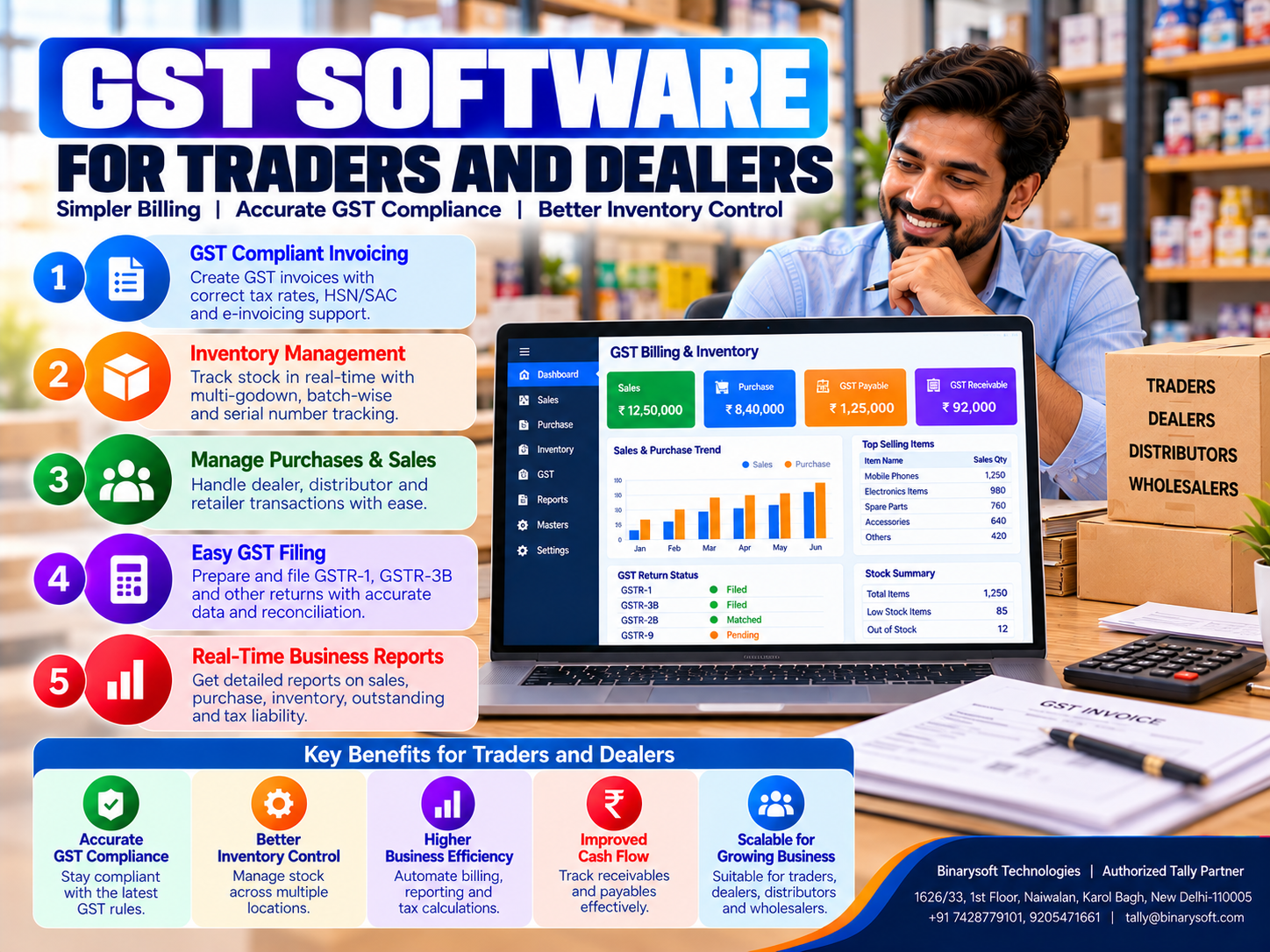
Introduction: Why Every Trader Needs Reliable GST Software
Running a trading business in India requires more than purchasing products and selling them at a profit.
Every day, traders and dealers must manage customer orders, supplier invoices, stock movements, payment collections and financial records.
For GST-registered businesses, taxation adds another important responsibility.
A trader must issue appropriate invoices, apply correct GST rates, maintain purchase records, monitor input tax credit and prepare applicable GST returns.
Errors can create additional work, affect customer relationships and expose businesses to compliance risks.
Consider a wholesale distributor processing hundreds of invoices every month. If GSTIN details are incorrect or tax rates are applied inconsistently, the accounting team may spend considerable time identifying and correcting mistakes.
Similarly, if purchase records do not match the relevant GST portal information, the business may face difficulties reviewing input tax credit eligibility.
GST software helps traders manage taxation and accounting within a more structured business environment.
Modern GST accounting software can support invoicing, purchase recording, inventory management, tax calculations, reconciliation and financial reporting.
For Indian retailers, wholesalers and distributors, Tally Prime provides integrated capabilities that support many of these requirements.
This guide explains how GST software works, its important features, the benefits for traders and dealers, and how businesses can use Tally Prime to improve billing accuracy and financial control.
A Trader's Story: The GST Mistake That Nearly Cost Him His Biggest Customer
Rajesh owned an electrical goods distribution business in Bhagirath Palace, Delhi.
His father had established the business with a small shop selling switches, wires and electrical accessories.
Over time, Rajesh expanded operations.
He began supplying electrical products to retailers, contractors and commercial establishments across Delhi NCR.
Business was growing.
His warehouse was busy, and customers regularly placed large orders.
Rajesh believed that increasing sales would automatically make the business financially stronger.
However, one afternoon, he received an unexpected telephone call.
One of his largest customers had identified incorrect information in several purchase invoices.
The customer requested corrections because the invoice details were affecting its reconciliation process.
Rajesh immediately contacted his accountant.
The accountant discovered that some customer GSTIN details had been entered incorrectly.
Several product records also needed review to ensure the appropriate tax treatment was being applied.
The accounts team had been preparing invoices using inconsistent procedures.
Rajesh felt anxious.
He had spent years building a relationship with this customer.
Now, administrative mistakes were threatening that trust.
That evening, he sat in his office reviewing the company's records.
He realized that his business had expanded, but its accounting processes had not improved at the same pace.
He decided to introduce more disciplined GST billing procedures.
The company reviewed its customer masters, stock records and tax configurations.
Employees received training in preparing invoices and checking transaction details.
Tally Prime was used to maintain structured accounting and inventory records.
The accounts team began reviewing GST reports regularly instead of waiting until return preparation deadlines.
Gradually, invoice-related corrections became easier to identify before documents were shared.
Rajesh also gained better visibility into customer outstanding balances and stock information.
The experience changed his perspective.
He understood that GST compliance was not simply a monthly responsibility.
It was connected with customer confidence, cash flow and everyday business operations.
For a trader, accurate billing is not just paperwork. It is part of protecting the reputation built through years of hard work.
This is an illustrative story based on common trading-business challenges.
What Is GST Software for Traders and Dealers?
GST software is a business application that helps organizations record GST-related transactions and prepare information required for applicable tax compliance.
For traders and dealers, GST software may support sales invoicing, purchase accounting, tax calculations, input tax credit review and GST reporting.
Many applications also include accounting and inventory management capabilities.
A suitable GST system should help businesses maintain consistent transaction information throughout the accounting period.
Instead of preparing invoices in one application and maintaining tax records separately, traders can use integrated processes.
However, GST software does not automatically guarantee compliance.
Correct configuration, accurate transactions and regular review remain essential.
Why Traders and Dealers Need GST Software
Trading businesses often handle large numbers of products and transactions.
A single invoice may contain items with different HSN classifications or GST rates.
Businesses may sell to registered customers, unregistered consumers or customers located in other states.
They may also purchase goods from multiple suppliers.
Each situation requires appropriate transaction recording.
GST software helps organize these activities.
It can reduce repetitive calculations, improve invoice consistency and support return preparation.
For wholesalers and distributors, integration with inventory and accounting can provide additional operational benefits.
15 Important Features of GST Software for Traders and Dealers
1. GST-Compliant Sales Invoicing
Sales invoicing is one of the most important activities for traders.
A GST-registered dealer must issue appropriate documents according to the nature of the transaction and applicable requirements.
GST software helps prepare invoices using structured customer, product and tax information.
How Tally Prime Helps
Tally Prime supports GST-related sales invoicing.
Businesses can configure relevant tax details and prepare invoices containing applicable information.
Business Benefits
Structured invoicing can improve consistency and reduce repetitive manual calculations.
Employees must still verify customer details, tax treatment and invoice particulars.
2. Local and Interstate GST Billing
Traders frequently supply goods to customers located in different states.
GST treatment depends on the nature and place of supply.
For ordinary intrastate taxable supplies, CGST and SGST may apply.
For applicable interstate supplies, IGST may apply.
Example
Suppose a Delhi trader sells taxable goods worth ₹50,000 at an illustrative GST rate of 18%.
For an ordinary intrastate supply:
CGST at 9% = ₹4,500
SGST at 9% = ₹4,500
Total invoice value = ₹59,000
For an applicable interstate supply at the same rate:
IGST at 18% = ₹9,000
Total invoice value = ₹59,000
The example assumes the same taxable value and rate in both cases.
Tally Prime Application
Tally Prime can calculate relevant GST amounts based on configured transaction details.
The business must ensure that place-of-supply information and tax settings are correct.
3. HSN Code and GST Rate Management
Traders often maintain products belonging to different categories.
Correct HSN classification and applicable tax rates are important for invoicing and reporting.
GST software helps maintain product-related tax information.
Tally Prime Features
Businesses can configure relevant HSN and GST information for stock items or other applicable masters.
Business Benefits
Consistent master data reduces repeated manual entry.
However, software cannot independently determine every complex classification issue.
Businesses should verify uncertain classifications and current rates.
4. Purchase Accounting and Input Tax Credit
Input tax credit is an important part of GST management for eligible regular taxpayers.
Traders purchase goods from suppliers and may claim eligible input tax credit subject to applicable conditions.
Incorrect purchase records can complicate reconciliation.
How Tally Prime Helps
Tally Prime supports GST-related purchase recording and input tax credit reporting.
Businesses can review purchase information and relevant GST summaries.
Important Consideration
Recording GST on a purchase does not automatically establish entitlement to input tax credit.
Eligibility depends on applicable legal conditions and reconciliation requirements.
5. GSTR-1 Preparation
GSTR-1 contains details of outward supplies and related information for applicable registered taxpayers.
Traders need to maintain accurate sales records to prepare this return.
Tally Prime Application
Tally Prime supports GSTR-1 reporting and, in supported releases and configurations, connected upload and filing-related workflows.
Business Benefits
Regular review can help identify incomplete or inconsistent transaction information before submission.
6. GSTR-3B Preparation
GSTR-3B is an important summary return for applicable regular taxpayers.
It includes relevant tax liability and input tax credit information.
Tally Prime Application
Tally Prime provides GSTR-3B-related reports and supported connected workflows.
Important Consideration
Businesses should reconcile relevant records and verify return information before filing.
Software-generated figures should not be accepted without review.
7. GSTR-2B and Purchase Reconciliation
Purchase reconciliation helps traders compare recorded purchase transactions with relevant GST portal information.
Differences may arise because of incorrect GSTINs, missing supplier invoices or reporting delays.
Tally Prime Features
Supported releases provide GSTR-2A and GSTR-2B reconciliation capabilities.
Business Benefits
Reconciliation can help businesses identify discrepancies and coordinate corrections with suppliers.
This supports more informed input tax credit review.
8. Invoice Management System Support
The GST Invoice Management System, commonly called IMS, is relevant to the review of specified inward supply records.
Depending on applicable requirements, recipients may need to review and act on eligible documents.
Tally Prime Application
Supported Tally Prime releases provide IMS-related functionality for applicable GST workflows.
Business Benefits
A structured review process helps businesses monitor purchase documents and related reconciliation activities.
Businesses should verify the current legal requirements and software capabilities applicable to their transactions.
9. E-Invoicing Support
E-invoicing requirements apply to eligible taxpayers and specified transactions according to current GST rules.
An e-invoice generally involves reporting relevant invoice information to the designated system and obtaining the required identification details.
How Tally Prime Helps
Supported Tally Prime releases provide connected e-invoicing capabilities.
Business Benefits
Integrated processes can reduce repeated data entry.
Important Consideration
E-invoicing applicability depends on current legal thresholds, transaction categories and other requirements.
Businesses should verify their eligibility and obligations before issuing invoices.
10. E-Way Bill Management
E-way bill requirements may apply when goods are transported under specified circumstances.
Traders and distributors frequently need to evaluate these requirements.
Tally Prime Features
Supported releases provide e-way bill generation and management capabilities.
Business Benefits
Connected workflows can help reduce duplicate information entry.
However, users must verify transport details and applicable legal requirements.
11. Inventory Management
Inventory management is essential for trading businesses.
Excess stock increases holding costs.
Insufficient stock can result in lost sales.
GST software integrated with inventory can help maintain consistent stock records.
Tally Prime Application
Tally Prime supports stock items, stock groups, stock categories and relevant inventory reports.
Business Benefits
Traders can review recorded stock information while managing sales and purchases.
12. Multiple Godown Management
Wholesalers and distributors may operate several warehouses.
Managing stock across locations requires organized records.
Tally Prime Features
Godown management supports location-wise inventory information.
Example
A distributor maintains warehouses in Karol Bagh and Naraina.
Location-wise stock records can help management review quantities at each location.
Business Benefits
Better location visibility can support stock transfers and purchasing decisions.
13. Multiple Price Lists and Discounts
Trading businesses often maintain different prices for retailers, wholesalers and other customer categories.
Tally Prime Application
Relevant price list and discount-related features can support selected pricing requirements.
Business Benefits
Structured pricing information can reduce repetitive calculations and support invoice consistency.
14. Customer Outstanding Management
Many wholesalers sell products on credit.
Unpaid invoices can affect working capital.
Tally Prime Features
Bill-wise accounting and outstanding reports help track customer balances.
Ageing analysis can support overdue payment reviews.
Business Benefits
Regular monitoring helps businesses plan collections and evaluate credit exposure.
15. Financial Reporting and Banking
GST management is closely connected with accounting.
Traders need reliable information about revenue, expenses, bank balances and profitability.
Tally Prime Features
Tally Prime provides accounting, banking, reconciliation and financial reporting capabilities.
Business Benefits
Integrated financial records help business owners review performance without maintaining unnecessary duplicate records.
GST Software for Regular Dealers vs Composition Dealers
GST requirements differ according to registration type.
Regular taxpayers generally follow the applicable invoicing, tax payment and return requirements.
Eligible composition taxpayers operate under a different compliance framework.
| Feature | Regular Dealer | Composition Dealer |
|---|
| Customer document |
Tax invoice where applicable |
Bill of supply |
| Tax collection |
According to applicable GST rules |
Generally cannot collect composition tax separately |
| Input tax credit |
Subject to eligibility conditions |
Generally not available on inward supplies |
| Return framework |
Applicable GSTR-1 and GSTR-3B requirements |
Applicable CMP-08 and GSTR-4 requirements |
| Tax calculation |
Based on applicable supply treatment |
Based on composition provisions |
| Software setup |
Regular GST configuration |
Composition configuration |
Eligibility for the composition scheme depends on current legal requirements.
Businesses should verify registration status and applicable restrictions before configuring their accounting software.
How Tally Prime Helps Traders Manage Daily Operations
Tally Prime provides several features relevant to trading businesses.
GST Billing
Prepare relevant GST invoices using configured customer and product information.
Purchase Management
Record supplier purchases and maintain accounting records.
Inventory Tracking
Monitor stock items and recorded quantities.
Godown Management
Review inventory across different locations.
Outstanding Reports
Track customer and supplier balances.
Banking
Record receipts and payments and perform relevant reconciliation.
GST Reporting
Review GSTR-1, GSTR-3B and other applicable GST-related information.
Financial Statements
Generate profit and loss statements, balance sheets and other financial reports.
Security
Use relevant access controls and data protection features.
These capabilities can help traders manage multiple business activities within a structured system.
Case Study 1: GST Software for an Electrical Goods Wholesaler in Bhagirath Palace
Business Type: Electrical goods wholesale distribution
Location: Bhagirath Palace, Delhi
Primary Challenges: Invoice corrections, inconsistent stock records and delayed GST reconciliation.
Business Background
Consider a distributor supplying switches, cables and electrical accessories.
The company processes numerous invoices every day.
Customer information and product tax details are maintained inconsistently.
The accounts team spends considerable time correcting transaction records.
Implementation Strategy
The business reviews customer GSTIN information.
Product masters and applicable tax details are standardized.
Tally Prime is configured for GST-related invoicing, accounting and inventory.
Employees receive practical training.
GST reports are reviewed regularly.
Illustrative Outcomes
Invoice information becomes more consistent.
Employees spend less time correcting avoidable entry mistakes.
Inventory records become easier to review.
The accounts team can identify discrepancies earlier.
Key Learning
Reliable GST billing begins with accurate master data and disciplined transaction procedures.
This is an illustrative case study, not a verified customer implementation.
Case Study 2: GST and Inventory Management for a Garment Distributor in Gandhi Nagar
Business Type: Garment wholesale distribution
Location: Gandhi Nagar, Delhi
Primary Challenges: Large product variety, warehouse stock tracking and customer outstanding management.
Business Background
Consider a garment distributor supplying products to retailers across North India.
The business maintains numerous product varieties and customer accounts.
Inventory records are updated through spreadsheets.
The accounts team struggles to reconcile sales information with stock movements.
Implementation Strategy
The company establishes structured stock groups and items.
Relevant inventory locations are configured.
Sales and purchase transactions are recorded consistently.
Bill-wise outstanding management is introduced.
Applicable GST information is maintained in Tally Prime.
Illustrative Outcomes
Recorded stock information becomes more organized.
Customer balances are easier to monitor.
Accounting and inventory reconciliation requires less manual effort.
Management gains better visibility into daily operations.
Key Learning
Integrated GST accounting and inventory processes can provide important benefits for distributors handling large product ranges.
This is an illustrative case study, not a verified customer implementation.
How to Set Up GST Software in Tally Prime
Step 1: Create or Open the Company
Enter accurate business information.
Verify the state, address and relevant registration details.
Step 2: Configure GST
Enable the applicable GST features.
Enter the correct registration information and relevant settings.
Step 3: Create Customer and Supplier Ledgers
Maintain appropriate party names, addresses, GSTINs and state information.
Step 4: Configure Stock Items
Create relevant products, units of measurement and inventory groups.
Step 5: Maintain Tax Information
Configure applicable GST rates and HSN details.
Step 6: Create Relevant Tax Ledgers
Establish tax-related accounting ledgers according to the selected configuration.
Step 7: Record Purchase Transactions
Enter supplier invoices using appropriate accounting procedures.
Step 8: Prepare Sales Invoices
Select the correct customer, items, quantities and tax treatment.
Step 9: Review GST Reports
Investigate incomplete or inconsistent transaction information.
Step 10: Reconcile and Prepare Returns
Compare relevant accounting records with GST portal information.
Review applicable returns before submission.
The exact configuration steps may vary according to Tally Prime release and business requirements.
Common GST Mistakes Traders Should Avoid
Incorrect GSTIN Details
Wrong customer or supplier information can create reconciliation problems.
Incorrect HSN Classification
Improper classification may affect tax treatment and reporting.
Using Outdated Tax Rates
Businesses should verify rates applicable to the transaction date.
Ignoring Purchase Reconciliation
Missing or mismatched supplier information may affect input tax credit review.
Incorrect Place-of-Supply Information
This may result in incorrect tax treatment.
Missing Credit Notes
Sales returns and other relevant adjustments should be recorded correctly.
Ignoring E-Invoicing Requirements
Eligible businesses must follow applicable e-invoicing provisions.
Inadequate Inventory Verification
Recorded stock quantities should be compared with physical inventory at appropriate intervals.
Delayed GST Reviews
Waiting until filing deadlines can make corrections more difficult.
How GST Software Can Improve Business Profitability
GST software primarily supports accounting and compliance processes.
However, integration with business management features can provide additional financial benefits.
Reduced Administrative Work
Structured invoicing and reporting can reduce repetitive tasks.
Better Inventory Visibility
Stock reports can support purchasing decisions.
Improved Receivables Monitoring
Outstanding reports help management identify overdue customer payments.
Better Expense Analysis
Financial reports help business owners review operating costs.
Reduced Correction Effort
Consistent master data can reduce avoidable transaction errors.
These benefits depend on implementation quality and employee training.
GST software does not automatically increase profits or guarantee tax savings.
How to Choose the Right GST Software for Traders
Before purchasing GST software, evaluate the following requirements:
-
GST-compliant invoicing capabilities
-
Local and interstate billing
-
Relevant HSN and tax rate configuration
-
Purchase accounting
-
Input tax credit reconciliation
-
GSTR-1 and GSTR-3B reporting
-
E-invoicing support where applicable
-
E-way bill support where applicable
-
Inventory management
-
Multiple godown records
-
Customer outstanding management
-
Banking and reconciliation
-
Financial reporting
-
User access controls
-
Data backup and recovery
-
Training and implementation support
The best software is the one that meets the organization's actual operational requirements.
Future of GST Software for Indian Traders
GST accounting processes are becoming increasingly digital.
Businesses are placing greater emphasis on invoice accuracy, reconciliation and timely reporting.
Connected software can support selected return preparation and portal-related activities.
Inventory and accounting integration can also help traders maintain more consistent records.
However, GST requirements may change.
Businesses should keep their software updated and verify applicable legal provisions.
The most effective approach combines suitable technology with accurate transaction recording and regular professional review.
Conclusion
GST software plays an important role in helping traders and dealers manage taxation, accounting and everyday business activities.
For wholesalers, retailers and distributors, accurate invoicing and structured purchase records are essential.
Suitable GST software can support GSTR-1 and GSTR-3B preparation, input tax credit reconciliation, e-invoicing, e-way bills and relevant financial reporting.
Tally Prime also provides inventory management, godown tracking, outstanding reports and banking capabilities.
These features can help businesses reduce repetitive work and maintain more consistent information.
However, successful GST management requires correct configuration, accurate data and regular reconciliation.
Businesses should review tax classifications, customer information and transaction records before submitting returns.
For a trading business, GST software is more than a compliance tool. When implemented properly, it becomes part of a stronger system for protecting customer trust, improving financial visibility and supporting sustainable growth.
Powered by Binarysoft Technologies
Authorized Tally Partner
Location: 1626/33, 1st Floor, Naiwalan, Karol Bagh, New Delhi – 110005, INDIA
Contact: +91 7428779101, 9205471661
Email: tally@binarysoft.com
Business Hours: 10:00 AM – 6:00 PM, Monday to Friday
Frequently Asked Questions
What is GST software for traders and dealers?
GST software helps trading businesses record GST-related sales and purchases, prepare invoices, review tax information and support applicable GST return processes.
Which GST software is suitable for traders in India?
Suitable software should support invoicing, purchase accounting, GST reporting, inventory and relevant reconciliation requirements. Tally Prime provides these capabilities for many Indian trading businesses.
Does GST software automatically calculate tax?
Suitable GST software can calculate applicable taxes using configured transaction information. Users must verify rates and tax treatment.
Can GST software help with input tax credit reconciliation?
Yes. Supported reconciliation features help businesses compare purchase records with relevant GST information.
CA. Atharv Nambiar provides advisory services in accounting, audit, and taxation. He shares practical guidance on financial reporting, business controls, and technology adoption for modern organizations.