Call CA Tally HelpDesk
+91 9205471661,
7428779101
Introduction: Why Service Businesses Need Smarter ERP Software in 2026
India's service industry includes consulting firms, IT companies, marketing agencies, professional service providers, maintenance businesses, logistics companies, educational institutions and many other organizations.
Unlike trading and manufacturing businesses, service companies primarily generate revenue through expertise, time, skills and customer relationships.
However, managing a service business involves much more than delivering quality work.
Business owners must monitor customer invoices, employee expenses, project profitability, outstanding payments, GST compliance and financial performance.
When these activities are managed through disconnected spreadsheets and manual accounting processes, even successful service businesses can experience financial difficulties.
A company may complete several profitable-looking projects but still struggle to pay salaries because customer invoices remain unpaid.
Another organization may generate substantial revenue while failing to identify projects where expenses exceed the original budget.
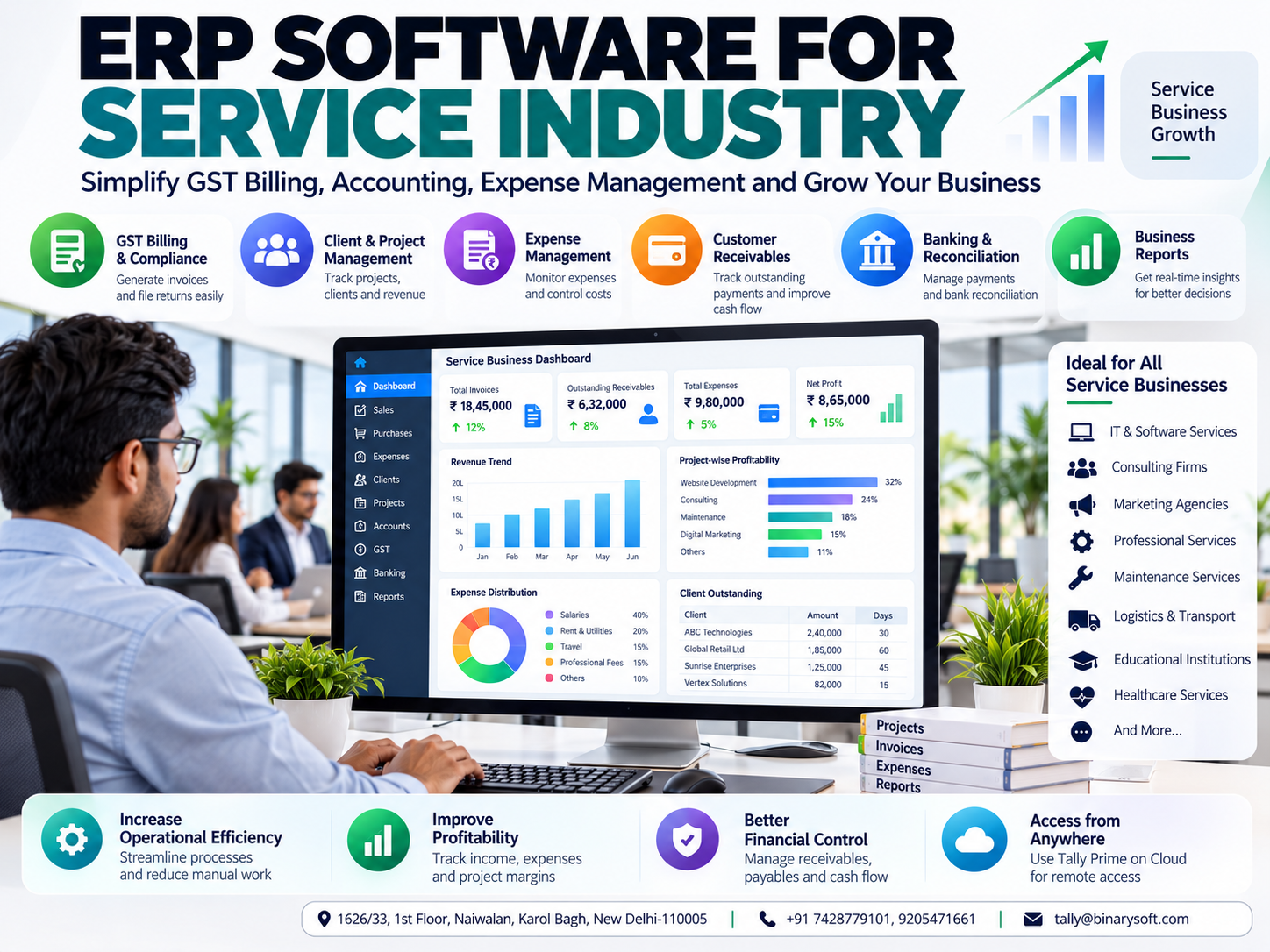
ERP software for the service industry helps businesses organize financial information, improve operational visibility and make better decisions.
For Indian service businesses, Tally Prime provides accounting, GST invoicing, expense allocation, banking and financial reporting capabilities that can support efficient business management.
This article explains the importance of ERP software for service organizations, its major features, practical applications and how Tally Prime can help service businesses grow sustainably.
1. What Is ERP Software for the Service Industry?
Enterprise Resource Planning software connects important business processes within an integrated management environment.
In service organizations, ERP requirements commonly include financial accounting, customer billing, expense management, project tracking, employee administration and reporting.
Unlike inventory-intensive businesses, service companies often focus on managing resources, time, profitability and customer payments.
A comprehensive service industry ERP solution may support:
-
Customer and contract management
-
Service invoicing
-
Project accounting
-
Expense monitoring
-
Employee time tracking
-
Resource allocation
-
GST and statutory compliance
-
Accounts receivable and payable
-
Financial reporting
-
Business performance analysis
Not every ERP product includes all these functions.
For example, Tally Prime provides strong financial accounting, invoicing, cost centre reporting and taxation capabilities. Specialized functions such as advanced employee scheduling, project collaboration or customer ticket management may require additional applications.
The objective is to connect essential business information and reduce unnecessary administrative work.
2. Major Challenges Faced by Service Businesses
Service businesses operate differently from product-based companies.
Their profitability often depends on employee productivity, project costs, pricing and timely customer payments.
2.1 Delayed Customer Payments
Many service organizations provide services before receiving full payment.
Customers may have payment terms of 15, 30, 45 or 60 days.
Delayed payments can affect salaries, rent, vendor payments and working capital.
2.2 Difficulty Tracking Project Expenses
A consulting or marketing company may handle multiple projects simultaneously.
Without proper expense allocation, management may struggle to identify the actual cost of individual projects.
2.3 Inaccurate Service Billing
Service invoices may involve retainers, milestone payments, hourly charges, reimbursements or recurring contracts.
Manual billing increases the risk of missed charges and calculation errors.
2.4 GST Compliance Requirements
Service providers must determine applicable GST treatment based on the nature of services, place of supply and other statutory requirements.
Incorrect classifications can create reporting and reconciliation difficulties.
2.5 Limited Financial Visibility
Business owners need to understand revenue, expenses, receivables and profitability.
Without timely reports, financial decisions may depend on assumptions rather than accurate information.
Integrated accounting software helps address these challenges by maintaining organized financial records.
3. An Emotional Story: A Successful Consultant Who Could Not Pay Salaries on Time
Rohit started a small digital consulting company in Delhi with three employees.
His ambition was simple.
He wanted to build a respected business that delivered excellent services and created stable employment opportunities.
During the first few years, the company grew steadily.
New customers arrived through recommendations, and the team began handling larger projects.
Eventually, Rohit employed fifteen people.
His office was busy, clients were satisfied and monthly revenue appeared encouraging.
But behind the growth, financial problems were developing.
Some customers delayed payments.
Project expenses were recorded in separate spreadsheets.
Invoices were occasionally generated late because project managers forgot to inform the accounts team that milestones had been completed.
One afternoon, Rohit's accountant informed him that the company did not have enough available funds to cover the upcoming salary payments.
Rohit was shocked.
The company had completed substantial work and had issued invoices worth several lakhs.
Yet the money had not arrived.
He spent the evening reviewing customer emails, payment records and project spreadsheets.
For the first time, he realized that business success could not be measured by revenue alone.
He needed better control over billing, expenses and cash flow.
Rohit introduced a structured accounting process using Tally Prime.
His team organized customer ledgers, maintained bill-wise outstanding records and allocated expenses to appropriate cost centres.
The company also established a monthly financial review process.
Over time, Rohit gained better visibility into unpaid invoices, operational expenses and financial commitments.
The greatest relief came from being able to plan salary payments with greater confidence.
A service business becomes financially stronger when its owners understand not only how much they earn, but also when they receive money and how much it costs to deliver their services.
This fictional story illustrates common financial challenges experienced by growing service businesses.
4. GST Billing and Service Invoice Management
Accurate invoicing is essential for service organizations.
Unlike product invoices, service invoices may contain professional fees, consulting charges, maintenance fees, retainers and other service-related amounts.
Tally Prime supports service invoicing and GST accounting.
Important Capabilities
GST-Compliant Invoices
Businesses can generate invoices containing applicable GST information.
Service Classification
Relevant service accounting details and SAC classifications can be configured according to business requirements.
Tax Calculation
Applicable CGST, SGST or IGST can be calculated based on the transaction configuration.
Customer Ledger Management
Invoices are recorded against customer accounts, helping maintain accurate receivable balances.
GST Reporting
Businesses can review GST-related transaction information and use supported compliance workflows.
Practical Example
A Delhi-based consulting firm provides taxable consulting services worth ₹80,000 to a customer in Delhi.
Assuming the applicable GST rate is 18%:
Service value: ₹80,000
CGST at 9%: ₹7,200
SGST at 9%: ₹7,200
Total invoice amount: ₹94,400
Tally Prime can record the invoice and applicable tax details when correctly configured.
Actual tax treatment must be determined according to the applicable GST rules.
5. Project Costing and Expense Management
Service businesses often work on multiple assignments simultaneously.
Without proper expense allocation, management may know total company profitability but not the profitability of individual projects.
Tally Prime supports cost centres and cost categories for suitable accounting requirements.
How Cost Centres Help
Businesses can allocate relevant income and expenses to departments, projects or other responsibility areas.
For example, a marketing agency may create cost centres for:
-
Website Development Projects
-
Digital Advertising Services
-
Search Engine Optimization
-
Content Marketing
-
Consulting Assignments
Relevant expenses can then be recorded against appropriate cost centres.
Project Profitability Example
A consulting assignment generates revenue of ₹2,50,000.
Direct project expenses include:
Employee-related costs: ₹90,000
Travel expenses: ₹20,000
External professional fees: ₹35,000
Other direct expenses: ₹15,000
Total direct expenses: ₹1,60,000
Contribution before indirect overheads: ₹90,000
This information helps management evaluate project performance.
For advanced project scheduling, time-sheet billing and resource utilization analysis, specialized software may be required.
6. Customer Outstanding and Credit Management
Delayed customer payments are among the biggest financial challenges in the service industry.
A business may generate substantial revenue but still experience liquidity problems.
Tally Prime supports bill-wise receivables tracking and outstanding analysis.
Key Features
Customer Outstanding Reports: Show unpaid customer balances.
Bill-Wise Tracking: Helps identify individual unpaid invoices.
Ageing Analysis: Groups outstanding invoices according to their age.
Receipt Recording: Maintains accounting records of customer payments.
Financial Reporting: Helps management evaluate receivables in relation to overall financial performance.
Business Example
A service company has outstanding invoices worth ₹18 lakh.
After reviewing its ageing report, management discovers that ₹6 lakh has remained unpaid for more than 60 days.
The company can prioritize collection efforts and review credit terms for customers with repeated delays.
Better receivables visibility supports stronger cash flow planning.
7. Banking and Payment Reconciliation
Service organizations receive payments through bank transfers, cheques and digital payment channels.
Accurate bank reconciliation helps ensure that accounting records match actual bank transactions.
Tally Prime supports bank reconciliation and relevant banking workflows.
Depending on the installed release and supported services, additional connected banking capabilities may be available.
Businesses can use these features to:
-
Review bank balances
-
Record receipts and payments
-
Identify unreconciled transactions
-
Monitor supplier payments
-
Improve financial record accuracy
Regular reconciliation reduces the risk of overlooked receipts and incorrect accounting entries.
8. Case Study One: IT Services Company Improves Project Financial Visibility
Business Background
A hypothetical IT services company provides website development, software maintenance and technical consulting services.
The organization employs twenty professionals and handles several customer projects simultaneously.
Challenges
The company struggles to identify project-level expenses.
Customer invoices are occasionally delayed, and management lacks a consolidated view of outstanding payments.
Solution Using Tally Prime
The business introduces a structured accounting process.
Customer ledgers are standardized.
Cost centres are configured for relevant projects.
Invoices are recorded against customer accounts.
Bill-wise receivables tracking is enabled.
Management begins reviewing project-related expenses and customer outstanding reports monthly.
Operational Improvements
The improved process helps the company identify unpaid invoices, review project costs and maintain more consistent financial records.
Management can also evaluate which assignments require closer expense monitoring.
Key Learning
Service businesses benefit from connecting customer billing with expense allocation and financial reporting.
This illustrative case study does not represent independently verified customer results.
9. Case Study Two: Facility Management Company Strengthens Expense Control
Business Background
A hypothetical facility management company provides cleaning, maintenance and support services to commercial buildings.
The organization handles multiple customer contracts and recurring monthly expenses.
Challenges
The business experiences difficulty tracking expenses across customer locations.
Supplier bills are sometimes recorded late, and customer collections require frequent follow-up.
Solution Using Tally Prime
The company creates suitable customer and supplier ledgers.
Cost centres are configured for major service locations.
Recurring expenses are recorded consistently.
Monthly customer invoices are generated according to contractual billing arrangements.
Management reviews outstanding receivables, payables and expense reports regularly.
Operational Improvements
The company gains clearer visibility into location-related expenses and payment obligations.
Its accounting team can identify overdue customer invoices more efficiently.
Key Learning
Consistent accounting and cost allocation can improve financial discipline in contract-based service businesses.
This case study is illustrative and does not claim measured financial savings.
10. How to Use Tally Prime for a Service Business
A service organization can establish an organized accounting environment through the following steps.
Step 1: Create the Company
Open Tally Prime and enter the required company information, accounting period and statutory details.
Step 2: Configure GST
Enable applicable GST features and enter relevant registration information.
Step 3: Create Service Income Ledgers
Create separate income ledgers for important service categories.
For example:
Consulting Income
Maintenance Service Income
Professional Fees
Technical Support Income
Step 4: Create Customer and Supplier Ledgers
Maintain organized customer and supplier accounts.
Configure bill-wise tracking where appropriate.
Step 5: Create Expense Ledgers
Record expenses under suitable accounting classifications.
Examples include salaries, office rent, travel, professional fees and communication expenses.
Step 6: Configure Cost Centres
Create cost centres for projects, departments or service locations where required.
Step 7: Record Service Invoices
Generate invoices using appropriate service and tax details.
Step 8: Record Customer Receipts
Record payments against the relevant customer invoices.
Step 9: Reconcile Bank Transactions
Review bank statements and investigate differences.
Step 10: Review Financial Reports
Monitor profitability, expenses, outstanding balances and cash flow regularly.
Businesses should validate opening balances and train employees before relying on reports for important financial decisions.
11. Tally Prime on Cloud for Service Organizations
Service businesses increasingly operate through remote teams, multiple offices and flexible working arrangements.
A consulting firm may have employees working from Delhi, Mumbai and Bengaluru.
Business owners may also need access to accounting information while traveling.
Tally Prime can be deployed through compatible hosted desktop infrastructure to support remote access.
Potential Benefits
Location Flexibility
Authorized users can access the hosted application from supported locations.
Centralized Hosting
Business data can be maintained within a managed hosting environment.
Collaboration
Properly configured multi-user arrangements can support accounting teams working from different locations.
Backup and Recovery
Suitable hosting services may provide managed backup and recovery arrangements.
Reduced Local Infrastructure Dependence
Businesses may reduce their reliance on maintaining dedicated office servers.
Actual performance and availability depend on network connectivity, hosting infrastructure, licensing and security configuration.
12. Financial Reports Every Service Business Should Monitor
Financial reporting helps service organizations understand their operational performance.
Important reports include:
Profit and Loss Account: Shows income, expenses and profitability.
Balance Sheet: Provides information about assets, liabilities and capital.
Customer Outstanding Report: Helps monitor unpaid invoices.
Supplier Payables Report: Supports payment planning.
Cost Centre Reports: Help analyze allocated income and expenses.
Cash and Bank Books: Provide transaction-level financial visibility.
Cash Flow Reports: Support liquidity analysis.
Expense Reports: Help identify significant operating costs.
Regular reporting enables management to identify financial problems before they become serious.
13. Benefits of ERP Software for the Service Industry
Improved Financial Accuracy
Integrated accounting reduces unnecessary duplication of transaction records.
Faster Invoice Preparation
Structured service billing helps businesses generate invoices more consistently.
Better Expense Visibility
Cost allocation and financial reports help management understand operating expenses.
Stronger Credit Control
Outstanding analysis helps businesses identify overdue invoices and plan collection activities.
Improved GST Management
Appropriate tax configuration supports more organized GST accounting and reporting.
Better Business Decisions
Timely financial information helps owners evaluate profitability, liquidity and business performance.
Support for Business Growth
Consistent processes make it easier to manage increasing transaction volumes and additional customers.
These benefits depend on accurate data entry, suitable software configuration and regular management review.
14. Choosing the Right ERP Software for Your Service Business
Before selecting software, businesses should evaluate their specific requirements.
A professional consulting firm may primarily need invoicing, expense allocation and receivables tracking.
An IT services company may also require project scheduling and employee time management.
A maintenance company may need contract tracking, service tickets and technician scheduling.
Important selection factors include:
-
GST invoicing capabilities
-
Financial accounting features
-
Customer receivables management
-
Project expense allocation
-
Banking and reconciliation
-
Reporting requirements
-
Multi-user access
-
Software scalability
-
Integration capabilities
-
Technical support
Businesses should avoid paying for complicated features they do not need.
At the same time, they should identify specialized requirements that basic accounting software cannot fulfill independently.
15. Future of ERP Software for Service Businesses in India
Service businesses are increasingly adopting digital accounting, cloud-enabled access and automated financial workflows.
Future improvements are likely to focus on better application integration, faster reporting and more intelligent analysis of business information.
Artificial intelligence may assist with expense categorization, anomaly detection and financial forecasting.
However, reliable financial information will remain essential.
Even advanced software cannot produce dependable reports when transactions are incomplete or incorrectly classified.
Businesses that establish accurate accounting processes today will be better prepared to adopt new technologies.
16. Why Financial Visibility Matters More Than Revenue Growth
Many service businesses focus heavily on acquiring customers and increasing revenue.
However, revenue growth without financial control can create unexpected risks.
A company may accept projects with low profit margins.
It may extend excessive credit to customers.
It may also underestimate employee-related expenses or recurring operational costs.
ERP-style financial management helps owners evaluate these issues using structured accounting information.
For example, comparing service income with allocated project expenses can reveal assignments that require pricing adjustments.
Reviewing receivables ageing can identify customers whose delayed payments create working capital pressure.
Monitoring monthly expenses can help management control unnecessary spending.
Sustainable business growth depends on profitability, cash flow and operational discipline—not revenue alone.
Conclusion
The service industry plays a major role in India's economy, but service businesses face unique challenges involving customer billing, project expenses, employee-related costs, GST compliance and delayed payments.
Managing these activities through disconnected records can reduce financial visibility and create avoidable operational difficulties.
ERP software helps businesses connect important processes and maintain more reliable information.
For Indian service organizations, Tally Prime offers practical capabilities for GST invoicing, financial accounting, expense allocation, receivables tracking, banking and business reporting.
Compatible cloud hosting can also support organizations that require remote access to their accounting environment.
Although specialized project management, human resources and service delivery functions may require additional applications, strong financial management remains the foundation of a successful service business.
The most valuable outcome of implementing suitable software is not simply saving accounting time.
It is gaining the clarity needed to price services appropriately, monitor expenses, collect payments and make confident business decisions.
In 2026, service businesses that combine quality service delivery with accurate financial management will be better positioned for sustainable growth.
Powered by Binarysoft Technologies
Authorized Tally Partner
Location: 1626/33, 1st Floor, Naiwalan, Karol Bagh, New Delhi – 110005, INDIA
Contact Us: +91 7428779101, 9205471661
Email: tally@binarysoft.com
Business Hours: 10:00 AM – 6:00 PM, Monday to Friday
Frequently Asked Questions
What should a service business consider before choosing ERP software?
Businesses should evaluate invoicing requirements, expense management, project accounting, GST compliance, reporting, scalability, integrations and implementation costs.
Which service industries can use Tally Prime?
Consulting firms, IT service providers, marketing agencies, maintenance businesses, professional service organizations and many other service companies can use Tally Prime for their accounting requirements.
How does ERP software improve service business profitability?
ERP software provides better visibility into income, expenses, customer payments and financial performance, helping management identify opportunities for improvement.
Does Tally Prime replace project management software?
Not necessarily. Tally Prime supports financial accounting and cost allocation, but advanced project scheduling, collaboration and resource planning may require specialized software.
CA. Aaryan Kanodia focuses on GST reporting, bookkeeping systems, and financial process improvement. He works with businesses to simplify routine accounting activities and maintain records suitable for compliance and internal review.