Call CA Tally HelpDesk
+91 9205471661,
7428779101
Introduction: Why Distributors and Wholesalers Need Smarter ERP Software in 2026
The wholesale and distribution industry forms an essential part of India's commercial economy. From FMCG products and electrical equipment to pharmaceuticals, automobile components, garments and industrial supplies, distributors connect manufacturers with retailers and businesses.
However, running a successful distribution business has become increasingly challenging.
Rising operating expenses, competitive pricing, delayed customer payments, fluctuating inventory demand and GST compliance requirements place considerable pressure on business owners.
A distributor may handle hundreds of invoices every day, maintain thousands of stock items, operate multiple warehouses and supply products to customers across different cities.
Managing these operations through disconnected spreadsheets and manual records creates opportunities for costly mistakes.
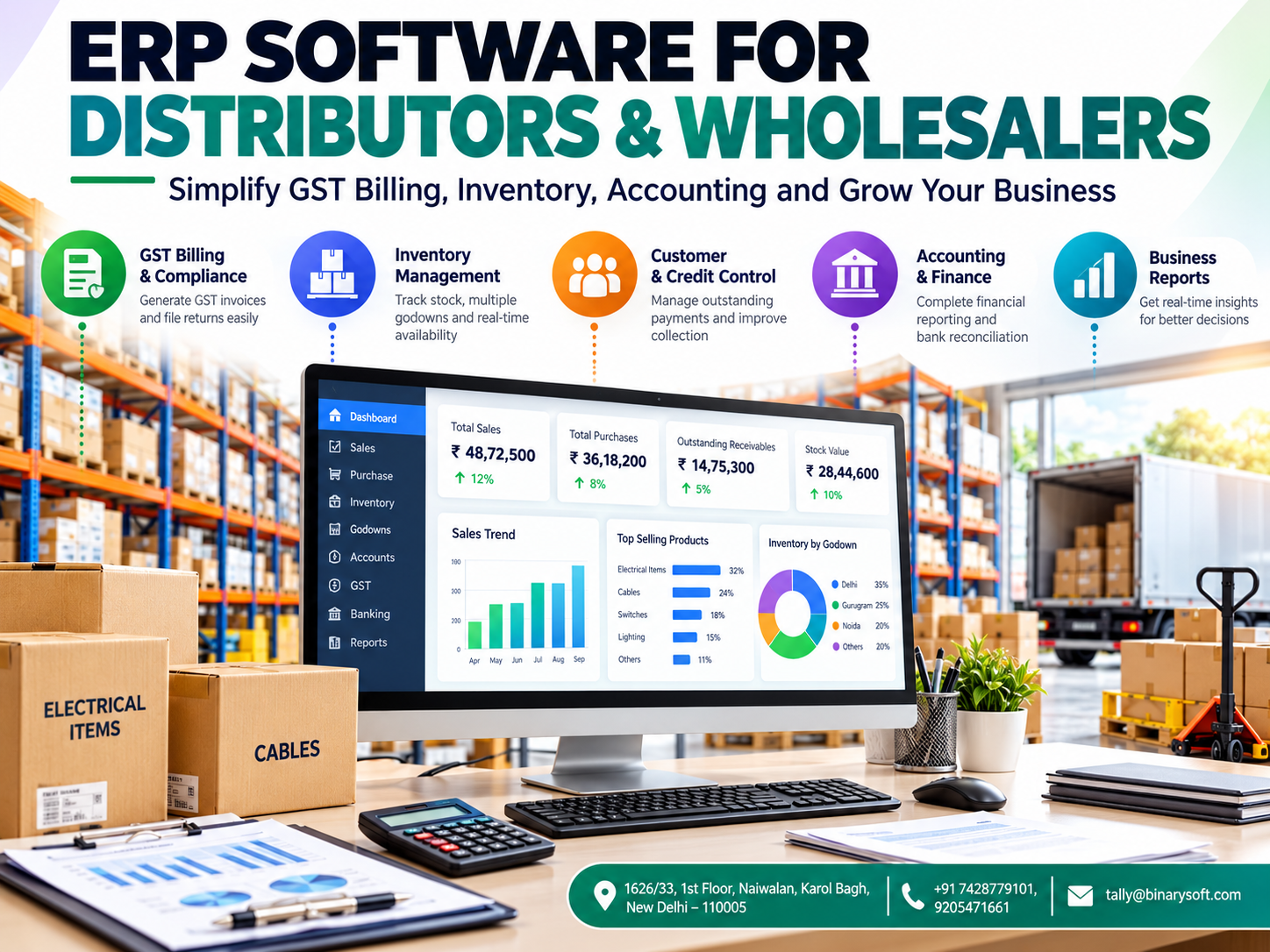
ERP software for distributors and wholesalers helps connect sales, purchases, inventory, accounting, taxation and financial reporting within a structured business management system.
For Indian businesses, Tally Prime offers integrated accounting, inventory, GST and financial management capabilities that can simplify everyday distribution activities.
Whether you operate a small wholesale shop or manage a growing distribution network, the right software can help improve stock visibility, reduce accounting errors, strengthen payment collection and support profitable business decisions.
This guide explores the major benefits of ERP software for distributors and explains how Tally Prime can help businesses operate more efficiently in 2026.
1. What Is ERP Software for Distributors and Wholesalers?
ERP stands for Enterprise Resource Planning.
ERP software integrates important business functions so that information recorded in one department can be used across related operations.
In a distribution business, these functions commonly include:
-
Purchase and supplier management
-
Sales orders and invoicing
-
Inventory and warehouse management
-
GST accounting and compliance
-
Customer credit management
-
Banking and payment reconciliation
-
Financial accounting
-
Business profitability reporting
For example, when a wholesaler records a sales invoice, an appropriately configured integrated system can update the customer ledger, sales accounts, tax details and inventory records.
This reduces repeated data entry and improves the consistency of business information.
Unlike standalone billing software, an integrated accounting and inventory solution provides a broader view of business performance.
2. Common Challenges Faced by Distributors and Wholesalers
Distribution businesses operate with relatively high transaction volumes and often depend on careful working capital management.
Several challenges can directly affect profitability.
2.1 Inaccurate Inventory Records
Businesses frequently experience differences between physical stock and accounting records.
These differences may result from delayed entries, unrecorded transfers, incorrect units or damaged goods.
2.2 Delayed Customer Payments
Wholesale businesses commonly sell goods on credit.
When customer payments are delayed, distributors may struggle to pay suppliers or purchase additional inventory.
2.3 Multiple Warehouse Management
Distributors operating several godowns need accurate information about stock availability at each location.
Without location-wise records, businesses may purchase unnecessary stock while products remain available in another warehouse.
2.4 GST Compliance
Different products, customers and transaction types may involve different GST treatment.
Incorrect tax classifications or incomplete records can create reconciliation and filing difficulties.
2.5 Limited Profitability Visibility
High sales turnover does not necessarily mean high profitability.
Discounts, freight, damaged stock, finance costs and delayed collections can significantly affect actual business earnings.
Integrated ERP-style software helps businesses address these challenges through better transaction recording and reporting.
3. An Emotional Story: A Wholesaler Who Was Selling More but Earning Less
For nearly eighteen years, Amit operated an electrical goods distribution business in Delhi.
He started with a small rented shop and gradually developed relationships with manufacturers, contractors and retailers.
His business expanded from a few product categories to thousands of electrical components.
Every morning, Amit reached his warehouse before his employees.
He personally checked urgent orders, contacted suppliers and followed up with customers.
His turnover was increasing every year.
Yet something was wrong.
Despite strong sales, his bank balance remained under pressure.
Customers frequently delayed payments.
Some products remained unsold for months, while popular items unexpectedly went out of stock.
His accountant needed several days to prepare reliable financial reports.
One evening, Amit received a call from a supplier requesting an overdue payment.
At almost the same moment, an important customer complained that a confirmed order could not be dispatched because the stock was unavailable.
Amit sat quietly in his office after everyone had left.
He had spent years building the business, but he no longer felt in control of it.
The problem was not a lack of hard work.
It was the absence of timely, reliable information.
Amit decided to improve his accounting and inventory processes using Tally Prime.
His team organized stock records, configured godowns, reviewed customer outstanding balances and introduced consistent sales and purchase entries.
Gradually, he could identify slow-moving inventory, review payment commitments and understand the financial position of his business more clearly.
The transformation was not instant, but his decisions became more informed.
A growing business needs more than increasing sales. It needs financial visibility, inventory discipline and control over cash flow.
This fictional story illustrates common experiences in wholesale distribution businesses.
4. GST Billing and Tax Compliance for Wholesale Businesses
GST compliance is a major requirement for Indian distributors.
A wholesaler may issue invoices to registered businesses, unregistered customers and buyers located in different states.
Accurate tax treatment depends on the nature and location of each transaction.
How Tally Prime Helps
Tally Prime supports GST-enabled invoicing and accounting.
Businesses can configure relevant GST information, maintain product classifications and generate invoices with applicable tax details.
Important capabilities include:
-
GST tax invoice preparation
-
HSN-based product classification
-
CGST, SGST and IGST accounting
-
GST-related reports
-
Purchase and sales registers
-
GST reconciliation workflows
-
Applicable e-invoicing and e-way bill functionality
Supported connected GST features depend on the installed release and service configuration.
Practical Example
A Delhi-based distributor sells electrical equipment worth ₹1,00,000 to a registered customer in Haryana.
Assuming the transaction is an interstate taxable supply attracting 18% GST:
Taxable value: ₹1,00,000
IGST at 18%: ₹18,000
Invoice total: ₹1,18,000
With appropriate configuration, Tally Prime can calculate and record the tax according to the transaction details.
Businesses should verify the applicable GST rate and place-of-supply rules for each transaction.
5. Inventory Management for Distributors and Wholesalers
Inventory represents a significant investment for most distribution businesses.
Excess inventory increases storage and financing costs, while insufficient stock can result in lost sales.
Tally Prime provides inventory management capabilities that help businesses maintain organized stock records.
Stock Groups and Categories
Distributors can classify products by brand, category or business requirement.
For example, an electrical wholesaler may create stock groups for cables, switches, lighting products and circuit protection equipment.
Stock Movement Tracking
Inventory reports help businesses review quantities received, sold and remaining.
Stock Valuation
Inventory valuation reports help management understand the financial value of available stock.
Batch-Wise Tracking
Businesses handling products with batch or expiry requirements can configure relevant tracking features.
Inventory Analysis
Regular stock analysis helps identify slow-moving products and supports better purchasing decisions.
Effective inventory management improves working capital utilization and reduces avoidable operational problems.
6. Managing Multiple Godowns and Warehouses
Many wholesalers maintain inventory across different locations.
For example, a distributor may operate warehouses in Delhi, Gurugram and Noida.
Without centralized inventory records, employees may struggle to determine which location has the required products.
How Tally Prime Helps
Tally Prime supports multiple godowns and location-wise inventory reporting.
Businesses can:
-
Create separate godown records
-
Record stock receipts and issues
-
Track stock transfers between locations
-
Review warehouse-wise quantities
-
Generate consolidated stock reports
Business Example
Suppose a distributor maintains 500 units of a product:
Delhi warehouse: 200 units
Gurugram warehouse: 180 units
Noida warehouse: 120 units
Location-wise stock reporting helps employees identify available quantities before confirming customer orders.
This can reduce unnecessary purchases and improve order fulfillment.
7. Wholesale Pricing, Discounts and Sales Management
Distributors frequently offer different prices to retailers, dealers and bulk purchasers.
A customer purchasing 500 units may receive a different rate from someone purchasing 20 units.
Promotional schemes and seasonal discounts introduce additional complexity.
Tally Prime supports price lists, price levels and discount recording for suitable business workflows.
Businesses can configure customer-specific or quantity-related pricing arrangements according to their requirements.
Accurate discount recording helps maintain consistency between invoice values, tax calculations and accounting records.
For more complex promotional schemes, businesses should evaluate whether additional configuration or integration is required.
8. Credit Management and Outstanding Payment Tracking
Credit sales are common in wholesale distribution.
However, excessive outstanding payments can create serious cash flow problems.
A distributor may report strong sales while having insufficient funds to purchase new stock.
Tally Prime supports bill-wise receivables and payables tracking.
Important Reports
Customer Outstanding Report: Shows unpaid customer balances.
Bill-Wise Outstanding Report: Identifies individual unpaid invoices.
Ageing Analysis: Helps classify outstanding amounts according to how long they have remained unpaid.
Supplier Payables Report: Helps businesses plan payments to suppliers.
Example
A distributor has outstanding customer invoices totaling ₹12 lakh.
Ageing analysis reveals that ₹4 lakh has remained unpaid beyond 60 days.
Management can prioritize follow-up on these invoices instead of contacting every customer without a clear payment strategy.
This improves collection planning and working capital visibility.
9. Banking and Financial Reconciliation
Distributors handle frequent payments through bank transfers, cheques and other banking channels.
Reconciling these transactions manually can consume substantial accounting time.
Tally Prime supports bank reconciliation and applicable bank statement import workflows.
Depending on the product release and supported banking services, businesses may also use connected banking features.
Benefits
-
Easier identification of unreconciled transactions
-
Improved visibility into bank balances
-
Better monitoring of customer receipts
-
More organized supplier payment records
-
Reduced manual reconciliation effort
Regular reconciliation also helps businesses detect missing or incorrectly recorded transactions.
10. Case Study One: FMCG Distributor Improves Stock and Payment Visibility
Business Background
A hypothetical FMCG distributor supplies packaged foods and household products to approximately 180 retail outlets.
The company handles hundreds of stock items and operates two warehouses.
Challenges
The business experiences frequent stock shortages, delayed payment collection and difficulty tracking promotional discounts.
Warehouse employees maintain separate spreadsheets, while the accounting department records invoices independently.
Solution
The company introduces structured inventory and accounting processes using Tally Prime.
Stock groups are created for different product categories.
Godown-wise inventory records are maintained.
Customer ledgers are configured with bill-wise outstanding tracking.
Sales discounts are recorded consistently, and management begins reviewing inventory and receivables reports weekly.
Results
The improved process helps the company identify stock shortages earlier, monitor overdue customer balances and reduce inconsistencies between accounting and inventory records.
Management also gains better visibility into the financial impact of promotional discounts.
Key Learning
Integrated accounting and inventory information can improve decision-making in high-volume distribution businesses.
This is an illustrative case study, not a verified customer implementation.
11. Case Study Two: Automobile Parts Wholesaler Strengthens Financial Control
Business Background
A hypothetical automobile spare parts wholesaler supplies components to garages, workshops and retailers.
The company maintains approximately 4,000 stock items.
Challenges
The business struggles with duplicate product descriptions, incorrect stock quantities and delayed customer payments.
Some products remain unsold for extended periods, increasing inventory holding costs.
Solution
The company standardizes stock item names and product categories in Tally Prime.
Customer and supplier ledgers are reviewed and corrected.
Inventory transactions are recorded consistently.
The accounting team begins monitoring stock summaries, outstanding invoices and profitability reports.
Results
The improved reporting process helps management identify slow-moving products and review purchasing decisions more carefully.
The company also gains clearer visibility into customer credit exposure.
Key Learning
Wholesale profitability improves when businesses combine disciplined inventory practices with accurate financial records.
This case study is illustrative; actual results depend on implementation quality and business conditions.
12. How to Use Tally Prime for a Distribution Business
Businesses can follow these practical steps to establish an integrated accounting and inventory workflow.
Step 1: Create Your Company
Open Tally Prime and create the company with the appropriate financial year, accounting details and statutory information.
Step 2: Configure GST
Enable applicable GST features and enter the required registration information.
Step 3: Create Customer and Supplier Ledgers
Maintain separate ledgers for customers and suppliers.
Configure bill-wise tracking to monitor receivables and payables.
Step 4: Create Stock Groups and Items
Organize inventory by product type, brand or category.
Configure units of measurement and relevant stock details.
Step 5: Create Multiple Godowns
Set up warehouse locations where required.
Maintain accurate location-wise inventory transactions.
Step 6: Configure Pricing
Create suitable price lists and discount arrangements for different customer categories.
Step 7: Record Purchases and Sales
Use the appropriate vouchers to record business transactions.
Where required, use sales orders, delivery notes and purchase orders to support order processing.
Step 8: Review Outstanding Payments
Monitor customer balances and overdue invoices regularly.
Step 9: Reconcile Banking Transactions
Compare recorded transactions with bank statements and investigate differences.
Step 10: Review Management Reports
Analyze stock summaries, profitability, receivables, payables and financial statements.
A successful implementation requires employee training, accurate opening balances and consistent transaction recording.
13. Tally Prime on Cloud for Distributors
Distribution businesses increasingly operate across multiple locations.
Business owners may need access to financial information while traveling or working away from the office.
Tally Prime can be deployed through compatible cloud-hosted desktop infrastructure to support remote access.
Potential benefits include:
-
Access from authorized remote locations
-
Centralized hosting arrangements
-
Support for distributed accounting teams
-
Reduced dependence on a single office computer
-
Professionally managed backup options
However, remote access performance, security and concurrent-user capabilities depend on the hosting configuration, network conditions and licensing arrangements.
Businesses should select a hosting environment that provides appropriate security, backup and technical support.
14. Financial Reports Every Distributor Should Monitor
A distribution business should review more than its daily sales total.
Important reports include:
Sales Analysis: Helps identify high-performing products and customers.
Stock Summary: Shows inventory quantities and values.
Receivables Ageing: Highlights overdue customer balances.
Payables Report: Supports supplier payment planning.
Profit and Loss Account: Helps evaluate business profitability.
Balance Sheet: Provides information about assets, liabilities and capital.
Cash Flow Analysis: Helps assess liquidity and financial commitments.
Stock Ageing: Helps identify products that have remained in inventory for extended periods.
Reviewing these reports regularly supports better purchasing, credit and pricing decisions.
15. How ERP Software Helps Improve Wholesale Profitability
ERP software does not automatically increase profits.
However, it can provide information and operational controls that support more profitable decisions.
For example, accurate stock reports can help reduce unnecessary purchases.
Receivables analysis can support faster collection follow-ups.
Product-wise sales information can help management identify valuable customer segments.
Expense reporting can reveal avoidable operating costs.
The financial benefits depend on how effectively employees use the system and whether management acts on the information available.
16. Choosing the Right ERP Software for Your Distribution Business
Before selecting software, distributors should evaluate their operational requirements.
Important considerations include:
-
Number of stock items
-
Daily invoice volume
-
Number of warehouses
-
Customer credit arrangements
-
GST and statutory requirements
-
Number of employees requiring access
-
Integration with existing applications
-
Reporting requirements
-
Software licensing and implementation costs
-
Technical support availability
Businesses requiring advanced route planning, delivery fleet management, van sales automation or complex warehouse operations may need specialized applications alongside their accounting software.
The ideal solution should address actual operational problems without introducing unnecessary complexity.
17. Future of Wholesale Distribution Software in India
Digital transformation is changing how distributors manage their businesses.
More organizations are adopting electronic invoicing, connected accounting systems, automated reconciliation and cloud-enabled access.
Data-driven purchasing and inventory planning are also becoming increasingly important.
Businesses that maintain accurate accounting and inventory records are better positioned to benefit from these developments.
For small and medium-sized distributors, improving existing processes with practical technology can be more valuable than investing immediately in an expensive enterprise platform.
The future of distribution management will depend on combining reliable business data with efficient operational processes.
Conclusion
Wholesale and distribution businesses face continuous pressure to maintain accurate inventory, manage customer credit, comply with GST requirements and protect profitability.
Disconnected records and manual processes can make these responsibilities increasingly difficult as transaction volumes grow.
ERP software helps bring essential business information together and supports better coordination between purchasing, sales, inventory and accounting.
Tally Prime provides integrated capabilities for GST billing, inventory management, multiple godowns, customer outstanding tracking, banking and financial reporting.
For businesses requiring remote access, compatible cloud-hosted environments can offer additional flexibility.
The greatest benefit of integrated business software is not simply faster invoicing.
It is the ability to understand stock availability, monitor financial commitments and make business decisions using dependable information.
For distributors and wholesalers planning sustainable growth in 2026, accurate accounting, effective inventory management and disciplined credit control are essential foundations for long-term success.
Powered by Binarysoft Technologies
Authorized Tally Partner
Location: 1626/33, 1st Floor, Naiwalan, Karol Bagh, New Delhi – 110005, INDIA
Contact Us: +91 7428779101, 9205471661
Email: tally@binarysoft.com
Business Hours: 10:00 AM – 6:00 PM, Monday to Friday
Frequently Asked Questions
What is ERP software for distributors and wholesalers?
ERP software helps distributors manage purchasing, sales, inventory, accounting, customer payments and reporting through connected business processes.
Is Tally Prime suitable for wholesale businesses?
Yes. Tally Prime supports important wholesale business requirements, including accounting, GST billing, inventory management, multiple godowns and receivables tracking.
Which businesses can benefit from distribution ERP software?
FMCG distributors, pharmaceutical wholesalers, electrical traders, automobile parts suppliers, garment wholesalers and industrial product distributors can benefit from integrated accounting and inventory management.
How should a wholesaler begin implementing ERP software?
Start by identifying operational requirements, organizing existing records, configuring accounting and inventory features, validating opening balances and training employees.
CA. Lakshit Chordia works with MSMEs on accounting automation, tax compliance, and financial reporting. His approach focuses on practical solutions that improve accounting accuracy and provide business owners with clearer financial information.