Call CA Tally HelpDesk
+91 9205471661,
7428779101
ERP Components and Modules Explained: How Integrated Business Software Improves Efficiency and Growth
Introduction: Why Every Growing Business Needs Connected Operations
Running a successful business involves much more than generating sales and earning profits. Business owners must coordinate financial accounting, inventory, customer orders, supplier payments, employee activities, taxation and operational reporting.
For small and medium businesses in India, managing these activities through separate applications can become increasingly difficult.
Imagine a wholesale distributor receiving hundreds of orders every day. The sales department maintains invoices in one system, warehouse employees update inventory spreadsheets, and the accounting team records financial transactions separately.
When information does not match, employees spend valuable time identifying errors.
A missing inventory update can delay an important delivery. An incorrectly recorded payment can create confusion with customers. Delayed financial reporting can prevent management from identifying problems early.
Enterprise Resource Planning (ERP) software helps businesses overcome these challenges by connecting essential activities through an integrated system.
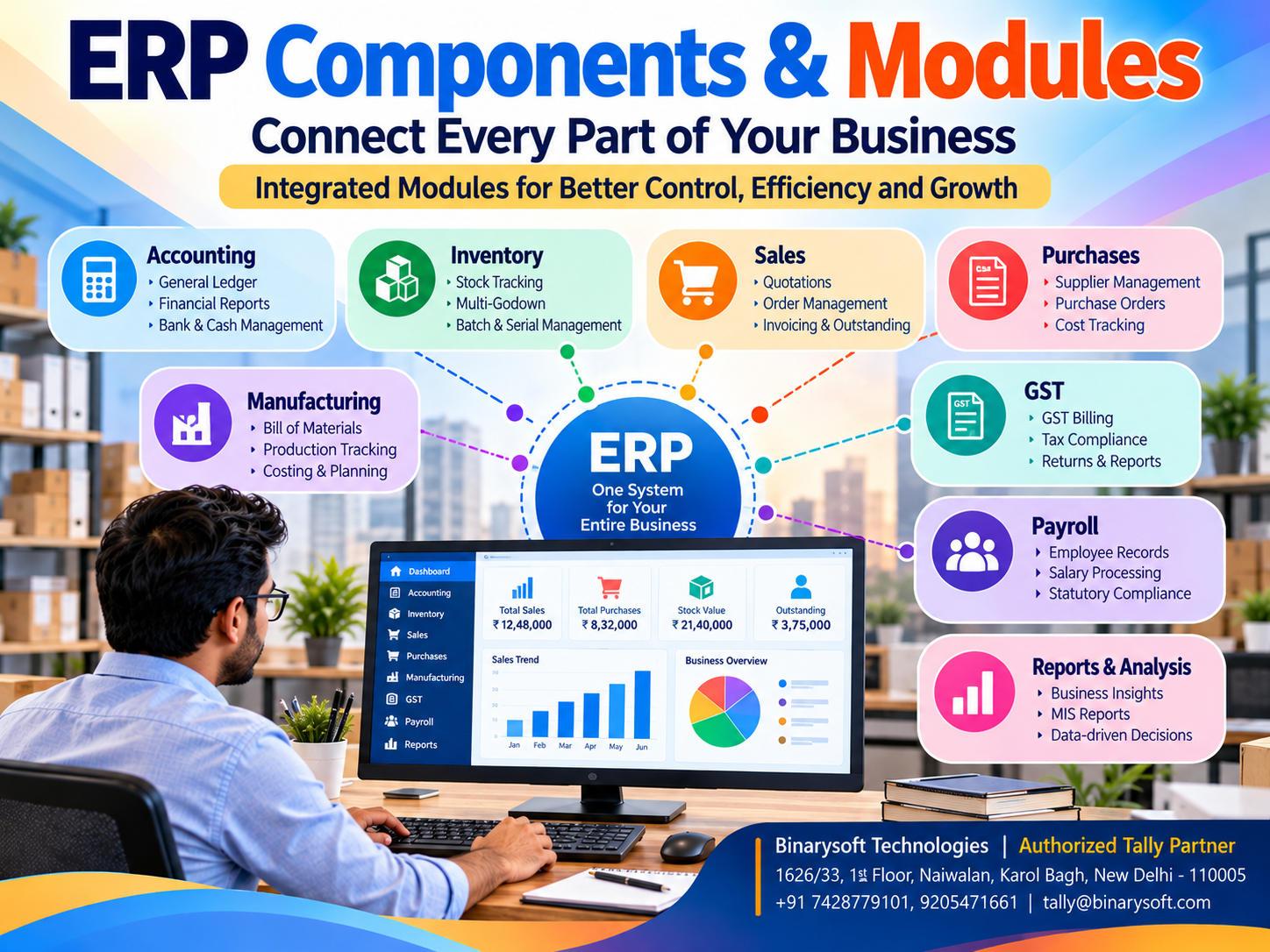
An ERP system consists of multiple components and functional modules. Each module supports a particular business activity, while shared information and connected workflows help departments operate together.
Understanding these components is essential for businesses planning to improve efficiency, reduce administrative work and prepare for future expansion.
For Indian organizations, Tally Prime provides integrated accounting, inventory, taxation and business reporting capabilities that address many everyday operational requirements.
A Business Owner's Story: When Growing Sales Created Bigger Problems
Rohit operated a medium-sized electrical equipment distribution business in Delhi.
His father had started the company with a small shop and a limited number of customers.
Over the years, Rohit expanded the business into wholesale distribution, supplying electrical products to retailers and contractors.
The company employed fifteen people and maintained thousands of inventory items.
Sales were increasing, but operational problems were growing even faster.
The warehouse team maintained stock records in spreadsheets.
The sales department prepared invoices separately.
Purchase orders were communicated through messaging applications, while the accountant updated financial records at the end of each day.
One afternoon, an important customer placed a large order requiring immediate delivery.
The sales team confirmed the order based on outdated inventory information.
When warehouse employees checked the shelves, several products were unavailable.
The customer cancelled the order and selected another supplier.
Rohit felt disappointed.
He had invested years of effort into building customer relationships, yet a simple coordination failure had damaged his reputation.
That evening, he reviewed the company's operations and realized that the problem was not employee dedication.
The real issue was disconnected business information.
He decided to introduce an integrated accounting and inventory management system.
After reviewing existing records and training employees, the company began following standardized transaction procedures.
Inventory movements, sales invoices, purchases and customer balances became easier to monitor.
The business still required careful supervision, but employees no longer depended entirely on disconnected spreadsheets.
Rohit gradually regained confidence in his operational information.
This illustrative story demonstrates an important business lesson:
A growing company needs connected processes, not merely more employees or more software applications.
What Are ERP Components and Modules?
ERP components are the underlying elements that support an enterprise resource planning system.
These typically include databases, application software, user interfaces, security controls, integration mechanisms and reporting capabilities.
ERP modules are functional sections designed to manage specific business activities.
For example, a financial accounting module handles financial transactions, while an inventory module manages stock-related information.
A comprehensive ERP system may contain modules for:
-
Financial accounting
-
Inventory management
-
Sales and customer orders
-
Purchasing and procurement
-
Manufacturing and production
-
Human resources
-
Payroll management
-
Customer relationship management
-
Supply chain management
-
Taxation and compliance
-
Reporting and business intelligence
The availability of these modules depends on the software product.
Some ERP systems provide all these capabilities, while others focus on selected business functions.
Core Components of an ERP System
Before understanding individual modules, businesses should recognize the technical components that make ERP software work.
1. Centralized Database
A centralized database stores business information in a structured environment.
It helps different modules access consistent records.
For example, customer details maintained in one part of the system may be available to authorized users working with sales and accounting.
This reduces duplicate records and improves information consistency.
2. Application Layer
The application layer contains the business rules and processes used by ERP modules.
It determines how transactions are processed and how related information is updated.
For example, recording a sales invoice may affect accounting balances and inventory records.
3. User Interface
The user interface allows employees to interact with ERP software.
Users may enter transactions, review reports, manage records and perform authorized activities.
A clear interface can reduce training difficulties and improve employee productivity.
4. Integration Framework
ERP systems may connect with external applications through supported integration methods.
These connections can help exchange information with e-commerce platforms, banking systems, payroll applications or other business tools.
Integration capabilities vary by product and may require additional development or services.
5. Security and Access Control
ERP systems contain sensitive financial and operational information.
Security components help restrict access according to employee responsibilities.
Businesses should configure permissions, maintain backups and follow appropriate data protection practices.
6. Reporting and Analytics
Reporting tools convert recorded transactions into useful business information.
Management can review financial performance, stock movements, customer balances and operational trends.
Reliable reporting supports better decision-making.
Major ERP Modules and Their Functions
1. Financial Accounting Module
The financial accounting module is one of the most important parts of an ERP system.
It helps businesses maintain accurate financial records and understand their financial position.
Important functions include ledger management, voucher recording, accounts receivable, accounts payable, financial statements and bank reconciliation.
For example, when a customer purchases goods on credit, the transaction creates a receivable.
When payment is received, the customer balance can be updated.
Tally Prime provides financial accounting capabilities that help businesses record transactions and generate financial reports.
These features support systematic bookkeeping and financial control.
2. Inventory Management Module
Inventory management is essential for businesses dealing with physical products.
Without accurate stock records, companies may experience shortages, excess purchases and delayed deliveries.
An inventory module helps organizations monitor stock quantities, product categories, storage locations and inventory movements.
Common functions include stock item management, stock groups, godown tracking, inventory valuation and batch tracking.
Tally Prime supports integrated inventory management.
Businesses can maintain stock records alongside accounting transactions, helping improve consistency between commercial and financial information.
3. Sales Management Module
The sales module helps organizations manage customer transactions.
It may support quotations, sales orders, invoices, returns and customer transaction histories.
An integrated sales process improves coordination between billing, inventory and accounting activities.
For example, sales staff can review relevant transaction information before preparing invoices.
Tally Prime supports sales-related transactions and order processing features, depending on configuration.
4. Purchase and Procurement Module
Businesses regularly purchase raw materials, finished goods, equipment and services.
The procurement module helps organize purchasing activities.
Functions may include supplier records, purchase orders, purchase invoices, purchase returns and outstanding payment tracking.
Advanced ERP systems may also support supplier evaluations and automated procurement approvals.
Tally Prime provides purchase transaction and supplier accounting capabilities suitable for many trading and manufacturing businesses.
5. Manufacturing and Production Module
Manufacturing businesses require systems that support material consumption and production activities.
A manufacturing module may include bills of materials, production orders, material requirements planning and production scheduling.
Some advanced systems also support machine utilization and shop-floor monitoring.
Tally Prime provides selected manufacturing-related inventory features, including bills of materials and manufacturing vouchers.
However, advanced production planning and industrial automation may require specialized software.
6. Human Resource Management Module
The human resource module supports employee-related administrative activities.
Comprehensive HR modules may manage employee records, recruitment, attendance, leave, performance evaluations and workforce planning.
These capabilities are particularly valuable for organizations with large employee teams.
Businesses should verify the specific HR features included in their chosen ERP software.
7. Payroll Management Module
Payroll management helps organizations calculate and maintain employee compensation records.
Depending on the software, features may include salary structures, payroll processing, deductions, statutory calculations and payroll reporting.
Tally Prime provides payroll-related capabilities that can support applicable business requirements.
Correct configuration and compliance verification remain important.
8. Customer Relationship Management Module
Customer relationship management focuses on customer interactions and sales relationships.
A comprehensive CRM module may include lead tracking, sales opportunities, customer communications, service requests and customer history.
These features help organizations manage relationships throughout the customer lifecycle.
Tally Prime maintains customer accounting and transaction records, but businesses requiring advanced lead management or marketing automation may need a dedicated CRM application.
9. Supply Chain Management Module
Supply chain management coordinates the movement of materials and products between suppliers, businesses and customers.
Advanced modules may support demand planning, procurement coordination, logistics, distribution and supplier performance analysis.
These capabilities help organizations manage complex supply networks.
Small businesses may begin with integrated purchase, sales and inventory records before adopting specialized supply chain applications.
10. Taxation and Compliance Module
Indian businesses must maintain accurate records for applicable taxation requirements.
Taxation modules help organizations manage tax classifications, transaction details and compliance-related reports.
Tally Prime supports GST accounting, invoicing and relevant reporting functions.
Businesses should verify applicable statutory rules and ensure that transactions are classified correctly.
11. Business Intelligence and Reporting Module
Business intelligence helps organizations convert operational data into meaningful insights.
Advanced ERP systems may provide dashboards, forecasting, performance indicators and analytical reports.
Tally Prime provides accounting and inventory reports that help management review business performance.
These reports can support decisions about purchasing, expenses, customer collections and profitability.
How ERP Modules Work Together
The real value of ERP software comes from integration.
Consider a distributor purchasing 500 units of a product.
The purchasing process records the transaction.
The inventory function updates the relevant stock information.
The accounting function records the supplier liability.
When products are sold, the sales and accounting records reflect the transaction, while inventory records capture the corresponding stock movement.
Management can then review stock availability, supplier balances, customer receivables and financial performance.
This connected approach reduces the need for employees to maintain separate versions of the same information.
However, successful integration depends on correct software configuration and disciplined transaction recording.
How Tally Prime Helps Integrate Business Functions
Tally Prime combines several important business management capabilities.
Integrated Accounting and Inventory
Businesses can maintain accounting and inventory information within the same application.
This reduces manual reconciliation between separate records.
Sales and Purchase Management
Sales and purchase transactions can be recorded systematically.
Related accounting and inventory information can be maintained according to the transaction type.
GST-Related Accounting
Businesses can prepare applicable GST invoices and maintain tax-related transaction records.
Outstanding Management
Customer and supplier reports help businesses monitor receivables and payables.
Financial Reporting
Management can review profit and loss statements, balance sheets, stock summaries and other reports.
Multi-User Access
Appropriate licensing and infrastructure arrangements allow multiple authorized employees to work with company data.
Remote and Cloud-Hosted Operations
Businesses may deploy Tally Prime through suitable remote-access or cloud-hosting arrangements.
Hosting, security, licensing and connectivity requirements should be evaluated before implementation.
Case Study 1: Wholesale Electronics Distributor in Nehru Place
Business Type: Computer accessories and electronics distribution
Location: Nehru Place, New Delhi
Primary Challenges: Inventory mismatches, delayed collections and inconsistent financial reporting.
Background
Consider an electronics distributor supplying computer accessories to retail shops and corporate customers.
The business maintains approximately 2,000 stock items and serves hundreds of customers.
Initially, inventory information is maintained in spreadsheets while financial transactions are recorded separately.
Employees frequently spend time reconciling stock balances.
Implementation
The business introduces Tally Prime to organize accounting and inventory management.
Products are classified into stock groups.
Purchase and sales transactions are recorded systematically.
Customer accounts are maintained with bill-wise details.
Management reviews inventory and outstanding reports regularly.
Illustrative Results
The company gains clearer visibility into recorded stock balances.
Employees spend less time combining separate transaction records.
The owner can review customer dues more efficiently.
Financial reporting becomes more organized.
These results are illustrative rather than independently verified performance measurements.
Key Learning
Integrated inventory, sales and accounting processes can help distribution businesses improve coordination and financial visibility.
Case Study 2: Manufacturing Business in Bawana Industrial Area
Business Type: Plastic components manufacturing
Location: Bawana, Delhi
Primary Challenges: Raw material tracking, production records and financial control.
Background
Consider a manufacturing business producing plastic components for industrial customers.
The company purchases raw materials, manufactures finished products and supplies goods to distributors.
Initially, raw material consumption records are maintained separately from accounting records.
Management struggles to review inventory-related costs consistently.
Implementation
The company configures Tally Prime for accounting and relevant inventory processes.
Raw materials and finished goods are maintained under separate stock categories.
Applicable bills of materials and manufacturing voucher features are configured.
Purchases, sales and expenses are recorded systematically.
Illustrative Results
The business gains better visibility into recorded material movements.
Accounting staff can prepare financial reports with less manual consolidation.
Management can review inventory and financial information more consistently.
Key Learning
Integrated accounting and manufacturing-related inventory records can support stronger financial control.
Businesses requiring advanced production scheduling may need additional specialized systems.
Benefits of Integrated ERP Modules
Improved Operational Efficiency
Connected workflows reduce repetitive data entry and administrative effort.
Better Financial Visibility
Management can review financial records and understand business performance more clearly.
Stronger Inventory Control
Inventory information supports purchasing, sales and stock planning.
Reduced Data Duplication
Shared information reduces the need to maintain identical records in separate applications.
Improved Customer Service
Accurate transaction records help employees respond to customer enquiries.
Better Cash Flow Monitoring
Outstanding reports help businesses identify overdue receivables and upcoming liabilities.
Support for Expansion
Structured business processes make increasing transaction volumes easier to manage.
More Reliable Decision-Making
Consistent reporting helps management identify trends and evaluate operational performance.
How to Choose the Right ERP Modules
Businesses should not automatically purchase every available ERP module.
Instead, they should identify their most important operational requirements.
A retail business may prioritize billing, inventory and accounting.
A manufacturer may need material tracking and production-related functions.
A service provider may focus on invoicing, expenses and financial reporting.
A larger organization may require advanced HR, CRM and supply chain capabilities.
Before selecting modules, businesses should evaluate functionality, integration, employee training, security, scalability and total implementation costs.
Starting with essential modules can reduce complexity and improve adoption.
Common Challenges in ERP Module Implementation
ERP implementation requires careful planning.
One major challenge is inaccurate existing data.
Incorrect customer balances, supplier records and inventory quantities can affect the reliability of the new system.
Another challenge is insufficient employee training.
Employees need to understand transaction procedures and their responsibilities.
Businesses must also configure user permissions carefully.
Finally, management should review reports regularly and establish consistent operational controls.
Software alone cannot correct weak business processes.
Future of ERP Components and Modules
ERP technology continues to evolve as businesses adopt digital operations.
Cloud infrastructure, connected services, workflow automation and advanced analytics are influencing modern ERP development.
Artificial intelligence may also support selected analytical and administrative activities.
However, businesses should distinguish between currently available capabilities and features requiring additional products or integrations.
For Indian SMEs, the priority should remain reliable accounting, accurate inventory records, efficient transactions and meaningful financial reporting.
Conclusion
ERP components and modules help businesses coordinate important operational activities.
From accounting and inventory to sales, purchasing, manufacturing and taxation, integrated software can improve information consistency and operational visibility.
The value of an ERP system depends on selecting appropriate modules, maintaining accurate records and training employees effectively.
For many Indian small and medium businesses, Tally Prime provides useful accounting, inventory, GST-related reporting and business management capabilities.
With suitable configuration and disciplined processes, organizations can improve financial control and support sustainable growth.
Businesses should choose software based on practical needs rather than unnecessary complexity.
A well-planned ERP implementation can help transform disconnected business activities into coordinated and manageable operations.
Powered by Binarysoft Technologies
Authorized Tally Partner
Location: 1626/33, 1st Floor, Naiwalan, Karol Bagh, New Delhi – 110005, INDIA
Contact: +91 7428779101, 9205471661
Email: tally@binarysoft.com
Business Hours: 10:00 AM – 6:00 PM, Monday to Friday
Frequently Asked Questions
Does Tally Prime support ERP-related functions?
Yes. Tally Prime supports several ERP-related requirements, including accounting, inventory, sales, purchases, taxation and financial reporting.
Can Tally Prime manage manufacturing activities?
Tally Prime supports selected manufacturing-related inventory processes, including bills of materials and manufacturing vouchers. Advanced production requirements may need additional software.
What is the difference between ERP and CRM?
ERP generally coordinates multiple organizational processes, while CRM primarily focuses on customer relationships, sales opportunities and customer interactions.
Can small businesses use ERP software?
Yes. Small businesses can benefit from integrated accounting, inventory and operational processes when the software matches their requirements and budget.
CA. Dhruv Bhandekar works with businesses on bookkeeping controls, GST reporting, and month-end accounting processes. His focus is on creating structured financial workflows that improve accuracy and reduce reconciliation issues.









